
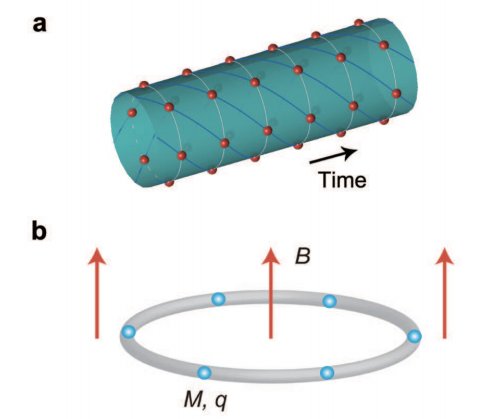
Time Crystal Fig. a shows a possible structure of a space-time crystal. It has periodic structures in both space and time. The particles rotate in one direction, even at the lowest energy state. Fig. b shows ultracold ions caught in a ring-shaped trapping potential in a weak magnetic field. Li et al./via arXiv

One of the simplest and most common physical objects is your average crystal, a collection of atoms arranged in an orderly, repeating three-dimensional pattern. Salt, snowflakes, and the quartz in your watch are all crystals. Earlier this year, the Nobel laureate and MIT physicist Frank Wilczek proposed that the fourth dimension can be crystallized, too: There can be space-time crystals. And now a team of physicists has proposed a way to build one.

This is highly strange, but the physics make sense, according to Wilczek’s theory, which he published on the arXiv server back in February. A spacetime crystal would simply be a physical object whose regular, periodic atoms move in a regular, periodic pattern. They would move forever, with no external input.

A basic time crystal could just be a circular arrangement of regularly ordered atoms that move around to the same spot at regular intervals. Now Tongcang Li at the University of California-Berkeley and some colleagues have described just such a system.

They propose a cloud of beryllium ions trapped inside an electromagnetic field, which forces them into a circular pattern. The ions all have the same charge and so repel each other, naturally ordering themselves in equilibrium. This is simple enough.

But if Wilczek’s theory is right, these highly organized atoms would also move around, even when they’re cooled almost to absolute zero. That’s because the magnetic field would give them a small nudge, setting them in motion forever. The very fact of their rotation gives them a time dimension.

Wilczek argues that a system in its lowest energy state, probably a little bit above absolute zero, would be frozen in space — so if it were to move, it would violate time symmetry. Think of a superconductor, for instance, which carries a current even at its coldest, lowest energy state. (Wilczek’s paper also discusses the time element in a quantum mechanical system, which forces you to think about imaginary time, or iTime ... so we’re not going into that). He just couldn’t determine how you might actually build such a system.

Li et al.’s rotating beryllium atoms would rotate forever at the same rate, so long as the electromagnetic field in which they’re suspended still exists. This sounds like perpetual motion, but it’s not a perpetual motion machine, because there’s no energy output you could obtain from these atoms — they’re already at the lowest states of energy possible.

The practical implications could extend to better clocks — a perpetually moving, forever-regular pattern would be a very accurate timekeeper indeed. All you would need is a really good ion trap.

[via PhysOrg]

21 Comments

This is pretty cool.. I'm very interested in seeing if this comes about. I still reject the idea that "time" is the 4th "dimension" since time isn't really a "spacial" direction. More like time is a condition of 3 dimensional space rather than it's own dimension.

Playing Devil's Advocate since 1978

"The only constant in the universe is change"
-Heraclitus of Ephesus 535 BC - 475 BC

I have a hard time thinking of what you described as anything but a perpetual motion machine. I get that the intended purpose is different from the common purpose of perpetual motion machines in that no one is trying to extract infinite amounts of free energy from it. But it is still a proposition of a perpetual motion. Regardless it is a very cool exercise in thought. I hope it yields a revolution in the physics world some day.

prepare for a bombardment of pseudoscience now. :p

Once this time crystal is made and developed, then
"Ti----ime is on our side! YES IT IS!".

..........................................
See life in all its beautiful colors, and
from different perspectives too!

I still say that time is not "real" and simply a means for thinking creatures to order change.

There is nothing new in this and it is not really perpetual in any sense.

A block of isolated matter will form an equilibrium related to the magnetic field and can be rotated by those fields. When frozen to as close to absolute zero as possible, HEAT energy is in it's lowest state, not all energy. The atoms of the material will receive a magnetic field to force atomic movement. Magnetic fields move electric fields. The electrons will shift together in one movement at the speed of light. Electricity will travel regardless of the temperature.

Depending on the material, some heat or light energy could be released. If that is the case, this system would eventually deplete itself as energy changes forms. At no point was the relative motion we perceive as time altered from what we would normally expect. Relativity theory at it's purest.

Also, to maintain this system would use up a large amount of external energy maintaining the fields and cooling the material.

That's an interesting perspective, Thrishmal. How long did it take to come to that hypothesis?

HAHAHA, ^^^ that was funny. Thrishmal, even if you decide to define time as "a means for thinking creatures to order change," it is still real. It is still Time.
And, CodeZero, there are actually ten spacial dimensions, and a time dimension. Obviously this is just theoretical physics, but so far the math points to this explanation; however, your not far off. Theoretically, again, time is the result of the quantum fluctuation associated with universal inflation.

I think.

Time is a dimension, but we can't comprehend it, as we cannot experience it as other 3 dimensions. Problem is, Time carries every single objects with it, everything surrounding moves with time, so its difficult to accept it. But if we see in quantum physics in which electrons behave weirdly, that can be understood as electrons moving IN and OUT in time (Past and Future). Its the only evidence (may be..!) to accept time.

Time is spent only once for humans. And if it spent differently for other creators, we humans will never know, because we are currently trapped in this one line of time.

Now what if we make this thing and it creates a little time tunnel? Not going back in time, but dramatically farther forward? It has two applications:
1: Time tunnel, you sit inside a massive room consisting of this thing, and then it has some kind of trigger that powers it, and the crystal forms around you, and locks you into a time null, allowing you to go forward in time dramatically faster, but without aging you at all. Problem, going back.

2: Poor-man's-hyperspace. Use this thing like a cannon, a whole barrel of the crystal, and finagle it to open a kind of wormhole, and shoot the craft through it. It might just create a very big explosion and the loss of several million dollars of equipment, but also could throw a craft into another galaxy. problem again, getting back.

There is a very intuitive though not simple way to understand the space-time crystal.

1) spontaneous broken symmetry in complex many particle systems. These are quantum phase transitions like when our observable universe is created in the moment of inflation out of the pre-existing unstable false vacuum in which all particles have zero rest mass because the Higgs field had not yet formed. The appearance of the Higgs field is the effect spontaneous broken symmetry in which the post-inflation quantum vacuum of our expanding universe. The quantum vacuum has less symmetry than do the field equations for some of the matter fields.

2) Quantum field theory shows that matter exists in two very different forms - real and virtual. Matter in virtual form lives inside the quantum vacuum briefly popping into and out of existence. We see this indirectly in small shifts of spectral lines of atoms (Lamb shift) and in the Casimir zero point force between two neutral plates. Virtual particles do not transport energy outside the "near field" and they cannot directly cause a counter to click only real particles can do that. The LHC just showed us a real Higgs boson kicked out of the vacuum by the tremendous focused energy of the machine. It's like chipping a small piece of ice out of a huge glacier that is the VIRTUAL Higgs-Goldstone spontaneous broken symmetry field inside the vacuum. There are two kinds of spontaneous broken symmetry particles. The Goldstone particle has zero rest mass like the photon particle of light. The Higgs particle has a finite rest mass now seen at about 125 Gev in the LHC. There may be several Higgs and Goldstone particles. The Higgs and Goldstone particles come in conjugate pairs like the amplitude and phase of a coherent laser beam wave. In fact the Higgs-Goldstone vacuum field is mathematically somewhat similar to a laser beam field with some important differences of course. The mathematics of these general "coherent states" was worked out in the early 1960's by Nobel Laureate Harvard physics professor Roy Glauber. Basically we have a large number of particles all in the same single-particle quantum state although that actual number is uncertain and in the simplest case has a Poisson distribution.This happens not only in lasers but in superconductors and as we see below even in Frank Wilczek's space-time crystal. The difference is that the Higgs vacuum field that itself gives rest masses to the leptons and quarks is made up of huge numbers of VIRTUAL Higgs-Goldstone conjugate particle pairs that form a set of complex numbers z in the polar representation for those of you who know some high school math where z = Rexp(itheta). R is the amplitude and theta is the phase. The massive Higgs particle in real form are quantized vibrations in the amplitude R like you AM radio. The massless Goldstone particles in real form are quantized vibrations in the phase theta of the coherent vacuum field like your FM radio roughly.

3) A space crystal is a periodic lattice of atoms that forms in a quantum phase transition in which the continuous translational symmetry of the higher temperature gas or liquid is spontaneously broken down to a much smaller discrete crystal group. The phonon is a massless Goldstone particle. The analogous Higgs particle would be a phonon sound wave with an energy gap at infinite wavelength. However, a single phonon is a collective normal mode of all the real atoms that form the crystal lattice. Now real phonons that propagate sound energy have a frequency that is the speed of sound divided by the wavelength. However, virtual phonons do not obey that relationship at all. Indeed, the crystal lattice itself is a Glauber coherent state of a huge uncertain number of VIRTUAL PHONONS all in the same single-phonon quantum state. These particular virtual phonons have zero frequency with finite wavelengths along the three directions of space that are determined by the particular discrete space-crystal group that is not spontaneously broken. A very similar thing happens for electromagnetic photons in the ordinary electrostatic Coulomb field e/r potential energy per unit test charge q in the rest frame of a point charge e where r is the distance between e and q. The longitudinal electrostatic field is a coherent Glauber state of a huge uncertain number of virtual photons of zero frequency with a whole continuum of wavelengths along the three dimensions of space.

4) We now have a unified conceptual framework. The space-time crystal is simply a Glauber coherent state of again virtual phonons but this time with a finite frequency and the same set of discrete wavelengths as in the space-crystal.

It would also be interesting to see what the effect of using a Boson gas instead of a Fermion gas. I suspect that a sort of super-fluid would form.

Despite Jack's lengthy explanation, I find it hard to conceptualize this concept -- if only because I don't understand most of his references :).

I do have some issues with the idea in general.

The field is a magnetic field, not an EM field as suggested several times in the article. If it's an EM field that implies that either 1) it's generated from an electrical current (electromagnet), or 2) it's a time varying field. ( point 2 might be technically in error).

In either case, it would call for input.

So, if there's a static magnetic field, I would think that everything would eventually settle to a fixed location. This is a simplistic way of looking at things, but it matches up with a lot of other physical phenomena.

My other issue is in trying to use it as a clock. If I am wrong and it does work ( horrors), I still don't see it as a clock. To use it as a clock, you would have to extract energy in some form to see what it was doing. Removing the energy would presumably cause it to slow down and eventually stop.

To clarify my previous statement:

I consider time to be a concept created by certain forms of life in order to make survival easier and to make sense of change. Time as a concept is merely the ticking of a clock and what time of day we think it is.

In actuality, I believe there is only one moment; a moment in which change continuously flows. Every aspect of our known Universe is in a constant state of change, the outcome of that change dependent on changes going on around it and within it. The relative change of something can be changed in regards to something else, but the change cannot be eliminated entirely.

I know that time is just a measure of change, but I can't help but feel that people want to make "time" into something it is not. Time is not the thing, change is. I think it is important to keep the concept of time away from the object that is change.

Say this experiment works you would need the ion trap and to test the crystal you would atleast need to to an absolute zero environment as said in the article and yes maybe clocks will be better and possible a perfected calendar not exactly for Earth but a universal one. Don't take it as a criticizing your work I can't see your ideals and goals but all I really see is a crystal creating its own paradox if you will. All I can really say I see is a better way to keep time and creating an eternal rock. But it might take a couple years to test it and call it perfect. The process of weathering and erosion might wear it out and if the crystal is still being created than you might even have to test its ability to take mass amounts of cold and hot climates if the universe were to collapse.

Isn't all of existence merely emergent phenomena created by vibration of a quantum space-time crystal lattice, just as electrical potential emerging from vibrating quartz?
Isn't the vibration itself only information traveling relative to other information flows across interacting clouds of probability? Wouldn't this vibration in probability clouds have resonant and harmonic properties which would create differentiated regions of relative interactional densities?
http://www.kickstarter.com/projects/irwitte/an-amateurs-cosmological-theory-of-everything


June 2013: American Energy Independence

Five amazing, clean technologies that will set us free, in this month's energy-focused issue. Also: how to build a better bomb detector, the robotic toys that are raising your children, a human catapult, the world's smallest arcade, and much more.


Online Content Director: Suzanne LaBarre | Email
Senior Editor: Paul Adams | Email
Associate Editor: Dan Nosowitz | Email
Assistant Editor: Colin Lecher | Email
Assistant Editor: Rose Pastore | Email

Contributing Writers:
Rebecca Boyle | Email
Kelsey D. Atherton | Email
Francie Diep | Email
Shaunacy Ferro | Email

circ-top-header.gif
circ-cover.gif