
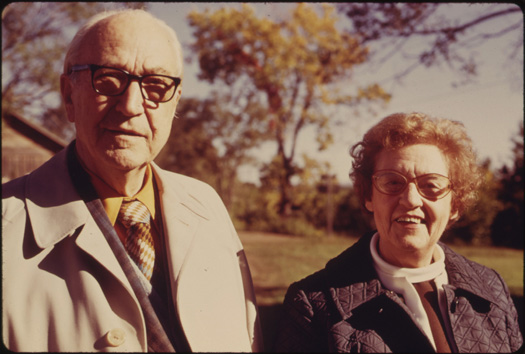
Is It the Glasses? Choosing a partner with similar traits to you is advantageous, as it ensures that your genes are more likely to be transmitted to future generations. Patricia D. Duncan

As long as you aren’t related, marrying someone who looks similar to you is advantageous, says Philippe Rushton, a psychologist at the University of Western Ontario. We use physical likeness as a way to assess underlying genetic likeness, which can cause us to be subconsciously attracted to reflections of ourselves. In evolutionary biology, the phenomenon is called “assortative mating,” or “self seeking like.” By mating with people who are genetically similar, you ensure that “your own segment of the gene pool is safely maintained and transmitted to future generations.”

Rushton and his colleagues have shown that the more heritable the physical characteristics, the higher the chance of mating between individuals with those particular traits. Height and wrist circumference, for example, are far more inheritable than waist size. “If you look at spouses across these characteristics, they are the most similar on the more genetic components,” Rushton says.

Robert Zajonc, a psychologist, found that physical likeness between couples increases over time. Through the years, couples’ wrinkles form in the same places because of a lifetime of shared emotions, he wrote in the journal Motivation and Emotion. Rushton hypothesizes instead that lookalike seniors have always looked similar and that it just becomes more obvious as they get older. As you grow old, “lots of distinguishing features drop away, like flesh on the skin or hair on the head,” Rushton says. “It’s more the bony structure of the skeleton that’s showing through.”

But what about people and their pets? Psychologist Michael Roy of Elizabethtown College studies whether or not dogs and their owners resemble each other. He has found that, indeed, purebreds do tend to mirror their owners, but not mutts. “Let’s say you’re very outgoing,” Roy says. “You would choose a dog that is likely to run up to other people, too.”

Have a science question you've always wondered about? Send an email to fyi@popsci.com

6 Comments

First male and females are human; naturally we look similar and age similar. If marry someone very similar, odds are you will continue this similarity.

I thought it was best that men and woman differ in genetics so to not accidently run across genetic problems; some extreme cousin from some past branch in our tree.

I suppose us humans feel comfort with familiarity. But on the other hand, too much genetic familiarity causes problems.

People love to adore their pets as babies. It is the nurturing part inside us. We choose pets of similarity and treat them often as human too. We are funny that way.

.............................
Science sees no further than what it can sense.
Religion sees beyond the senses.

I like your sig dude

I'll go out on a limb and say you probably don't want to post to many articles based on the work of Philippe Rushton. Not only are his methods under constant scrutiny but his views are as well. Rushton's work is pseudo science at best.

http://www.youtube.com/watch?v=1QOtsSj1chg

This topic is not exactly rocket science. When a couple marries, they most certainly don't look alike. It is after 25+ years of marriage that people begin to notice the couple's similarities. And it is the wife who slowly begins to look like her husband. The reason: in the course of their marriage, the wife absorbs copious amounts of her husband's semen plus their sexual relationship so deepens their marriage that the two, indeed, become like one. In a sense, they become one body. In contrast, just observe couples who have a history of marriage troubles. Those two do, in fact, look different.

coatswg you are absolutely right.During intercourse couples tarnsfer energy(life energy) and this belief's trace can be observed the some cultures

So... humans are subconsciously narcissistic?


140 years of Popular Science at your fingertips.

Innovation Challenges


Popular Science+ For iPad

Each issue has been completely reimagined for your iPad. See our amazing new vision for magazines that goes far beyond the printed page


Download Our App

Stay up to date on the latest news of the future of science and technology from your iPhone or Android phone with full articles, images and offline viewing


Follow Us On Twitter

Featuring every article from the magazine and website, plus links from around the Web. Also see our PopSci DIY feed


June 2012: Invent Your Own Anything

The 6th annual Invention Awards are here, from an inflatable tourniquet to a better lobster trap to spring-loaded hocket skates. This issue is all about the celebration of invention.

Plus: Making synthetic biology breakthroughs in a garage, building a constantly-moving ping-pong table, and a ridiculously overpowered barbecue.

circ-top-header.gif
circ-cover.gif
bmxmag-ps