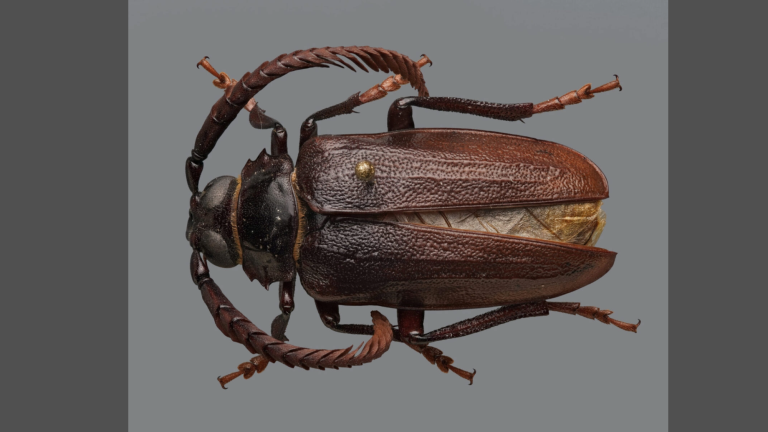
The Adult Stage of the Western Corn Rootworm USDA

Some consumers may have a problem with genetically modified food crops, but in at least one case described in an Iowa State University researcher’s paper there’s one customer that’s happy to consume Monsanto’s GM corn: rootworms, the very pest the corn is modified to thwart. According to the paper, western corn rootworms in at least four northeast Iowa corn fields have developed a resistance to the natural pesticide in corn seed produced by Monsanto, marking the first time a major Midwest pest has developed a resistance to GM crops.

That could spell all kinds of trouble for food crops, farmers, Monsanto, and pretty much everyone who isn’t a western corn rootworm. Though based on isolated cases thus far, the problem could be more widespread, and the paper is bound to rouse another debate on the benefits and demerits of GM crop cultivation and current farm management practices.

The big problem here would be, of course, the widespread proliferation of rootworm resistance. Monsanto first dropped their rootworm-resistant corn seeds on the market in 2003 at a time when its herbicide-resistant modifications had made Monsanto’s seed extremely attractive to farmers, who could blanket their fields in herbicide and kill everything but their food crop plants. The corn seed also contains a gene that produces a crystalline protein called Cry3Bb1, which delivers an unpleasant demise to the rootworm (via digestive tract destruction) but otherwise is harmless to other creatures (we think).

The seed was so successful that it’s estimated that roughly a third of U.S. corn now carries the gene. Which means one-third of U.S. corn could potentially be susceptible to rootworm again if the resistance that has reared its head in Iowa is indicative of a larger problem.

The good news is that the same rootworms that are resistant to Monsanto’s special sauce are susceptible to a competitor’s similar-but-different GM toxin. But if rootworms can develop a resistance to one strain of GM toxin, it stands to reason that--if farming practices remain unchanged--that it could eventually become resistant to others.

[WSJ]

20 Comments

It's the very thing ingrained into all creatures on earth, the drive to survive. If something changes, we are forced to change with it. This goes for ALL things in nature, every little change requires adaptation to some level. The more drastic the change, the more drastic the adaptation. Otherwise, this planet would be barren. Religion aside for a moment. We know that the planet has seen several major climate and ecological changes, these changes at the planet level spawned changes in every aspect of life as needed.

If we engineer a plant, that happens to be the food source of another lifeform, that lifeform will adapt, or face extinction, so it adapts.

Playing Devil's Advocate since 1978

"The only constant in the universe is change"
-Heraclitus of Ephesus 535 BC - 475 BC

@CodeZero - well said.

Time for Monsanto to sue for ownership of the bugs.

It gives a ill feeling when we farms or airplanes drop any type of chemical onto a farm. Yes with good genetically modified food crops the companies can produce the defensive chemicals right inside the plant itself. It does for awhile chase away the bugs, until they adapt of course. But mean while us humans are so happy to be eating that brightly colored corn, tomatoes or potatoes with all those new chemicals hidden inside.

There's no crop to grow resistant to if the bugs can't get to the crop in the first place. Still no skyscraper farms? Come on, society, those are the future!

@onihikage:
I know! It's not that hard to figure out. I mean, maybe you can't keep the bugs out with a multi-leveled pasture/crop field, but there will still be way more room to farm way more crops!

why learn from your own mistakes, when you could learn from the mistakes of others?

monsanto needs to be shut down, and we need to stop companies like it from having so much control over our food supplies.... monsanto doesn't give a flying F*@& about the people! to them it's all about the profit. and as long as they still control the food market they will continue to step all over the independent farmer and continue to pump crap loads of chemicals into our food. and alot of those chemicals that they are putting in we dont even get to know the names or quantities because they fall under some stupid patent law.

lol, this is fantastic news if you've ever watched food, inc., though I believe it was soy that monsanto had control over.
Whatever the case, this completely destroys monsanto's strangle-hold on farmers, so I'm glad the bugs have done this.

Can the farmers now sue Monsanto for misleading claims of their product? They are said to resist bugs. They do not resist bugs. Class-action, here American Farmers come!

You mean that organisms actually evolve and adapt? That is astonishing. Imagine that! Has anyone told those scientists at Monsanto?

I wonder what happens to a monoculture that gets a disease?? You mean to say it ALL dies???

Wow! Who would've thunk it?

These people are true geniuses.

"The seed was so successful that it’s estimated that roughly a third of U.S. corn now carries the gene."

Yeah, it's amazing how this GMO corn started finding it's way into farmers fields once the patent was granted. This is such good news in my mind. Now farmers that were forced to convert to GMO corn since it took over their existing crop can now sue the hell out of Monsanto for a defective product.

Monsanto needs to go away and take their test tube food with them. They exist only for their profits as rkstr noted and could give two squirts of piss about the needs and health of the populace.

Farmers should have counter-sued Monsanto by saying that their seeds went into their own farms without permission.

Somebody needs to remind those rootworms that what they're doing is purely fictional, as obviously nothing evolves.

@Bilyous, I do hope your comment isn't directed at me. If that's the case, it sure does seem that the people designing these geneticly modified food sources are seriously under estimating the drive to survive, or else this adaptation and increased resistance would not have come as a shock. I'm glad you added something to the conversation other than a waste of time.

Cropsourcing needs take a turn towards more effective solutions, be that in the form of updated farming methods, locations, ensuring that there is a lifeform that eats the lifeform that's damaging the crop, whatever. Trying to change the genetic information may work for growth rates, production rates and health, it will never be a solution for infestation and destruction by insects and still be viable for human consumption.

Don't for one moment think that the people creating these "advancements" are doing it purely for "man-kind" and not just for the money. When you overwhelm someone with technical data, it's easy to "forget" that the very things your "Wonder product" is modified to ward off will in turn adapt and return.

Where is the money in putting out a product that never needs to be updated, fixed or replaced?

Playing Devil's Advocate since 1978

"The only constant in the universe is change"
-Heraclitus of Ephesus 535 BC - 475 BC

There was a time long ago farmers over planted. The farmers new a certain amount of bugs and animals got their crop. They also rotated crops around, so not to completely diminish the nutrients of the land. Roting crops also put nutrients back into the land as well. The farmers did not have these chemicals and they wanted their farm, their business to last a life time and be passed on to their children. They actually cared about the land.

Now it’s all about greed and taking short cuts and not giving a dam to the long term consequences, for the land, environment or even people.

@Bilyous,

Exactly.

Those who ignore history are doomed to repeat it. And clearly corn farmers in Iowa have ignored the Irish Potato Famine (well, to be fair, their elected representatives have probably cut education funding to the point where they never even had the chance to ignore history).

I hope humans are are as resilient as the root worms. We too are consuming this poisonous gmo "food"

One of Monsanto's competitors is genetically engineering insects that eat Monsanto's stuff and leave their own stuff alone.

Everyone in North America who can, should turn their lawns into gardens. I read something about lawns being the 3rd most watered crop in the US. What a waste. Not to mention lawnmowers.

Community gardens really bring people together. You trade firsthand knowledge about the practice, and then trade finished product. All while making friends along the way.

I have a garden. No chemicals at all. What about insects? Catnip keeps away many kinds. Critters? It's a new kind of technology known as a "fence". Ferrets have been used to hunt vermin for a long time. Plus they're cute and hilarious. Even our fat cats are a deterrent. Sure, I've been eating potatoes all week. But they're the best potatoes I've ever had :)

Hahahaha! The food mafia (Monsanto) trying to dominate Mother Nature. What a hoot!


July 2013: The Future Of Flight

The incredible innovations, like drone swarms and perpetual flight, bringing aviation into the world of tomorrow. Plus: today's greatest sci-fi writers predict the future, the science behind the summer's biggest blockbusters, a Doctor Who-themed DIY 'bot, the organs you can do without, and much more.


Online Content Director: Suzanne LaBarre | Email
Senior Editor: Paul Adams | Email
Associate Editor: Dan Nosowitz | Email
Assistant Editor: Colin Lecher | Email
Assistant Editor: Rose Pastore | Email

Contributing Writers:

Kelsey D. Atherton | Email
Francie Diep | Email
Shaunacy Ferro | Email

circ-top-header.gif
circ-cover.gif