
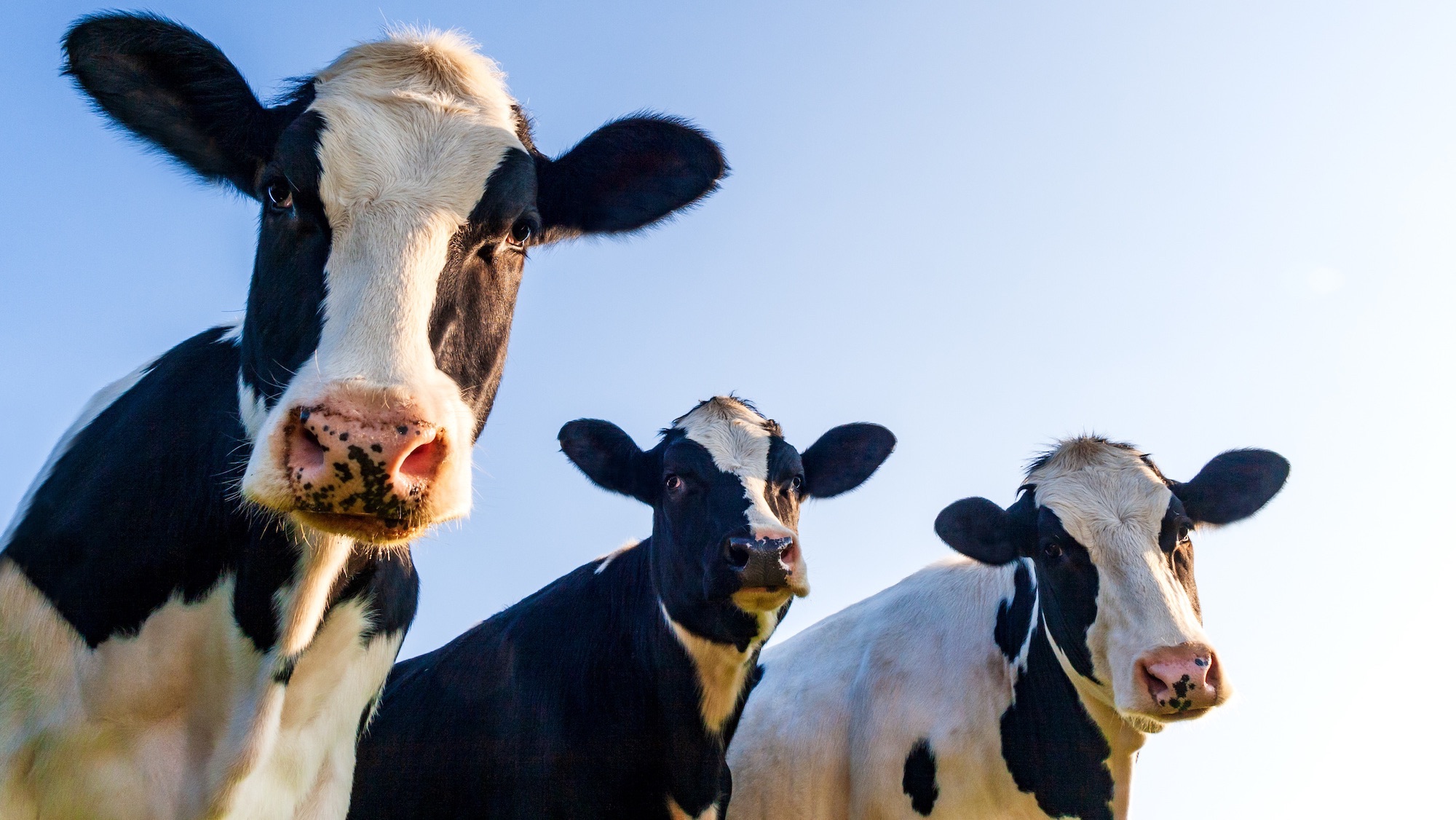
I grew up on a dairy farm in rural Ontario, a fact that occasionally surprises people I know. I guess I don’t come across as a farm kid.
These days I live in a city and occasionally hear people confidently talk about the reality of farm life in ways I know are flat out wrong. Here are a few common myths and misconceptions about farms, along with the scientific truth.
Cow tipping isn’t real
There’s a belief, mostly among city folk, that country dwellers like to tip over cows for fun (typically while drunk). The myth depends on a couple of things. First, cows sleep standing up, so you can sneak up on them in fields. Second, a person could push over a cow on their own. Some versions of the myth also state that cows, once tipped, can’t get back up.
This is, to be clear, an urban legend—even the Wikipedia page for the practice is labeled that way. Jake Swearingen, writing for Modern Farmer, pointed out that there are no videos on YouTube of someone successfully tipping a cow. I checked—there still aren’t (but there are some funny fakes). Even so, multiple people have insisted to me that the practice is real. It’s not, for two reasons.
To start, cows don’t sleep standing up. It feels ridiculous to me, a person who grew up on a dairy farm, to cite sources here—I know that they lie down to sleep and get up without any problems. If you need more than that, though, a 2019 paper published in PLos One by researchers at the University of Tennessee shows that cows deprived of the ability to lie down don’t get the REM sleep they need. A 2020 paper published in the Journal of Dairy Science concludes that “being able to lie down is a high priority for dairy cows, and animal welfare can be at risk when this behavior is thwarted.” Cows sleep lying down.
But let’s imagine that cows did sleep standing up, or that you could sneak up on one. This is unlikely—cows are easily spooked—but let’s put that aside. There’s still a problem: physics.
Adult Holstein cows (the black and white cows that you see on most dairy farms) weigh around 1500 pounds. For comparison: a baby grand piano weighs around 500 pounds, and typically requires multiple movers to pick up. The Modern Farmer piece I mentioned earlier quotes University of British Columbia professor Margo Lillie, who together with her student Tracy Boechler ran the numbers back in 2005. Tipping over a totally still cow would require around 1360 Newtons of force; the average person can only produce around 660.
Let’s say you had three people (possibly drunk) who manage to (somehow) sneak up on a cow and exert all of their strength in the exact right place. Wouldn’t that be enough? Possibly, but that’s assuming that the cow doesn’t brace itself in response to being pushed. If the cow braces itself, according to Lillie and Boechler, you’d need closer to five or six people. And all of this is assuming that the cow doesn’t simply run away or start trampling people (which…it will).
Put simply: Cow tipping—sneaking up on a cow and knocking it over—isn’t real. It’s a myth.
Bulls don’t hate the color red
It’s possibly more of a TV trope than a myth, but there’s an idea in popular culture that bulls hate the color red and will charge anything red that they see. The origin of this one is obvious: bull fighters often wave red capes in order to attract attention.
But there’s a problem: cows can’t really see the color red. A 1998 study published in Visual Neuroscience found that cows are dichromatic, meaning they only have two photoreceptors. Most humans, by contrast, are trichromats. The only exception is humans who are colorblind.
Maybe you see where I’m going with this. Cows, according to the study, can detect light up to 555 nm in wavelength; the color red is between 620 and 750 nm. Cows can’t see the color red.
Given that, why do they run after bullfighters waving a red cape? Because the bull fighters are very good at getting a bull’s attention. Any color of cape would work. You have to admit, though: the red ones look pretty good (to us humans, at least).
Not every bale is hay
You might think “hay” and “straw” are two words for the same thing. It sure seems like the people who make movies and TV shows do. An episode of The Office, for example, involved Dwight wanting to become the “hay king”. The issue? Every single bit of supposed “hay” in the scene is actually straw.
You might be wondering: what’s the difference? I’m glad you asked. Hay is dried grass, clover, alfalfa, or any other thing that livestock including cows or horses might like to eat. It’s generally green in color. Straw, meanwhile, is the dried stalks left over after harvesting wheat, barley, and other grains. It’s inedible, even by livestock, and is generally yellow in color. It’s used as bedding, not food.
So why do TV shows and movies get this wrong so often? There’s the obvious—non-farmers don’t interact with either hay or straw on a regular basis, and tend to use the words interchangeably. But there are practical reasons too. Straw bales, typically, are a lot tidier than hay bales, meaning they look better on camera. They’re also a lot less dusty, which makes them easier to work with on a set. But straw and hay are totally different, and now you know.
