Everyone has some skeletons in their closets, and after 138 years in publication, we’re no exception. Just type the words “telepathy” or “Abominable Snowman” into our archives and you’ll realize that “Popular Science” includes fields that are a little heavy on the popularity, less so on the science.
Click to launch the photo gallery.
To be fair, at least half of our pseudoscience features focused on debunking these practices instead of supporting them. After American spiritualists elevated ouija boards from harmless parlor games to supernatural communication devices, one inventor created a typewriter-ouija board hybrid to that forced the operator to punch blank keys instead of moving a triangle over painted letters. Granted, the ouija board typewriter didn’t prove or disprove the involvement of spirits, but it did prevent swindlers from consciously moving the triangle while pretending they were possessed.
Refreshingly enough, the myth-busting didn’t always come from scientists. In 1930, we published an article from a scientist supporting hypnosis as a valid form of psychiatric treatment. His insights provoked famed magician Harry Blackstone to write a counter-article explaining how the power of suggestion could be exaggerated to convince people that they were being hypnotized. Later that decade, we explained how retinal sensitivity was responsible for ghost sightings, how precognition was glorified dumb luck, and how phrenology (or the study of skull bumps) was nothing more than a layman’s form of pseudoscience-y entertainment.
At the same time, we dedicated serious study to dream interpretation, the Yeti’s footprints, and the practice of hypnotizing chickens (by swinging them around, no less). Sure, it sounds like a load of bunk in retrospect, but you can’t blame us for exploring these subjects initially; after all, doesn’t every scientific breakthrough begin with a little curiosity?
Click through our gallery to learn more about how we covered horoscopes, mind-reading, and the like.
Ouija Board Typewriter: February 1921
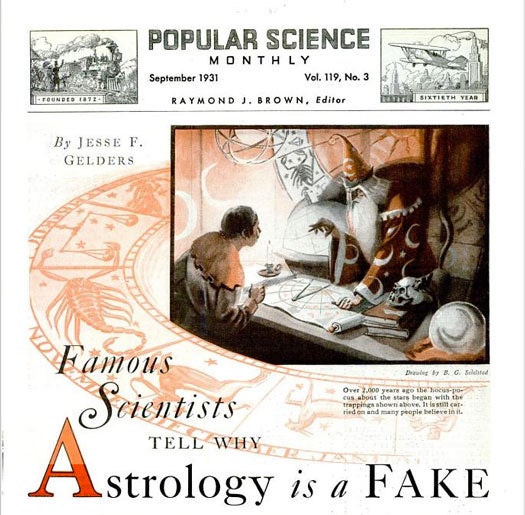
What’s the secret to a Ouija board? Up until World War I, the device was treated like a harmless parlor game, but people began debating the board’s paranormal properties after American Spiritualists touted it as a divining tool. All occultism aside, we still argued about whether the board’s “messages” were manipulated consciously or subconsciously. To settle the argument, Sunker Abaji Bisey, an Indian scientist, invented a “spirit typewriter,” or a ouija board that used blank typewriter keys instead of letters. In a patent from 1922, Bisey wrote that he developed the device as a means to receive so-called spiritual transmissions without human interference. Each key was attached to a letter or number hidden under the circular tray. While using the ouija board, the operator would spin the device several times before allowing “the spirits” to type on the blank keys using the handheld triangle. That ensured that the operator could not in any way see the letters the Ouija board was supposedly selecting. At the end of the session, you could pull out the ribbon to see if there were a message on it. The spirit typewriter seems to have vanished–we’re not sure if it ever succeeded in debunking the powerful Ouija board. (Scientists now see the Ouija board, which is used in most corners of the world, as an example of the ideomotor effect in action: an unconscious physical movement. Basically, we’re doing it without knowing we’re doing it. Except when people know they’re doing it. Which they sometimes do.) Read the full story in “Is the Ouija-Board Controlled Subconsciously?”
Hypnotism Debunked…By a Magician: May 1930
In March 1930, Syracuse University professor Wesley R. Wells contributed an article to Popular Science defending hypnotism as a scientifically reputable field. A couple of months later, famed American magician Harry Blackstone fired back, insisting that the practice was little more than clever hocus-pocus, a psychological placebo. In his article, Professor Wells claimed he could induce amnesia and heightened memory in his subjects. Blackstone pointed out you could achieve the same results in ordinary circumstances. For instance, Wells would stroke the faces of his subjects to make them feel calm and drowsy, which would lull them into remembering forgotten events. What’s so special about that? Barbers do the same thing while shaving your face, Blackstone said, yet no one calls a barber a hypnotist. Blackstone’s smackdown didn’t stop with that burn: Wells said that his subjects would write in an unconscious state, but Blackstone noted that this action is merely an exaggerated version of doodling while daydreaming. While performing, a professional hypnotist would tell his subject to stutter, and he would stutter. Blackstone called this a “case of clever suggestion,” arguing that a performer’s test subjects would nervously stutter due to stage fright anyway. Read the full story in “Hypnotism Fake, Says Magician”
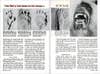
Hypnotizing Animals: September 1931
Fine, hypnotism on human subjects is total bunk, but what about when it’s performed on animals? Our answer was yes. “Science has as yet no satisfactory explanation for such strange phenomena as are illustrated by the unusual photographs on this page, but that they occur is undisputed,” we said, before launching into a series of instructions on hypnotizing impressionable creatures. To hypnotize a crayfish, stand it on its head and stroke its back until it falls into a trance. To hypnotize a frog or a lizard, place the animal on its back and pin it in place with the palm of your hand. To “charm” a rooster, hold it gently with its face to the ground. Hypnotizing a chicken, on the other hand, required swinging it about. The poor rabbits, however, required a little more work. “An experimenter grasps a struggling rabbit and swings it up and down several times,” we wrote. “Then he throws it on its back and holds it still for several seconds. Its struggles cease. It is in a hypnotic sleep.” Or, er, dead? To our credit, we surmised that when it came to animals, a hypnotic trance was more like muscle paralysis than mental manipulation. Read the full story in “Animals That Can Be Hypnotized”
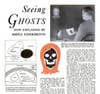
Seeing Ghosts: November 1931
We don’t mean to frighten you, but ghosts aren’t imaginary. They’re quite real, just not in the way you think they are. Here, we explained that ghosts are merely enhanced optical illusions. Want to creep yourself out? Stare at the ghost on this page for a minute, blink, and look at the wall — hello, scary face. It’s an optical illusion phenomenon known as “afterimage,” or, more appropriately for this story, “ghost image”: a sort of burn-in on the retina that can sometimes revert color (here’s a patriotic example). At the time, psychologists posited that the retina could retain these images for several hours after they’d initially faded away. Seeing a ghost in a graveyard probably came from staring at someone in a lighted doorway earlier. The same goes for sinister figures you see by your bed after waking up in the middle of the night. This also explains why people tend to see while carrying candle lamps. By placing the light directly in your face, you increase the chances of manipulating the sensitivity of your retina. Read the full story in “Seeing Ghosts Now Explained By Simple Experiments”
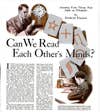
Mind-Reading: March 1937
We’ve all heard stories about people who awoke with a premonition about a family member and ignored it, only to find out the next day that the person they were worrying about had died in an accident. Some people shrug off these incidents as coincidences, the religiously inclined attribute it to God, and the rest of us very logically imagine that telepathy allowed the deceased person to send out a psychic distress signal before dying. In this article, we reasoned that for every premonition that comes true, there are thousands that go unmentioned. In one instance, a lottery winner claimed to have dreamed up the number before filling out her ticket, but at least a hundred people in that batch who had lost also said they dreamed the number they’d selected. The only test that seemed scientifically credible was conducted by Dr. Joseph B. Rhine of Duke University, who asked subjects to guess which cards he was drawing from a special pack. The results of his test suggested that some people do possess a small amount of hereditary telepathic abilities that can be manipulated by chemical substances. People’s “psychic” powers would improve under the influence of caffeine but decline if the subjects took a depressant, leading Rhine to surmise that the nervous system influences our special gifts. It leads us to surmise that coffee is even more amazing than we thought. Read the full story in “Can We Read Each Other’s Minds?”
Dream Interpretation: March 1938
The purpose and meaning of dreams have eluded scientists for years, and while people have attempted to interpret their visions, it’s still impossible to back up their conclusions scientifically. That being said, a team of psychologists in the late 1930s offered us a few of their theories, many of which were rooted in the perfectly plausible idea that dreams are influenced by external stimuli. If your blanket slips off, you’ll feel cold and dream of a snowstorm, for instance. Other explanations were a little less credible. Some psychologists said that flying dreams were caused by the “rhythmic motion” of our respiratory system (whatever that means), murder nightmares arise from digestion problems (would have to be a pretty serious stomach-ache), and a sagging bed can cause you to dream of falling. As psychologists, they also delved into the realm of subconscious fears and desires, positing that dreams of wild animals can reflect intimidation by an actual person. Nobody has yet to decipher that dream I had once where I was in a three-legged race at my elementary school’s spring fair with my ex-landlord, except he wasn’t my ex-landlord at all, he was Dennis Rodman. Explain that one, scientists. Read the full story in “Why We Dream”
Hunting the Yeti: December 1952
While climbing Mount Everest in 1921, explorers were baffled by the sight of giant, human-like footprints in the snow. No one could identify their origin, not even the native Himalayans who had claimed to see the hairy creature bounding around the peaks. Hence the legend of the Abominable Snowman. Nowadays, most people consider the Yeti a myth, but we took it pretty seriously in 1953 while covering a Royal Geographic Society-sponsored to locate the creature. Under a curiously definitive heading titled “It’s Real, All Right,” we said that the yeti “definitely exists,” as evidenced by photographs of the tracks. The latest report came from Eric Earle Shipton, a champion Everest mountaineer, who claimed to see the giant tracks on both sides of crevasse, leading him to believe that the creature was large enough to jump long distances. The tracks were around 12 and a half inches long and were all in one line, not staggered like that of a four-legged animal. Although several scientists suggested that the tracks were made by apes or bears, none of their tracks matched the ones in photographs taken by Everest climbers. While the mystery remains unsolved, we imagined at the time that the prints could belong to hairy cavemen who had been isolated from general society–a likely explanation, to be sure. Read the full story in “The World’s Most Mysterious Footprints”
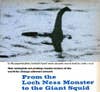
Cryptozoology: June 1961
We can’t mention cryptozoology without giving a shout-out to the king (or queen?) of them all, Nessie. In 1961, we reported that the mysterious creature was “at last being taken seriously.” Researchers from the Universities of Oxford and Cambridge planned to explore the Loch Ness using binoculars, telephoto cameras, and sounding gear to confirm whether or not the animal actually existed. Of course, Nessie wasn’t the only monster scientists were pursuing. We considered the African Nandi Bear (“The Great Scalper”), Australia’s kangaroo-killing tiger cat, the leaping lizard, and best of all, the diminutive men residing in Switzerland and the Ivory Coast. “Africa’s little men and the Swiss bones suggest that elves and gnomes are not, perhaps, just phantom figures in fairy tales,” we wrote. Just recently, one of the most famous mythical beasts, Mexico’s chupacabra, was unmasked as not an alien-like vampire that preys on livestock, but, um, a product of some lady’s imagination after she saw the movie Alien. Seriously. Read the full story in “From the Loch Ness Monster to the Giant Squid”
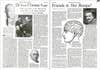
Phrenology: August 1926
By 1926, phrenology, which sought to explain personality through the physical dimensions of the skull, was so disreputable that we couldn’t publish this article without mentioning that “though scientists generally do not endorse it, the subject always has fascinated the layman.” The writer of this article, William J. White, Jr., was a phrenology enthusiast who compared the brain to a business with 42 departments. Each section the brain corresponded to a section of the skull so that you could judge a person’s character and capabilities by rubbing his skull. Since the region of Individuality is on the bottom of your forehead, you could discern a strong personality by the top of the person’s nose. To support his case, White pointed out how people have personality quirks despite being normal in every other aspect. If an otherwise rational person possesses hypochondriac tendencies, it’s reasonable to assume that one of his 42 mental departments has shut down. Read the full story in “Do You Choose Your Friends By Their Bumps?”
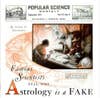
Astrology: September 1931
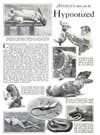
One less-than-desirable (to us, anyway) byproduct of the radio’s popularity in the early part of the century was the resurgence of horoscopes. Day after day, scores of gullible audiences listened to astrologers divine the future by analyzing the positions of astronomical bodies. Worst of all, these astrologers claimed to use scientific principles while practicing their art. To procure credible answers, we interviewed a group of scientists from Yale, Princeton, Columbia University, the American Astronomical Society, and the American Museum of Natural History. All of them insisted that there is no scientific basis for any theory of the planets influencing people’s destinies. When put to the test, astrologers were wrong about 90 percent of the time. We specifically cited an incident where a researcher asked six different astrologers whether he should marry that year. All of them gave a yes or no answer without realizing that the person asking the question was already married. Wouldn’t the stars have told them that? (This is one of the earlier instances of ‘gotcha journalism.’) Ancient astronomers believed that the planets were influenced by gods, and thus, the planets influenced our destinies. But we’d grown aware of concepts like gravity, so there was no reason to believe that the position of Mars would ruin your day or that the conjunction of planets has anything to do with how you should make decisions. Read the full story in “Famous Scientists Tell Why Astrology is a Fake”