
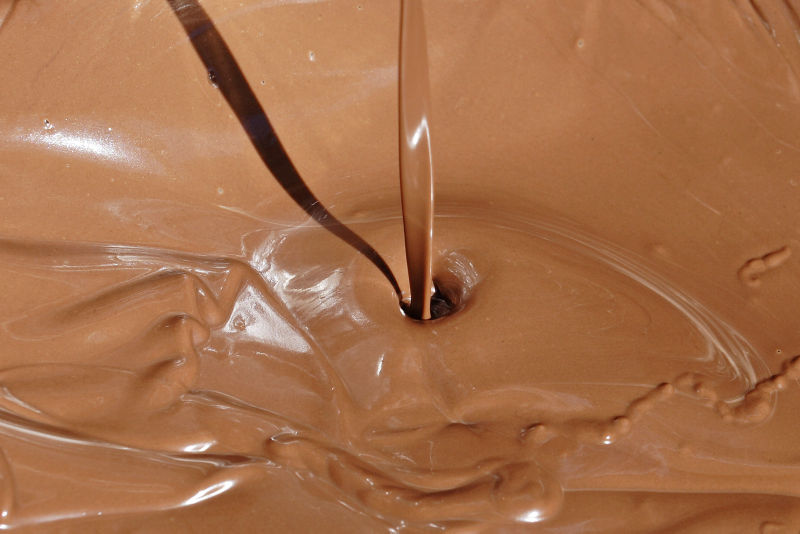
Chocolate Black Hole Chocolate consumption is increasing faster than production, meaning the future will probably be less chocolaty. Wikimedia Commons

Savor that leftover Halloween candy, because in the future, you won’t be able to afford it. Chocolate consumption is increasing faster than cocoa production, according to the Cocoa Research Association, and that means prohibitively expensive chocolate is in our future.

Since even before Choc Finger started hoarding it, cocoa prices have been on the rise, doubling in the past six years. The cacao plant can only be grown in latitudes within 10 degrees of the equator, but cacao farmers (largely in developing nations) lack incentives to re-plant their trees as they die off, according to a report in the Independent.

Competing efforts at chocolate giants Hershey and Mars Inc. have sequenced the cacao genome, which could improve efforts to breed more resilient, higher-yielding trees. But better chocolate plants will still have to compete for acreage with engineered corn, soybeans and even palm oil, which are used for biofuel as well as food. Those plants could help farmers reap greater rewards, according to Tony Lass, chairman of the Cocoa Research Association and a former Cadbury’s trader.

Small-scale growers earn just 80 cents a day, so they have little incentive to plant new trees when their older ones die. In addition to planting more lucrative crops like rubber, hordes of cacao growers are moving into cities to seek higher-paying work, according to the Independent.

The result will be $11 chocolate bars. John Mason, executive director and founder of the Ghana-based Nature Conservation Research Council, says in 20 years, chocolate will be like caviar: “It will become so rare and so expensive that the average Joe just won't be able to afford it.”

The chocolate market is already trending toward higher prices; all the growth in the $5.8 billion industry is in premium chocolates, the Independent says.

First helium, now chocolate — seems like birthday parties in the future will be a lot less fun.

[The Independent]

26 Comments

I just had a terrible thought. We're running out of chocolate and helium. But how awesome would it be to infuse a chocolate bar with helium so that it weighs abnormally less, texture is just as dense, and you laugh like a chipmunk when you eat it?

On a slightly more serious note but still not all that serious, we need to stop wasting cocoa on those cheap brand chocolate manufacturers. Like you see in a gas station. They don't even taste right. That's just good cocoa gone to waste.

We already have floating chocolate bars you never seen a musketeers chocolate bar commercial.

that commercial is just a\talking about the fluffy inside and the little amount of calories in it.

Yeah I know it was a joke because he/she mentioned helium being put inside of chocolate.And the commercial is what came to mind when I read alias007's post.

Chocolate becomes scarce, chocolate rises in value, cocoa farmers can earn more that .80 per day, farmers stop growing rummer and corn for more lucrative cocoa trees, problem solved.

An $11 bar is a good thing. It returns chocolate to treat status from the junk it is today. If reduces consuption and increases enjoyment and satisfaction.

Corn prices doubling is a crisis, chocolate prices increasing ten fold is only the market ajusting for criminal production wages.

woah is me!

What most people here fail to consider is that The Independant is a UK based company. In the UK, chocolate bars are far higher in cocoa and lower in sugars.
There is a reason in North America they're called "candy bars". N.A. 'chocolate' bars contain so much sugar you might as well just take a spoon full and get on with your day.
So N.A. bars won't get to $11 each unless the price of sugar climbs so high that sugar beets will be considered pure gold.

My beloved chocolate! What am i going to eat in the future while im playing my PS14?

The NA vs Europe (world?) difference aside-- if a $1 chocolate bar cost $11 in 20 years, it isn't quite like price jumping 1000%.

Assuming inflation over the next 20 years is similar to the last 20 years [2.74%], then the increase in price is more like 6.6x, not 11x.

And, inflation has been pretty low over the last 20 years; if the last 50 years gives us a more realistic expectation [4.16%], then the inflation-adjusted jump drops to 5.1x.

Granted, they might have thought of that already and are talking $11 in 2010 money which would put the 2030 chocolate bar at $18 to $24 [using the two inflation figures above]...

Instead of wasting millions on studying cow burps the government should be financing artificial chocolate research. Talk about misplaced priorities.

I guess I'll just have to start growing my own cocoa, make chocolate, and sell it for cheap. Then it would stay about the same price as it is now or even lower.

lol @kidkaboom22... Totally forgot about the musketeers commercials. I had a chocolate bar when I was in Canada. I think it was called Aero? It was almost all air. It was weird, but slightly pleasant. Mostly, I just felt like I was getting what I was paying for though. hehe

If chocolate becomes too expensive and/or unavailable, I know a LOT of women who are going to be VERY unhappy.

I guess when helium runs out we'll have to switch to hydrogen-filled balloons, won't that be a bomb at birthday parties?

As for chocolate, we'll have to raid Willy Wonka's horde stash. But this is sad news-must be the sign of the end times those religious wackos have been raving about for 2000 years.

Here's an article that says that prices of a commodity are rising, but "farmers lack incentive" to replant. That could
only be true if the farmers aren't seeing the price increase, which would mean that the middlemen are cheating them. In an open market, this guarantees that either the existing middlemen will get religion and start passing on those profits to farmers, or new ones will enter the market. The more sophisticated farmers will form their own marketing co-ops and bypass the middlemen entirely.

Bottom line: in twenty years we will all still be able to afford chocolate - unless it is added to the list of Controlled Substances, in which case we will have to be Hollywood producers to afford it.

http://www.archivale.com

Health wise...do we really need to convert our medical chocolate to candy? We can actually live better without all the sugar and milk. Non-converted, chocolate is actually good for your heart.

Cocoa beans cost ~$3000 per metric tonne. Decent milk chocolate is approximately 1/4 cocoa butter, 1/4 cocoa solids, 1/4 milk solids and the rest being sugar and various minor flavourings(e.g. vanilla extract).

In a standard 200 g bar of milk chocolate(~7 oz for zee americans), that's about 100 g of cocoa beans(30 cents).

If the price of cocoa beans goes up it does not significantly increase the spread between raw materials and finished chocolate for chocolate manufacturers.

If the price goes up by a factor ten the cocoa in that bar will go up to about $3. So what it actually implies is about a doubling of chocolate prices.

"Health wise...do we really need to convert our medical chocolate to candy? We can actually live better without all the sugar and milk. Non-converted, chocolate is actually good for your heart."

Stop wasting that delicious chocolate on the latest health craze nonsense.

There is very little evidence that antioxidants are good for you, or even not harmful for you. Many studies have been made; when properly adjusting for confounding factors most come up with a weak positive or negative correlation with health outcomes. The press has a strong reporting bias in favour of precisely those studies showing the largest positive benefit; that's how health crazes start. Ignore the press, look for meta-analyses of the effect of the antoxidants you are interested in.

It is known that most if not all antioxidants downregulate cell autophagy, essentially slowing down repairs of oxidative damage. A plausible reason why your body might do this is that it figures it can hang on to some more calories by skimping on repairs when there are lots of antoxidants around. It is not known whether antioxidants reduce or increase oxidative damage in total. Some antioxidants may also be biologically active in other ways. How long they stick around and where they go in your body depends on the specific antioxidant under study.

NOOOOOOOOOOOOO!

lnwolf41

This is chick lit crying wolf. On a good note by the time the so called chocolate is that rare and expensive I'll be dead so I'll enjoy my dark chocolate till the end.

On a side note the world was suppose to be like the movie soylent green by the 1980's; and this was from well respected scienctist, go figure.

awww how sad! they must be able to make fake chocolate from rubber or something. They should make a choc. foundation, like "Crazy for Cocoa" (COC) foundation. The proceedings would go to cacao farms! Thank god i like dark choc. alot more than milk!

thats funny this morning i was talking about this article and just as i finished it came up on the news. Weird!

I don't think it would ever get that bad the snack industry is huge billions of dollars are at stake.

I think if the price goes up it would all the sudden become lucrative to plant coca trees and invest in automating the farming process.

Besides a world without chocolate is something I would rather not contemplate.

Cocoa genome 'will save chocolate industry'

http://www.bbc.co.uk/news/science-environment-11747616

$ invest in cocoa and coffee... legal addiction and becoming rare!!

A chocolate shortage is what got us nutella... I'm just sayin..


June 2013: American Energy Independence

Five amazing, clean technologies that will set us free, in this month's energy-focused issue. Also: how to build a better bomb detector, the robotic toys that are raising your children, a human catapult, the world's smallest arcade, and much more.


Online Content Director: Suzanne LaBarre | Email
Senior Editor: Paul Adams | Email
Associate Editor: Dan Nosowitz | Email
Assistant Editor: Colin Lecher | Email
Assistant Editor: Rose Pastore | Email

Contributing Writers:

Kelsey D. Atherton | Email
Francie Diep | Email
Shaunacy Ferro | Email

circ-top-header.gif
circ-cover.gif