
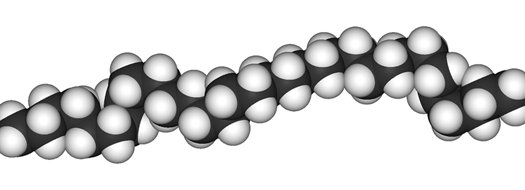
Polymers are generally put to work as insulators, but a team of researchers at MIT has devised a way to turn polyethylene -- the most commonly used polymer -- into a conductor that transfers heat better than many pure metals. But the conversion of insulator to conductor is only half of the breakthrough; by coaxing all the polymer molecules into precise alignment, the researchers have created a polyethylene that conducts heat in only one direction. The plastic material remains an electrical insulator.
Getting a bunch of polymer molecules to fall in line is no easy task -- left to their own devices, the molecules will settle into a chaotic arrangement that is resistant to heat transfer. But the MIT team found that by drawing polyethylene fibers slowly out of a solution they could get the molecules to line up facing the same way, creating a material that will let heat pass in one direction but not the other.
This kind of one-way conductor is ripe for myriad applications in devices where heat must be drawn away from a certain place, such as heat exchangers, computer processors or portable electronics. With a thermal conductivity 300 times greater than conventional polyethylene, the polymer is actually more conductive than about half of all pure metals, meaning it could potentially replace metal conductors in several common devices.Of course, all that is dependent on scaling the process to create conductive polyethylene at market-feasible prices and quantities, something the team has not yet done. But should they find a way to produce the stuff in bulk, it could quickly jump from lab bench to commercial applications, providing a cheap alternative to certain metals used in heat exchange -- metals that add cost and sometimes an environmental toll to common devices.

138 years of Popular Science at your fingertips.
Each issue has been completely reimagined for your iPad. See our amazing new vision for magazines that goes far beyond the printed page
Stay up to date on the latest news of the future of science and technology from your iPhone or Android phone with full articles, images and offline viewing
Featuring every article from the magazine and website, plus links from around the Web. Also see our PopSci DIY feed
Science is reinventing play, from extreme sports to gamification to ridiculous roller coasters to the playgrounds of tomorrow, and this issue is chock full of fun. Also, on a less fun note: Did global warming destroy my hometown?
"Metals that add cost and sometimes an environmental toll to common devices..."
...in addition to more widespread use of environmentally toxic plastic leaching into our bodies, and our water and potentially clogging the Pacific Ocean.
Surely it doesn't conduct heat in only one direction. Shades of Maxwell's Demon. Shouldn't it be described as conducting heat back and for along one line, or something similar?
Unless the comment above about it not exactly being a one way conductor is technically accurate, it sounds to me that such a substance could be turned into a non-mechanical refrigerant moving heat away from a contained area with little to no energy expense.
As for it being toxic, I don't know why we shouldn't be able to encase it properly and recycle it. It's just like so many of our other toxic items. The problem very well could be reduced to a matter of responsibility.
Could this one-way thermal conduction be used in a thermocouple to generate electricity?
No, it doesn't lead to maxwell demons, it doesn't MOVE heat, it just conducts heat when one side is hotter than other, but not when second side is hotter than first. Just like diodes in electronics. It's just a heat diode.
Not just refrigeration but heating your house. Picture pipes made of this stuff in other pipes made of it with the directions all facing in. Blowing in outdoor air, even freezing air, the air will become progressively hotter in the inner pipes. Heat your house, produce electricity, anything from that heat all harvested from cold air.
This is great. Could be a serious game changer if they can make enough of it. And by game changer I mean all the games the way everything is built.
Think of this as fiber optics for heat. Just like light travels along a glass fiber, heat will travel along fibers made of this new material. Unless MIT has figured out how to break the second law of thermodynamics, that's the only way to interpret this story.
Just to be clear, I should have said "Just like light travels BOTH WAYS along a glass fiber, heat will travel BOTH WAYS along fibers made of this new material."
Anything else violates the second law of thermodynamics. Someone above mentioned a "heat diode". They are possible, but only with energy input.
Conducting heat one way does not cool something any more than a check valve, by itself, will pump water.
One end of the polymer still must be cooler than the other end in order for heat to flow. This doesn't break the second law of thermodynamics and it doesn't get you free energy.
It makes for more efficient heat transfer in the same way that a pipe with a check valve is more efficient than a plain pipe at allowing water to flow from a source to an outlet when the source has a variable pressure that is sometimes less than the outlet pressure.
TANSTAAFL
Sounds like the best laptop heat sink ever. When can I get my hands on some?
I think actually the press release on this was worded poorly. I believe that it is more accurate to say that this heat-conductive polymer allows heat to travel as efficiently as many metals along a single *axis*, rather than in a single direction. In other words, if you took a block made of this stuff, whose fibers were aligned along an east-west axis (for example), it would conduct heat very efficiently either East or West, but would conduct heat very poorly in any other direction (North/south, or northwest/southeast, etc). Think "pipe" rather than "diode". A block of metal doesn't do that; if you heat it up at any point, heat will flow out in all directions along no preferred axis.
Shikata ga nai
"Someone above mentioned a "heat diode". They are possible, but only with energy input."
They have an energy input; the energy input is the difference between the hot and cold side.
"[...] a team of researchers at MIT has devised a way to turn polyethylene [...] into a conductor that transfers heat better than *many* pure metals". So it would probably be worse than aluminum. No breakthrough radiators folks, sorry.
If they can even get thermal conductivity to work in such a way, just on the basis of making plastic conductive to heat in such a way ensures a specific path in the right direction towards electron conduction through plastic. I know its not the same thing, nor do i know the exact specifics about it, but the way that they conduct heat in only one direction is the main reason why i believe it is possible, getting strands of this plastic to line up in the same way a circuit would (after of course ajusting the molecular structure for electron transport) enable a plastic circuit board.
sounds about right? in addition i just realized that since it is plastic you would still might have ESD problems, however they would be different, instead of being destructive it would be interfearance with the signals. to midigate this you could put a layer of normal plastic over the conductive circuits, effectively isolating them from the ESD. this is of course only theory, however it sounds about right.
another thought however is that you might have to have a cooler for the mainboard in this case. as this is all speculative and theory, i cannot be sure on any of this but it is possible, though future tech.
The simplest way to think about it is that it would be a conductor in one direction and an insulator in the other.
It wouldn't be useful as a refrigerator or heater -- but if you made a cooler out of it, and put some hot food in the cooler, it would allow the food to cool down to room temperature at a normal rate, unlike a current cooler, which would keep the hot food hot for awhile.
I agree with the article -- if it could be manufactured, the first commercial applications would probably be to replace or improve heat sinks. You could have two hot chips next to each other, and if each had it's own heat sink made of this stuff they would could dissipate their heat to the outside without warming each other up.
How about incorporating into clothing? you could make three piece suits to keep those wall street CEO's from sweating while the prosecutor is grilling them about the 1.6 trillion dollars they fleeced from Americans.
"highly conductive new polymer that conducts heat in only one direction"->"meaning it could potentially replace metal conductors" well if it really conducts heat in one direction only it will not replace any metals, metals conduct bothways, but it will revolutionize heating and cooling devices. so unless this article is stating something wrong* we can have a plastic wire that has the cold end in my room and the hot end outside in the 90 deg temp and it would still draw heat from room to outside, in the winter you switch the cold and hot ends to heat the room
geebob, others:
(Others have said this but it's worth repeating.)
This substance would seem to behave like a one-way valve for heat; a passive device -- not one that does work. The heat only flows where it naturally would.
Hence this material cannot possibly act like a heat pump. It won't make a refrigerator that runs without power; neither will it heat anything. Rather, it could allow your 'fridge's temp to come down to ambient (whatever that may be), while resisting the tendency for the fridge interior to come UP to a higher ambient temp later on. Or vice versa.
Heat conduction is like water flow in gravity. Given a path, water will flow from a higher reservoir to a lower one.
It's an elegant idea, with numerous uses. I'm not an engineer per se, but I've done a lot of electronics design. Such a material could be immensely useful under certain circumstances, particularly used as or in conjunction with heatsinks.
Even so, thinking back, in almost every design I've actually produced, copper heatsinks alone would be more appropriate.
If it were really cheap, it would be a VERY interesting material from which to fabricate equipment enclosures.
How about incorporating into clothing? you could make three piece suits to keep those wall street CEO's from sweating while the prosecutor is grilling them about the 1.6 trillion dollars they fleeced from Americans.
www.tran33m.com/vb/
One of the best examples of Heat Spreading Technology is the Power Blanket at www.powerblanket.com