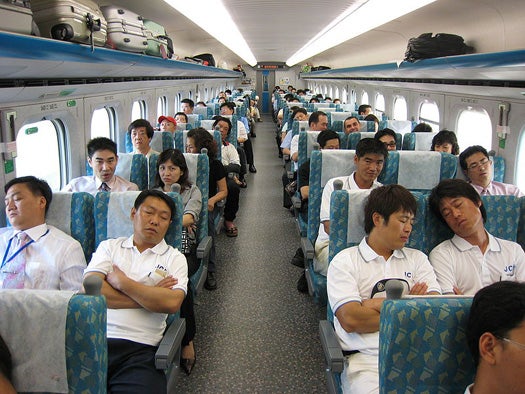
Chinese High Speed Rail Link Will Connect Asia and Europe

Chinese rail passengers already zip between cities on trains traveling three times faster than the average train in the States, and a 217-mph line linking Wuhan and Guangzhou will soon be the fastest train on Earth. But not content with screaming-fast trains linking cities within its borders, China now plans to extend its high-speed network all the way to London with a rail line that will fly through 17 countries at speeds reaching 200 miles per hour.

The project calls for the construction of three lines, hopefully by 2020: the first will link London's King's Cross Station to Beijing and take approximately two days to traverse the entire stretch (it will then continue on down to Singapore). A second line will connect China with Southeast Asian nations like Vietnam, Thailand and Malaysia. The third line will link Germany and Russia, crossing Siberia to terminate, of course, in China.

How is China getting 17 nations on board with such an ambitious -- and expensive -- project? For starters, they're offering to pick up the tab. China will build the infrastructure in exchange for rights to natural resources in the nations that benefit from the high-speed links. So China gets timber, minerals, oil, gas, etc. as well as a fast, efficient means to pipe them to cities within its borders, and smaller, sometimes isolated nations (here's looking at you, Burma) get a high tech, high speed connection to the greater global economy.

Meanwhile, in the U.S. we can't get federal, state and local bureaucracies to agree on funding for a much slower link between Chicago and St. Louis, and San Francisco to L.A. in less than three hours feels like a distant dream. Sigh.

[Inhabitat]

33 Comments

Well they can export more people to the rest of the world

200 miles, of course.

I have to hand it to China, that's brilliant: rights to natural resources in exchange for building a high speed rail line. I wonder if they have to maintain it too? If they don't, it would be an awesome deal for China, considering that only 2 high speed rail lines in the world are actually profitable; Tokyo to Osaka and Paris to Lyon.

Think about it: all those 17 countries would be paying from their public treasuries to maintain the system, increasing the financial burden on their people, while at the same time draining off natural resources to China, reducing their economic strength. It would be a win-win-win for China.

I wonder how long it will be before we have a network of high-speed trains here in the US.. I would love to be able to hop on a train and zip around the country. Seems like it would be a good way to travel, and probably a lot cheaper than flying. The lines could be laid along-side the interstates for the most part, so the environmental inpact would be minimal. Not to mention all the emissions this would eliminate from aircraft and automobile travel.

Democracy is mostly a good thing, but one of the drawbacks is that it's hard to get everyone behind big projects like this, so progress is sometimes slower.

Since it isn't maglev, it's a waist of money.

People are going to eventually start building maglev rail networks, so why bother building a conventional rail network beforehand? It's stupid; in the long run it means two big rail projects are going to have to be paid for rather than one.

Bravo Google for standing up for free speech. Booo China for continued human rights abuses.

USA will benefit from launching high speed rails projects. Maglev technology is still somehow experimental. With all the unemployed people sitting idle the high speed rail should be up in little time.
Lots of jobs will be created in designing the rails and building and maintaining them. Later if Maglev becomes mature enough I guess it can be built in top of the existing high speed rails. Or it can replace the existing rails. It is a car culture in USA but the high speed trains will have customers.

Maglev technology has passed the experimental stage, after decades of work in Germany and Japan, and is for sale all over the world. Here in the U.S. we've been looking at potential travel corridors to deploy the German Transrapid since the late 1990s. More recently, Japan has announced it will begin to deploy its high-speed superconducting maglev in Japan starting in 2025. Exports are expected to follow soon thereafter.

To showcase maglev's superior speed and performance, we should invest in at least one demonstration project to see its benefits in commercial service, just as the Chinese have done in Shanghai for the past six years. Then we can better debate its merits compared to high-speed rail.

On the bright side the land will already be cleared and graded if they ever do upgrade to maglev.

Guy Thompto

So we don't have high-speed trains. I wonder why we are bankrupt and China is swimming in money?

How much does China spend on Social Security? How high is the minimum wage that employers must pay to the least skilled workers? Oh, was that NOTHING? And what Cap and Trade tax do Chinese manufacturers pay? Was that NOTHING again? And what limits does the Chinese government put on mineral, gas and oil exploration? NOTHING again?

So when your grandchildren ask why China rules the world, perhaps you should mention something about all of the well intentioned Leftists from your generation that saved our planet and destroyed our economy.

Sure Guy. I'll tell them as they die of cancer from the toxic mess we've made of our country ala China.

Seriously Guy, you have no idea what its like over there, but feel free to pack up your belongings and move on over to Beijing anytime you want to be with the future rulers of the world. On second thought, leave your belongings behind, unless you have a government title.

Also, don't forget that we should grossly inflate our currency's value and and protect the truth by controling all access to media and locking up anyone who dares defy the government, since that is the key to China's economic power in the world. If that's the future of America, I suppose in your "ends justifies the means" paradigm we can solve the problem of what to tell our grandchildren by assuring that we have none to speak to.

I for one would rather live in a country that may not be the economic ruler of the world, but is a place where my children can grow up in a healthy environment with the assurance of a living wage and a pension to support them through retirement.

But its obvious you are more concerned with being on the "ruling" team. There's a plane leaving for there today, or you can wait until they finish the high-speed rail. It's up to you.

Oh, and don't worry about your stuff, Guy -- There's thousands of Chinese willing to take your place in this bankrupt country. Explain that.

Douche.

Sorry Guy Thompto, I would much, MUCH rather live in a second-tier economy with clean water, fair labor practices, a solid social safety net (including national health care for everyone), and a vibrant arts scene than a first-tier economy that fouls its own nest, exploits its own people, elevates the love of money over quality of life, and glorifies individualism to the exclusion of the common good.

What holds America back most of all (again, my opinion) is our over-inflated (and totally undeserved) sense of self-importance. Many Western European nations somehow manage to balance the need for a healthy economy with the need to preserve a social safety net for their citizens. For some reason (that escapes me completely), the majority of America seems to believe it has all the answers - mounting evidence to the contrary notwithstanding.

If you really believe in the free market, support opening all national borders. Allow all of us to choose the type of country we want to live in. Lots of people will want to come to America I'm sure. But I bet there's a whole bunch of Americans (myself included) who would gladly live elsewhere.

Sounds to me like everybody wins: Third-world nations in Southeast Asia get a modern transportation link, China gets resources from those nations, and Europe gets a more economical link to cheap Chinese goods. And none of the participating countries to pay for setup costs either.

But a trip that takes two days would have to offer a lot to convince people to not ride a plane - a far shorter trip. But if the price is right, a 2 day sight-seeing tour across Eurasia would be a great offer.

Though having maglev trains would be nice, China would not have made this offer if it was built that way. Maglev is far too expensive for even industrialized nations. The advantage with high-speed rail is that is doesn't have to replace every last mile of track from London to Beijing but just make a few tweaks to currently existing routes.

But if you want something faster, go to Wikipedia and search for "vactrain". The concept is quite mind-blowing

Guy Thompto, your post just keeps bugging me and I had to come back and add to my previous comments. The US was the worlds premiere economic powerhouse during all of the years that we were building the sorry excuse for a social safety net we currently have. We are now the world's premiere debtor nation because we have squandered our wealth on unncecessary foreign misadventures (wars) and the corruption that (very predictably) followed the rise of laissez-faire capitalism espoused by every administration since Ronald Reagan.

This isn't a political story and it's unfortunate that the commentary has been hijacked by a political discussion, but until laissez-faire capitalists take ownership of the economic catastrophe that they brought down on all of us, I can't imagine anyone ever taking you seriously.

Obviously 200ish MPH is slower than a plane. An amtrack ticket for today's slow trains costs as much, if not more, than a plane ticket to the same destination. High speed rail will be more expensive to build and maintain.

So, I fail to see the benefit of high speed rail in the US. We're not a small country like japan (about the size of Montana, I think). It'll be slower and more costly than taking a plane.

Okay, maybe it's a cleaner form of transportation, but I'm sure the money spent would be better invested in other forms of tree-huggery like wind and solar.

I love trains and I'd enjoy riding a high speed train, but realistically, it doesn't make sense to me.

P.S. Lay off of Guy. His only point was that China has no regard for its people or environment, that's why they can push through whatever project or agendas they want.

Bperetto, Not sure where you buying your Amtrack tickets? It's pretty damn cheap. (unless you're trying to go cross-country, which doesn't make much sense, even for high-speed rail)

The true benefit of high-speed rail is providing fast, reliable transportation between cities that are otherwise impractical to commute or fly daily. This truly would expand the job markets in certain regions of our country, and hopefully help with the congestion of our highways. So Cal definitely needs it. Also, would improve productivity for commuters who would be able to get work done while on their commute, rather than stuck behind the wheel of a car.

bpretto, I think you need to re-read Guy's post before ordering the rest of us to "lay off". His point was that America's social safety net (social security, minimum wage, etc.) is the cause of China's rise (and by extension, America's decline). I disagree. It is the failure of laissez-faire capitalists to require our trading partners to adhere to the same environmental and labor standards that their domestic competitors must adhere to that allows our markets to be flooded with cheap imports from countries like China that have little regard for the well-being of their own citizens.

Thom Hartmann (talk-radio personality) talks about this almost every day. If it costs $1 to make a pair of shoes in the United States (because of our labor and environmental standards) and it costs 10 cents to make the same pair of shoes in China (because they have none of those standards) then the shoes imported from China should have a 90 cent tariff applied to them to even the playing field. Our manufacturing jobs would never have left this country if this rule had been applied across the board.

In the event that this vision will be realized, this would be a huge breakthrough in the transportation industry. It would make the transport of good and services to the countries covered easier and faster. People will have another option aside from ships and airplanes as a means of going to the countries included in the railway system. Aside from the benefits this would bring to the countries involved, China will be opening herself to more economic opportunities and tourism. China will have a very good reputation in the global community. Not considering other factors such as maintenance and repairs, the railway system will greatly benefit the global community.

@MTPPublic, you made this political, so let's correct your errors. Laissez-faire capitalism is what made America great not socialism. The reason we are in debt is because of the "social safety net" as is the case in every socialist nation (who, by the way, aren't at war but still in debt). Wartime spending is always temporary, but entitlements never end, and their costs grow faster than any other government spending, far outstripping inflation. That's unsustainable. If you don't count Social Security, social spending amounts to 900 billion or 31% of the budget. If you count Social Security, it's 1.5 trillion or 51% of the budget. Military spending is 16% and war spending is 5%.

And those cheap shoes from China generate income for Chinese people, elevating their living standards. As they grow wealthy--as we've seen with every nation that has risen from poverty--they demand a higher standard of living and better personal protections, which causes the cost of manufacturing their goods to go up. In the meantime, we get cheap goods, they get wealth and a better standard of living. It's a win-win. Protectionism has always proven counter-productive. And a changing economy is as certain as death and taxes. As it changes, old-style jobs disappear and new industries and opportunities emerge. We adapt and grow rich.

Oh, and those "unnecessary" wars? Destroying Al Qaeda and the Taliban has made us safer from attacks. 'Nuff said. By the way, that's one thing the Constitution actually requires our government to do: protect us. Nowhere in the Constitution is there a mandate for social security, welfare, Medicare, Medicaid or universal health insurance.

Dante, I actually think you and guy were saying much the same thing. I think you were both saying China treats their people like all communist countries do, like crap. They view their populace as pawns in social engineering or slave labor.

I am surprised anyone still views this economic problems as to do with capitalism. This started in the 90's, when politicians in their ever arching desire to socially engineer decided they wanted more people based solely on being non european descent to own more houses, as unconstitutional and immoral as choosing policy that way is. The banks were not only required to make high risk loans they wouldn't otherwise make but why not, the government guaranteed them, much like they are doing in the health care insurance now.

More like socialist/ communist/ progressivist problem rather than a capitilism problem methinks. The road to hell is paved with good intentions, (and the desire for a fat voter block). And no group wants those things more than progressive social engineers willing to trade power now for pain for everyone later.

"Dante Alleghory" - The original Dante's name was spelled "Dante Alighieri" unless you're referring to his use of "allegory", which is also spelled differently. I guess at this point I should stop and consider that you're likely just trolling, but I'll make my points anyways.

I have traveled to China. I am by no means an expert on that country, but I obviously know far more about economics than you. I find it ironic that all the things you accuse China of doing are done by the U.S. as well. To wit:

1) "don't forget that we should grossly inflate our currency's value" - First, I don't follow your use of "inflate". Inflation, in economic terms, lowers a currency when ever greater amounts of currency exist (today, most of that "currency" is in an electronic form). You seem to use "inflate" to mean "increase in value". This is wrong, both in China's case and that of the U.S. Now, China keeps the exchange rate of their currency (Renminbi, or new Chinese yuan) artificially LOWER in value, in order to keep their exports cheap. Indeed, this exploits the labor provided by their population, sending many of the benefits to the countries that import from China in the form of nice shiny products (but this is outside of the scope of what I'm discussing here). Conversely, the U.S. is the one that, vis-a-vis the Federal Reserve, creates money out of thin air, inflating the AMOUNT of currency and thus lowers of the value of the U.S. dollar. This, unlike China, is not for the purpose of strengthening our exports, but rather to pay for Trillions of dollars of expenses that would be political suicide for all of Congress if they were paid for via taxes.

"and and protect the truth by controling all access to media"
China's media is indeed much more restricted by LAW than in the U.S. However, in practice, all you need to do is compare coverage by the BBC, Al Jazeera, and any of number of other worldwide outlets to the coverage of the five major news corps in the U.S., to see that we still are getting censored propaganda. And this is not a dig at "big business" on my part. These corporate giants are engendered by U.S. govt. policies that allow their existence, from rules on "frequencies" and "bandwidth", to many other well-meaning yet incompetent laws that end up stifling competition and innovation.

"and locking up anyone who dares defy the government"
Just look at the U.S. "War on Drugs". For example, how about the policies of arrest on crack cocaine vs. powder cocaine

www.jackandjillpolitics.com/2010/03/making-crack-vs-cocaine-sentencing-just-a-little-less-racist/

It doesn't take a genius to see that this "War" produces much more costs than results, and it is inherently racist.

bperetto - Obviously, a 200 MPH train is *not* slower than taking a plane. When you fly, do you teleport into your seat on the airplane, already buckled in, and the plane instantly takes off. Of course not!

Even for flights within the U.S. (that as of yet have no passport control, thankfully), comparing train travel to plane: at the airport you need to check in luggage, get a seat assignment, go through security, etc. Go to France, and compare the flight from Paris to Nice to the same train ride. The train wins hands down, maybe not on price, but definitely on efficiency. For distances of 500 miles or less, a high-speed train almost always beats a commercial plane unless you're required to travel across a large body of water (intl' standards are 155 MPH for new high speed rail lines; see - en.wikipedia.org/wiki/High-speed_rail_in_the_United_Kingdom

laurenra7, don't forget what the article said -- some of those countries will be the destinations for some of the stuff China exports, stuff they need, such as natural gas and oil, plus other stuff (wood, for example). You mentioned the maintenance side, and that is a huge issue indeed. Like you, I wonder who will handle it. It's entirely possible it'll be some sort of joint-venture deal.

I lived in China several years, as well as next door in Macau (before it returned to China's rule), starting in 1985. Even back then, and despite the numerous problems with the rail system, it was impressive. I remember one Chinese New Year after which the rail authorities said they estimated some 70 *million* people had traveled on the railroads -- JUST in the northeastern three provinces *alone.* That's pretty impressive (and I don't even like the government, but I hand it to them on that point). Some have doubted me when I've repeated that story, but having traveled long distances across China by train, I have no doubt at all; I've been on standing-room-only trains -- standing for hours, by the way -- packed liked sardines. Lo-o-o-ong trains, with many passenger cars.

The country's domestic plans are equally impressive as this route that will eventually stretch from Singapore to London (and further after London, counting onward connections).

I'm American and live in Asia (though no longer in China or Macau), so if I last long enough, I'd like to take the train from Singapore to as far north in Britain as possible! (Then I'll FLY back. .)

I'm intrigued, what natural resources are the Chinese going to get from Britain. They do mean London, England?

Anyway, I'm pretty sure our planning regulations will put a stop to all this nonsense.

www.faqmyjob.co.uk | www.proviser.com | www.faqmyjob.com | www.conakat.com

Wow, I could see the use of that for transportation of goods quickly.

Beecher Bowers
www.beecherbowers.com

wonder how long before we have a network of high speed trains here in the U.S.I want to go on a train and zip code across the country. It seems to travel a great way to fly and probably much cheaper. The lines can be placed on the side of the road, for the most part, so that the environmental impact would be minimal. Not to mention all the shots at a distance of aircraft and automobiles.Democracy is usually a good thing, but one drawback is that it is difficult to get behind these projects is often so slow. www.popsci.com/user-comments/82655 www.mortgagecalculatorlender.com

With all the unemployed people sitting idle the high speed rail should be up in little time.

Lots of jobs will be created in designing the rails and building and maintaining them. Later if Maglev becomes mature enough I guess it can be built in top of the existing high speed rails. Or it can replace the existing rails.

Aaron
www.howtosellgoldforcash.com

"China now plans to extend its high-speed network all the way to London with a rail line that will fly through 17 countries at speeds reaching 200 miles per hour."

This is incorrect. The article implies the Chinese will be financing/building a rail link all the way to London. They won't; the plan is to connect with the existing European railway network. The "Chinese railway to London" actually terminates far to the east of Eastern Europe. Even if that wasn't the case, the Europeans would never allow the Chinese to build rail links across their countries...and the Chinese have no leverage over them to do so anyway: bribery of first-world countries by second-world ones doesn't work, and Europe is already crisscrossed with a high-speed rail network anyway.

Naoise O Rourke,
www.hotelsindublincitycentre.com

articel very interesting, very glad to read it

This isn't a political story and it's unfortunate that the commentary has been hijacked by a political discussion, but until laissez-faire capitalists take ownership of the economic catastrophe that they brought down on all of us, I can't imagine anyone ever taking you seriously.
www.tran33m.com/vb/

Seems like a sci-fi concept.Let see whether it is possible or not.
http://wiity.blogspot.com/

The country's domestic plans are equally impressive as this route that will eventually stretch from Singapore to London (and further after London, counting onward connections).

www.1spoort.net/vb/


June 2013: American Energy Independence

Five amazing, clean technologies that will set us free, in this month's energy-focused issue. Also: how to build a better bomb detector, the robotic toys that are raising your children, a human catapult, the world's smallest arcade, and much more.


Online Content Director: Suzanne LaBarre | Email
Senior Editor: Paul Adams | Email
Associate Editor: Dan Nosowitz | Email
Assistant Editor: Colin Lecher | Email
Assistant Editor: Rose Pastore | Email

Contributing Writers:

Kelsey D. Atherton | Email
Francie Diep | Email
Shaunacy Ferro | Email

circ-top-header.gif
circ-cover.gif
bmxmag-ps