Seeing things in outer space that aren't necessarily there

The Martian Canals Percival Lowell mapped the straight lines he observed on the Martian surface, which he believed to be intentionally engineered canals. NASA

Martian Irrigation Canals

As bizarre as it may seem now, in the late 19th and early 20th centuries it was commonly believed that there were artificial canals on Mars. The rumor started in 1877 when Italian astronomer Giovanni Schiaparelli observed long, linear features on Martian surface through his telescope. He named the features "canali," which translates to "channels" or "canals" in Italian. Schiaparelli did not intend for the term to be interpreted as "artificial" canals; he actually meant simply "narrow waterways." But the coined phrase took on a life of its own, and some people even believed that Martian intelligent life had constructed a canal system to bring water from the polar regions to its cities.

Astronomer Percival Lowell was a strong proponent of this theory, and he envisioned Mars as a planet laced with engineered waterways and canals. Because straight lines don't typically appear in nature, Lowell rationalized, they could only have been made by an intelligent civilization. In 1909, a Greek astronomer named E.M. Antoniadi used an 83-centimeter telescope to observe Mars when it was in opposition to the Earth, which is the best time to observe a planet. He concluded that the canals were an optical illusion, and the Martian canal theory slowly began to lose support.

Metal Bridges on the Moon

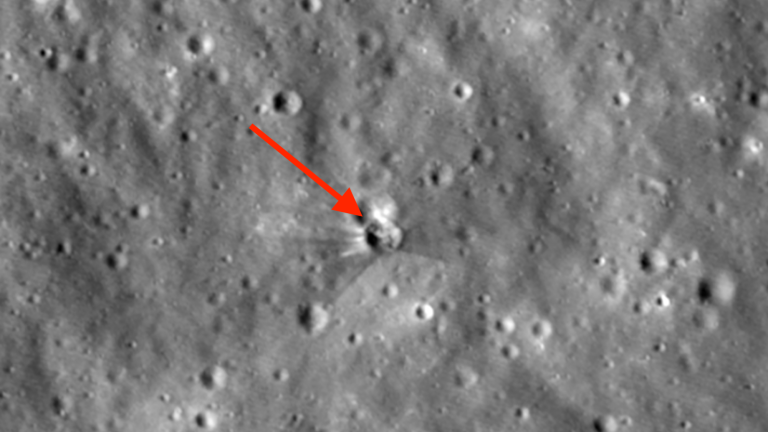
Bridge on the Moon: This image shows the region on the Moon in which John J. O'Neill reported seeing a gigantic natural bridge in 1953.  Robert Dyrda
In 1953, John J. O'Neill, a science editor with the New York Herald Tribune, reported seeing something that looked like a bridge in the Moon's Crisium Basin region. He reported, "a gigantic natural bridge having the amazing span of about 12 miles from pediment to pediment." Although O'Neill had been careful to call it a "natural bridge," soon thereafter British astronomer and moon mapper H. Percy Wilkins confirmed the bridge's existence and mentioned it in his book Our Moon. In fact, he hinted that the bridge was artificially engineered. Wilkins had a following of believers -- including several astronomers -- who were convinced the bridge existed. But the British Astronomical Association wasn't so supportive -- they forced Wilkins to resign as director of the Lunar Section.

The "bridge" was, of course, an illusion created by lighting conditions and shadows on the Moon's surface. The myth was finally put to rest when the Apollo missions obtained photographs of the region.

The "Face" on Mars

The Face on Mars: In the 1970s, the Viking mission took this image of a formation in the Cydonia region of Mars that resembled a human face.  NASA
For many, the lessons of the "bridge" on the Moon didn't sink in, and in the 1970s light and shadow combined once again to create an illusion -- this time on the surface of Mars. Photographs taken of the Martian surface by the Viking Mission cameras captured a landform that resembled a human face. The "face" -- which was actually a mesa -- was located in the Cydonia region of Mars, an area whose geography is much like that of the Colorado Plateau in the southwestern United States. The Viking cameras happened to take the image at a time of day when shadows caused the mesa to have a face-like pattern, so scientists on the Viking team jokingly named the land formation the "Face on Mars." They had no idea what they had started, and a media frenzy ensued, with many face-believers being convinced that NASA was covering up evidence of civilization on Mars.

The Mars Face mania became so intense that when the Mars Global Surveyor arrived at Mars in the late 1990s, NASA instructed mission scientists to reprogram the spacecraft so that it could look in the direction of "the face" and take the highest resolution photograph possible. The resulting images confirmed that the "face" was indeed an eroded mesa that, at certain times of the day, looked like a face due to shadows created by gullies in the eroded rock. In fact, the "face" is only one of thousands of similar mesas, buttes, and ridges in the Cydonia region.

The Incan City on Mars

The Inca City: In 1972 scientists on the Mariner 9 mission gave the informal name "Inca City" to this area of intersecting ridges in the south polar region of Mars.  NASA/JPL/Malin Space Science Systems
Some die-hard Mars Face fans still believed in a conspiracy even after images from the Mars Global Surveyor revealed a mesa, and their beliefs were further fueled by images that showed what looked like an ancient Incan city. The photo, which was taken of an area near Mars' south pole, shows a series of grid-like formations. In 1972 a team of Mariner 9 scientists informally gave the name "Inca City" to the region because it resembled an ancient ruin. This time, the coined phrase didn't spark a media spectacle, but scientists puzzled over what process could have created the unique pattern.

In 2002, scientists solved the mystery while analyzing images taken by the Mars Orbiter Camera. The images revealed that the ridges of "Inca City" were part of a larger circular structure, which is likely a large, ancient impact crater on Mars.

single page
Page 1 of 2 12next ›last »
Want to read more articles on the military, aviation, and space? Subscribe to Popular Science today, for less than $1 per issue!

2 Comments

There have been lots of studies done to show that people are always looking for familiar patterns and faces in things. It's in our nature to do it. We are programmed to do it and get excited when we find possible matches. The guardian of the badlands image from Google Earth is another example. We love this stuff.

I grew up familiar with the face on Mars photo and all the hype that went with it. I had thought it to be a rock, but was a bit let down when it was proven to be just a rock. Wouldn't it have been something though if it was a fallen statue face that had came back in that hi-res image...

Just Jesus? Heck, no! If you look real closely, you can see that he is holding a lamb.

But in the next cloud over, Shiva and Wotan are flipping him the bird, so it's all good.

I'm sure I've even seen a space cloud that looks like Anubis lifting his leg on a fire plug.

And let's not forget the famous photo of Sauron's eye, which was apparently blue, despite what the movie would have you believe ...


June 2013: American Energy Independence

Five amazing, clean technologies that will set us free, in this month's energy-focused issue. Also: how to build a better bomb detector, the robotic toys that are raising your children, a human catapult, the world's smallest arcade, and much more.


Online Content Director: Suzanne LaBarre | Email
Senior Editor: Paul Adams | Email
Associate Editor: Dan Nosowitz | Email
Assistant Editor: Colin Lecher | Email
Assistant Editor: Rose Pastore | Email

Contributing Writers:

Kelsey D. Atherton | Email
Francie Diep | Email
Shaunacy Ferro | Email

circ-top-header.gif
circ-cover.gif
bmxmag-ps