
Invention Awards 2012
An engine mod uses waste heat to cut gas consumption

Over7

For the better part of Frank Will’s life, he has been consumed with improving engine performance. He started racing motorcycles as a teenager in Germany in the 1970s, winning a world championship race in 1991, and later became an automotive engineer at Ford in Australia. When he left his job in 2008, he applied his passion to a new endeavor: Over7, a system that by redirecting and then heating an engine’s oil, cuts gas consumption by 7 percent and emissions by up to 30 percent.

Over7 heats oil to higher-than-usual temperatures, making it less viscous, without burning up the engine. The temperature of a warmed engine in a car running at a moderate speed, and the oil inside it, hovers at around 200°F. When the same engine is modified with an Over7 system, oil runs through it at 250° to 300°, while the engine block remains at 200°. Because this makes it easier to turn the crankshaft and run the oil pump, the engine requires less gas. The increased engine efficiency also reduces the emission of carbon dioxides, carbon monoxides and nitrogen oxides.

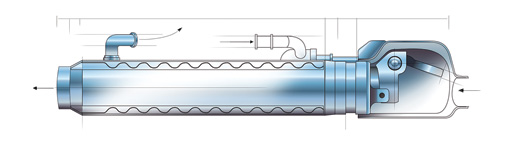
In the Over7 prototype, a bypass hose collects hot motor oil before it returns to the oil pan, where it would have cooled down, sending it instead to a heat exchanger that transfers heat from the engine’s exhaust gas and makes the oil even hotter. A thermostat ensures that the exit temperature of the oil does not get above 300°, so it’s still within most car manufacturers’ maximum temperature specifications.

Will is now testing his invention at the Ford emissions labs where he used to work. He says new cars featuring Over7-adapted engines could roll off the assembly line in less than five years. In that time, he also plans to finish a $200-to-$400 conversion kit that mechanics could use to install the system in older cars. Putting an Over7 system in every passenger vehicle in the U.S. would reduce carbon dioxide emissions by 64 million tons every year, he says—and save drivers seven billion gallons of gasoline.

Inventor: Frank Will
Invention: Over7
Cost to Develop: $200,000
Distance to Market: short ● ● ● ● long

HOW IT WORKS

Oil flows through a bypass pipe into a heat exchanger, rather than flowing back into an oil pan to cool. Once the oil is heated to as high as 300˚, a flap valve in the heat exchanger redirects exhaust gas into an exhaust bypass so that no further heat transfers to the oil.

Inventors

The Other 2012 Invention Awards Winners Are...

Want to read more articles like this, plus tips and tricks, home hacks, DIY projects, and more? Subscribe to Popular Science today, for less than $1 per issue!

20 Comments

Brilliant! Better use of waste heat.

We build motors that are essentially a heat engine and then add a radiator to get rid of the waste heat. If we could somehow recycle all that heat we could probably power our homes on what our cars waste every day. At the same time we could reduce that never discussed factor which is waste heat that adds to global warming.

While this sounds great for reducing emissions, it's got an awfully long ROI time.

For example, my Honda Accord gets 26 mpg. Improving that by 7 pct gets me up to almost 28 mpg. If gas is $3.50 per gallon, and I drive 12,000 miles per year, it will save me $9.42 per month. That means that the conversion kit (between $200-$400) will take between 21 month and 3.5 years to pay for itself.

Maybe this makes more sense for lower mpg vehicles, but no so much for my Accord.

I just re-ran the numbers, and even with a car only getting 15 mpg, it's a 1-2 year break-even period.

Heating the oil decreases its viscosity. While this does result in the savings noted in the article it also reduces the lubricating ability of the oil and thus increases the risk of ruined engine bearings. Any fuel savings wouldn't even come close to the cost of replacing a blown engine.

Green would you please not complain about this. so what it costs $200. Is that price too much to ask to help keep our planet clean for another couple years. stop worrying about yourselves and worry about future generations and what they will have to pay to fix our mistakes. If your that worried about your wallet you can go bite a bullet that only costs $2.50. BTW they should make one of these for motorcycles i get 66 mpg now with a 7% increase i'll get 70.

john, i could be wronge but i think your missing the point it's not going to decrease lubrication because this device is just preventing the oil from cooling down to the point where it's thick. think of it like reheating leftover dinner

They are using the exhaust temperature to heat the oil and run the engine at a hotter temperature increasing the efficiency of combustion. This is not new and it does have its draw backs, namely metal fatigue happens sooner.

Sounds like more frequent oil changes too.
Perhaps better to heat the air intake and use a lower viscosity oil instead.
Adding submicronic molybdenum in suspension makes things very slippery indeed and prevents metal to metal contact too.

Porche,if something can't pay for itself, it's not using fewer resources which means it's not "saving the planet." I think the ROI for this thing is pretty reasonable, but if it wasn't, it wouldn't help anything.

I drive all my cars for more than 2 or 3 years. I'd take this over ethanol in the gas anyday! :D

Uh, wouldn't it actually increase reliability to get the oil up to temperature much sooner? it sounds like this system doesn't increase the operating temperature all that much in comparison to it's gains while engines are usually cold (aka a good portion of most commutes). If it doesn't actually affect viscosity as much at temperature as it does coming up to temp, I am guessing the cold engine damage would be reduced somewhat. At what cost long term? I guess that's what ford is testing

I would guess somewhere around 12.5-25% more engine coolant would have to be pumped through the engine block in order to keep it(the block) running at 200° while the oil temp is running at 250-300°. It could be as high as 50% more, depending on the materials used, the coolant composition, and their respective heat transfer rates. I have a hard time believing less resistance on the crank and oil pump will offset the added cooling that would have to be done, and at best would consider the two a wash. Also, like has been mentioned already in the comments, the oil will break down sooner, which means more oil changes, faster wear on the internal moving parts, and may mean specialty oil($) if conventional synthetics dont handle the increased temperature well, not to mention the fact that the device itself is just more stuff that will break, all of which have negative environmental connotations that the supposed gains might not be able to justify. Speaking of the gains, if there are any, i would hazard that they have next to nothing to do with the oil providing less resistance and have far more to do with indirectly cooling the exhaust, where heat from the exhaust is transfered to the oil, then to the block, then out through the coolant and finally dissipated through the radiator. If that is the case i think there are much better ways to go about it. It would definitely be interesting to find out how they tested it and what they've tested it on. If they just slapped it on a newer car and read the gains I could see it being something as simple as the somewhat cooler exhaust tricking the O2 sensor into telling the computer to advance the timing, or dozens of other scenarios that i can think of, and dozens more that i cant lol.

@Racinjetford - I completely agree with what you're saying, getting the engine up to operating temperature as soon as possible is a good thing, above op temp though, is another matter.

Another aspect that has been completely overlooked is the effect hotter oil with a thinner viscosity will have on other mechanical and non-mechanical engine components. Thinner oil will undoubtedly make it's way past piston rings and into the combustion chamber, especially on engines with a fair amount of ring or cylinder wall wear. We know this, as thicker oil tends to minimally help bump up compression on worn engines for the short term. Hotter thinner oil will also tend to run off more quickly from valve train components and may have additional effects on hydraulic lifters. Then there are non-mechanical components such as gaskets and gasket sealers. Thinner, hotter oil will likely cause premature or increased leakage from sealing points not to mention the fact that oil is responsible for a major portion of cooling the engines bottom end without which other problems such as premature wear, increased deposit accumulation and loss of the precise oil film barrier engineered specifically for each engine and application. To think a cookie cutter novelty like this one can be applied effectively to all, or even any, precision manufactured internal combustion machines is a faulty thought and over the long term, I believe it will be proven as such.

Good points Darkbreeze! it almost sounds to me like f*rd needed a way to decrease longevity(to increase sales later on), and increase required maintenance all under the guise of being green. I seriously wouldn't be surprised if someday this, or something similar, became federally mandated equipment. But hey! it'll create jobs!! lmao

Hox,
Your comment brought to mind the center upper brake light that is required on all vehicles for the benefit of safety all consumers must buy.
In my opinion, while it is an enhancement to be seen during braking, I find it fraudulent to be considered mandatory.
By the way, take notice just how small the brake lights are behind a motorcycle.

I don't quite get it, I owned several cars in the past ( apart from the Volkswagens) that had separate oil coolers. Obviously you don't want to run the engine too cold but oil at high temps breaks down quicker.

I think people are missing a major point. Just because you are not recovering the cost of the converter in fuel cost savings doesn't mean you're not recovering it in, for instance, lower medical bills as a result of lower pollution. Admittedly, since that number would be an aggregate based on millions of devices using the converter, it would be harder to track at first, but bear in mind that this is a brand new design still in the early stages. Why pooh-pooh it while it's still in the starting gate when a better implementation may still be in the offing a little while down the road?

I believe it's a waste of time to say this is a bad idea. Instead, come up with a better idea.

um... those oil coolers aren't for the engine, they're for the TRANSMISSION. I also note you only seem to drive automatics.

re: oil breakdown: Most people change their oil about 5 times more often than necessary, and modern oils are VERY resistant to heat breakdown. About... 5 times more, actually. it's amazing how math works. I'm sure they could engineer an oil to deal with this issue just fine.

Whenever I see one of these "cranky elderly inventor comes up with awesome way to save a ton of gas but the stupid OEMs won't play ball" stories, my BS detector starts pinging.

If it were really this simple, would VW, Ford, GM, Hyundai, and Toyota have all missed it all these years while screwing around with LRR tires and BAS systems and active grill shutters as they desperately try to eke out every last mpg to meet CAFE and Euro regs? Probably not. Same with water combustion and HHO and the Turbonator and all the other things that conspiracy enthusiasts babble on about.

Heating up the oil reduces its viscosity, which in all likelihood also reduces its lubricity and its ability to isolate engine surfaces from each other. The reason the OEMs don't do this is because it probably seriously reduces the engine's lifespan and the durability of its components. Same reason you don't run 25W-60 oil in your car. Could this be done? Sure. Would an OEM that has to pay for warranty claims and needs its car to function properly in any usage regime want to reduce the life of its drivetrain? God no.

Also, certain components of your engine are cooled by oil. You'd be directly affecting their longevity, durability, and function by preheating the oil.

Also, boomshadow, you want better ideas? Hybrids, diesels, electrics, active aerodynamics, smaller frontal areas, direct injection, 8 speed transmissions, tall final drives, low rolling resistance tires, continuously variable transmissions, lightweight components. And the cool thing is, all those ideas are being put into practice - because they work.

Popular Tags

Regular Features


June 2013: American Energy Independence

Five amazing, clean technologies that will set us free, in this month's energy-focused issue. Also: how to build a better bomb detector, the robotic toys that are raising your children, a human catapult, the world's smallest arcade, and much more.


Online Content Director: Suzanne LaBarre | Email
Senior Editor: Paul Adams | Email
Associate Editor: Dan Nosowitz | Email
Assistant Editor: Colin Lecher | Email
Assistant Editor: Rose Pastore | Email

Contributing Writers:
Rebecca Boyle | Email
Kelsey D. Atherton | Email
Francie Diep | Email
Shaunacy Ferro | Email

circ-top-header.gif
circ-cover.gif
bmxmag-ps
