Invention Awards 2012
A cleaner wash feeds back water as you shower
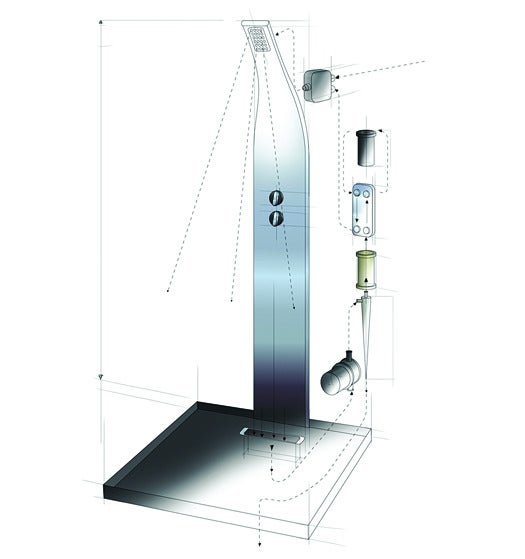
Recycling Shower Ollie Bland

Taking a shower draws more water and more energy than any other daily household activity. Low-flow showerheads save only a little of both, typically at the expense of comfort. That’s because they let the hot water—and all the heat energy it contains—go down the drain.

In 2004, Peter Brewin, an industrial-design student at the Royal College of Art in London, set about creating a more efficient shower that doesn’t require lower pressure. It couldn’t just capture and recirculate the water; most countries require shower water to meet potable-water standards. So instead he designed a miniature treatment plant that continuously captures, cleans, and recirculates 70 percent of the water used during a shower. Even with the energy the system consumes, it still uses 40 to 70 percent less power because the system doesn’t have to heat as much water. Over the course of a year, a typical household would use 20,000 to 32,000 fewer gallons of water with Brewin’s system. That, in turn, would save a local treatment plant upward of 200 kilowatt-hours of energy.

Because other water-treatment processes are too slow for real-time recirculation, Brewin decided to use pasteurization, the quick heating and cooling method for purifying milk. Shower water is already about 106°F when it hits the drain. A heat exchanger and a small electric heater raise the temperature the extra 56 degrees needed to reach the pasteurization point of 162°. To filter out dirt particles, Brewin constructed a funnel that spins the water that flows into it. Centrifugal force flings the heavy undissolved particles to the edges, where they are washed down the drain.

Within a year of starting work, Brewin had a proof-of-concept prototype. (To test its filtering ability, he would limit his showers to once a week.) Since then, he has licensed the technology to Australian engineering firm Cintep to solve remaining problems, such as how to more effectively remove shampoo residue. The first showers, which will most likely be installed in drought-prone cities and disaster areas, will debut next year.

Inventor: Peter Brewin
Invention: Recycling Shower
Cost to Develop: $1.75 million
Distance to Market: short ● ● ● long

HOW IT WORKS

A funnel separates undissolved particles from water. The water passes through a filter, a heat exchanger and a pasteurizer that kills any remaining bacteria. It circulates through the heat exchanger again and mixes with new cool water before entering the showerhead.

Inventors

The Other 2012 Invention Awards Winners Are...

Want to read more articles like this, plus tips and tricks, home hacks, DIY projects, and more? Subscribe to Popular Science today, for less than $1 per issue!

12 Comments

A real reason not to pee in the shower...

Interesting. Funnel Vac system meets shower.

someone needs to invent the Star Trek "shower" system.

Using a small electric heater to heat and then cool down the water by adding some more water? The 'funnel filter' is great, but it might make a lot more sense to capture all that water and use a passive filtering system to clean it and then use it for your next shower.

A better solution is designing an effective tankless battery driven solar energy system which harnesses the sun to charge a hybrid battery - Ultra Capacitor system which then provides the power to run a tankless system.

Then it's uses ZERO energy used from the utility company and produces no pollution.

Let the water company worry about cleaning up the water for the next go round of showers!

A simple heat exchanger between the incoming cold water to water heater line would be enough to increase efficiency... but, no water savings.
Seems like recirculating a small percentage of the water without filtration would still fall within acceptable limits for safety... although not potable in strictest terms... safe nonetheless.
Perhaps regulators ought to revisit the issue and set a maximum percentage of allowable recirculated shower drain water.
Done properly, ie. on the shower diverter only, so that bath water is not effected in any way, I would personally have no problem with it.

Can it remove chlorine?

@ gizmowiz,
You forgot about the fuel consumed to make it in the factory and to transport it for your self sustaining home.

@pehash If you saved the water for your next shower then you would lose the heat that the filtering water has and the system would then be ineffective at saving energy plus then you would be sharing shower water with whoever showers after you which even if the water is treated properly it would still repulse a lot of people. And finally if any bacterial get through the system and sit in the tank until the next shower which my not be for a few days after, the bacteria will have time to multiply and become vast enough to have potential negative health effects.

Take a shower with your love parner. You save water, hot water and enhance social bonding.

Just wet yourself down, shut the shower off, bathe, then rinse. Saves a hell of a lot of money and costs less than the dodad. If you are going to invent, do something practical for gods sake.

Contoria, you raise some good points, but a major factor here is water savings, which over time will likely be just as important as energy savings.

As for complexity, some improvements cause unavoidable complexity.

Solar heating should still be an option for this rig, unless I'm missing something. Heat loss between the shower head and the drain should not be too drastic.

Gizmowiz, energy is still being spent either way.

Glock27, just because you don't find it useful doesn't make it useless.

Everyone, why spend the energy to negate these ideas when you can spend it to come up with better ones?

Popular Tags

Regular Features


July 2013: The Future Of Flight

The incredible innovations, like drone swarms and perpetual flight, bringing aviation into the world of tomorrow. Plus: today's greatest sci-fi writers predict the future, the science behind the summer's biggest blockbusters, a Doctor Who-themed DIY 'bot, the organs you can do without, and much more.


Online Content Director: Suzanne LaBarre | Email
Senior Editor: Paul Adams | Email
Associate Editor: Dan Nosowitz | Email
Assistant Editor: Colin Lecher | Email
Assistant Editor: Rose Pastore | Email

Contributing Writers:

Kelsey D. Atherton | Email
Francie Diep | Email
Shaunacy Ferro | Email

circ-top-header.gif
circ-cover.gif