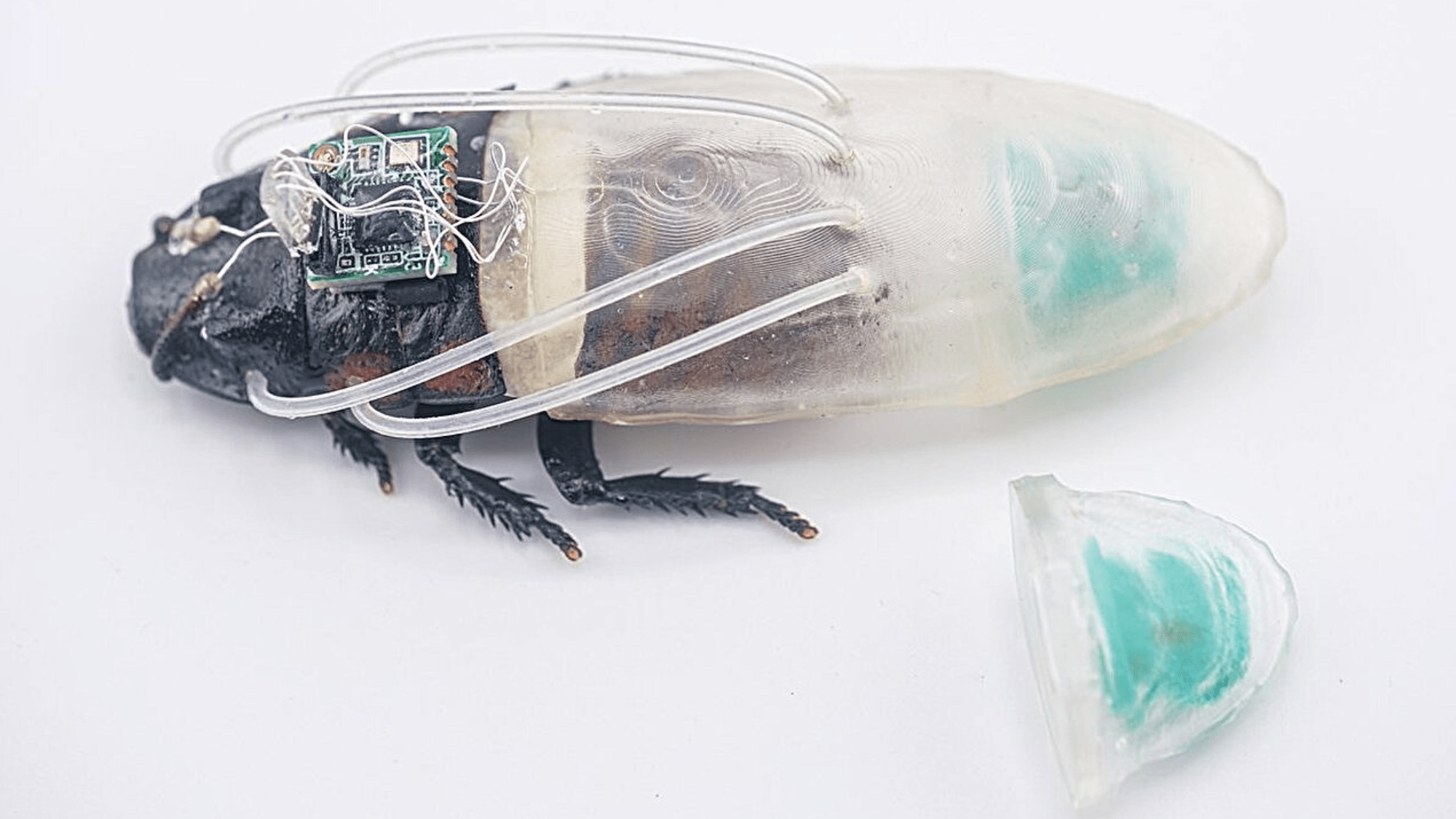
The next time an ambitious adventurer gets trapped in a flooded cave, the person coming to their rescue might not be a human at all. It might be a mind-controlled, diving-suit-wearing cockroach. Sorry, entomophobes.
These cyborgs are already being used in search-and-rescue operations and pipeline inspections, but so far those efforts have been limited to dry land. That’s changing. Researchers at Nanyang Technological University in Singapore 3D-printed a flexible diving suit that roaches wear like a backpack. A chemical oxygen generator inside of it creates oxygen when the bug swims underwater and pumps it through tubes connected to the spiracles the roach uses to breathe. In testing, the cyborg roach was able to move around and breathe underwater for up to three hours. That added ability could make the critters much more viable for longer search-and-rescue operations.
Eventually, this same principle could also apply to other low-oxygen environments like space. In theory, this means cockroach cosmonauts may not actually be all that far-fetched.
“By fitting a cockroach, which is a terrestrial species, into this diving suit, we allowed it to survive and operate in oxygen-deprived environments,” the researchers wrote in the paper. “Transforming it into an amphibious cyborg robot capable of operation across land and water.”
The study was published in the journal Nature Communications.

Cyborg cockroach to the rescue
Cyborg insects to the rescue
Scientists have tinkered with the idea of remote-controlled insects for over a decade. In general, the process works by first anesthetizing the insect and then attaching electrodes to its brain and sensory organs. The team can then press a button on a remote controller to send a signal to nudge the insect in the direction they want it to go, even when it would normally stop.
This bug mind control isn’t just mad science. It can serve a much greater purpose. By working with the animals’ natural biology, the cyborg bug requires far less computing power to operate, since it’s not powering the motors and actuators needed for a robot. A cyborg also doesn’t need to carry around a large battery, which could similarly get in the way during a rescue operation. But the cyborg approach also doesn’t simply turn the roach into a mindless zombie. It’s actually crucial that the roach maintains some level of autonomy so that it can naturally traverse obstacles and avoid hazardous debris. The human operator basically just makes sure it stays on path.
“For example, in a rescue scenario, we only need to stimulate the cockroach to turn its direction when it’s walking the wrong way or move when it stops unexpectedly,” Osaka University roboticists Keisuke Morishima, who was not involved with the diving suit, said when describing the technology in 2023.
But cyborgs also come with some major downsides compared to robots. Maybe the most obvious is that animals need to breathe oxygen. That severely limits the type of terrain they can access. And in the case of rescue operations (which often involve water-flooded spaces or areas with toxins in the air) that’s a pretty significant limitation.
“This is important because real disaster sites can be challenging after heavy rain or flooding, blocking access routes in the rubble, drains and narrow gaps,” NTU Singapore Aerospace Engineering Professors and study lead Hirotaka Sato said in a statement. “By expanding the operating parameters of our cyborg insects to include underwater travel, we believe they can enhance search-and-rescue efforts.”
World’s first cockroach diving suit actually works
That’s where the idea for this new bug diving suit comes into play. The engineering team wanted to design a system that was lightweight and didn’t require lots of complex mechanical parts that could potentially slow the roach down. For the oxygen tank, they settled on using a sponge coated with a catalyst made of manganese dioxide. The chemical compound can slowly break down when exposed to hydrogen peroxide, which in turn would create oxygen.
The oxygen released in the tank then flows through four silicone supply tubes that are attached to the roach’s spiracles prior to the operation. The researchers say the roach doesn’t seem to mind wearing its chunky backpack, though of course it’s hard to know for sure without actually speaking bug. But roach-human conversation is a discovery for another day.
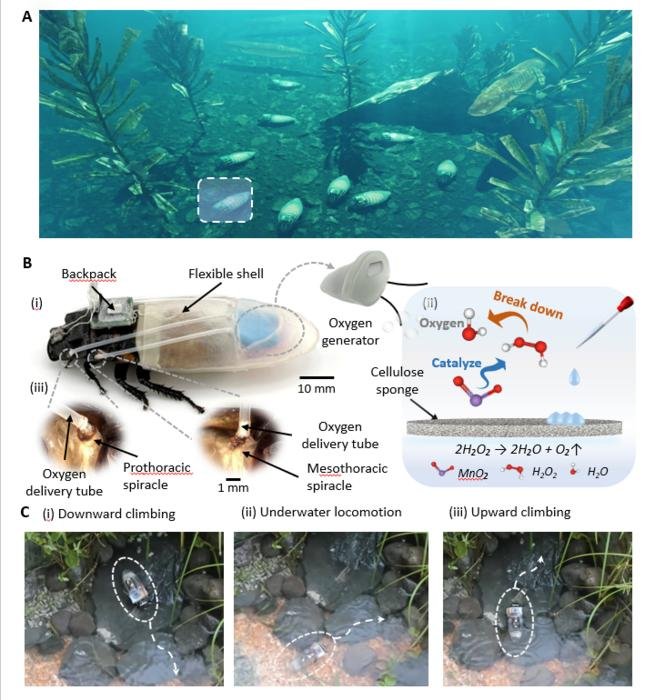
The backpack housing the oxygen tank is made of a 3D-printed plastic-like material measuring only 10 by 10 millimeters, or the size of a small piece of gum. The whole thing is connected wirelessly to a simple controller, which the human overseer uses to dictate the roach’s movement. To test the suit, the team put together a series of tube-shaped obstacle courses (also 3D-printed) meant to replicate some of the submerged scenarios the rescue bug might find itself in.
It performed shockingly well. The cyborg was able to successfully traverse every hazardous zone it faced, and did so at speeds only slightly slower than it would above ground. With the diving suit on, the researchers say the roach’s survival time in those underwater settings extended from just a few minutes to up to three hours.
It should be noted that while the roach did get submerged, it was tested in scenarios where with only a few inches of water. In other words, don’t expect to see roaches scuba diving alongside a James Cameron expedition anytime soon.