
| October 3 | Saturn at Full Opposition |
| October 9 | Draconids Meteor Shower Predicted Peak |
| October 24 | Orionids Meteor Shower Predicted Peak |
| October 26 | Full Hunter’s Moon |
| October 26 | Uranus at Full Opposition |
Everything comes in twos this month: two outer planets reaching full opposition to the sun, providing optimum viewing conditions, along with two meteor showers. There are not two full moons this October, but there is still plenty to be going on with, so let’s get to stargazing!
October 3: Saturn at Full Opposition
The Solar System’s fanciest ringed lad (and most problematic father) is swaggering into full opposition to the sun, just in time for Mean Girls Day. This is the best time to see Saturn: the planet’s signature disc is largest at opposition, it’s at its brightest, and as an added bonus, its rings will also be back on display.
Saturn’s rings are as close to one-dimensional as you get for a cosmological feature. The planet itself has a diameter of about 75,000 miles at its equator, and the rings stretch out another 50,000 miles on either side. This makes the diameter of the largest rings some 175,000 miles—and yet they’re as little as 30 feet thick at some points. So when the rings’ plane is aligned with earth’s orbit, they’re virtually invisible.
This alignment happens every 15 years or so, and it happened most recently in March 2025. Saturn’s ring system has been in hiding ever since, but now it’s back on display. The planet itself should be visible to the naked eye, but if you want to see Saturn in its full glory, you’ll want to see the rings, which should be discernible with a small telescope. The planet will rise in the east at sunset and ride the great fish Pisces to the southeast over the course of the night, reaching full opposition early in the morning of October 4.
October 9: Draconids Meteor Shower Predicted Peak
The Draconids are the perfect meteor shower for anyone disinclined to stay up all night stargazing, because more meteors are visible just after sunset than there are in the wee hours of the morning. Look to the northern sky just after sunset to see them. The Draconids’ radiant point, the spot where the meteors appear to be coming from, is in the constellation Draco, hence the shower’s high fantasy moniker.
The shower may live up to that name this year, too. As EarthSky explains, the Draconids’ parent comet reached its perihelion—the point at which it’s closest to the sun—last March, and passed pretty close to Earth soon after, trailing ice and rocky debris as it went. Since meteor showers occur when the Earth’s gravity captures some of that debris, this year might well be in which we see The Dragon Awaken™. Fingers crossed!
October 24: Orionids Meteor Shower Predicted Peak
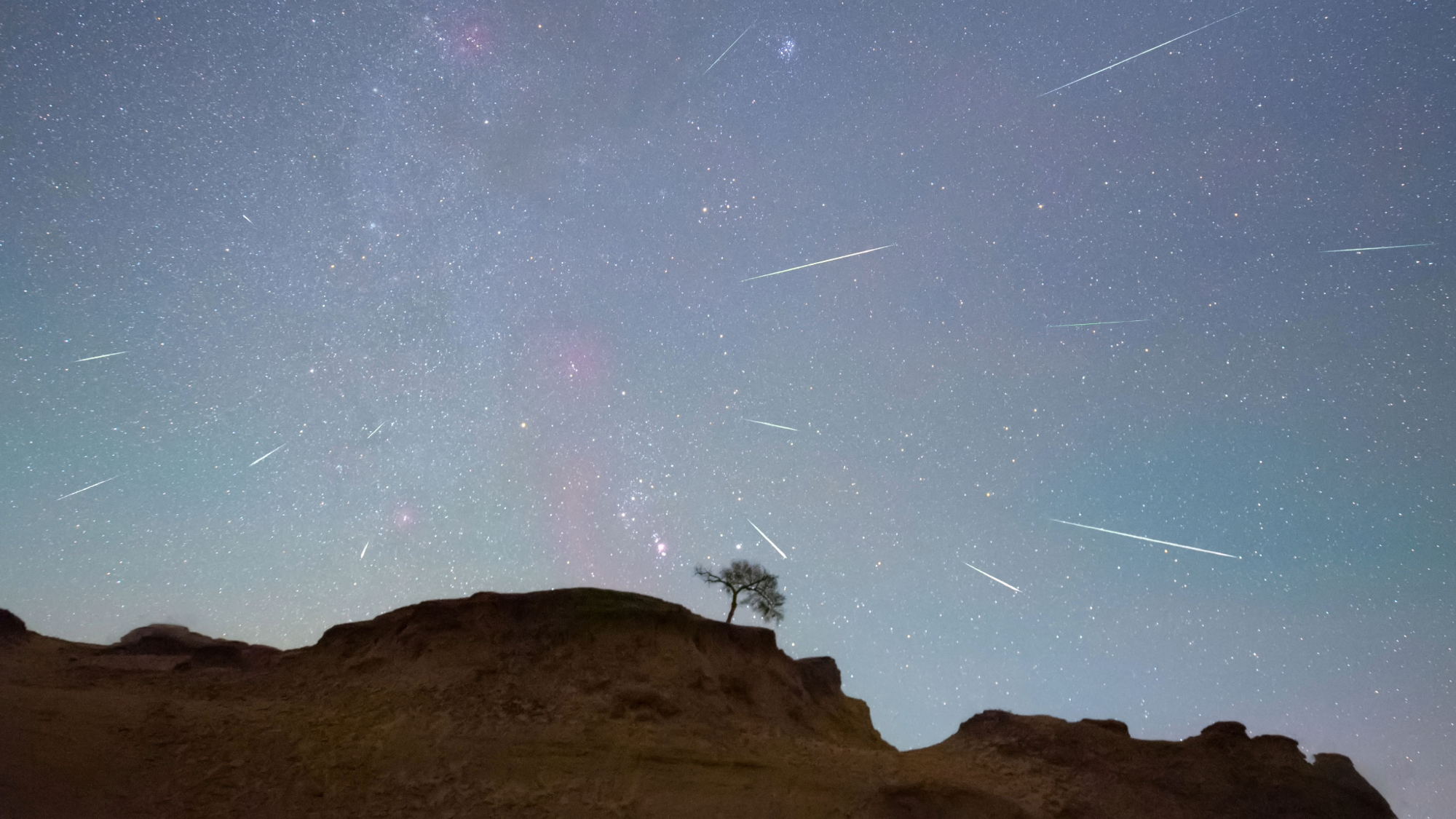
And while we’re on the topic of meteor showers, there’s another good one later in October: the Orionids will reach their predicted peak on October 24. The Orionids can be spectacular, although unlike the Draconids, you’ll need to sacrifice some sleep to see them at their best. Specifically, you’ll need to work around the almost-full moon that coincides with their peak, which won’t sink below the horizon until 4 a.m. local time. Once it’s gone, though, the dark sky should let you see a whole lot of meteors—at least 10 to 20 an hour, and if you’re lucky, up to 50 or 60. They’ll appear to emerge from a radiant point in the constellation Orion, in the southeastern sky.
October 26: Full Hunter’s Moon
This month’s full moon is the Hunter’s Moon. This name reflects the fact that once you’d harvested your crops for the year, those grain supplies would be all you had for the winter—along with whatever game you might be able to hunt. Other names for October’s full moon have similar themes of seasonal transition: as per the Farmer’s Almanac, the Dakota people called it the “Drying Rice Moon,” while to the Cherokee nations it’s simply the Harvest Moon. The moon will wax to completion in the very early hours of October 26, reaching peak illumination at 12:12 p.m. EDT.
October 26: Uranus at Full Opposition
Following his cousin Neptune’s example from September, Uranus, the god of the sky, peeks his lofty head into the firmament for a rare appearance this month. The planet will reach full opposition to the sun on the same night as October’s full moon, but should be visible, so long as you’ve got some decent binoculars or a telescope. Either of those tools will reveal the planet’s distinctive sky-blue coloration. However, to see any of Uranus’ surface details, you’ll need at least a 200mm telescope. Like Saturn, Uranus will rise in the eastern sky, emerging along with the constellation Taurus at about 8pm.
Remember that you’ll get the best experience gazing up at the cosmos if you get away from any sources of light pollution. You should also give your eyeballs some time to adjust to the darkness, and review our stargazing tips before setting out into the night.
