
| August 1 | The Summer Triangle |
| August 12 | Six Planets in Alignment |
| August 12 | Full Solar Eclipse |
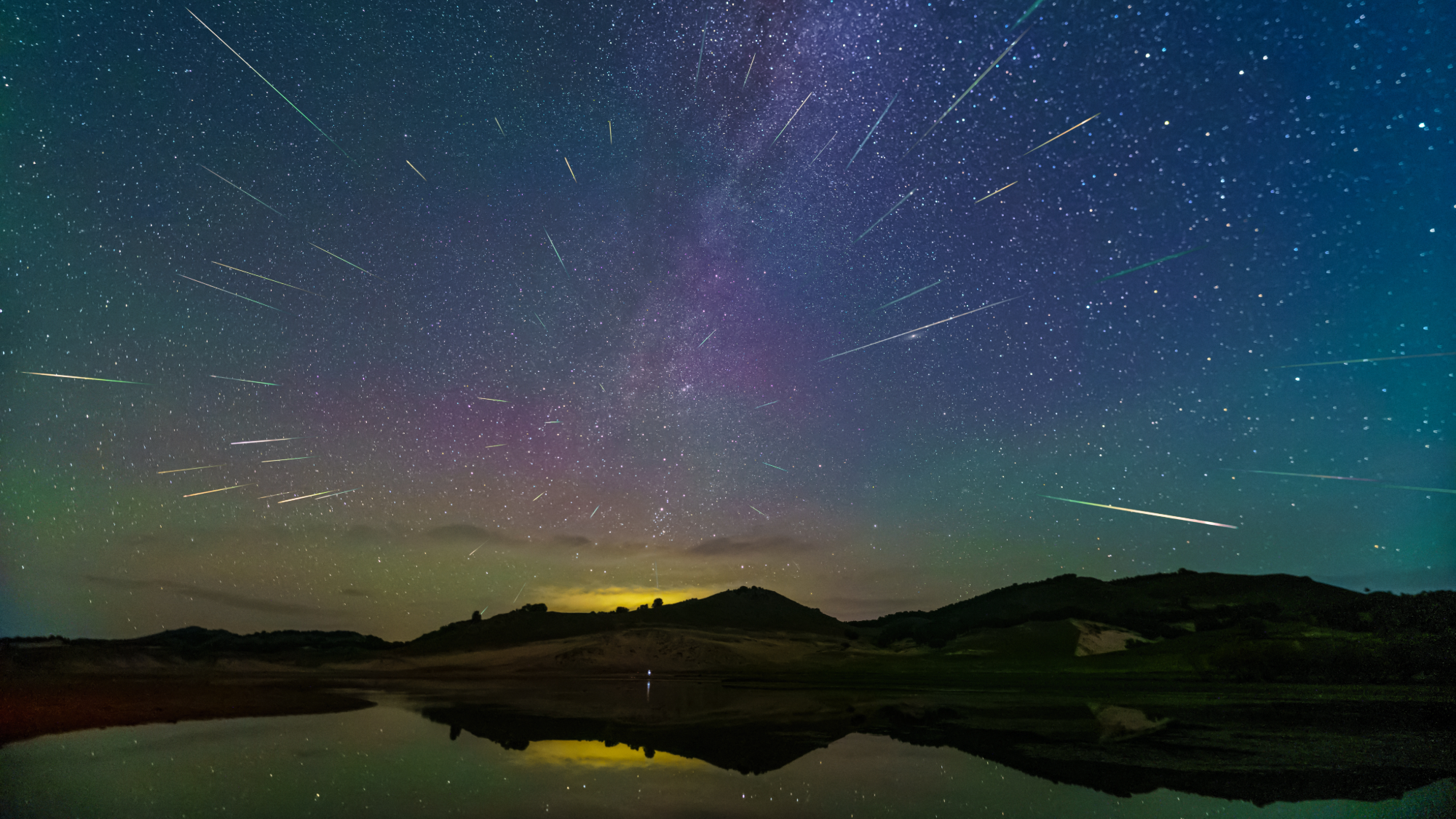
| August 12–13 | Perseids Meteor Shower Predicted Peak |
| August 27–28 | Partial Lunar Eclipse |
| August 28 | Full Sturgeon Moon |
If you’re one of our European readers, then August is potentially a particularly big month. A full solar eclipse will sweep across parts of several countries including Spain and Iceland on August 12. But even if you’re not, there’s still plenty to see this month, from a new planetary parade to a Lovecraftian horror lurking in plain sight. Let’s get started.
August 1: The Summer Triangle
If it’s summer—and boy, is it ever summer—then it must be time for the Summer Triangle. If you look skyward as another long day recedes into another hot, sleepless night, you’ll see the triangular formation. The stars Vega, Deneb, and Altair shining bright in the southern sky form this seasonal shape.
As the Farmer’s Almanac explains, although the stars appear close from our perspective, they’re actually a long way from one another. Altair is 17 light-years away, and Vega is another eight light-years out, putting it at 25 light-years away from Earth. While Deneb appears similar to its two companions, it’s actually orders of magnitude further away. Estimates of exactly how far vary from about 1,400 light-years to 2,600 light-years.
The reason it looks as bright to us as Vega and Altair is because it’s huge. It’s an extremely rare blue supergiant. Deneb is anywhere between 55,000 and 196,000 the mass of our sun. If it magically replaced the sun, Deneb would swallow the planets Mercury and Venus whole. If our upper estimates on the star’s size are correct, it would swallow Earth too—and if not, never fear, it’d simply cook our planet into blasted uninhabitability.
If you’re still up for looking at the relatively benign Altair and Vega, along with the cosmic horror that is Deneb, crane your neck upwards, look south, and be glad that the star at the apex of the triangle you see is a long, long way away.
August 12: Six Planets in Alignment
From a triangle to a … hexagon? Sort of. August 12 is a big day for those of a stargazing persuasion. It begins with a chance to see six planets in alignment. But wait, who’s missing? Venus has thumbed her regal nose at this month’s gathering—the Goddess of Love prefers to shine on her own, thank you very much.
That leaves Mercury, Mars, Jupiter, Saturn, Neptune, and Uranus left at the planet party. They’ll stretch across the sky like a string of Christmas lights than the regular hexagon that you’ll find in a geometry textbook. But look, if its internal angles sum to 720°, we’re claiming it.
As per Starwalk, the best time to catch the planets on parade will be just about an hour before dawn on August 12, with the planets rising in the eastern sky and moving southwest. The two easiest planets to spot will be Mars and Saturn, both of which should be visible with the naked eye.
August 12: Full Solar Eclipse
If you happen to be in Greenland, Iceland, northern Russia or northern Spain, then a genuinely profound experience is heading your way. Popular Science was lucky enough to catch the total solar eclipse visible from North America in April 2024, and it’s a remarkable feeling to watch the sun disappear, replaced by a black disc and a ghostly silver corona, while darkness sweeps across the landscape. Birds stop singing, the temperature drops, and for a moment it’s midnight. And then it’s over.
NASA has details on exactly when and where the path of totality falls this time around.
August 12–13: Perseids Meteor Shower Predicted Peak
As if a planetary parade and a total solar eclipse weren’t enough for one day, the night of August 12 and early morning of August 13 will also be the best time to see this year’s Perseids meteor shower.
This will be a particularly good year to spot this iconic meteor shower, given that the meteors will be streaking through a moonless sky. Look to the constellation Perseus, which will be high in the northeastern sky. EarthSky suggests looking just before dawn for the best chance of seeing the shower in all its glory.
August 27–28: Partial Lunar Eclipse
Look, it’s not a solar eclipse, but for those of us in North America who’ll miss out on the spectacle of the disappearing sun, there’s a pretty decent consolation prize in the form of an almost-full lunar eclipse.
A lunar eclipse happens when the moon falls into the Earth’s shadow. Instead of disappearing completely, the moon turns a deep shade of red, which is why these eclipses are often called “blood moons”. (Why? All the answers you seek are here.)
This one will begin at around 10:30pm ET, with the maximum eclipse—where 96.2 percent of the moon’s surface will be covered in shadow—reached at 12:12 a.m. EDT on August 28. It will be visible across the entire contiguous United States and in Hawaii. Only the western part of Alaska that misses out.
August 28: Full Sturgeon Moon
One day after its encounter with the Earth’s shadow, almost to the minute, the moon will reach peak illumination for this month. At 12:18 a.m. EDT, the full Sturgeon Moon will shine in all its glory. According to the Farmer’s Almanac, the name comes from the giant fish that once swam in abundance in the Great Lakes of North America. The arrival of European settlers led to a predictable and depressing decline in their numbers, and the once-common lake sturgeon is now considered Endangered by the International Union for Conservation of Nature.
Remember that you’ll get the best experience gazing at the cosmos if you get away from any sources of light pollution, give your eyeballs some time to adjust to the darkness, and review our stargazing tips before setting out into the night.
