
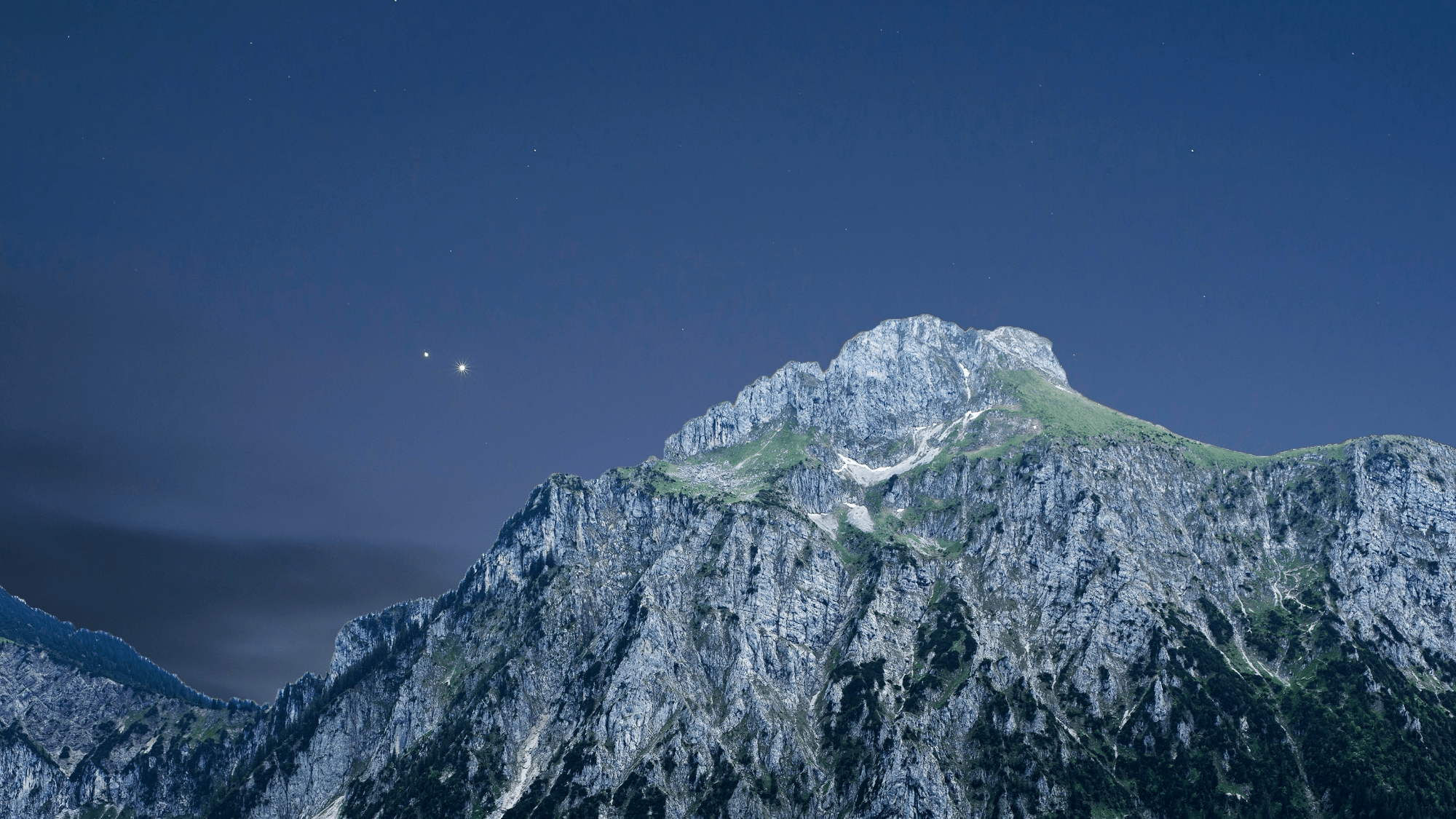
| June 9: | Conjunction of Jupiter and Venus |
| June 21: | Summer Solstice |
| June 29: | Full Strawberry Moon |
| June 30 | Asteroid Day |
Summer arrives this month and with it come long, sweltering days along with all-too-brief nights. But if you can dodge the fireflies and stock up on mosquito repellent, there’s still stargazing to be done! This month’s highlight is a conjunction between our solar system’s two biggest show-offs. There’s also the summer equinox to consider—along with a very tasty-sounding full moon.
June 9: Conjunction of Jupiter and Venus
Fellow fans of the solar system’s large adult son may have noticed that Jupiter has been rather quiet of late. But fear not! Our big rambunctious lad is back in the spotlight this month, galumphing his way across the sky toward the beckoning goddess of love. The gas giant will reach his destination early this month, and the result for us earthbound folk will be the chance to witness a Jupiter-Venus conjunction.
The two planets will be at their closest on June 9, when they’ll be spotted lounging happily together above the northwestern horizon just after sunset. There’ll also be a couple of peeping Toms in the vicinity. The twin stars Castor and Pollux will be peeking out in space just to the right of the two planets. Spotting these two malcontents might require binoculars, but Jupiter and Venus should absolutely be visible to the naked eye.
June 21: Summer Solstice
There’s an argument to be made that the longest day of the year is always the Wednesday of the current week. But in a technical sense, the longest day of 2026 arrives on June 21. That’s right—get ready for the summer solstice!
We tend to think of the solstice as the start of summer, but that’s not technically what the term denotes. Instead, it has to do with the Earth’s orbital axis.
The orbital axis is the imaginary line through the north and south poles around which our planet spins. Like many planets, Earth’s orbital axis isn’t perfectly perpendicular to its orbital plane. It’s tilted at approximately 23.44° and the tilt remains constant in relation to the orbital plane. This means that as the Earth moves around the sun, the angle at which it leans toward the sun changes. This is the reason behind our seasons!
The solstice is the day when this tilt toward the sun is most pronounced as shown below.
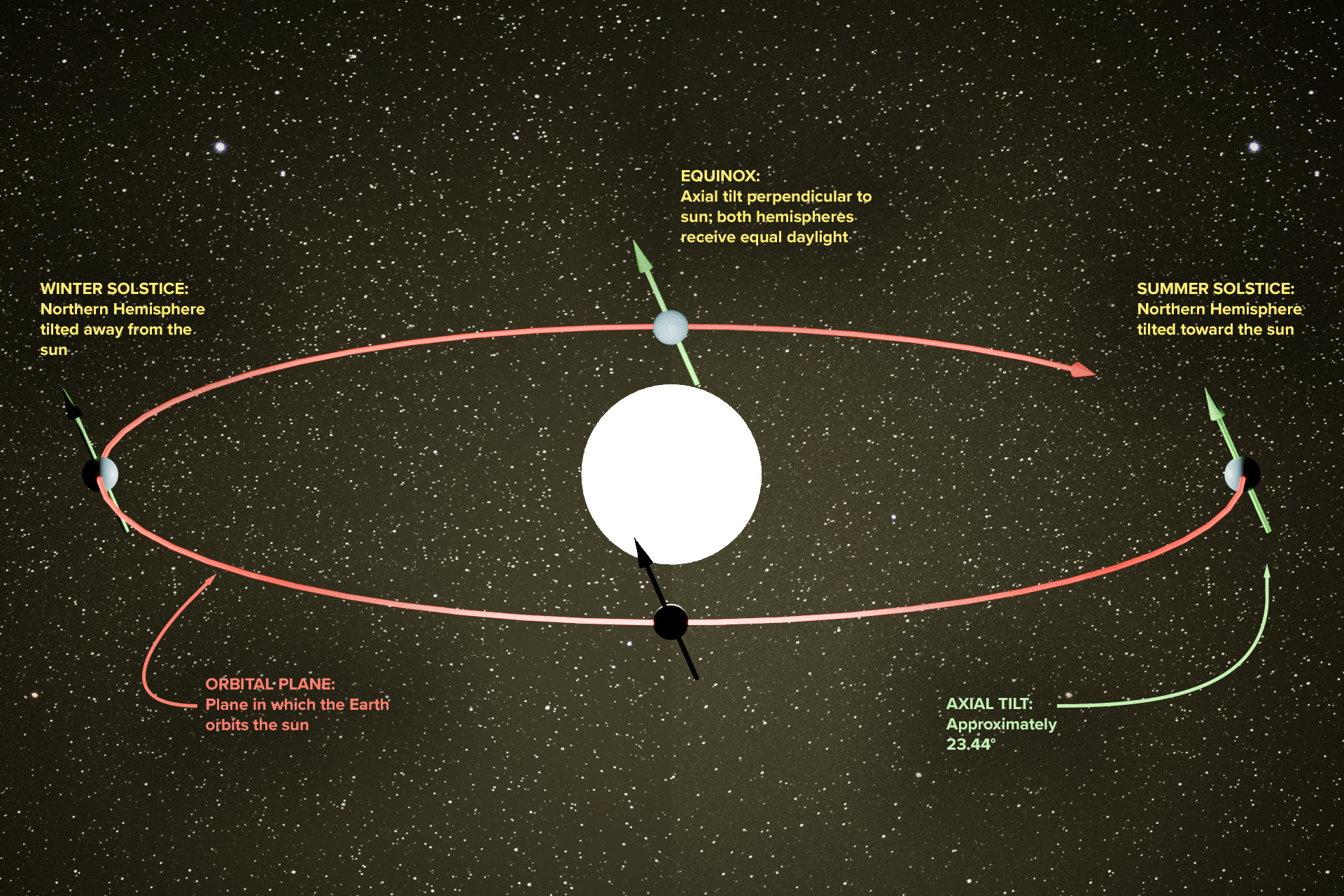
On the left, we see the Northern Hemisphere’s winter solstice, while the Southern Hemisphere is tilted sharply toward the sun. Halfway around, the Earth’s axis is perpendicular to the sun, so neither hemisphere is leaning inward. This is the equinox, and there are two of these every year. On the right, it’s the Northern Hemisphere leaning toward the sun, marking the northern summer solstice—which arrives this year at 10:22 p.m. EDT .
June 29: Full Strawberry Moon
For the last couple of months, we’ve had early full moons. But thanks to May’s Blue Moon, our satellite will wait until almost the very end of the month to emerge in its full sunlit glory. As per the Farmer’s Almanac, the Strawberry Moon’s moniker comes from similar names given to June’s full moon by multiple Native American nations, including the Algonquian, Ojibwe, Dakota, and Lakota peoples. It’s a beautiful and rather poetic name, and a perfect fit for the moon that will rise at the end of this month’s long, hazy summer twilights.
June 30: Asteroid Day
June 30 is Asteroid Day, a day to celebrate the fact that Earth has not been hit by a decent sized asteroid in well over a century. The date was chosen to commemorate the 1908 Tunguska event, the last time the Earth experienced a significant impact. Fortunately for humans, that collision took place in a remote part of Siberia, where it flattened 500,000 acres of forest and caused a shock wave that was felt as far away as Indonesia.
In 2014, the United Nations declared June 30 as a “sanctioned day of public awareness of the risks of asteroid impacts.” So be aware! One of the people behind the idea was Brian May. Yes, the same Brian May who plays lead guitar in Queen. May moonlights as an astrophysicist when he’s not tearing up the fretboard of the guitar he and his father built together in the early 1960s.
When the sun finally does go down, remember that you’ll get the best experience gazing at the cosmos if you get away from any sources of light pollution, give your eyeballs some time to adjust to the darkness, and review our stargazing tips before setting out into the night.
Until next time!
