
This post has been updated. It was originally published on January 1, 2018.
In a battle royale for Most Powerful Animal, a red kangaroo might take the martial-arts belt, thanks to a bone-shattering kick that delivers 759 pounds of force. Evolution has nudged wild creatures to hone their blows, bites, and brute strength for survival. For humans to even measure up, we must methodically shape our bodies with specialized practice and diet. But what if you pit all of us brutes against each other? That’s just what we did, creating the following four competitions to find out who puts the “king” in animal kingdom.
80
Degrees a Tasmanian devil can open its jaws to chomp carrion snacks or rivals’ faces. This gives its bite a force 3.6 times its weight.
150,000
Muscle units in an Asian elephant’s trunk. Its nose has the strength and flexibility to store and spray a gallon of water—or uproot a tree.
15
Duration, in milliseconds, of an African secretary bird’s cobra-killing kick. In sub-Saharan regions, these predators help control reptile populations.
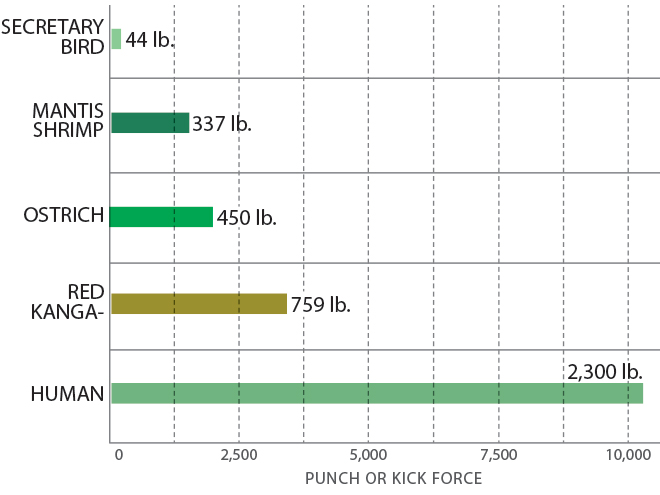
In the ring, a taekwondo master with a black belt—and a 136-mile-per-hour kick that hits opponents with 2,300 pounds of force—could go toe to paw with a kangaroo. But the average human gym rat, who lacks the training to focus his kick, would be McGregored in round one.
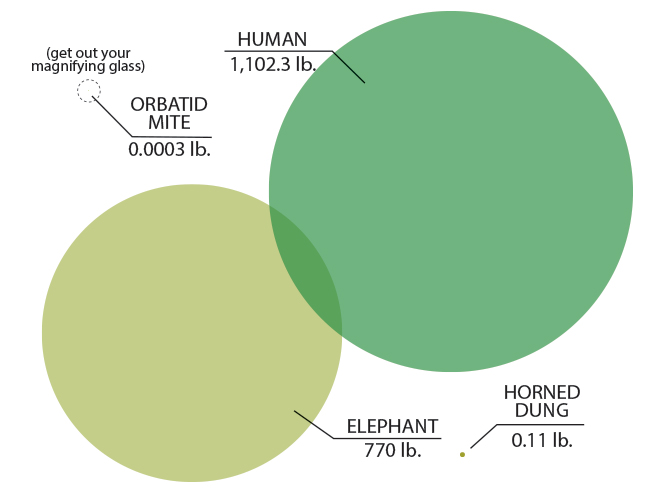
In 2016, English strongman Eddie Hall set the current world record for a dead lift by hoisting 1,102.3 pounds, more than the weight of a concert grand piano. Asian elephants, by comparison, can shift 770 pounds with their trunks alone. Not bad, humans.
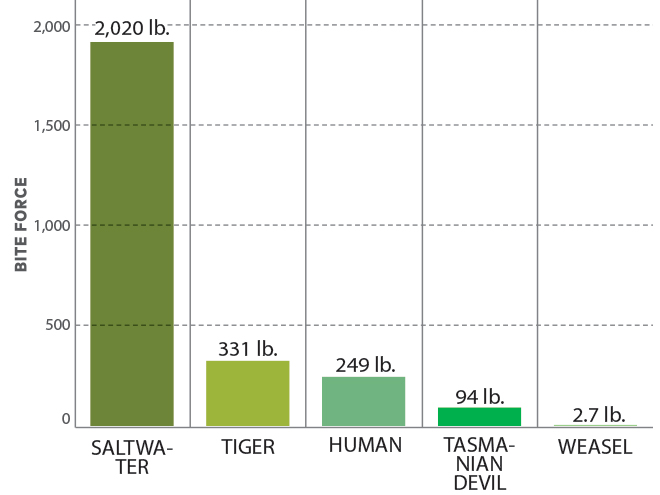
If the saltwater crocodile’s horrific bite doesn’t snap a wild boar’s spinal cord, its underwater death spin will surely take it down. With a literal ton of brute force in its jaw, a croc easily out-crunches its closest competitor, the tiger, with a bite six times as strong.
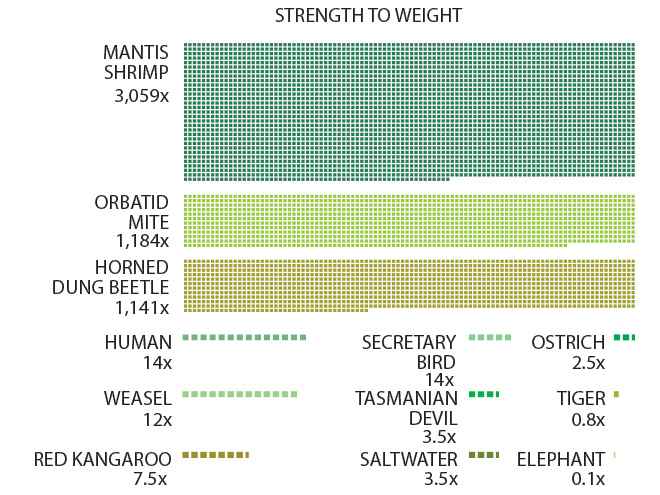
Because big animals weigh more, they’re relatively weak for their size. So tiny critters carry this category: A mantis shrimp’s punch delivers more than 3,000 times its weight, and a mite shorter than a tenth of an inch can bench-press nearly 1,200 of its fellows.

What is the Most Powerful Animal?
This article was originally published in the January/February 2018 Power issue of Popular Science.
