More NASA Letters
"Go Somewhere" produced a large volume of mail and vigorous online debate about the future and cost of NASA. Here are more highlights.

"Go Somewhere" produced a large volume of mail and vigorous online debate about the future and cost of NASA. Here are more highlights.

Lint is composed of tiny bits of fabric fibers that are shed from the edges of our garments.

What's it like to grow up with a mother who is a distinguished physicist and the sister of one of the most famous scientists of the 20th century? In the month of Mother's Day, Popular Science News Editor Charles Hirshberg remembers.

This is the engine, fuel tank, and transmission of a revolutionary new kind of car. In this feature, we offer a first peek at the cool designs it makes possible.
Our eyes only see objects by processing light waves reflected off the object or absorbed by it.
All organisms, including humans, have the ability to regenerate something in the body. But the process is much more developed in lower organisms.

Society has been fighting the plague of addictions without knowing how drugs, cigarettes, and alcohol hot-wire the brain's pleasure response. Now researchers may be closing in on a magic bullet.

In this intimate interview, hear insights about Sir Ernest Shackleton and the Endurance voyage as only a devoted granddaughter can have them.
Seven ideas that will correct NASA's trajectory and get Americans to love the space program again
Scientists tell us it's technically possible. Here's a how-to guide for the ambitious tinkerer.
Our FYI editor explains how the 360-degree circle came to be.

Who really stole the secret of the atom bomb? In this PopSci.com exclusive, the producer of the NOVA special tells us what it was like to be involved with this project.
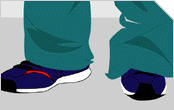
Ford's new pickup, with design cues from the toymaker, stores energy and then boosts power with a hydraulic accumulator.

With little fanfare, the race is on to build a Mach 2.0 private jet with a reduced sonic boom.
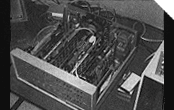
On Dec. 8, 1941, one day after Pearl Harbor, the United States was at war. As private industry scrambled to convert its assembly lines to weapons production, Popular Science's editors were moving speedily as well.
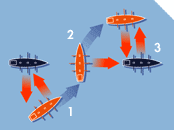
Believe it or not, this may be the prototype for the killer app in portable computing. It's called augmented reality and it alters how we see the world. But there's still a little work to be done.
Who is the weakest link? We all are when it comes to science, says new research -- especially women.
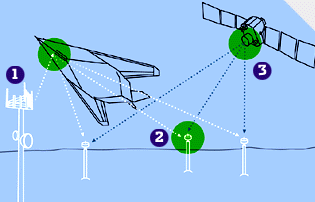


Physicists are praying that their 4-mile-long machine will detect a tiny bit of matter so elusive that some consider it practically divine.