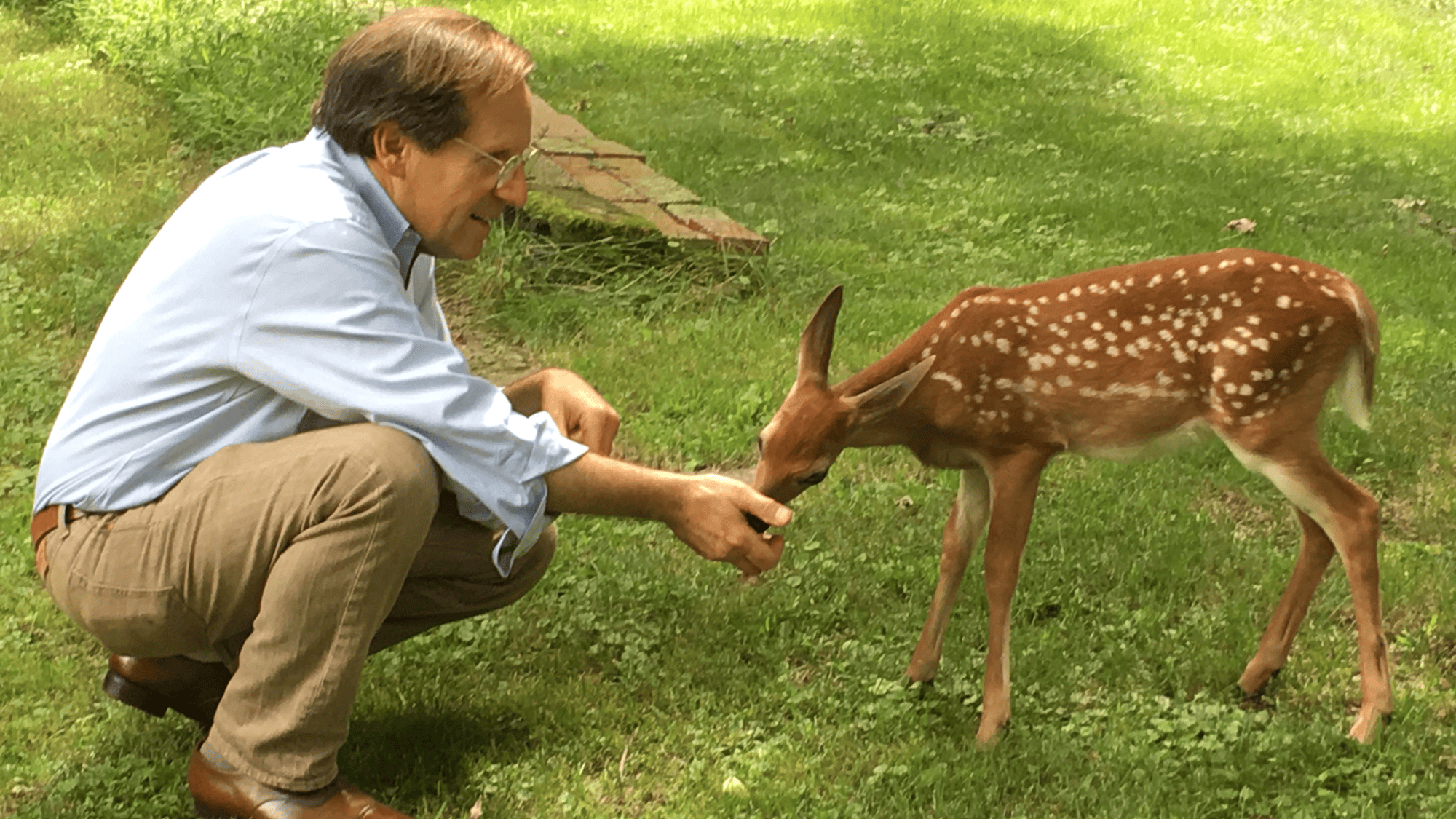
One evening, writer Paul Bochner happened to look outside of his home in Nyack, New York, and what he saw by chance would change his life forever. Bochner spotted a fawn, injured and abandoned by its mother standing on his property. And so began a years-long relationship between Bochner and the deer he named Penelope, after Odysseus’s wife in Homer’s Odyssey.
Popular Science recently spoke with Bochner about this special relationship that he recounts in his recent book Penelope. Answers have been condensed for clarity.
Laura Basias: Tell me about your first encounter with Penelope.
Paul Bochner: There were two first encounters, really. I saw her just by chance when she was only a day or two old. She had been born in an area of my property that I’ve always thought of as the deer sanctuary. It’s a place in front of the house that I have left wild for them, and the deer give birth there every spring. I feel that it may have been a birthing place for thousands of years, for all that I know. The deer that are born there will return to give birth, and so on and so forth.
And there she was, this tiny little perfect being, standing in a shaft of sunlight. But something happened to her after that. I don’t know what it was that broke her front left leg, and she more or less vanished. Her mother had abandoned her, rejected her because of this disability. I saw her very infrequently, fleetingly, throughout the winter of 2015, which was memorably hard and intensely cold. How she survived to this day, I can’t tell you. She survived without a mother, without nursing, without protection.
In March 2015, she came to the door one evening. It was almost dark, and very mysteriously, I had gotten up and gone to the window to look outside. I can’t tell you why. I thought of her at that point as the girl with the broken foot, and so of course I recognized her. I went outside, and she was in extraordinarily poor health. She looked to me as though she was not going to survive very much longer. And I went indie and I came out with some apples and I put them on the ground between us. She allowed us to be very close to each other, which was astonishing for a deer in the wild. She didn’t know me, and yet it felt as though we had always known each other. I can’t explain the mystery of that, but it was very palpable.
LB: What about her life as a mother and relationships with her fawns?
PB: Penelope was so solitary as a fawn growing up without her mother, without her siblings, and I deeply wanted her to have a fawn of her own. She gave birth beautifully when she was about two years old. And she was an exemplary mother, kind, tender, protective. Penelope was loving in such a way that affirmed my belief that we can overcome any wounds we may sustain in this world. That if a life is imbued with goodness, kindness, no matter what it is, generosity, that will sustain itself. And to watch Penelope not only nurture her fawn, but to become a family.
One year after that, she gave birth to twins.
LB: Wow twins! What was that birth like?
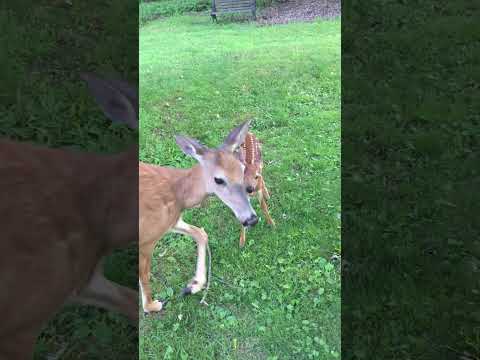
PB: Penelope’s disability remained very severe. Her broken leg really forced her to struggle with every step, and I could see that she endured a great deal of pain. I knew that she was pregnant with twins because she allowed me to put my hands on her body, and I could feel them inside. They were born very early one morning at about 5:00. And half an hour later, she brought one of them to me. She allowed us to bond with each other by bringing this fawn directly to me and putting her against my lower leg, allowing me to touch this baby who was half an hour old. Penelope left this half-hour-old fawn with me for the first four hours of its life, while she went to care for the other one. I think she knew or she felt she couldn’t care for them both, and it was an act of trust for a wild animal to entrust a human with a newborn.
LB: How has your relationship evolved and changed over time?
PB: She and I have been through all of the things that happen to two lives: birth, death, pain, loneliness, joy, separation, reunion. There’s hardly a human attribute of connection that I haven’t experienced with her. One of the things that I have found most enlightening, most deeply moving in our closeness and our interactions, is to see that she has had a full range of emotion. That’s not simply with me, but toward other deer fawns, especially after what she went through with her mother, who continued to brutally reject her long past any ostensible excuse for it. I came to feel so much respect for Penelope as a living creature.
I’ve tried to be very scrupulous in my observations and not to project or anthropomorphize. I’ve been really very careful to observe what was happening in her life, and her expressions of emotion through action, but also through facial expression. And you know, the more carefully I was able to truly connect with her, the more I was able to see, and certain attributes that might seem to a casual observer to be projection were undeniable.

LB: What else do you hope people take away from this unusual love story?
PB: I feel very strongly and very deeply that we live in this world with other lives. This is their world in some ways more than it’s ours. White-tailed deer have been in North America for 13,000 years. This has been their home, and we have come along, and we have done, unfortunately, some pretty selfish things to their world. I feel that they are so deeply deserving of our respect.