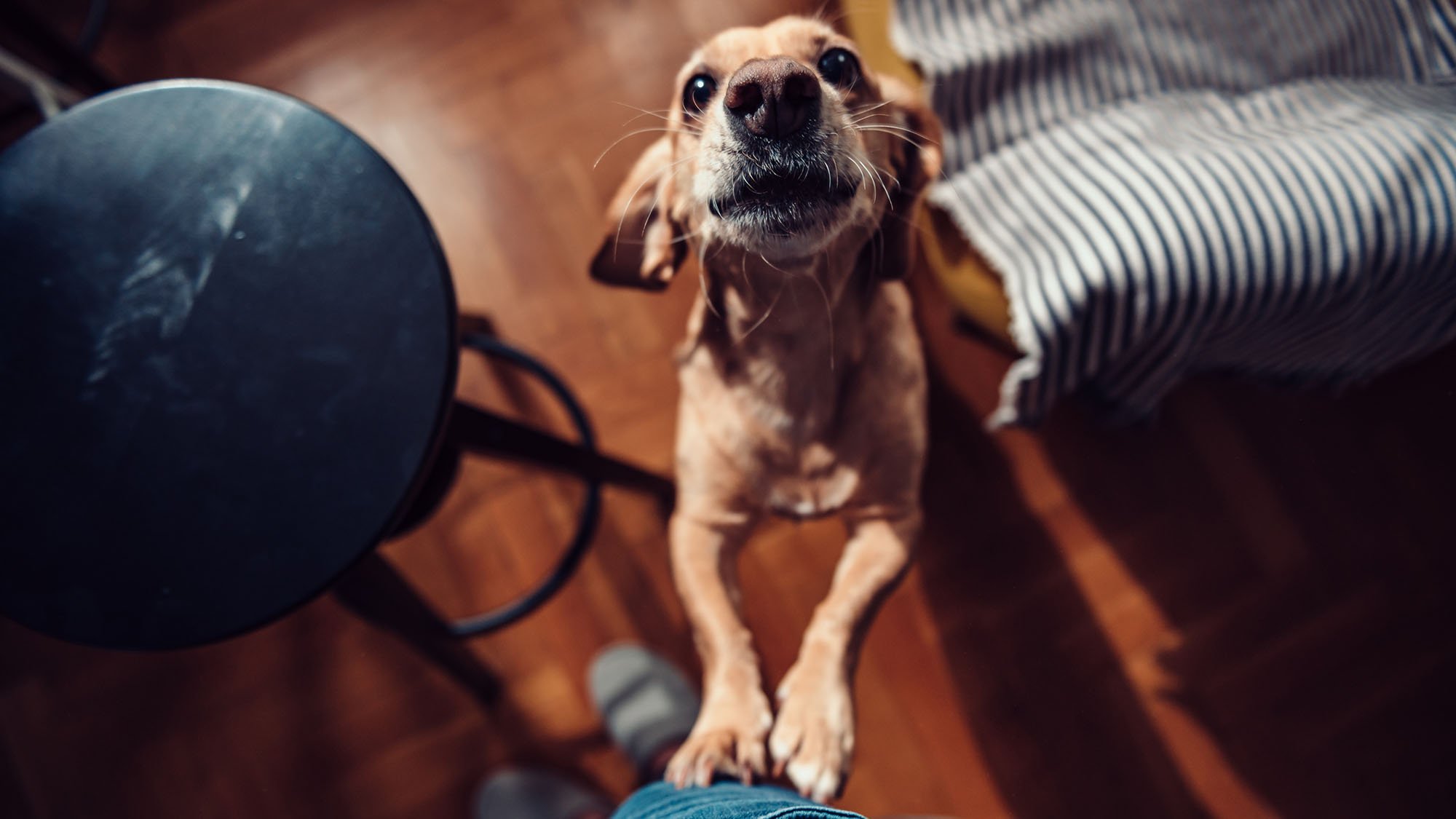
From the crazed zoomies to the frantic nudges, dogs might just be the best greeters on the planet. But why exactly do our dogs get so excited when we come home? In a new episode of Popular Science’s Ask Us Anything podcast, we delve into the surprising biology behind dogs’ tail-wagging hellos.
Ask Us Anything answers your most outlandish, mind-burning questions—from the everyday things you’ve always wondered to the bizarre things you never thought to ask. So, yes, there’s a reason airplane seats have gotten so small (blame 1978) and no, you probably shouldn’t fret over Yellowstone’s supervolcano erupting. If you have a question for us, send us a note. Nothing is too out there or mundane.
This episode is based on the Popular Science article “Why your dog gets so excited to see you.”
Subscribe to Ask Us Anything
Listen and follow Ask Us Anything on your favorite podcast platform:
Spotify | Apple Podcasts | YouTube | Or wherever you get your podcasts.
Full Episode Transcript
Sarah Durn: You just got home, you push open the door, and chaos. Your dog is sprinting in circles, wagging their tail like a helicopter rotor, completely possessed by the zoomies. It’s the best greeting in the world, but looking at this furry little tornado, you have to wonder, “Why exactly do our dogs get so excited when we come home?”
Welcome to Ask Us Anything from the editors of Popular Science, where we answer your questions about our weird world. From “what exactly is Gonzo from The Muppets?” To “why don’t humans have tails?” No question is too simple or too out there. I’m Sarah Durn, an editor at Popular Science.
Laura Baisas: And hello, I’m Laura Baisis, PopSci‘s news editor.
SD: Here at PopSci, we’re always pondering quirky questions.
LB: And this week we’re wondering why do dogs get so wild when they see their pet parents?
So Sarah, what is actually happening here? Why do dogs turn into these furry little cyclones at the front door?
SD: Yeah, so it’s a mix of their incredible long-term memory and a massive rush of brain chemicals. Basically, it’s a biological explosion of pure love.
LB: An explosion of pure love. I mean, that’s absolutely perfect and tracks with dogs.
But is it just because they know we’re the ones who feed them?
SD: It goes way deeper than that. Studies show that the way dogs attach to us looks a lot like the way human infants attach to their parents.
LB: So they really are our babies.
SD: Biologically speaking, yeah. When dogs smell your scent, a specific part of their brain completely lights up, and when you make eye contact, both of your brains start pumping out oxytocin.
LB: Oxytocin, AKA the love hormone.
SD: Exactly. And you and your dog get caught in this amazing escalating loop of feelgood vibes. But what’s really fascinating is how their memory works and whether they actually know how long you’ve been gone.
LB: Okay, please tell me exactly how this works.
SD: We’re gonna get into all of it.
LB: But before we unleash all of this canine science Had to. We want to know, what questions are you wondering? Is there something you’ve always wanted to know? Submit your question by clicking the Ask Us link at popsci.com/ask. Again, that’s popsci.com/ask, and click the Ask Us link.
SD: Send us your questions.
LB: We’ll be back after a quick break to find out exactly what is happening in your dog’s brain when you walk through the door.
SD: And stick around to the end of the episode because Laura will be sharing a brand-new science-backed trick to strengthen your emotional bond with your dog in just four weeks.
LB: Spoiler alert, it only takes a few extra minutes a day, and it might just involve playing peekaboo.
SD: That’s all coming up right after this.
And we’re back. Okay, Laura, before we get into the science of zoomies, I feel like we need to talk about the sheer joy of walking through a front door when you have a dog.
LB: I mean, it’s really unmatched. Like, even though I don’t have a dog of my own yet, hint, husband- i’m pretty familiar with the welcome wagon, but in kind of a different way.
My sister Casey and I, not twins, but we look a lot alike.
SD: Can attest.
LB: Yep. We went out to dinner last week, and we were asked if we were twins again. So this has not really stopped as we’ve gotten older. You know, we fool humans all the time, and we did fool a dog once.
SD: Mm.
LB: A few years ago, Casey was working in Arizona and living with our aunt and her dog Harley. So Harley really got to know Casey, and she was totally a member of his pack. Well, when they came to New Jersey for a visit, Harley saw me from across the room, and like many a teacher, neighbor, classmate, et cetera, thought that I was Casey. So he runs over, but once he kind of got, like, within sniffing distance, he stopped dead in his tracks and backed away.
SD: Aw.
LB: It was kind of like, you know, imagine, like, a cartoon dog running on a rug, and he stops, and the rug gets all caught up under his legs. And it was kinda like he was saying, you know, “Who is this fake Casey?” He was then kind of leery of me the entire trip. Like, he didn’t bark or avoid me or show aggression, but he was definitely just kind of suspicious of me.
And unfortunately, I, we did not have that on video. That would’ve been, you know, pretty epic because it was kind of… It was crazy to watch.
SD: Oh my gosh. Aw, poor Harley.
LB: Poor Harley. Poor Harley. RIP Harley.
SD: Aw. But really, aw. Yeah, I actually have a very specific greeting in mind, too. Whenever I go home to my mom’s house, her two Saint Bernards, Poochie and Tufo-
LB: Seriously the best dog names.
Love it.
SD: Thank you. Thank you, thank you. Yeah, but Poochie and Tufo, they go absolutely crazy, wagging tails, nudging, sometimes even pushing you over.
LB: Well, big dogs have big love.
SD: They do, definitely. But probably the best greeter we’ve ever had was our other Saint Bernard, Bellini, AKA Belli. A lot of times he’d trot off to find you a gift. Oftentimes it was a empty water bottle, and he’d just be so happy- Aw … wagging his tail, pushing against you. It, it just melted your heart.
LB: Ugh. Belli, another top-tier dog name, and bringing a gift, top-tier dog behavior. Absolutely.
SD: Totally.
LB: But why do dogs do this? Like, why the zoomies? Why the helicopter tail? Why that, you know, empty water bottle?
SD: Yes. Well, the short answer is they love us, but the scientific answer is that it involves everything from neurobiology to operant conditioning.
LB: Operant conditioning sounds a bit intense for dogs.
SD: Yeah, it’s basically just fancy science speak for how dogs learn. Dogs can distinguish between good and bad behaviors based on how we react to them.
When Belli would bring a water bottle, he’d get a huge reaction. We’d say, “Oh my gosh, you brought a present. What a good boy. We love you.” And his brain learns, “Ah, my humans like this. I will do this every time.”
LB: Right. Every time, forever and ever in perpetuity.
SD: And ever and ever, yes.
LB: So, okay. They learn how to greet us, but what about that pure unadulterated chaos, the running in circles, the uncontrollable zoomies, which we obviously love.
SD: Yes. That ties into something we touched on before the break, attachment bonds. In the late 1960s, a psychologist named Mary Ainsworth developed a study called the strange situation procedure. It was originally designed to measure the attachment between human infants and their caregivers.
LB: Ah, another big love, and arguably the biggest.
SD: Arguably. Though belly might give babies a run for their money. And researchers later adapted that exact same procedure for dogs and their owners. They wanted to see how a dog reacts to their owner versus a stranger.
LB: And so I’m guessing the dogs cared more about their owners.
SD: A lot more, obviously. The study showed that dogs definitely recognize their pet parents, and they display a lot more affiliative behaviors upon reunion.
LB: Are affiliative behaviors things like nudging and nuzzling?
SD: And jumping and squealing and bringing you a water bottle. Basically, positive interactions that facilitate connection. Dogs view us as their safe haven, which builds a huge emotional response when we get reunited.
LB: Okay, but how do they even recognize us right away? I mean, when I’m dog sitting for my aunt’s other dog, Marshall, who for the record is not afraid of me, he will start to get excited before I even open the door.
SD: Yes. That’s because of their memory, which is incredible and highly tied to their senses. In 2012, Emory University neuroscientist, Dr. Gregory Berns, started something called The Dog Project.
LB: Kinda sounds like the best project ever.
SD: Right. Berns used fMRI machines to measure which areas of a dog’s brain light up when they are reunited with their caregiver versus a stranger. And don’t worry, no dogs were harmed. They just had to sit very still in the scanner.
LB: AKA good boy challenge.
SD: Exactly. And what the researchers found was a part of the dog’s brain called the caudate nucleus, which is associated with positive expectations. That brain region was activated the most by the scent of their owner.
LB: So they sometimes smell us before they even see us, and their brain just kinda goes, “Yay.”
SD: Pretty much, yeah. Allison Gerken, a board-certified veterinary behaviorist, says that the first thing a dog does is smell you. Then they hear you. Dogs can distinguish our specific voices and even specific words, and then they see you. Though their vision isn’t as strong as their smell or hearing.
LB: So their brain is basically combining all of these sensory cues, so my smell, the sound of my keys, and basically it’s pulling up the memory of who I am?
SD: Yes. Dogs possess associative memory, which is learning the relationship between two things, like your scent equals playtime. But they also have something close to episodic memory, where they can recall specific past experiences.
LB: So when they smell me at the door, it triggers this whole avalanche of memories about how I make them feel.
SD: Exactly. It triggers their long history of positive experiences with you. And once that hits, the zoomies are inevitable.
LB: Or, you know, paw-sitive experiences. Sorry, I see myself out for that one. And so what about the love hormone we talked about? When does that kick in?
SD: Right away. Oxytocin gets excreted from the hypothalamus in the brain and delivered through the bloodstream.
In 2015, researchers did a landmark study where they asked pet parents to just interact with their dogs, and they took urine samples from the dogs before and after.
LB: Ah, the glamorous side of science.
SD: Yep, doesn’t get more glamorous than dog pee. But researchers found that oxytocin levels were highest when the dog and the owner were making eye contact. The more they gazed at each other, the higher the oxytocin levels. Eye contact creates this ongoing loop of positive reinforcement.
LB: So gazing into your dog’s eyes makes both of you chemically happier.
SD: It really does. Both parties secrete oxytocin, increasing the feel-good vibes.
LB: Okay, but here’s, here’s my real question.
Say you leave for 10 minutes just to go get the mail, and your dog greets you as if you’ve been gone for a year. Do they actually know how long they’ve been apart from their pet parents?
SD: They do have a sense of time. Dogs cannot obviously read clocks, but they have internal circadian rhythms. They are very in tune with their daily routines, and studies have actually shown that the longer you are away, the more exuberant the greeting tends to be.
LB: So they do know if you’ve been on, say, a two-week vacation versus, you know, that quick trip to the mailbox.
SD: They do, definitely. And one thing to watch out for, though, is if the greeting crosses the line from super happy to actual distress. Gerkan points out that sometimes frantic greetings can be a sign of separation anxiety.
LB: Oh, how can you tell the difference?
SD: Yeah. She recommends setting up a webcam while you’re out. If your dog is pacing, panting, howling, or having accidents while you’re gone, that’s a sign of distress, and they might need treatment.
LB: Very, very good to know since they can appear pretty similar.
SD: Mm-hmm.
LB: But most of the time it really is just that they think life is better with us in it.
SD: Exactly, and they’re just really, really excited to see us.
LB: So we know our dogs love us, and we know eye contact importantly helps build that bond, but there’s actually a brand-new science-backed trick to level up that relationship even more.
SD: Yes, and you actually just wrote a whole story about this for PopSci.
LB: I did, and spoiler, it only takes a few extra minutes a day.
SD: I need to know everything. We’re going to get right into it after this short break.
Welcome back. Okay, Laura, before the break, you promised us a brand-new science-backed trick to level up our bond with our dogs.
LB: I did, and the best part is it’s completely free, no trips to the pet store are required, and it only takes a few extra minutes a day.
SD: Okay. What’s the secret?
LB: Playtime. So a recent study in the journal Royal Society Open Science found that extra intentional playtime drastically strengthens the emotional bond between dogs and their humans.
SD: Oh, I love that. But what counts as play? Because our Saint Bernards are basically just giant heavy rugs most of the day.
LB: Kinda. Well, just absentmindedly throwing a ball from the couch while, you know, you’re scrolling on your phone doesn’t cut it. So for this study, the researchers split dog owners into three groups.
Control group, like in any good experiment, a group that did extra treat training, and another group that did extra social play.
SD: And the play group won?
LB: Big time. After just four weeks, the play group saw a massive improvement in their emotional bond, and it’s all because they focused on real social interactions.
So games like tug of war, hide and seek, or even playing peekaboo.
SD: Oh, peekaboo. So fun.
LB: Right? And this is especially good for rescue dogs, where you may have missed that early puppy bonding window.
SD: Hmm.
LB: And again, you don’t need to do this for hours either. The lead researcher noted that just a few minutes of engaged, goofy attention makes a huge difference, so it’s really quality over quantity.
SD: So basically, put down the phone, grab a rope toy, and give your dog some undivided attention.
LB: Exactly. It’s good for them, and honestly, probably really good for us, too.
SD: Well, on that note, I think I need to go play peekaboo with Toofo and Poochie immediately.
LB: Do it. I will join. and that’s it for this episode, but don’t worry, we’ve got more episodes of Ask Us Anything live in our feed right now.
Follow or subscribe to Ask Us Anything by Popular Science wherever you enjoy your podcasts, and if you like our show, leave a rating and review.
SD: How does your dog greet you? Tell us in the comments. Our producer is Alan Haburchak. This week’s episode was based on articles written for Popular Science by Laura Kinnery and our very own Laura Baisis.
LB: Thank you, team. Big thank you to dogs, and thanks everyone for listening.
SD: And one more time, if you want something you’ve always wondered about explained on a future episode, go to popsci.com/ask and click the Ask Us link. Until next time, brace yourself for zoomies and keep the questions coming.
Sometimes when Tofo greets you, he jumps up to the window on the door and it looks like he could come through.
LB: Down, Tofo, down.
SD: I know. He’s just so big. He can’t help it.