
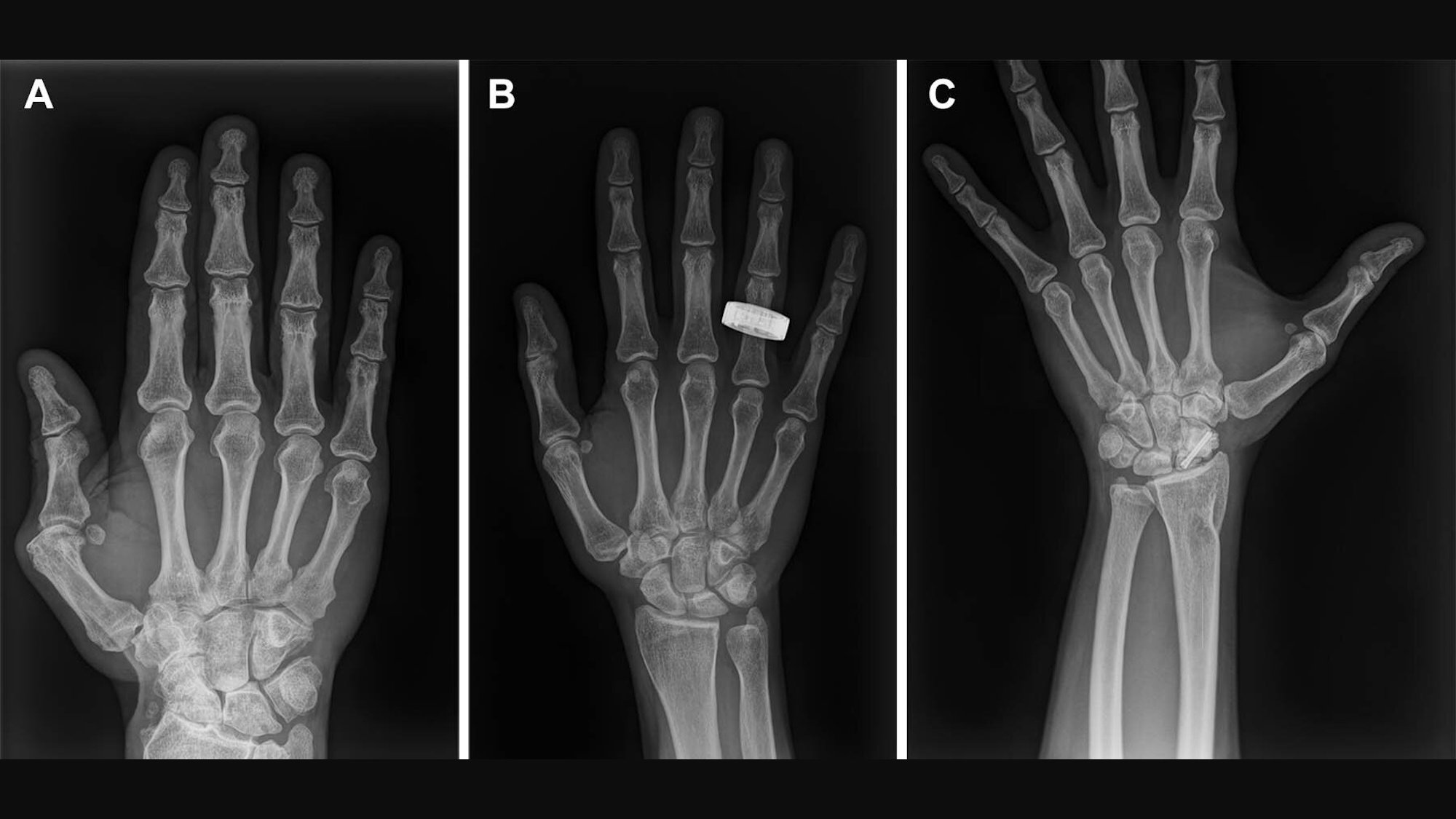
For more than 40 years, ultrasound has remained the sole medical imaging method in space, but not by choice. Astronauts require extensive training in order to operate the equipment, and the technique relies on soundwave transmission—something particularly difficult to maintain in a cramped, loud environment.
“It’s been a dream for aerospace medicine to have more than one imaging modality for diagnosing illnesses and injuries in space,” explained Mayo Clinic researcher Sheyna Gifford.
So why haven’t crews started packing X-ray devices for their missions? X-ray machines are hefty and generate sizable amounts of radiation, while subjects must remain very still during imaging.
“Because everything in space is constantly moving, the conceit has been that obtaining a diagnostic image in orbit was too technically challenging,” added Gifford.
These past limitations are finally disappearing. Commercial off-the-shelf X-ray machines like the ice cooler-sized MinXray TR90BH now allow users to perform scans on subjects far away from traditional facilities. In 2022, Gifford assisted in preparing a crew to successfully generate digital X-rays while experiencing microgravity during a parabolic flight. Gifford’s team then spent years collaborating with SpaceX to plan another feasibility study. This time, they didn’t want to operate an X-ray machine aboard an aircraft simulating the conditions in space—they intended to use the equipment during an orbital mission.

The process was detailed in a recently published study in the journal Radiology, and focuses on last year’s Fram2 mission. Instead of days of medical training, astronauts spent only four hours learning how to use their portable radiography device. They then took preflight X-rays of a hand, forearm, chest, abdomen, and pelvis ahead of their SpaceX Falcon 9 rocket launch on March 31, 2025. Once in orbit, the team calibrated the system before testing their MinXray on the same body parts as well as a smartwatch.
Once the crew returned, a trio of independent radiologists reviewed the orbital X-ray images based on their positioning, spatial and contrast resolutions, and general scan quality. Although positioning scores were slightly decreased for the central body images, every other scan held up to similar examples created on Earth. Meanwhile, the astronauts reported that using the machine was easy despite minimal prior coaching.
“Acquiring diagnostically useful X-rays in space is something that anyone can do,” said Gifford. “Three very talented nonmedical people with four hours of training in one of the harshest environments did it right and did it well.”
Looking ahead, researchers hope to conduct further X-ray tests during orbital missions, while continuing to reduce the overall size of equipment. According to Gifford, the implications go beyond medical emergencies.
“For sustained human presence in space, X-rays are critical not just for crew members but also for other mission components like electronics and spacesuits,” she said. “The only way to look inside these objects without taking them apart is to X-ray them.”
Before astronauts install X-ray machines on the moon, there is at least one issue that requires immediate attention. While still useful during the mission, Fram2 astronauts did report their machine received some relatively minor exterior damage during the takeoff and landing.
