
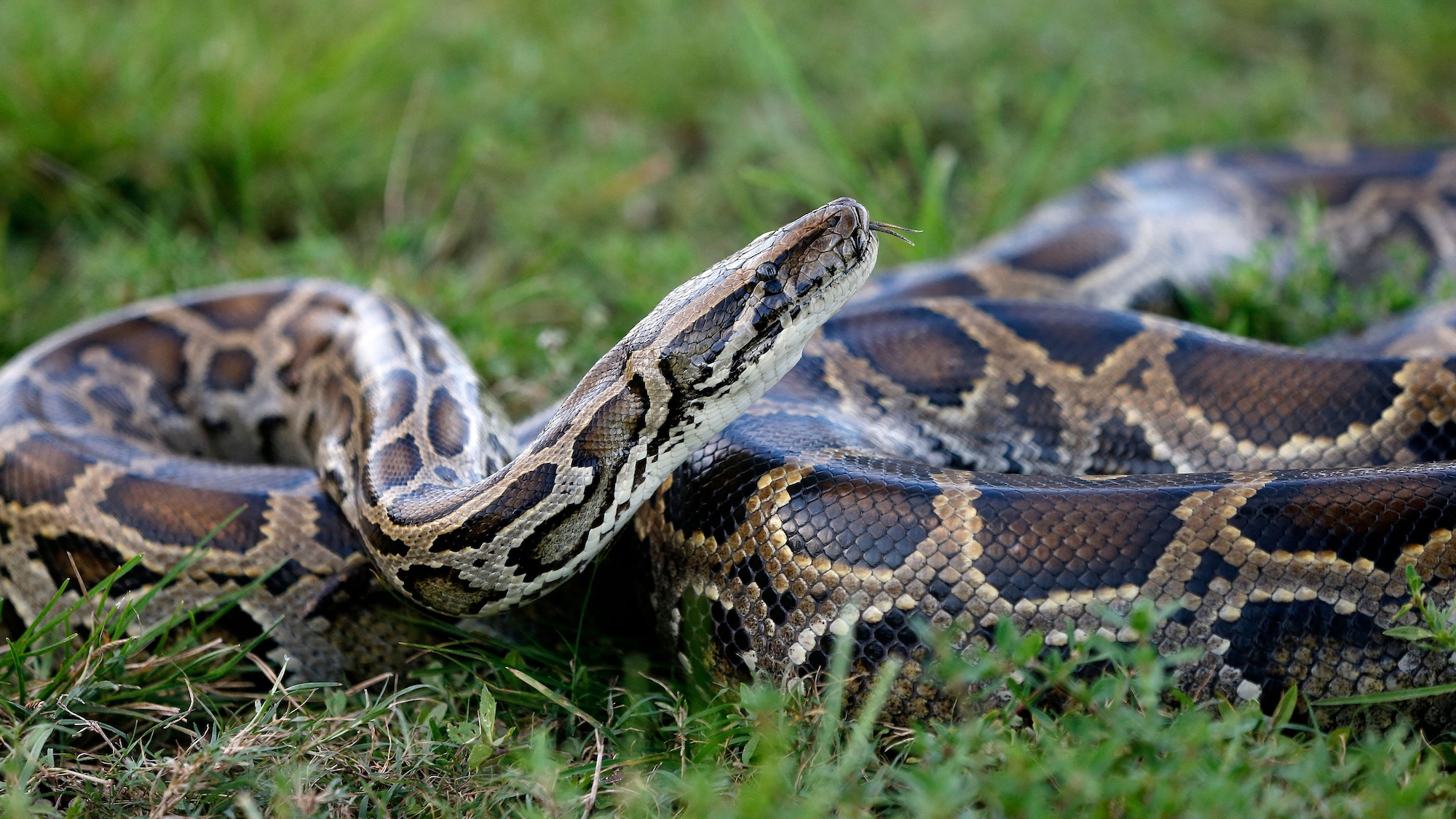
There are anywhere between 100,000 and 300,000 invasive Burmese pythons (Python bivittatus) currently slithering through the Florida Everglades. You’d be forgiven for thinking far fewer of the destructive predators are causing havoc, however. The often 13-foot-long snakes perfectly blend into the ecosystem’s subtropical riverways and foliage. Conservationists estimate that less than five percent of them are visible to the average passerby. That means for every 20 pythons, only one is caught during Florida’s annual summer culling season.
To help boost those numbers, the Florida Fish and Wildlife Conservation Commission (FWCC) recently released a brief PSA video advising on the best ways to locate and dispatch the ongoing troublemakers.

Looking for Burmese Pythons
It’s not as simple as grabbing a pair of binoculars, either. Any python-nabbing excursion requires adequate prep work to ensure everyone stays safe—and actually hunts the proper animals. That said, the FWCC makes it clear the task may not be for everyone.
“Prepare yourself by envisioning large snakes over six feet in length that are outstretched or coiled up,” the video’s narrator suggests early in the segment.
Burmese pythons are recognizable by more than their size. Hunters should be on the lookout for a telltale, arrow-shaped marking on the snake’s head, along with giraffe-like spots across its body and dark spots around its eyes. During the summer months, they’re most likely to be found sunning on levee banks or near trees.
Importantly, snake searchers should ignore the ones you may see swimming in the waterways. That’s home turf for them, which puts humans at greater risk for losing the tussle.
Speaking of safety, proper attire and gear is vital while python hunting. Despite the brutally humid Florida heat, snake searchers should wear long pants, closed toed shoes, and gloves while always carrying a lengthy snake-handling tool. Any successful catches need to be killed humanely following strict state guidelines, as well as accurately documented. Record the latitude and longitude whey any pythons were found, and be sure to take lots of photos to provide conservationists.
Think you’ve got what it takes to combat one of the region’s most invasive animals? Aspiring snake wranglers have a few more days to prepare for the Florida Python Challenge, the state’s annual roundup competition that draws participants from around the United States. If the thought of taking care of the snakes yourself isn’t appealing, sightings can still be reported to the Exotic Species Hotline by phone at 888-IveGot1 (888-4681), online at www.IVEGOT1.org, or through the IVEGOT! smartphone app.
But before you start, remember the PSA’s advice to first envision those giant serpents—then ask yourself, “Do I really want to do this, or should I leave it to the professionals?”
