
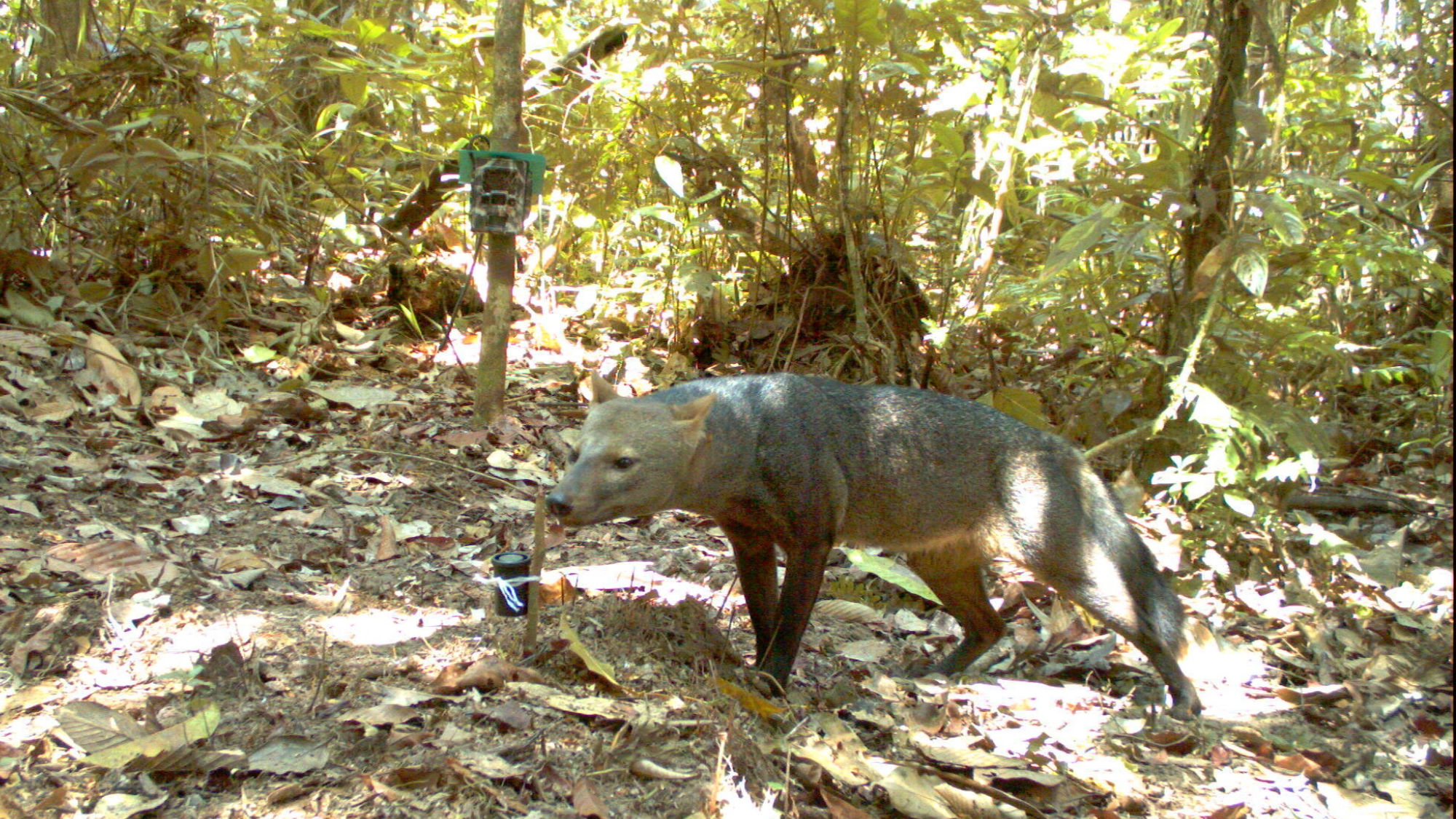
Hidden deep in the forests of Bolivia and Peru is a species so mysterious it has been dubbed the “ghost dog.” The short-eared dog (Atelocynus microtis) has been deemed one of the region’s least-known carnivores, if not one of the world’s least-known canids, period.
After almost a quarter-century of work, researchers finally have gathered new data on this highly cryptic wild dog. Their results, published in the journal Neotropical Biology and Conservation, shed light on the short-eared dog, revealing something particularly unexpected.
“The most surprising aspect of the results was that despite being an almost mythical beast, short-eared dogs are much more abundant than we had imagined,” the team said in a statement, though they still don’t qualify as “common.”
Researchers carried out 34 intensive camera-trap surveys throughout the lowland regions of Bolivia and Peru for over 25 years. This yielded 594 individual photographs, revealing the ghost dog’s large head, small round ears, short legs, long bushy tail, and a dark coat swinging from reddish-brown to blackish gray. The little dog also has partially webbed paws, which isn’t seen in other amazonian canids.

Short-eared dog
Based on camera-trap data, the team estimates they have a population density of 15 dogs per 38.61 square miles. This indicates that they are not as sparse as researchers had anxiously theorized. The species is likely more abundant than larger carnivores in the area such as jaguars, but there are less of them than medium-sized carnivores such as ocelots (Leopardus pardalis).
This study is a “wonderful example of how conservation technology and remote sensing – in this case the intensive use of camera traps—can provide substantial data on one of the least known species of the Amazonian rainforests,” said Robert Wallace, a conservation scientist at the Wildlife Conservation Society and lead-author of the study. He and his colleagues also found that the species is most active between 6 a.m. and noon.
While the dog’s webbed toes might make you think of an aquatic animal, the species is a “true forest specialist,” according to the statement, demonstrating a significant preference for upland forests far from rivers. Their preference for these dense habitats is a significant reason why humans see so few of these wild dogs—in addition to their secretive nature and excellent hearing and sense of smell, which has allowed them to stay away from people.
As always in conservation, the more scientists learn about a species, the better equipped they are to protect them. According to the paper, the relative abundance of short-eared dogs was higher in national protected areas and overlapping Indigenous territories, as opposed to unprotected areas. The creation and successful management of protected areas is exceedingly important for the conservation of the species.
