
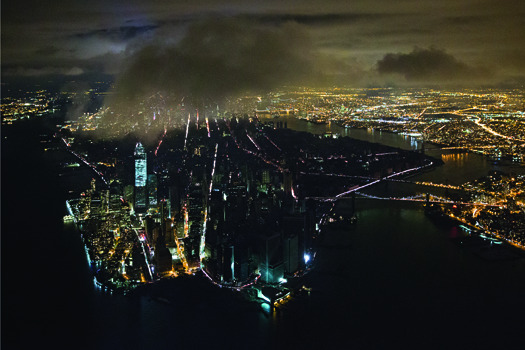
The explosion lit up the Manhattan skyline. A sudden boom, a one-two punch of yellow light—then everything went black. After Hurricane Sandy shoved water into Con Edison’s 14th Street substation in October, causing electricity to arc between capacitors, about a quarter million customers were left in the dark. Video of the high-voltage spectacle quickly went viral: It became an early, brilliant symbol of the massive storm system’s most pervasive and inescapable affront—a total and lingering loss of power. Across the U.S., as far west as Indiana and from Maine to North Carolina, Sandy caused hundreds of other mass outages. A tree blown down, wires ravaged by wind, a flooded power facility—each event had rippled out to affect homes far from the point of failure. The blackouts continued for weeks afterward, thwarting the region’s recovery.
While the duration of Sandy’s outages was unusual, their breadth—more than eight million homes in 21 states ultimately lost power—has become disturbingly common. In 2011, Hurricane Irene cut electricity to about 5.5 million homes. Tornadoes, ice storms, wildfires, and drought now routinely overwhelm the nation’s aging electrical infrastructure, inflicting sweeping blackouts. In the early 1990s, the U.S. experienced about 20 mass outages a year; today it’s well over 100. A 2012 Congressional Research Service report attributes much of the rise to an increase in extreme weather events. It also states that storm-related power failures cost the U.S. economy between $20 billion and $55 billion annually.
A century ago, when the foundation of today’s power distribution system was laid, electric appliances were just beginning to enter homes. Over time, the nation’s power use has skyrocketed, and so has the population. Demand is now rising at 1 percent a year, pushing more electricity through lines that were never intended to handle such high loads. “We sometimes joke that if Alexander Graham Bell woke up tomorrow and saw my phone, he’d be astounded,” says David Manning, executive director of the New York State Smart Grid Consortium. “If Thomas Edison woke up tomorrow and saw the grid, he could not only recognize it, he could probably fix it.”
A modern grid, capable of creating and delivering efficient, reliable power even in the midst of disaster, is long overdue. Such infrastructure would be more resilient to both storms and terrorist attacks, which the National Research Council warned in November could cripple entire regions of the country for months. Many of the necessary upgrades already exist: They’ve been developed in labs and demonstrated in smart-grid projects across the country. Other steps just require common sense.
STOP CASCADING FAILURES
A single tree felled by a storm like Sandy can cut off power to thousands.The existing U.S. electric grid has a linear structure. Large power plants, typically located far from the customers they serve, produce most of the electricity. Transformers at the plants increase the voltage so it can be moved more efficiently to local substations, which reduce the voltage and send it out to neighborhoods and individual homes. When a fault current, or surge, occurs anywhere along the line, automatic circuit breakers open to halt it. That’s why a single felled tree can cut power to thousands of customers. And that’s how overgrown trees brushing high-voltage lines in Ohio could black out 50 million people along the East Coast in 2003.
One way to reduce the impact of any individual failure is to replace the linear structure with a looped one. Imagine a power line studded with five smart switches that connects back to a substation on both ends. A tree hits the line. In the old, linear system, all the customers beyond the fault point would lose power; the utility would send out a work crew to search for the cause. In the new system, switches on both sides of the fault could isolate the problem and only customers between the two switches would go dark. Then, “those switches communicate and say, ‘It’s right here, come and fix me,’ ” says John Kelly, executive director of the nonprofit Perfect Power Institute.
Communities such as Naperville, Illinois, and Chattanooga, Tennessee, which are among the most advanced in the U.S. when it comes to smart-grid adaptations, have already installed looped systems and demonstrated their advantages. “You’re looking at 50 to 80 percent improvements in reliability,” Kelly says. Also, “you’ve limited the problems. You know right where to go, so now you can get those few customers back up quicker.”
Another way to stop failures from cascading is to install a fault-current limiter, or what University of Arkansas engineer Alan Mantooth calls a “shock absorber for the grid.” He’s developing the refrigerator-size device at the university’s National Center for Reliable Electric Power Transmission. “As bad things happen, circuit breakers just start opening and the lights go out,” Mantooth says. Rather than simply stopping the electrical surge altogether, his machine can absorb the excess current and send a regulated amount down the line.
Utilities have been slow to adopt looped systems, even though smart switches were developed in the 1990s. Florida Power and Light, whose customers experienced multiple hurricanes in the early 2000s, was among the first to do so. “Most utilities are very averse to change,” Kelly says. “And part of it is the monopoly structure that impedes innovation and improvement.”
When large-scale change does come, it will likely arrive in high-demand areas first. “In urban centers like New York City and Los Angeles, their fault currents are getting so high that they’re having to start replacing all of their circuit breakers,” Mantooth says. A fault-current limiter would be a practical solution. “We would insert this guy into the grid,” he says, “leave the existing circuit breaker, and limit the current so that the breaker is not overwhelmed.” The new equipment helps the old equipment remain in service for longer, a much more cost-effective approach than replacing all the breakers.
PLAN BETTER BACKUP
On the evening Hurricane Sandy struck, John Bradley was in his office on Broadway when the building suddenly lost power. Bradley is the associate vice president for sustainability, energy, and technical services at New York University, and he was on the phone with the local utility, Con Edison, at the time. “They were telling me they were systematically shutting down low-lying areas because they knew the storm surge and the full-moon high tide were going to hit around 9 p.m.,” he says.
It was 8:30. “I looked out my window, and all the lights were out,” Bradley recalls. “They said, ‘We’ve got some issues,’ and they got off the phone.” Nearly all of Lower Manhattan had lost power—except for much of the NYU campus.
In 2010, the university completed a project to replace its 1970s-era boilers with natural-gas-powered turbines, subterranean engines that generate 11 megawatts of electricity. Waste heat from the engines creates steam to produce an additional 2.4 megawatts and hot water, a process known as co-generation. Natural disasters were not at the top of the university’s list of concerns when the administration approved the project. “Number one was cost-effective production of electricity,” Bradley says. “Number two was reduction of greenhouse-gas emissions.” (The system, which powers 22 buildings and heats 37, is saving the university millions of dollars each year; it’s also helped reduce the campus’s carbon footprint by 20 percent.)
New York University was an island of power in a darkened neighborhood.When Sandy knocked out that ConEdison substation, a third benefit of NYU’s self-sufficiency became clear. “My equipment sensed that loss of voltage, and the breakers opened up, isolating the NYU grid from the larger utility grid,” Bradley says. For the next week, NYU was an island of power in a darkened neighborhood. Staff set up power strips on long tables in the library and unlocked outdoor outlets for anyone to use. “You saw people from the community plugging in their laptops, iPads, and phones all over campus,” Bradley says.
Natural-gas systems also kept much of the Princeton University campus and a sprawling Bronx apartment complex known as Co-op City up and running. Critical services such as hospitals, hotels, and fire stations should all have self-sufficient power generation, says Kelly. And relying on natural gas makes sense, he says, because it already flows through underground pipelines. Diesel must be trucked in to keep generators online and, during storms like Sandy, such fuel can be scarce.
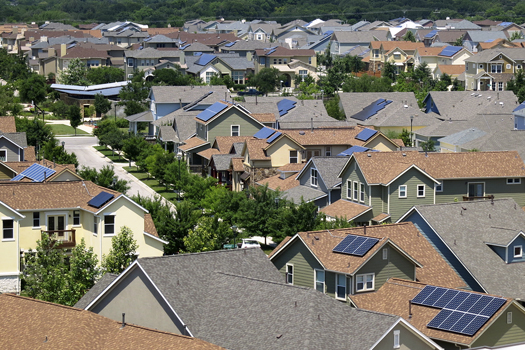
Buildings can also rely on renewable-energy systems during a blackout. Solar panels on the Midtown Community School in Bayonne, New Jersey, helped power it as an evacuation center during Hurricane Sandy. But if such systems can’t automatically disconnect from the grid, utilities require them to shut down. Workers attempting to repair lines could be killed by electricity flowing back into the grid. “It’s like they’ve been on one-way streets all their life, and now all of a sudden there’s a car headed toward them,” Mantooth says.
A special inverter connected to a battery can enable buildings to island, or isolate themselves from the grid, as they continue to produce and store power. But existing technology is cost-prohibitive for homeowners. Mantooth’s lab is developing an affordable alternative: a microwave-size “green power node” that could be mounted on a garage wall. He hopes to find a manufacturer who could sell it at home stores for about $500.
INVEST IN EFFICIENCY
The more power coursing through an aging infrastructure, the more vulnerable the grid will be to disruption—even without a natural disaster. Over the last three decades, U.S. household electricity usage tripled, from 30.3 million BTU per home in 1980 to 89.6 million BTU in 2009. Transformers, meanwhile, are now more than 40 years old on average, and 70 percent of transmission lines are at least 25 years old. To be resilient, the grid-—and those who rely on it—must also be more efficient.
Many utilities have already begun to replace one ubiquitous and outmoded device: the electricity meter, generally a spinning dial mounted near a thorn bush at the back of the house and read, in person, once a month. About 40 million U.S. homes now have smart meters, devices that digitally monitor and communicate home power use as often as several times an hour. The information allows utilities to track and bill more precisely—and recognize power outages instantly.
In Austin, Texas, volunteers in a smart-grid project are testing tools that will help the grid work more like the Internet, with two-way energy and information flow. So far, engineers have equipped 480 houses with advanced energy-monitoring systems. Researchers at the University of Texas at Austin analyze the data with supercomputers. “We carry out the nation’s deepest-ever research on how people use electricity and natural gas on literally a second-to-second basis,” says Brewster McCracken, president of Pecan Street, the consortium that runs the project.
Companies such as Intel, Best Buy, and LG have also partnered with Pecan Street to test and develop products in a real-world setting. For example, Sony has installed a home energy -management system that measures the power consumption of various appliances from a single outlet and can be managed through a television set-top box. Homeowners can use the real-time data to minimize their load on the grid, shifting such activities as electric-vehicle charging to periods of surplus power.
The American Recovery and Reinvestment Act of 2009 devoted $16 billion to installing new transmission lines and implementing smart-grid projects such as Pecan Street. It’s a modest start. Truly modernizing the U.S. grid will require an investment of $673 billion, according to a recent study by the American Society of Civil Engineers. In the meantime, the costs of inaction continue to add up: Hurricane Sandy caused $69.7 billion worth of damage to New York and New Jersey. Just weeks after the storm, Governor Andrew Cuomo requested federal funding to help New York install the technology for a smarter grid. “It will be a significant investment,” New York State Smart Grid Consortium’s Manning says. “But Sandy has rewritten the opportunity to make the case.”
Kalee Thompson is a freelance writer based in Los Angeles. She plans to add solar panels to her home after she can island it. This article originally appeared in the February 2013 issue of Popular Science.
