
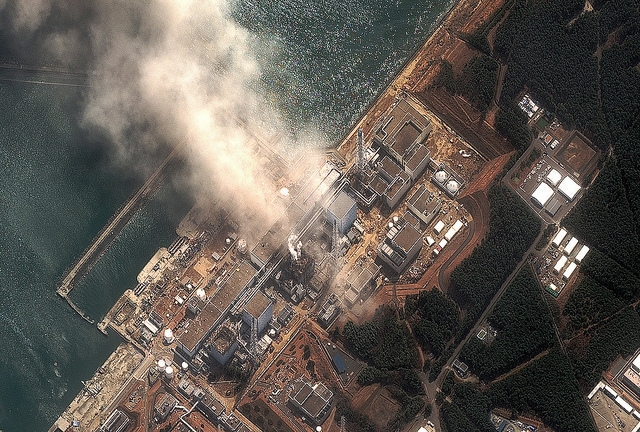
Fukushima Dai-ichi Nuclear Plant, March 14, 2011 DigitalGlobe via Getty Images

The Fukushima Nuclear Accident Independent Investigation Commission, an independent (well, duh) committee set up by the Japanese parliament to look into last year's nuclear disaster, just released its official report--and it's pretty damning. In the introduction, the chairman of the commission says the nuclear accident "could and should have been foreseen and prevented."

You can read the entire report here, in excellent and eloquent English, but the gist is this: the commission finds that the nuclear accident was preventable, and is directly attributable to "serious deficiencies" in the government, regulators, and TEPCO (the utilities company responsible for the Fukushima plant).

It's a specific and detailed look at all the ways those in charge let down their guard, accusing TEPCO and the government of colluding--the influential company managing to endure only the most cursory of regulations and the government allowing itself to be bullied. But the report is also kind of a fascinating cultural study from a commission looking inward at how the nature of modern Japan may have contributed to the disaster.

What must be admitted--very painfully--is that this was a disaster "Made in Japan." Its fundamental causes are to be found in the ingrained conventions of Japanese culture: our reflexive obedience; our reluctance to question authority; our devotion to 'sticking with the program'; our groupism; and our insularity. Had other Japanese been in the shoes of those who bear responsibility for this accident, the result may well have been the same.

The whole thing is worth reading. More coverage:

13 Comments

And the US budget is profoundly a man-made disaster--compliments of one man--Obama.

I respect and appreciate the Japanese people. I wish them well. In admitting with mistakes, they maturely are dealing with their mistakes and will bring future opprotunity to their country. I wish for all those that suffer in Japan well and god bless!

@gizmowiz
damn threadjacker.

@everyone else
While the report's honesty is commendable, how exactly are these conclusions to be acted upon? Are the authors suggesting that to avoid another Fukushima, Japanese cultural values and practices have to be changed?

Mr. Robot, your parts are made in Japan. You are a Robot after all. Domo arigato Mr Roboto!

All right, Gizmowiz, I'll bite.

The U.S. Federal budget has been a disaster for 40 years. I remember when there were $200 billion annual deficits during the Reagan administration, and that was when $200 billion was a lot of money.

The president does not control the budget. The executive branch only spends what Congress lets it spend. Congress controls the taxes and the budget. The president can only exert political influence on them.

Also, what is a good way to bend 1/16" sheet metal to make small shapes (around 1" in size)? I have been using hand tools and the results are nearly as disasterous as Fukushima or the U.S. Federal budget.

Igot1forya,
I am a login and icon on PoPSCI. I am a creation of my owners imagination. I am always changing and evolving. Often as I comment, I am in great need of spell check and grammar correction, lol. You sir, assume much of me, of my orgin. Have fun! ;)

Look for the NEI and the rest of the nuclear industry to spin the "take-away" on this new report something like this: "The conclusion reached in the Japanese report, which finds that Fukushima was 'a profoundly man-made disaster' and 'could have been prevented,' reaffirms what we in the industry have asserted all along -- that nuclear technology is perfectly safe, when properly managed."

Now all we need to do is knock a few heads together, fine tune the human species around the edges, and all will be right with the (nuclear) world.

Phew!

I think they are wrong. It was not assumed to be unsafe by most experts before the tidal wave and lowering of the coast line. The real disaster happened after the natural effects. They only needed to drop in generators. Why they didn't ask the US Army Corps to send them some I'll never know. They have suites to protect workers and special housing units for this task somewhere within a few thousand miles. They were in shock for too long. When they finally got going it was too late.

We now know that several improvements could be made. Everyone hates this sort of disaster, it is obvious and instant. The hidden disaster from burning coal and even natural gas over 50 years creates just as bad or worse environmental disaster.

Human error is an important part of the safety of anything. Saying nuclear is safe because disasters are from human error is untrue. As is inherent in humans we have and always will make mistakes, its what happens when we do make mistakes. Solar panels are considered to be incredibly safe and for good reason, but make a mistake and get the wiring wrong and its possible you could cause a house fire which while bad is nowhere near the caliber of a nuclear accident. Also, it is much easier to wire solar panels then it is to run an entire nuclear plant. The more complex something is the easier it is for humans to make mistakes on it (usually).

In regards to a comment about bending metal. I have used a metal bender ( which is basically a giant clamp with a hinged plate) to bends sheets of metal. Depending on the size and complexity of your creation that might work for you. If not there are probably smaller and cheaper versions of that.

the nuke plant here has a duplicate plant. its a non functioning station used to run tests trying to see what would cause a melt down. thats all they do is test test test just so we can plan and repair or head off any issues. but then again i live in a "redneck" state so take any tests with a grain of salt.

beyond9, maybe it would ease your anxiety to get some perspective on how little radiation was actually released and on how little low-level radiation affects us.

Not a single person has died as a result of radiation from the Fukushima reactor meltdowns. Thousands died from the earthquake and tsunami. The long-term effects on the first responders closest to the reactors may or may not be significant. In reality no one knows because the statistical models for radiation accumulation are probably all wrong. The most recent study by MIT shows that those old models significantly overstated the hazards of long-term exposure to low-level radiation.

www.web.mit.edu/newsoffice/2012/prolonged-radiation-exposure-0515.html

If you have radiation burns from a high initial dose of radiation, you're going to have significant health impacts. As far as we know, no one suffered radiation burns at Fukushima. Six workers received more than lifetime "legal" limits of radiation, but those limits are very likely understated by a factor of 10.

The good news is, as Popular Science has pointed out, the mistakes made can be corrected. Those old reactors were designed to withstand major natural disasters without any loss of life, which they did. Future reactors will be designed to withstand major natural disasters without any loss of life and will shut down more safely.


June 2013: American Energy Independence

Five amazing, clean technologies that will set us free, in this month's energy-focused issue. Also: how to build a better bomb detector, the robotic toys that are raising your children, a human catapult, the world's smallest arcade, and much more.


Online Content Director: Suzanne LaBarre | Email
Senior Editor: Paul Adams | Email
Associate Editor: Dan Nosowitz | Email
Assistant Editor: Colin Lecher | Email
Assistant Editor: Rose Pastore | Email

Contributing Writers:

Kelsey D. Atherton | Email
Francie Diep | Email
Shaunacy Ferro | Email

circ-top-header.gif
circ-cover.gif
bmxmag-ps
