
Whether conducted by an industrial farming outfit or a small, independent farmer, agriculture is all about yield. Per-acre production makes or break the year, and taken at the macro level it impacts global markets and can lead to humanitarian crises. And while agriculture already happens at the field-by-field level, David Dorhout wants to make agriculture even more precise. Think: plant-by-plant farming, optimized on a seed-by-seed basis.
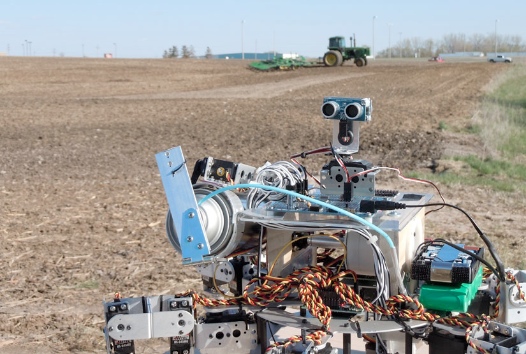
Who can manage such a precise, immense workload? Why, the diminutive hexapod robot named Prospero, of course.
Dorhout currently works in the biotech industry, but his side project and passion for the last few years has been robotics. Built as the test platform for a larger robotic farming system, Prospero is just one of what will eventually become a swarm of planting, tending, and harvesting robots running game theory and swarm behavior algorithms to help optimize every inch of arable space in a given field. Dorhout has launched his own company, Dorhout R&D, to pursue this vision, and he’s hoping that as the larger robot revolution unfolds that farmers will once again be at the forefront of technological revolution.
“Looking back at history agriculture seems kind of quaint,” Dorhout says. “But I realized growing up around a farm in Iowa that rather than being one of the last industries to adopt technology, agriculture is one of the earliest adopters.”
Dorhout points to technologies that we now take for granted–things like the diesel engine, modern statistics, genetic engineering–that trace their origins back to a common impetus: the need to reliably grow more and better food. The ongoing robotics revolution is leaving its mark on agriculture already, as self-driving, GPS-equipped tractors now till land autonomously and other existing farm machinery becomes increasingly computerized and automated. A single human farmer can now maintain well more than 1,000 acres of farmland each year, using bigger and better farm equipment to increase productivity.
But to Dorhout, the simultaneous computerization and intensification of existing farm technologies doesn’t make much sense. If you trace the development of agricultural technology along its entire arc, there’s always been a focus on increasing the individual farmer’s output: bigger tractors mean one human can cover more ground in less time, and huge irrigation apparatuses mean a single farmer can keep huge amounts of plants watered. But the future, Dorhout says, means moving in the exact opposite direction: smaller, smarter, and hands-free.
“What I’m proposing is that you take the piece of machinery and you essentially explode it, so instead of having one piece of machinery you have maybe hundreds–many small robots instead of one big one,” Dorhout says. Previously, humans had to direct the machinery, so fewer (and bigger) machines meant fewer humans were needed to operate them. Now, the falling cost of microcomputers means intelligence can be spread across many machines that work both independently and together. Such technology could lead to a new farming paradigm where decisions are made on a plant-by-plant basis rather than acre-by-acre or field-by-field. Such a system could cut waste down to nearly nothing and push yields-per-acre through the roof. Prospero is Dorhout’s first step toward this vision.
Prospero is a lone prototype planter robot designed to work with other identical robots in a swarm (Dorhout’s formal education happens to center around insect biology and behavior). In order to create something that the average farmer could actually use and service, Dorhout wanted simplicity and low cost. He built Prospero from an off-the-shelf robotics platform called a Boe-Bot packing a Parallax microcontroller–basically a small robot brain that costs something like eight bucks, he says. He wrote an advanced walking program that allows Prospero to move in any direction without turning its body. A sensor array packed into its belly–LEDs, a photo resistor, etc.–and other augmentations like a seed-hopper and a fertilizer spraying apparatus round out its hardware.
The end result is a somewhat awkward but friendly-looking farmbot that can communicate with other robots around it via weak radio signals. It requires no GPS or complex computer vision algorithm–it sees only what is directly beneath it, taking the world in through this very small window. If it detects that there is no seed planted in the soil below (or in the immediate vicinity), it drills a hole down to the optimum depth, deposits a seed, sprays it with just the right preprogrammed amount of fertilizer and nutrients, covers the seed, and then marks the spot with a shot of “paint” that the other robots can detect should they walk over the same patch of soil.
Every robot in the swarm is doing this simultaneously. If a robot passes over an area where a seed is already planted, it keeps moving. If not, it plants. Should a single robot come across a large swath of earth where it detects few seeds have been planted, it can signal others to come help it. If it encounters an area that seems to be already heavily planted, it can tell nearby robots to move away from it. Each robot doesn’t have to know the exact position of the others, which cuts down on a lot of the processing and data crunching that can make distributed robotics like this difficult. Yet the entire field gets planted, not necessarily in straight rows but with seed spacing optimized and a minimum of wasted space, fertilizer, and human effort.
Future of Farming: Prospero Robot Farmer
“I love these swarm technologies because they are so simple but you can get such complex behaviors,” Dorhout says. And because they don’t rely on complicated technologies or expensive robotics components, they’re something farmers of the very near future could actually use, and even enhance. “They’ll adapt it, and that’s important,” he says. “They’re the original hackers. They’ll make it better.”
Prospero is just a first step, and a very preliminary one. Even Dorhout isn’t quite sure how the next phase will take shape. He envisions a planter like Prospero working side by side with other specialized ‘bots: a tender robot that can maintain crops around the clock, monitoring for and combating pests and disease and ensuring soil conditions and moisture remain optimal, and a harvester that would only reap the crops plant-by-plant as they are ready, replacing today’s wholesale harvesting methods that always lose some percentage of yield by harvesting too early or too late for some plants in the field. The idea of course is to integrate all of these into a single robotic system that can handle everything from planting to harvest, perhaps organized around a kind of shepherd robot that is responsible for overseeing the entire system and that the farmer could direct as he or she sees fit. After all, the idea here isn’t to remove the human farmer from the system, but to make modern agriculture rise up to meet the demands of a growing global population. If that’s going to happen, farming has to become smarter.
“When you’re sitting in a chair on a tractor, you’re not doing the brainwork,” Dorhout says. “A swarm of robots allows you to focus on increasing the productivity of, literally, each square foot. This won’t solve all of our problems, but it definitely gives us a little breathing room until we work things out.”
