Feature
Or, perhaps more accurately: Dear Congress: please fund NASA sufficiently. After witnessing first-hand the extraordinary act of putting humans into space this Friday, I've realized that the importance of our manned exploration of space transcends budgets and politics

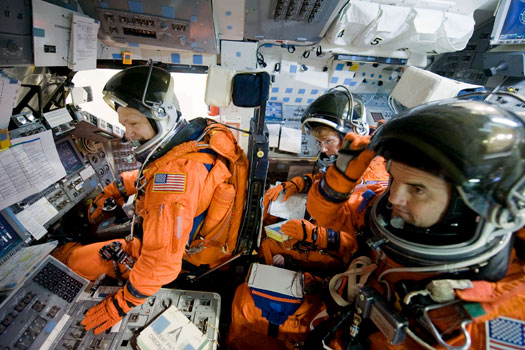
STS-135 Astronauts Training STS-135 pilot Doug Hurley (left) and mission specialists Rex Walheim and Sandy Magnus train for the final space shuttle flight in the Johnson Space Center's crew compartment trainer NASA

Just like Rebecca, I'm sitting here drinking out of a space shuttle mug. Mine, with the STS-135 mission seal, I bought from the Kennedy Space Center souvenir stand on Friday, a few hours before Atlantis took to the skies. I certainly won't need it to remember my first (and last) shuttle launch--something that's been thoroughly seared into my memory--but it will be a nice, frequent reminder of the incredible feelings of that day.

It's been tough to articulate those feelings--where they came from, and why. But I think I've managed to trace them back to a single source: the four astronauts inside Atlantis.

As of today, the United States no longer has the capacity to put humans into space. Three decades of doing it several times a year are over. So what now?

Part of that answer is an ambitious program of unmanned missions beginning this year. But having witnessed space flight from an entirely different perspective this weekend, I'm hooked on humans in space. NASA needs to regain the capacity to fly astronauts into orbit and beyond as soon as possible.

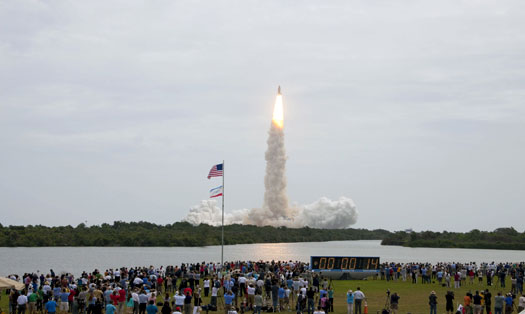
I surprised myself by becoming so emotional as Atlantis faded out of sight beyond the cloud ceiling. And I wasn't alone, judging by the eye-drying and spontaneous hugs I saw around me at the KSC press site--everyone was similarly buzzed. It doesn't get much more dramatic than a rocket launch, as far as what we humans are capable of here on Earth. The tension of the countdown, the loud and fiery release--it's indescribable.

But then your brain chokes on an amazing fact: there are four people inside that shuttle experiencing all this excitement and tension on a completely different level, one of unfathomable magnitude relative to where you stand on terra firma. Your heart pours out to them, imagining them three miles away, strapped in, prepared to do something extraordinary. If I'm this worked up as a spectator, I thought, imagine the feelings inside the heads of the astronauts.

And these are government employees. They're not millionaires. Not to disparage space tourists; if I had the money, I would be spending it on putting myself into orbit, no question. But does the public cry or hug en masse when Charles Simonyi blasts off from Baikonur in a Soyuz rocket? Do crowds gather? This question is in no way indicative of any fault in Mr. Simonyi's character or motivation. I stood behind him while we were waiting to get our launch credentials; he seemed like a perfectly nice gentleman. But the reason an estimated one million people packed up their cars and RVs to drive to the Space Coast for a space shuttle launch is because it is put on by the people. Everyone who made that launch possible--in the truest definition of a government employee, they're our representatives in this incredible project. We don't just associate ourselves with them, we live through them. That means something. They've devoted their life to this very civil, very scientific cause--the exploration of outer space.

Kennedy Press Site, Atlantis Launch:  NASA
More than anything else it's the humans who made me tear up. Humans are what made us all feel that spontaneous joy next to the big clock in that field. Humans are what elicited a loud cheer in NASA's Tweetup tent accompanying main-engine cutoff--the point in the mission where a safe orbit is assured. Humans are what made me well up again when my phone buzzed with messages in my pocket, knowing my own friends and loved ones were on the other end, wanting to share in what I had just experienced.

This is not to say, though, that canceling the shuttle program was a bad decision. After three decades of service, all in low-earth orbit, NASA has wisely elected to utilize cheaper launch systems, both foreign and private, for the laborious duty of ferrying supplies and eventually astronauts to and from the ISS, which has become the shuttle's primary mission.

What's troubling is the uncertain future for the type of American manned spaceflight that pushes the boundaries of exploration forward. It could be argued that the shuttle itself failed on that goal. But despite its compromised scope, the world's first reusable space plane became an iconic figure in the American space program, perhaps for no other reason than it carried more humans into space than any other launch system in history.

The two leading candidates to replace the shuttle currently demonstrate how interesting a time this is for space exploration. SpaceX, a private company, will almost certainly have the capability to put a human into low-earth orbit with its Falcon 9 rocket and Dragon capsule before NASA itself does. SpaceX is also racing to develop a much bigger rocket, Falcon Heavy, with the ability to haul more cargo and/or reach deep space.

NASA's own plans, recently in flux after the cancellation of the moon-bound Constellation program, have solidified around the Space Launch System (SLS), a heavy-lift rocket based on the shuttle's main engines and solid rocket boosters, and the Multi-Purpose Crew Vehicle (MPCV), a two- to four-person crew capsule developed by Lockheed Martin based on its Orion concept. Both are essentially the same systems outlined in the Constellation plan, but with reconfigured mission goals of reaching an asteroid and eventually venturing to Mars, rather than again landing on the moon.

Speaking to CNN over the weekend, NASA Administrator Charles Bolden reaffirmed the Obama administration's timeline for the two missions: reaching an asteroid by 2025, and achieving Martian orbit "with the intent of landing" sometime in the 2030s. But in a time of severe deficit crisis, ambitious NASA programs like these are of course subject to appropriations. The recent cancellation threat of the behind-schedule but critically important James Webb telescope should be indicative of the budgetary struggles NASA is up against.

I believe, though, that It is absolutely critical, even in these fiscally constrained times, to push relentlessly forward with manned space exploration. Now that the shuttle program is gone, I think we'll begin to realize something even more profoundly in its absence: That the most important thing we can put into space is ourselves.

26 Comments

I hope I live long enough to see the launching of the next generation of space vehicles.

It will be interesting to see if all the paper manuals in the trainer pictured above will be replaced with some form of e-paper or digital pad. Or maybe there will be an on board robot that will carryout the commands.

You can easily put yourself into space and for a very long trip but you have to die first. There is a company that sends ashes into orbit.

This is by far the best article i have ever read on POPSCI...ever

This is Journalism

This is our future! As cliche` as it sounds space is the next frontier and I hope we can all push our boundaries further in the next 20 years.

No, get NASA and the politicians away from human space flight. Look how they've screwed it up! Get the private industry involved in a major way. So long as you got some slimy politician who's more concerned with the next election than mankind's future we'll be dragging our feet to space for the next 100 years.

Don't take life to seriously! You'll never get out of it alive.
-Elbert Hubbard

Cool Article!

Exactly cobalt - this article should say - Dear NASA, don't get in the way of the general public who wants to operate in space.

NASA should take all of its information and put it out there for US businesses who want to build a space related business. It's time the general public takes this one over.

What I don't get is why are all of these 'future missions' being kept in the future? By that I mean that first NASA, back in the 90's or so, planned on sending a mission to Mars in 2012. That's not happening. Then it was pushed back to the 2020's now it's the 2030's. This is ridiculous. Plus, if we have the 'due date' scheduled for so far in the future people won't get as energized about it. That's why JFK challenged ourselves to get to the moon within a decade! I'm currently reading a book titled "The Case for Mars" by Robert Zubrin (look up the title or "Mars Direct" on wikipedia). Basically, it states that we can get to Mars in about five years using technology that's easily available TODAY! Also, if Washington is serious about fixing the economy, reviving the Space Program/Space Race would be a good way to do it (manufactuing, R&D, and other jobs). Not to mention that it would be a major morale boost for the American Public. None of this robotic mission malarkey. Like the author said, people get excited about people, not glorified remote controlled cars. "Mars or Bust," that's what I say. Let's get going. And let's get going NOW!

The aurora space plane any one? Black ops patent?

The aurora space plane any one? Black ops patents?

NASA, quit blowing our tax dollars, get out of the way and let real engineers put us into space.

The fact is, they were headed into space before NASA got into the act! Back in the days just after 'Chuck Yeager' broke the sound barrier, the 'X' project was steadily getting higher and higher! They were not far from an actual push into 'LEO' when 'Kennedy' ruined it all by pushing them into a race with the Russians. As much as I loved the idea of walking on the Moon, let's face it, they stopped going after the public got bored... Politics is both a blessing and a curse when it comes to stuff like this. The only way that we are going to get back out there is when we run so low on rare earth elements and iron etc. It's out there in the asteroid belt, the miners just have to want it bad enough...!

Don't get me wrong but this shuttle must come to an end and we need to move towards more advanced means of going up there.

Technology advance is one area where nostalgia does not do any good. I am sure that the idea of man in space is not dead and it cannot be, as long as man is in existence.

Let's face it, LEO is not that much "space" as is going out there on some planets. The LEO era is indubitably a paramount stage in this process. Time to get better transportation methods.

Until that happens, we should sort out the "ethics debate" as well and move forward, the idea of sending some people on some planets to establish a base and die off (never come back), is very good indeed; plenty of volunteers, that's for sure. No robots can reach the human ability to adapt and explore.

I have the sts-100 seal.
when the shuttle was built it was only suppose to launch 85 times.... but it kept going.
100 was when they put the Canadian made robot arm on the ISS.

The problem is that we got to the moon, scoped out Mars and Venus a bit, and found nowhere useful to go. Space is pretty useless, it seems. Especially when it still costs $10K/pound or whatever to get up into Earth orbit. We need to stop the mindless manned space program. Keep the robots and telescopes going. http://billdietrich.byethost8.com/Reason/ReasonMannedSpaceProgram.html

That would be nice BUT the US is too busy wasting endless billions in Iraq, Afghanistan and other places it has no business to actually care. Very sad indeed.

www.Privacy-Toolz.tk

In addition to all the government employees there are all the contractors; USA, Lockheed, Hamilton, Oceaneering, etc. etc.
As someone who worked for a NASA subcontractor in the Houston area UNTIL Obama canceled the Constellation program I know the community that makes this possible. Living in an area where 85-90% of the people living there worked in some function to support the space program. Regardless of where I went, church, supper market, bank, odds were that the person standing next to me loved space as much as I did. I imagine it would be like being a Mormon in Utah.
And these people do this because they love it and no other reason. And even the people at the top of the food chain would have taken any excuse to get in and get there hands dirty. They were all living their dream.
Space exploration is not 'the American dream' but it is a perfect example of what the American dream is. Just about anyone can be an astronaut if they work hard enough. And those of us that decided not to get in the rocket can still be part of that mission, that dream.
I pray Obama hasn't already killed that dream.
tjanderson.wordpress.com/2010/03/30/the-atrophy-of-ambition/

This article is excellent! I agree with everything in it. Space is the future. We can't turn back. Folks have to realize that there is more going on that simple numbers. Thinking only in terms of numbers and fiscal budgets is exactly what has gotten us afraid of our own shadows. This is America. And while space is ultimately a Human endeavor, not just an American one, this nation is the leader in space and will remain that way. Why? Because of spirit. You can't attach a cold number to mankind's drive to explore. Monetary concerns are important, but the fate of Humanity as a whole is at stake. Going backwards is not the answer, and neither is telling NASA to get out of the way.

The way forward is clear. We need to quit spending money on useless wars that serve no strategic purpose. Let's give the Intelligence community the funding it needs to locate terrorists and keep the military funded enough so that they are on the cutting edge and capable of defending American interests as necessary. But occupying countries is too expensive AND it sacrifices our moral standing as innocent people continue to get caught in the crossfire. We can bring the troops home and still maintain a strong forward presence with the Navy and other current treaties. End our heavy footprint in Afghanistan and Iraq and then put the difference in spending towards a serious, ambitious space program.

Turning away from progress in space or surrendering entirely to the commercial sector is not the answer. NASA will continue to thrive and expand. I, for one, have not given up on this country or its space program. We are the Gold Standard, and will continue to be so well into the future. I'm planning on being a part of it.

congrats. With a stroke of a pen we lose the space race to the Russians, and lose 10,000 jobs in the process. Sad that we will have to pay other countries to reach space now

What kind of fool thinks were lost the space race to the Russians?!? The US government in the form of NASA may have temporarily suspended manned ground to space transport flights, but there are private companies stepping in to pick up where NASA has left off where manned spaceflight is concerned. Private sector is the future of manned space travel.
Will the thousands of engineers losing their jobs now find work in the private sector? No, of course not. BUT this could also be the oppoprtunity some need to step up their game and contribute more than they could as individual engineers than the could as part of the mass of engineers they worked among. Hardship is one of the best motivators mankind has ever known.

There's always time to do it better NOW.

John,
A very well written article, I think it is something that should be sent to our representatives in Congress. Would you be willing to write a similar open letter that we can sign and send to Congress? I recently joined Votizen (votizen.com) a site that matches people with voting records and sends letters that they have signed to their representatives in DC. I think this is a great one for them to send.

Look folks, if you want NASA to be rejuvenated you KNOW how to vote next election. It's a really really simple solution.

You'd think voting would be that simple, except more often than not (like after a bad night of inebriated intercourse) you wake up the next day wondering what you did and ready to vomit (that one's for Steven Colbert).

In order to illicit change, become an activist and take the place of elected officials currently in office. Don't play the mafioso game of "this is the way things have always been done," when elected, and make changes for the better based on the desires of the people.

The only other logical course to expedient change is revolution.

I love your post and I do agree with you. The government must not stop supporting NASA since every shuttle launched represents not only astronauts or the NASA itself but it represents every American people living on earth. These astronauts who are willing to take the risk of going out in space are truly heroes I may say. They've been doing it for the past years and still doing it now for the American people, to represent all of us so let's not keep them hanging. The government must support them and continue the human spaceflight.

In a news I've read a couple of days ago I've read that NASA's shuttle system won't be sending everyone to space in the near future. Though they're not spending cash putting individuals into space, NASA will still be innovating. The development is going to be aiming into groundwater, not into space. The environmental cleanup will take years to clean up, as it took decades to cause. The spending budget for the cleaning is getting close to $1 billion. Here is the proof: NASA will be spending billions on environmental cleanup

on a different note, instead of using rockets to constantly get stuff out of the atmosphere and into space why not build something of a super elevator, im not an engineer so the support structure isnt my specialty, but you could use rail gun type equipment, which uses magnetics to lift teh elevator out of the atmosphere, eliminating needs for rockets and the such, then ships could be assemble in space (pre-assembled sections) rather then being flown small peice by small into space and being built, or jsut plain assembled in space. far fetched? maybe, costly? what isn't costly now a days to start up? a possibility? most deffinetly, the main concerns are building a tower to support it that doesnt move or sway, or wont break wehn it does, and the energy needed to power the elevator, both are overcomeable eventually, obviously its not sumthing that would be up and done tommorrow, but i imagine with concerted effort it could be done in shorter time then we think.

this way we could jsut lift space faring ships, satellites, probes, etc, into space and then fire them off where ever we want, solar panels could even be used as another coat (weight permitting and such) to lessen the electrical need of the elevator.

Musings of Me
Call me a dreamer, but i bet im not the only one to think it up.
We're on the brink of so many jumps in technology its impossible to conceive what will come in our lifetimes.


June 2013: American Energy Independence

Five amazing, clean technologies that will set us free, in this month's energy-focused issue. Also: how to build a better bomb detector, the robotic toys that are raising your children, a human catapult, the world's smallest arcade, and much more.


Online Content Director: Suzanne LaBarre | Email
Senior Editor: Paul Adams | Email
Associate Editor: Dan Nosowitz | Email
Assistant Editor: Colin Lecher | Email
Assistant Editor: Rose Pastore | Email

Contributing Writers:
Rebecca Boyle | Email
Kelsey D. Atherton | Email
Francie Diep | Email
Shaunacy Ferro | Email

circ-top-header.gif
circ-cover.gif
bmxmag-ps