
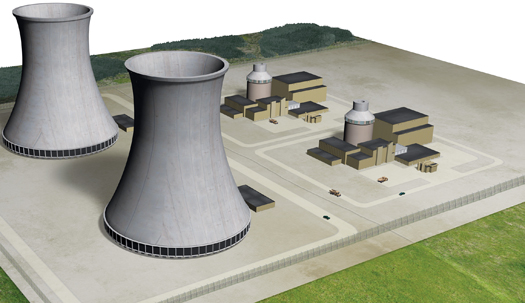
In the aftermath of the Fukushima disaster in March, the appetite for new nuclear power plants slipped to post-Chernobyl lows. Regulators from Italy to Switzerland to Texas moved to stop pending nuclear-power projects, and the U.S. Nuclear Regulatory Commission (NRC) began to reevaluate the safety of all domestic plants. Yet nuclear power still provides 20 percent of America’s total electric power and 70 percent of its emissions-free energy, in large part because no alternative energy source can match its efficiency.
One nuclear plant with a footprint of one square mile provides the energy equivalent of 20 square miles of solar panels, 1,200 windmills or the entire Hoover Dam. If the country wants to significantly reduce its dependence on carbon-based energy, it will need to build more nuclear power plants. The question is how to do so safely.
In the 30 years since regulators last approved the construction of a new nuclear plant in the U.S., engineers have improved reactor safety considerably. (You can see some of the older, not-so-safe ones in this sweet gallery.) The newest designs, called Generation III+, are just beginning to come online. (Generation I plants were early prototypes; Generation IIs were built from the 1960s to the 1990s and include the facility at Fukushima; and Generation IIIs began operating in the late 1990s, though primarily in Japan, France and Russia.)
Unlike their predecessors, most Generation III+ reactors have layers of passive safety elements designed to stave off a meltdown, even in the event of power loss. Construction of the first Generation III+ reactors is well under way in Europe. China is also in the midst of building at least 30 new plants. In the U.S., the Southern Company recently broke ground on the nation’s first Generation III+ reactors at the Vogtle nuclear plant near Augusta, Georgia. The first of two reactors is due to come online in 2016.
(Click the above image for more details.)
Like many of the 20 or so pending Generation III+ facilities in the U.S., the Vogtle plant will house Westinghouse AP1000 reactors. A light-water reactor, the AP1000 prompts uranium-235 into a chain reaction that throws off high-energy neutrons. The particles heat water into steam, which then turns a turbine that generates electricity.
The greatest danger in a nuclear plant is a meltdown, in which solid reactor fuel overheats, melts, and ruptures its containment shell, releasing radioactive material. (Want more information? Check out our explainer on how nuclear reactors work--and how they fail.) Like most reactors, the AP1000 is cooled with electrically powered water pumps and fans, but it also has a passive safety system, which employs natural forces such as gravity, condensation and evaporation to cool a reactor during a power outage.
The U.S. has 104 nuclear reactors operating at 65 sites in 31 states, all of them approved before 1980.A central feature of this system is an 800,000-gallon water tank positioned directly above the containment shell. The reservoir’s valves rely on electrical power to remain closed. When power is lost, the valves open and the water flows down toward the containment shell. Vents passively draw air from outside and direct it over the structure, furthering the evaporative cooling.
Depending on the type of emergency, an additional reservoir within the containment shell can be manually released to flood the reactor. As water boils off, it rises and condenses at the top of the containment shell and streams back down to cool the reactor once more. Unlike today’s plants, most of which have enough backup power onsite to last just four to eight hours after grid power is lost, the AP1000 can safely operate for at least three days without power or human intervention.
Even with their significant safety improvements, Generation III+ plants can, theoretically, melt down. Some people within the nuclear industry are calling for the implementation of still newer reactor designs, collectively called Generation IV. The thorium-powered molten-salt reactor (MSR) is one such design. In an MSR, liquid thorium would replace the solid uranium fuel used in today’s plants, a change that would make meltdowns all but impossible
single pageFive amazing, clean technologies that will set us free, in this month's energy-focused issue. Also: how to build a better bomb detector, the robotic toys that are raising your children, a human catapult, the world's smallest arcade, and much more.


Online Content Director: Suzanne LaBarre | Email
Senior Editor: Paul Adams | Email
Associate Editor: Dan Nosowitz | Email
Assistant Editor: Colin Lecher | Email
Assistant Editor: Rose Pastore | Email
Contributing Writers:
Kelsey D. Atherton | Email
Francie Diep | Email
Shaunacy Ferro | Email
The nuclear power crowd always has some excuse for why it's "new and improved" designs are accident proof, and they are always terribly wrong, and great misery ensues. The pool of water resting above the reactor could be fractured and drained by earthquake shocks, again leaving a meltdown situation. Again with the talking points about energy density. The claim of big power from a small footprint conveniently leaves out the exclusion zones that result when accidents occur, and the fact that these dead zones are worthless forever, while the electricity lasts for a few decades. Even normal operations have shown increased cancer risks down wind from all reactors, as radiation releases are frequent. The huge amounts of water for cooling are a big factor, especially since thermal pollution and radiation are a hazard to other users of that water. I for one have no more patience to offer nuclear power. We should bury this example of mankind's greatest mistake.
There must be something missing from this article: If thorium-based MSR plants are smaller, safer, more secure, generate less waste with a thousanth the radioactivity and half-life of uranium... and we've known this since the sixties... why in the livin' hell haven't we converted our entire national power grid to thorium-based MSRs already?!?
It's because used thorium fuel cannot be weaponized. Look at this article in popsci for further reading: thorium-reactors-could-wean-world-oil-just-five-years
==> @Steven: Why are there no MSR power plants?
You may as well ask, "Why are there no Sony Betamax VCR's on the market?" MSR technology and nuclear engineering became like "Sony Betamax" and VCR technology. Today MSR technology is nowhere to be found in nuclear engineering textbooks and labs.
Basically Alvin Weinberg (head of the MSRE project at Oak Ridge) was fired for insisting on safer, and more efficient designs for nuclear reactors. This was a politically incorrect attitude when the head of the AEC believed he already had the final answers to safety documentation and safety procedures (via U.S. Navy reactor programs). He had a plan to fill the world with fast breeder reactors, not thermal (molten salt) reactors.
Alvin was deemed irrelevant and out of touch with reality. MSR development was set on a shelf, and inertia kept it there until 25 Jan 2011 when the Chinese Academy of Science (CAS) announced their own development program. Reps from the CAS visited Oak Ridge Labs last Fall (2010) to make a reality check, and have now decided to eat our collective lunch by going after the IP and patent rights to molten salt reactors. This is a true "sputnik moment."
The most impressive response to the Chinese challenge has been the founding of Flibe Energy [...] www.flibe-energy.com [...] by Kirk Sorensen, with the blessing of his former employer, Teledyne-Brown Engineering, where he was Chief Nuclear Technologist for the last year or so. Flibe's goal is to have a functional, pilot-design Lithium-Flouride-Thorium Reactor (LFTR) on line by 1 Jun 2015, the 50th anniversary of the first MSR achieving criticality at Oak Ridge. Flibe will take the proven MSR theories and designs of 1965-1969 to commercial reality.
This agressive development program will succeed by using Computer Aided Design (CAD) programs that were non-existent in 1965; off-the-shelf pumps and plumbing; radiochemical synthesis via SCADA and Chemistry Process Control Units (CPCU) (also new since 1965); tapping private venture capital; and enlisting a staff of dedicated, enthusiastic professional engineers, IT, and business folks.
The rest of the world can go their merry way, boiling water, risking explosions, and straining to create designs using solid-fuel thorium. Flibe Energy will create a better way to "burn" all the HEU, spent fuel rods, Pu239, and 99% of the thorium fuel, then reduce the storage/disposal problems by a factor of 1,000 with LFTR's.
a 20-kilometer radius of Japan is now "closed" and uninhabitable due to nuclear radiation pollution from the six generators.
How is that "clean" energy?
-Just a 'bot that is hot in a 'lectronic world.
@aligatorhardt
Molten Salt Reactors, as the second page describes, does not use water in the plant at all, not even for cooling.
This means the reactor can be placed practically anywhere, even potentially deep underground. Though for transmission losses, being close to where the energy is used is always better, unless superconducting transmission lines can be built.
The most promising MSR design uses Thorium Tetrafluoride as fuel, which was even tested in Oak Ridge back in the 60's when they tested the MSR. This design is called LFTR, or Liquid Fluoride Thorium Reactor.
The molten salt fuel loop is self-regulating, and can not melt down and technically, it is already molten, which is the whole point.
As the temperature in the reactor increases, the liquid fuel expands, causing less fuel to be in the reactor, thus slowing down the rate of fission.
In reverse, the lower temperature it is, the tighter it contracts, causing the rate of fission to increase.
This means it can adjust to the changing demand from the power grid.
So there is no need to actively cool the reactor, since the design will not overheat.
The liquid fuel cycle means that the reactor fuel can be processed on the fly, removing fission product that impede the continuation of the fission.
It also means you can continuously refuel it, meaning that it can potentially run for decades without ever shutting down because it ran out of fuel.
And as it was described in the article, there the passive "walk away" safety system using the freeze plug.
This was routinely used in the Oak Ridge MSR experiment, where they would literally shut off the power to the reactor on Friday, letting the fuel pour in to the drain tank, built for maximizing passive cooling, where it would cool and solidify during the weekend.
On Monday they would just turn on heaters around the tank, and then pump it back in to the reactor and continue.
This is the most robust safety system there is, because it is based on the laws of physics, namely gravity.
Also because of the use of this system, any fission product in the fuel that has not been removed during normal operation at the time of shutdown, will be trapped in the fuel when it solidifies, bonded with fluoride, waiting to be removed once the plant starts again.
The future of nuclear energy is the designs that use liquid thorium fuels, as it is the fact that the fuel now is solid that it can melt down, and current reactors are not designed for molten fuel.
And the thorium fuel cycle is also much, much more proliferation resistant.
@robotbetty9,
The bulk of the "uninhabitable" area around Fukushima has an exposure rate of 3.5 mrem per year. The "hot" spots get as high as 5 mrem per year. Denver Colorado has a natural background level of 10 mrem per year due to elevation and being mountainous. Considering 1000 tons of uranium and over 1000 tons of thorium are dumped into the environment in particulate form every year by just one single coal plant and the US has over 600 coal facilities, Fukushima isn't even as bad as a week of standard fossil fuel operation in the US. You aren't familiar with radiation and fear mongers and the fossil fuel industry are using that to get you to make assumptions and choices against your best interests. Even if you use Greenpeace's numbers, coal still killed far more people in the past 25 years in the US alone than Chernobyl has globally. Nuclear also doesn't dump arsenic, lead, mercury, and half a dozen other toxic heavy metals into our water supplies. You need to look for information sources that don't have an ideology and agenda to promote.
Nature is not helping the Anti-Nuclear argument. According to their ideas about radiological contamination, a very large area around the Chernobyl Nuclear Energy Facility should be nothing but a swath of dead land, and should be dead for the next couple thousand years. I guess the pro-nukes have the access required to doctor satellite imagery to make the area look normal.
A little food for thought: If nuclear is pure evil, and fossil fuels are not much better and rapidly depleting, how are you going to produce a constant supply of electricity equaling 16 Terawatts a year? With solar? Wind? Neither of them can provide constant power. Solar PV has an energy output of 5kW/h per square meter, at noon on a clear day. Considering the entire planet uses 30MW/hr, that means you need Six Million square meters, or 6000km2 at optimum input to generate the required electricity. That is an absolutely massive area when it comes to maintenance, not to mention the environmental impact covering such an area will have on the ecology below and the climate above. Then you have the effects of the environment. Wind can cause damage to PV arrays, not to mention what a major disaster will do. Looking at numbers like that, even a 100km seclusion zone around a nuclear reactor is nothing, especially when you can scale said reactor to your output requirements. I took all my source data from www.Wikipedia.com by the way, so feel free to get your output over area data from a more reliable source.
Ugh, so nuke-haters show up here even in a science and technology magazine. The evidence that Nuclear Power, specifically thorium molten salt reactors, are the answer to most of the world's electric energy concerns (and many others) escapes you, even though the evidence is easily at hand. This is because there is so much lies and propaganda out there, trying to deceive you. If I were paranoid, I'd say it was the coal industry trying to stop the only thing that will keep them from taking over electrical generation when wind and solar fail. Coal, with its hazardous mining and dirty, radioactive emissions with lots of carbon dioxide, is not from the last century, but the century before that. A vote against nuclear is a vote for coal. But don't get hung up on the problems of Fukushima - that is old technology, we've got something so much better now, the LFTR, otherwise known as the Thorium Molten Salt Reactor. Read up on it, and you'll learn how it is the best answer.
and the anti nukes attack. as they do with every article everywhere. every comment they post is the same. fukushima doomed for six generations, chernobyl is a wasteland, millions killed in the usa from radiation. i have been debating these narrow visioned activists for what seems like forever on facebook nuclear pages. their "facts" are based on opinion pieces and "uncovered" secret government conspiracies.every interaction with them degenerates into almost hysteria. great article, keep up the good work.for more nuclear info check out "nuke roadie" on facebook. keep the information flowing.
Yeah, it's gonna be sweet when China is up and running with their Gen IV MSR's while we lag behind and run samo' samo' and create more Hanford sites while we wait for any of our old reactors to have a major accident. This is supposed to be one of those areas where the American people have put more than enough money into always being the leading edge, but as with green energy, we now cede even our own proven design in order to produce massive amounts of waste, less power per pound of material, and less safely. Oh yeah, and with a much less plentiful material that is much less efficient...real regular there U.S.D.O.E., N.R.C....
@Falconer13
There would be absolutely no negative side effects if we covered every inch of the earth in solar panels, duh!
If that did cause some unforeseen drawbacks we could just cover the earth in windmills to harness the 'renewable' energy from the wind... that couldn't possibly have any negative effects, right?
Am I the only one that thinks that the systems should be self sufficient? During a power outage, the rods are still boiling water and making steam, which is generating power... why the outage inside the plant? I understand that when lines and transforms are down, power can't be transmitted out, but if the systems are built so that it maintains self sufficiency first and foremost, than there *should* never be a condition to cause a meltdown, unless all the plants generators are damaged... I just can't fathom why these plants were designed without internal reduntant power supplies, they knew meltdown was a danger, the way the system *should* be built is that, no matter what happens outside the plant, as long as the generators keep spinning, the cooling systems stay online.
But I guess that's just too much to ask for.
Playing Devil's Advocate since 1978
"The only constant in the universe is change"
-Heraclitus of Ephesus 535 BC - 475 BC
Does the illustration picture the control room directly under the reactor? Should give the operators incentive to prevent melt down.
1. Nuclear power comes with a long, dirty tail that also has to be factored into it's costs and impact: mining, refining, storage, transport, and disposal.
http://en.wikipedia.org/wiki/Nuclear_fuel_cycle
2. I'll accept nuclear power is safe and cost-effective when Price-Anderson is repealed and the government stops indemnifying nuclear power plants.
http://en.wikipedia.org/wiki/Price–Anderson_Nuclear_Industries_Indemnity_Act
3. That being said, I'm not opposed to nuclear power but neither am I blind to its faults; it is not a silver bullet and much more research is required before I would recommend it over renewable sources of energy in the long run.
a quick read through wikipedia:
"Thorium is found in small amounts in most rocks and soils; it is three times more abundant than tin in the Earth's crust and is about as common as lead."
"much cleaner: as a full recycle system, the discharge wastes from the reactor are predominately fission products, most of which have relatively short half lives compared to longer-lived actinide wastes. This can result in a significant reduction in the containment period in a geologic repository (300 years vs. tens of thousands of years)"
-abundant sources of thorium doesn't really mean it will never reach it's peak. but it's much better than advocating for natural gas.
-electric cars/vehicles of the future could be powered by thorium plants. although that could mean that thorium would reach it's peak at a more accelerated pace.
-shorter half life of 300 years for waste materials instead of tens of thousands. although 300 years is still a very long time and compound it with the rapid rate of population growth and it's further needs in the development of real estate and other resources, still makes the disposal of the accumulating nuclear waste a huge problem.
-although i have to admit that these next-gen nuke designs are starting to get impressive with their efficiency, which is very commendable as a temporary solution for the energy/climate change crisis.
but eventually, the idea of developing further the technologies that would harness sustainable fuel sources that does not produce harmful waste materials as well as eventually applying the concepts of wireless energy transfer in it's distribution system, is still a goal worth striving for.
A little food for thought: whenever scientists come up with new and better ideas to produce electricity more safely--uncommonly large amounts of national ignorance will kill it (the idea).
Do you anti-nuclear energy posters realize that the burning of fossil fuels is maiming the entire planet? The greenhouse effect, rising water levels every year, ozone depletion, the environmental and ecological effects of pollution, etc. will make our planet unsuitable for life soon. These nuclear power plant meltdowns are disastrous with practically permanent effects on the environment, but they are extremely rare. If the thorium based nuclear plant design is truly as advantageous and safe as is claimed, then it seems like a solution to the energy production crisis that will happen in the near future.
As the article states the land area required to power the world with solar and wind is massive and unless some revolutionary advances are made will not be capable of producing enough energy. I'm sure we will find better ways to produce energy in the future, but we have not yet discovered or refined them and are running out of time. Maybe some type of geo-based plant that uses the heat from the Earth's core to produce energy or safe fusion. We can also reduce our electricity needs by redesigning the systems/devices that use the most.
However, industrial countries everywhere need to make colossal changes within the century, which isn't much time to make a breakthrough discovery in fusion or anything else and produce it. A resource that literally took millions of years to form will have been entirely consumed by mankind in a few hundred years. And our consumption of it will have severely damaged the planet. Name another short-term solution that efficiently produces as much energy as fission that is practical and capable of producing the increasing amount of electricity humanity requires. If you are capable of answering that question and engineering its design, the world is ready to give you billions of dollars and accolades.
Look, we're running out of fossil fuels and wind and solar will never meet the worlds energy demands. We have to get a little dirty ok.
I would just like to say whoever designed the AP1000 reactor (1st picture) has a horrible placement for the control room... right underneath the reactor.
"is it melting down?"
*looks up* "yep."
@aligatorhardt Gee, your ignorant line of thinking is what has the US stuck with aging Gen II reactors just like all the others that have had meltdowns. Anti-Nuclear activists will doom the US to having a meltdown scenario in the near future unless we can break their ignorant blockades and build newer and safer reactors.
How the heck is nuclear "efficient"? Nuclear is only about 30% efficient, and the rest is dumped into the ocean as thermal discharge.
And RADIOACTIVITY is "clean"? In your dreams...
I am SO sick and tired of these nuclear idiots playing Russian roulettes with our lives! WE CAN NOT CO-EXIST WITH RADIOACTIVITY. WE WILL DIE FROM BEING EXPOSED TO IT. GET. REAL.
When there was an accident at the Gen I reactor, their excuse was that Gen II reactors are much more safe.
And now that there was an accident at Fukushima, their excuse is Gen III reactors are much "safer". And if there was another accident, then they will probably say that Gen IV reactors are much "safer". It just goes on and on. NO TECHNOLOGY IS 100% SAFE! GET REAL, NUCLEAR IDIOTS.
The nuclear dream is OVER! WAKE UP, NUCLEAR IDIOTS, YOUR DREAM IS ALREADY OVER. NUCLEAR IS NOT GOING TO RECOVER, EVER. IT IS ALREADY DEAD AND IN DECLINE.
We do NOT need expensive and dangerous nuclear plants just for pretend "clean, cheap and efficient" energy. We know that all these claims are pure lies. It is not clean, it is not cheap, and it is not efficient. It is financially impossible to build so many new expensive nuclear plants. It may even be politically impossible in many places. Renewables are going to take over in 20 years. Nuclear is already dead.
There are 10,000 times more sunlight than we need to power up the entire world's electricity needs. We just need to use that 1 part in 10,000. And the sun is going to last for billions of years, while the precious uranium will deplete in as early as 40 years.
We can store the electricity in nano-engineered fuel cells. This is already happening. This is the future. Not needlessly dangerous and expensive nuclear with no future. And how the heck are we going to deal with the radioactive waste that we'd have to manage for centuries to millennia? Come up with a proper solution before going nuclear, please. Otherwise, going nuclear is just insanity, with NO plan or solution.
Thorium MSR sounds amazing and appears to have amazing potential. Hopefully China's interest in it will be a wake up call for us. I find it interesting that so many protesters who are anti- something focus only on negatives. If they would focus their energy on creating technology that will produce clean energy at a lower cost the world will be happy to switch over. When will people realize that the world needs energy and it is best to be productive rather than negative.
these next-gen nukes are just a temporary fix at best for at least the next 50 years or the worst global ecological disaster waiting to happen.
but the drastic effects of climate change nipping at our heels is probably what's gonna force our hands and bite the bullet and go partially nuclear.
phase out the coal, oil, natural gas, gen 1 & 2 nuclear power plants. bring in the renewables and augment it with gen 3 nuclear.
hopefully, even develop a wireless energy transfer distribution system while we're at it. which would allow electric vehicles continuous access to energy, with no longer the need to recharge it.
energy moguls might vehemently oppose that at first (jp morgan. *cough*). but since they can monitor the energy output from each powerplant. then i'm sure they can still find ways to monetize such a procedure.
but i really don't get this binary way of thinking about pro and anti nuclear propagandas..
just because some of us pro renewables doesn't necessarily mean we're anti-nuclear.
some of us are actually willing to look at the pros and cons of each and every technology offered on the table.
but at the same time we're also aware that there are other technologies out there being developed for renewables and look forward to the time when it reaches a stage where it can finally provide for all of our energy needs.
as a side note: unlike solar PVs, solar thermals can store heat via molten salts which can be used even at at night. the larger the storage capacity, the longer it can operate without sunlight.
a fresnel lens can focus sunlight to generate enough heat to melt concrete.
a parabolic mirror can can redirect sunlight and focus it a singular point.
greenhouse gases can allow sunlight to pass through while having heat retention properties.
a hermetically sealed dome lined with fresnel lenses, filled with greenhouse gas, and a parabolic mirror at the bottom refocusing ambient sunlight towards a pipe at the center of the dome containing the heat transfer liquid (ie: molten salt)
could theoretically generate the same amount of power as a traditional solar power tower that uses mirrors surrounding the tower to reflect sunlight towards it. while at the same time occupy less space (ideally small enough to fit on top a skyscraper) and it's dome shape can protect it from any adverse effects from the elements.
now, if augmented in urban settings along equatorial areas. it could add a significant impact to the power grid.
while at the same time, allowing the technology adopters a certain degree of freedom from power companies who would rather continuously leech money from them.
and that is what's important to some of us. being able to be free from the leash of those power moguls.
i'm not saying the above suggestion is a complete solution to the problem at hand. but i'm just trying to point out that certain innovations are being developed all of the time to address some of the faults that current renewables have.
just as nuclear is constantly improving, renewables are constantly improving as well..
anyway, this is just an example out of many technologies out there. there's also OTEC, CETO, etc..
and if we could only harness efficiently every sources of renewable energy that is available to us to it's full potential. then we have finally paved our way towards a clean and practically limitless energy source.
also, i would like to add that there are wind turbine designs that can be placed on top freeways where the vehicles moving below it can generate enough wind as they pass through.
just imagine the length of all of those roads combined and how much wind turbines can fit it. and how much traffic passes through it. then you now have an effective way to harness wind energy.
anyway, the point is that some of these wind, solar, etc. technologies can eventually be harnessed and augmented right inside urban settings with minimal impact to the environment or to the people that lives within it.
"Johnny had three truckloads of plutonium/thorium. He used three of them to light New York for 1 year. How much plutonium/thorium did he have left? -Answer: 4 truckloads."
Breeder reactors for the win! If you don't know what the thorium fuel cycle is, what the differences between Pu-235, Pu-238, and Th-232 are, why today's Nuclear Reactors require water, the difference between heavy and light water, what the conservation of energy entails, how power efficiencies are calculated, what the curve of binding energy tells us, the difference between fission and fusion, then you probably have not educated yourself to the point where you can intelligently partake in physics/engineering conversations.
Do yourself a favor and grab a copy of Serway and Jewett, and probably Townsend's Introduction to Quantum Mechanics and teach yourself!
People are focusing on the "negatives", because there ARE negatives. Not everything is just roses and peaches and everything will be magically all right if we only blindly supported it. My God, I can't believe that after Fukushima, people are still blind to the faults of nuclear. People are still blind to the fact that nuclear plants can meltdown. In fact, they are downright denying that it has even happened, or at least they're denying that it's bad as it is. They're in denial. I'd say this is an emotional blindness... they've been fervently and blindly supporting nuclear for so long that they just can not see the faults of nuclear. They see things through rose-colored glasses. It's almost like a religious support. Nuclear supporters are usually very dogmatic and zealous, it's always simply nuclear, or else. False dichotomies, denial, justifications and rationalizations are some of the nuclear peoples' favorite lines of defense.
Typical rationalizations used by the nuclear people:
False dichotomy = "It's either nuclear, or coal". "Nuclear or we go back to the ice age". "Nuclear or have the economy plummet". "Nuclear or we'll have an energy crisis".
Denial = "A nuclear meltdown will never happen." "A meltdown at Fukushima is impossible." "Fukushima is nothing like Chernobyl, and it will never be like Chernobyl." "Nuclear is just 100% safe, a nuclear accident will never occur, it's impossible."
Rationalization = "A meltdown at Fukushima is not so bad." "Radiation is not so bad, in fact it may even be good for you." "Radiation is harmless." "Radioactive waste is harmless and easy to manage." "We're all going to die anyway, so what if nuclear kills us?"
Justification = "We NEED nuclear to reduce the CO2." "Nuclear is a lot better than coal." "We need nuclear for the economy." "So what if nuclear killed a couple of people from exposure to radiation?"
Every technologies has advantages and an equal amount of opposing disadvantages. The advantage of nuclear fission is that it produces so much energy from so little material, the disadvantage is containing so much energy that it releases.
ROFLOL, good luck trying to find a breeder reactor, the entire world has been working on the fast-breeder reactor for over 50 years, and there are NO working fast-breeder reactors in this world.
Thomas B. Cochran, nuclear physicist and senior scientist in the Nuclear Program at the Natural Resources Defense Council, said:
“Fast-breeder reactor development programs failed in the: 1) United States; 2) France; 3) United Kingdom; 4) Germany; 5) Japan; 6) Italy; 7) Soviet Union/Russia 8) U.S. Navy and 9) the Soviet Navy. The program in India is showing no signs of success and the program in China is only at a very early stage of development. Despite the fact that fast breeder development began in 1944, now some 65 year later, of the 438 operational nuclear power reactors worldwide, only one of these, the BN-600 in Russia, is a commercial-size fast reactor and it hardly qualifies as a successful breeder. The Soviet Union/Russia never closed the fuel cycle and has yet to fuel BN-600 with plutonium."
The delusions of the nuclear people... it just never stops. Again, they only blindly look at the good, while ignoring what's not even possible! Intelligently partake in physics/engineering conversation, my ass. What you're engaging in is pure sophism.
The sun has 8000 years left. I hope that the nuclear plants survive the 2012 solar CME. They better have it factored in.
@gorash Ignoring what's not even possible? MSRs ARE possible right now, or if not right now, then in the near future. The technology is already established, the fuel source is readily available with less effort and mess required to obtain it than with uranium or plutonium, and they're inherently cleaner, safer and more flexible by design than light water reactors. No, MSRs aren't a magic bullet. Nothing is. That said, it's plenty feasible to get them close enough to perfect fairly soon for the benefits to vastly outweigh the costs and disadvantages of any other presently available method of power generation. The reason why people are focused on the positives over the negatives is at least in part because the positives, in this case, appear to be much greater. No risk, no reward.
Anyway, here's my question: if people are always going to be worried about natural disasters causing meltdowns, why not just use a little common sense and not stick nuclear reactors in places that routinely get hit by large-scale natural disasters? Simply don't put them anywhere that keeps getting whacked by earthquakes, hurricanes, tsunamis or massive flooding. That still leaves most of the country, so you should be good to go.
It is encouraging to see Popular Science mention the LFTR technology, the true Green Nuclear solution. As a Green, I think I can speak for the sane portion of the Environmental Movement when I say that this is the technology we've been looking for to solve the energy crisis. It is unfortunate that it has been kept under wraps for decades in deference to less capable technologies. The efficiency and inherent safety of the liquid-fuel configuration are 'killer' features.
The Anti-nuclear Movement does have legitimate concerns about nuclear energy, but the need to develop a viable energy policy that is going to safeguard Western Civilization means that we absolutely cannot abandon this energy path. While solar energy is abundant, it is diffuse, which makes it expensive in terms of land, environmental impact, storage, and transmission, and it will never succeed in being competitive with coal. With thorium, we could completely replace the fossil fuel industry in just a few decades- no other technology is remotely ready to do that. Global Warming and Peak Oil make it imperative that we do this now.
With LFTR, its efficiency and high temperatures makes it entirely feasible to synthesize liquid fuels that are cheaper than what is currently available. Who wouldn't want <$2.00US/gal carbon-neutral fuel for their cars? Because these plants can operate without water cooling, we can safeguard our shorelines, rivers, and aquifers. Efficient LFTR desalination plants can bring an end to the global potable water crisis, and their ability to synthesize carbon-neutral fertilizer would go a great deal towards maintaining the productivity of agriculture.
It should be very clear that this technology is vital to National Security. We can and should aggressively pursue this technology. It would not be good for us (psychologically or otherwise) to be at the mercy of China for technology that originated here.
This is not science-fiction, but science fact. Our world will be transformed so much by this technology that it will be known historically as the Thorium Era.
You have yet to demonstrate you possess any scientific knowledge whatsoever. A Google search of your quote lead to an article from salon.com. Really? If this isn't the source I suggest citing information you throw out there.
Also, for your information, I have always loved and endorsed the use of PV's (in certain situations such as on your roof) and other "renewables." I currently am involved with bioenergy research and clean coal utilization.
Side note: If the BN-600 in Russia was a LFTR, why would it be refueled with plutonium. It would be at least 12 years before refueling was necessary and it would be a combination of Th-232 and U-235.
If thorium power is anything remotely like, well, what it's apparently been proven to be, then it's practically as cool as cold fusion.
I do wish that those of you who are concerned about the possibility of accidents or environmental damage would consider that every power generation technology we have causes immense damage in ways we rarely consider, and the only reason nuclear seems any riskier than anything else is that the possible damage is concentrated on one location. Strip mining for the coal to feed one coal plant or the deaths associated with mining accidents for the same, the heavy metals and other pollutants that coal burning releases, etc. has to be weighed against a once-in-a-generation accident like the Fukushima incident (which was, of course, caused by a natural disaster unprecedented in modern history for that region.) There's no question that nuclear power is scary, but that kind of gut reaction is just the *wrong* question. You have to look at the big picture and the full cost-benefit ratio. Saying that the "nuclear dream" is dead, so we need to get moving with the renewables that everyone is talking about, is talking about social sentiments, not production realities.
But the *economic* reality is that the closest thing to a "silver bullet" is going to be natural gas, with the fuzzy possibility of *maybe* some kind of carbon capture system in the next couple of decades. And that's okay to a certain extent, because it's a hell of a lot safer and cleaner than coal, with none of the mining and none of the heavy metal pollutants and half the carbon, but it's not perfect, either.
"Also, for your information, I have always loved and endorsed the use of PV's (in certain situations such as on your roof) and other "renewables.""
i actually agree with this statement. there is no reason why we can't obtain energy from multiple sources.
citing the faults of each technology and addressing those concerns in order to improve upon it, as well as giving other alternatives sounds like logical behavior to me.
so long as we're aware of all the pros and cons of each technology then we would be able to apply it whenever it is feasible and be ready to transition from one power source to the next.
i think versatility is a key part for sustainability.
redundant systems can add extra layers of defense against unforeseen catastrophic disasters.
You know what, humans want to have the cake and also eat it. Sorry, but it doesn't work. Something has to give and stopping overpopulation seems to not be considered so that means we need more of everything. Human race consider nukes safer than birthrate control laws and growing with the technology, as it seems.
Controlling the birthrate can solve most of these issues in 50 years. We're not even going to the global warming issue, it's a matter of resources.
@dhagan No, that was a quote by Thomas B. Cochran and I got the quote from here:
http://www.nirs.org/reactorwatch/newreactors/fastbreeder21710.pdf
Russia's BN-600 is a fast-breeder reactor, the whole idea is to use plutonium as fuel to breed more plutonium.
@CodeZero
Generally speaking, if an event is capable of cutting off the plants power source (such as a tsunami hitting thier generators AND power lines), the reactor is automatically shut down for safety reasons. If it werent for that, I can see no reason why your suggestion wouldnt work.
@topgadgets
This comment isnt to deny the positive sentiment of your comment (I agree with it), but some of the current generation reactors operate in much the same way, but rather than fuel density changing, the moderator density changes, regulating power by demand through coolant temperature. To an extent of course.
@gorash : Please describe the process to which plutonium breeds plutonium.
@gorash : Some quick research is showing BN600 as loaded with LEU (to the tune of ~20%) Uranium (235) dioxide fuel... not plutonium. It is a fast breeder though.
I know by "emissions-free energy" they meant these plants don't throw copious amounts of greenhouse gases into the atmosphere... but nuclear isn't exactly "emissions-free" when you count the equally, if not more, hazardous waste they produce.
Don't get me wrong, I'm an advocate of nuclear, and particularly I support more research into thorium-based reactors... I just like the facts to be stated in a straight-forward kind of way.
Emissions implies release. Generally speaking, if all goes as designed, there isnt any 'release' of nuclear material above background levels. It is all stored onsite. A little wordsmithing makes it sound somewhat neater than it really is, but in all reality it isnt all that far from the truth. Baring the occasional tritium release of course (which is generally far over-hyped when they do surface).
@dhagan : I think he is refering to the breeding of Pu239 from U238. I guess the idea is to start with a Pu239 and feed U238 in to offset fuel burn. Not incredibly familiar with the total cycle, but I get the impression that it wasnt originally intended to suppliment itself with Plutonium, but rather breed for another reactor.
And of course I will caveat that with a firm 'but I could be completely mistaken.'
I love it!!! The people who are against the building the new nuke plants haven't EVEN READ THE ARTICLE or COMMENTS.
its too funny. one is talking about water. but there is no water. just sand.
another is talking about uranium but we are talking about thorium.
they come in here and call everyone stupid and idiots, but but offer not a single piece of information for their argument, and when they do, its not even on topic!
its obviousness they just click on the article then go straight to comments, and end up coming off like the biggest idiots of them all.
aligatorhardt: "The pool of water resting above the reactor "
Steven L Jordan :and we've known this since the sixties... why in the livin' hell haven't we converted our entire national power grid to thorium-based MSRs already
BECAUSE we stopped building nuclear power plants 50 years ago!
@robotbetty9: a 20-kilometer radius of Japan is now "closed" and uninhabitable due to nuclear radiation pollution from the six generators.
How is that "clean" energy?
DO you have ANY idea what so ever how bad ONE coal mine is for the envoirment. thats what I thought.
What about HYDRO electric??? every heard of 3 gorges dam? yeah well tell the millions that lost their homes, MILLIONS how clean their homes are. UNDER WATER!
@gorash you don't offer ONE single piece of information to back up ANY of your inane ramblings. you may think nuclear is dead, but plenty of countries INCLUDING the USA are constructing new plants right now. China. France... the list is LONG!
"ROFLOL"
I hate to tell you, but everyone is rolling on the floor laughing at your comments. your simply ill informed.
The article is informative and the comments from you folks making fun of each other is very entertaining. Inka, thanks for the comedy. Everyone is very opinionated about this subject for one reason. History has shown that Nukes do have the chance of disaster. I know, I know you are thinking this guy has an agenda. I do for a reason. When was the last time a wind mill leaked and killed people? When is the last time a solar panel melted down and caused damage? When a Nuke "operates correctly" there is no damage caused (as far as we know), but we do have a hazardous byproduct.
According to the Department of Energy, there are 131 separate sites storing nuclear waste in 39 states across the country. And they're pretty full, too: there are literally millions of gallons of nuclear waste in the US alone, according to the DOE. In fact, at a single site in Fernald, Ohio the DOE counted 31 million pounds of uranium waste product.
In retrospect this is why everyone is scared of Nukes. I didn't mean to upset you nuclear engineers. The rest of us would like renewable energy even if it takes up a ton of space. Have you ever driven across country and seen all the extra room we have for solar/wind etc...
with a proper urban planning, cities can be augmented with urban farming as well as the equipments to generate renewable energy from any locally available renewable resources without adversely affecting living space or essential infrastructures.
however, the continued development of MSRs, LFTRs, etc. to the point where 1)it can reliably generate a sustainable fuel source via breeder reactors 2)there would no longer be a radioactive waste product or that waste products could be recycled back into the system.
which i believe is similar to what these next gen thorium based power plants are striving towards. (they're not quite there yet)
nevertheless, harnessing every energy resources efficiently, sustainably, and with minimal ecological impact will eventually lead to larger amounts of energy surplus.
which translates to an increase in development and productivity as well as a post-scarcity of energy.
which means that we will have finally reached the golden age of free energy. which also leads to the increased viability of nanofactories.
at least up to the point where overpopulation is no longer viewed as a burden, but as an incentive towards space colonization.
@CodeZero,
Nuclear power plants can be self sufficient, and do indeed use the power they create to power their own loads, however, to do so we have to be in whats called Mode 1, which is Power Generation. NRC regulations that allow us to operate, also don't allow us to operate without redunant systems, a backup source of power being one of them.
Basically, the plant has a window it can operate based on extremes, (metal/instrument failures, water boiling, etc.) The NRC gives us boundaries based off of these extreme values, and then individual plants establish their own, tighter boundaries to prevent ever reaching the NRC's limits.
@www.energysqua Indeed! There is plenty of room for a combination of renewables, nuclear, and natural gas sources that would complement each other nicely. However, it is a real pain when the same people who say we absolutely must move to traditional renewable's (i'm talking about wind/solar)are the same people that block massive PV arrays due to a few tortoise (i don't remember the name of the project but I know it was in SoCal).
The reason Thorium is potentially such a great fuel is because a much, much higher percentage of the fuel is actually used than in traditional uranium plants. In traditional uranium plants, once so much of the uranium has underwent nuclear fission, there simply are too many spent atoms compared to fissile atoms, and it becomes inefficient. With Thorium however, essentially you begin with a combination of thorium and uranium and when a neutron is ejected as part of the fission of the uranium atom it has the opportunity to collide with one of the thorium atoms in the fuel mixture. When this happens, the nucleus of the now thorium-233 atom becomes unstable and undergoes beta decay to become Protactinium-233. The Pa-233 undergoes a final beta decay to become Uranium-233 which is also fissile.
Essentially, you begin with a little bit of fissile uranium which undergoes fission ejecting on average 2.5 neutrons, some of which collide with thorium, and some with other uranium. The thorium that absorbs a neutron then undergoes the decays and becomes fissile uranium. Thus, you are generating more fissile material than you are using typically. Of course, it will only generate more than you use if more than one of the ejected neutrons is absorbed by a thorium atom.
Because you are creating fissile fuel as you go along, there are more opportunities for these neutrons to collide, and you don't have to isotopically separate the fuel nearly as often. With the liquid flouride breeder reactors, as of now, I believe they need to be refueled only once every twelve years or so. This means that there would be far, far less waste than with traditional Gen. 1 reactors.
Some of this may not be completely right, but its the best i could generate off the top of my head.
"(i'm talking about wind/solar)are the same people that block massive PV arrays due to a few tortoise (i don't remember the name of the project but I know it was in SoCal)."
i believe there's also some next gen solar PV design that allows the solar cells to be applied as paint. which sounds more versatile than the traditional solar PVC panels.
and there's also transparent solar PVCs that can be attached to glass windows.
which makes these next gen solar PVCs easier to integrate in the urban landscape.
i'm actually kinda enthused about all of these developments in technology. and there's plenty of leg room for more improvements and innovations.
nevertheless, it's astonishing how many inventions there are out there still just waiting to be properly tapped and implemented.
@energysquad by "open land" you mean the farm land that is keeping the nation and a good part of the world fed, of the pristine enviroment that is slowly being degraded anyways just curious, i want you to tell me the enivormental impact of putting up enouch solar, wind, hydroelectric powerplants to replace all of energy needs, fossil and nuclear.......thats what i thought, massive solar farms covering 100's of acres of farm land/praries. Very eco friendly, and read the comments, the MSR/LFTR produce close to 90% less nuclear waste, yes theres some but dramatically less.
Solar will not have the efficiency to replace everything for the better part of a century at my guess,(an un-educated one but mine still the same)
I only managed to read 1/2 of the comments. So forgive me if this has been covered but...
The people being called "anti-nuke" here are generally right for the wrong reasons. The people blasting the anti-nuke folks are generally right that a lot of comments are reflexive and uninformed. However, even countering the misconceptions about radiation, they fail to get at why we are in the fix we are in.
1. Nuclear is not cheap. The reason that it appears cheap is that running costs (operating costs) of the CORPORATION are used for comparison - often to the Life Cycle costs of something like solar or wind or hydrodynamic (tide/wave) power systems. When s/w/h systems are priced in popular media, subsidized and unsubsidized prices are used to make the point that the tech will not truly be competitive until **unsubsidized** prices reach parity with quoted prices for NG/Coal/Nuke plants.
However - and let's stick with nuke plants - Nuclear reactors are very heavily subsidized in quite a number of ways. As a national policy, we have chosen U-plants (primarily) because Uranium & Plutonium fit into strategic national defense plans. LFTR tech never had a chance in the 1960s/70s because LFTR would not create Pu for the rapidly proliferating MIRVs that were just coming on line.
Moreover, "life cycle" for renewables is cut prematurely short, with the panels amortized to $0 when the 10 year life cycle is used primarily because that is the horizon by which most investors want to be turning profits. The fact that panels can produce at 80% rated efficiency even 50 years out is not considered at all in life cycle calculations.
In sum: Nuclear isn't cheap. It's certainly not as cheap as coal or NG. It didn't make it as our primary electrical source because **even with dramatic subsidies** Nuke couldn't make it in the marketplace.
2. Pro-nuke people exaggerate the position of responsible anti-nuclear energy (RANE for short) advocates. A good example is the person above who says that "nature" is disproving the anti-nuke argument, b/c there is supposed to be a "dead zone" of thousands of square miles around Chernobyl. In fact that is exactly what RANE advocates DON'T say. They say that biological forces will concentrate certain radioisotopes in ways that will enter the human food chain. This concentration will lead, according to RANE, to excess cancers not otherwise found in the general pop. 3 people in 100 will die early, according to some estimates.
If you had a 3 percent chance of losing decades off your life just by where you built your home...would you build in the risky place or the non-risky place. Theoretically you could ban food production in that area and suffer much lesser risk, but in most countries in the world - definitely including the Ukraine, Finland & Russia - local food is the primary source (in some cases the vast majority source, though I don't think that applies to U/F/R) of food. Plus, you don't really know for sure if the supermarket is buying from a local source or trucking things in. Further, local food is an important source not just because of trucking expenses, but because it is cheaper to grow food than buy it. All those local residents who hunt or farm or garden just to survive would be out of luck in a no-local-food zone.
That would mean only the relatively wealthy could afford to live there. But it is exactly the relatively wealthy who have the options that allow them NOT to live there.
So you have massive depopulation or dramatic increases in social costs such as medicine and loss of productivity (due to both illness and death).
This sounds horrible to say, but if the radio contamination was in a country with extremely low productivity, no advanced medicine, and crappy life expectancy, Chernobyl would likely make little long term difference. In urbanized countries, however, it makes quite a large difference.
These are the consequences of accidents. Not "dead zones" where nothing will grow, but "dead zones" where the economy will not grow.
The thing about increased death from coal is that the effects are so widespread that you can't reasonably get away from them. Thus, as bad as the effects are, they don't create economic dead zones. Coal deaths are only avoidable through social consensus. Nuke deaths are avoidable through individual choice. That's the difference that makes nuclear more of a threat to economies.
LFTR, with a better safety potential CAN fix this. HOWEVER...we have no working LFTRs. Getting widespread implementation of LFTR is easily as far over the time horizon as widespread use of SmartGrid tech & distributed generation.
3. The waste problem is so difficult and so expensive that as of yet we have no solution.
Again, LFTRs will prevent the problem from getting worse as the absence of actinides (and super-long-term radioactivity generally) means that we would (for that future portion of the waste) only need to plan safety procedures that can last centuries, not many thousands of years. That's a much easier job.
However, LFTR is only 1 of the reactor designs being proposed and the ones being implemented are all Gen3/+. This means that they will still be generating more of the same waste with which we currently cannot deal.
There are plenty of reasons to oppose current nuclear tech.
LFTR has some major advantages, but no one is building commercial LFTR plants. The time for a "nuclear renaissance" is not now. WHEN LFTR becomes commercially viable - IF that happens - then we can talk.
LFTR deserves no more of less enthusiasm than S/W/H projects which nuke advocates so like to disparage. Other nuke tech deserves much less.
What we have to remember with the AGW threat is that the world and its biome will survive just fine. What changes with climate is where people can live. If the US becomes less agriculturally productive, but Canada becomes MORE so, the world as a whole goes on....but people in the US suddenly pay much more for food than they are used to. And people in Canada pay less (trust me, most food is pretty expensive up there). This will drive people to move from the US to Canada.
Likewise from Mexico to the US ...only even more than today. Likewise around the world people will be shifting because the lives they have known have become too expensive to continue living - either they must move to retain their lifestyle or they must move AND adopt a completely different lifestyle.
This is a vast economic threat. With vast economies comes vast violence - people are willing to kill for a lot less than a billion dollars.
We must replace this economic threat by burning less carbon. However, replacing it with a different threat to our economy only works if the new threat is substantially less.
The truth is we can't even establish the costs to our economy until we know how much it costs to store radio-waste for 10k years. And however much it costs, we know that it won't show up on the corporate bottom line.
I for one am not willing to promise companies an amount of money = "whatever it takes" and still assume that they are the cheapest option around.
These are the primary RANE arguments. Adopt them or not, but lets have the radio-reactionaries and the pro-nuke people both try to argue about facts and not boldly joust straw men.
--)->
I should have said above "other FISSION tech" not other "nuke" tech deserves little enthusiasm. Certain FUSION ideas have as much promise as LFTR does. General Fusion - covered by PopSci fairly extensively - has what I think is even more promising technology. Safety systems are far less needed and costly in such acoustic fusion reactors, for instance. We have no idea what, in the long run, GF's approach might cost, but it seems hardly less likely than LFTR to reach economic costs of generation...IF the next round of reactor testing goes as promised. While the same can be said of LFTR it is true that the LFTR concept has a much more successful past history than fusion has had. While the individual reactor designs in LFTR might turn out to be viable or not, they don't have to get over the hurdle of proving the physics works the way GF does.
Still, there's no reason to think the physics *won't* work. So I rate GF & LFTR almost equally in likelihood of economic viability.
--)->
gorash why so scared? Ohhhhh nuclear energy should be so safe before we change from coal!!! ohhhhhh Look. We should already have these reactors. They got batted down because some capitalist scumbag had money in what we are using now. Its like everything else in this raggedy country. The needs of the rich outweigh the needs of the many, or the country, or the environment. We have completely turned the country over to the prigs and elitists that produce funds to finance their own scabby desires and lame ass ideas and then manipulate the less educated and easily impressed into backing them through the media, pressure, or worse.
The truth of the matter is We need this technology.
USA isnt the foremost power in the world anymore... We aren't even going to be in the race to be that power again. We have created a generation of spoiled self entitled do nothings while china and india have been Grinding education and intelligence into their youth.
You can thank capitalism for that too.. Making Education a commodity instead of a responsibility for every single American.
We need to prepare now for the next century if there is any desire at all by any of you to make The United States of America more than a footnote in a future history lesson. Our Grid is TRASH! The maintenance and upkeep of this fossil has easily cost more than recreating a better and far more stable supply of energy. And All these energy companies collect their profits and distribute them and charge the everyone else for maintenace and running costs. Electricity Should Be Free. America needs a decade break from sending hundreds of billions of tax dollars to aid other countries to bend to our will. and concentrate on revamping our infrastructure. I see this technology as a viable first step.
What would our economy be like right now if we weren't all slaved under the yoke of parasitic energy companies? The days of competition being the spark that drives forward our technology breakthroughs has come and gone and large industries and corporations are killing progress for profits.
Why aren't our tax dollars being spent on projects that make our people and our lives better? And easier to live. I am a disabled vet I refuse welfare and I can't even eat every day anymore. But that didn't stop our local coal burning energy company from raising its rates.
If any of you have a better solution than ooooohhhh lets wait for something better... The time is now to speak up. Otherwise how about you just remain silent.
I think nuclear fission power plants will never be safe, because it always will produce neutrons for breeding plutonium for nuclear weapons. I believe the best option to power mankind future energy needs will be the aneutronic fusion, neutron-free, no radioactive wastes, no nukes.
@bicrip, rdrtwjohnson
please, please google LFTR. it is a viable technology, it can be implemented tomorrow, its safe, and there is little chance of LFTR from being weaponized. Y you ask do we not use it right now for all our energy need? Easy because the people that create fuel for the current nuclear reactors don't want it to happen, because they make there money from the fuel they put into these reactors. LFTR use thorium, it cheap, and easily attainible, on the scale of Tin, in the abundance of Aluminum. The nuke industry makes its money from the fuel not the power it generates. Till someone makes a consious effort to change then it won't happen. @johnson, the ability to breed plutonium at the levels to create nuclear weapons in an LFTR is so slow that no one will use it for that specific reason.
http://www.energyfromthorium.com/lftradsrisks.html
From the article:
"America’s total electric power and 70 percent of its emissions-free energy, in large part because no alternative energy source can match its efficiency".
Efficiency has nothing to do with it. Actually, most nuclear plants are not highly efficient, because many in the US were built with the attitude that they did not have to be efficient. The reason they are used is because they generate large amounts of baseload power. One of the most touted features of a nuclear plant is its "capacity factor", which is its ability to stay on most of the time, producing at or near its theoretical potential. The problem, of course, is that energy demand is not constant and you can't easily turn a nuclear plant down during the night when demand is less. So nuclear just keeps cranking out the power, whether we need it or not.
The problem with nuclear is that it is way too expensive, even under ideal conditions. In cases of emergency it costs more than society can afford. No insurance company will touch these liabilities, so the government has to insure it. We can see how well that worked in Japan.
Gen III+ sounds like a modest improvement, but no great shakes, especially if regulators are not diligent about making sure that the safety features are actually used and remain functional. That is one of the problems now with the "backup generators" which are often not up to the task of even providing a few hours of backup power. 800,000 gallons of water sounds like a lot, but that is about the amount of water needed in 1 minute to cool a 1GWhe reactor in case of a serious rise in temperature.
Other passive designs instead of LFTR do exist, such as Pebble Bed Moderated Reactors. LFTR sounds fine except that the Indian government has invested considerable money in them and not seen the advantages that proponents keep touting.
@bicrip 06/29/11 at 6:22 pm
To equate a technology like (LFTR) that is based on work with actual power plants that have actually produced a net positive energy output over a 5 year period in reasonably compact designs with the massive, expensive research projects of what you call General Fusion (magnetic confinement and inertial confinement designs) that have not yet even achieved break-even point is nonsense to put it mildly.
In General Fusion, it isn't a matter of whether the physics works. It's a matter of is the engineering practical enough to make any sense economically if the physics does work. If the massive ( www.iter.org/factsfigures ) ITER actually breaks even by 2030 and beyond that is actually able to put power on the net by 2040. It is still just ONE facility.
Give the drastically smaller engineering scale of the LFTR, it's entirely possible to have a LFTR online producing power to the grid before 2020 and even before the ITER construction is completed. Given the modular design that from an engineering perspective would allow construction of LFTR's on an assembly line much like Boeing produces planes at a cost low enough that by 2030 there could be thousands of LFTR's producing power for the grid by 2030-2040 when one ITER is just beginning to add some power to the grid.
In 500 years, you may be able to pop a Mr. Fusion micro powerplant in your antique DeLorean, but fusion won't be the answer to whatever may or may not happen with the environment or energy independence in the next 50-100 years even in the most sunny expectations.
LFTR's could. There is a difference.
@aarontco "Other passive designs instead of LFTR do exist, such as Pebble Bed Moderated Reactors. LFTR sounds fine except that the Indian government has invested considerable money in them and not seen the advantages that proponents keep touting."
By making this comment, you just proved that you are not as informed as you think you are and most likely the rest of what you wrote isn't any better.
FYI, the Indian government's thorium work has NOTHING to do with LFTR or the technology LFTR is based on. What they have been trying to do is use thorium as a fuel in solid form which allows them to use it in pressurized water systems much like the current conventional solid fuel uranium based reactors. For many engineers, this isn't seen as a very sane approach. In fact, many consider it just nuts and of only marginal sense in a country like India which is Thorium rich and Uranium poor.
@rbrtwjohnson 06/30/11 at 10:52 am "I think nuclear fission power plants will never be safe, because it always will produce neutrons for breeding plutonium for nuclear weapons. I believe the best option to power mankind future energy needs will be the aneutronic fusion, neutron-free, no radioactive wastes, no nukes."
Okay, this like shooting fish in a barrel ! LOL.
First off, a thorium reactor of the design like a LFTR is a thermal breeder and NOT a fast breeder. It produces a very tiny amount of plutonium, and can be designed to make that practically zero. It's a terrible way to try to produce plutonium, and anyone that desires to and has the technical know-how has far, far better more economical methods to produce plutonium. You are confusing LFTR's with fast breeders designs which don't use thorium.
Despite the attractiveness of aneutronic fusion, it still remains from an engineering perspective on the level of fantasy of Star Trek. Maybe when we can create transparent aluminum and fly whales through space using warp drive we will be able to use aneutronic fusion for power generation, but until then, it's fun to think about but it isn't going to help us in the 100 years.
200 minutes VS 200 Years
Dear Editor,
I know selling issues is your number one goal But "Safe Nuclear" on the cover.
I've been reading popular science for 20 years, that was quite disappointing especially after Japan's incident.
Dear Kalee Thompson,
I have some issues with your Next-Gen Nukes article.
You need to keep the global warming risk in perspective as compared to the risk of nuclear weapons
Nuclear waste is bad for the environment and it can be used to make nuclear weapons which is really bad for the environment.
With every nuclear power plant that is built it provides funding for nuclear engineering jobs, equipment, and skills to make nuclear weapons.
The stronger the nuclear power industry the stronger the nuclear weapons industry.
Our friends in Iran are hiding their nuclear weapons program under a nuclear power program.
(Even thorium reactors can have their byproducts weaponized)
it only takes 200 minutes for ICBMs to deliver enough nuclear weapons to destroy the planet.
It will take over 200 years to destroy the planet with global warming CO2.
It only takes 2 seconds for a terrorists to destroy a city with a nuclear weapon.
The only thing stopping nuclear attacks in the past is there's always a return label for who attacked you.
With the anonymous terrorist attack what is the response?
I would've hoped you would've discussed something to the nature of as nuclear power becomes more prevalent what are we doing with the nuclear waste that can be used to create nuclear weapons.
OK Hope you're still reading
You said:
"One nuclear plant with a footprint of one square mile provides the energy equivalent of 20 square miles of solar panels, 1,200 windmills or the entire Hoover Dam."
How many miles of land is mined to get uranium and processing?
How much energy is used for mining and processing it for fuel?
How much land and energy is needed to store nuclear fuel safely for the life of the nuclear plant?
Oh forget the question there is no official designated place to store nuclear fuel in the US.
Yucca is still not done and how much has it cost the US taxpayer? Why doesn’t the nuclear power companies pay this bill?
What is the real cost of nuclear power?
@bicrip "In sum: Nuclear isn't cheap. It's certainly not as cheap as coal or NG. It didn't make it as our primary electrical source because **even with dramatic subsidies** Nuke couldn't make it in the marketplace. "
A great deal of your long post reveals that you are not very well-informed. It would take a whole bunch of posts to point out all the errors, but lets just take this one. What isn't cheap about current solid fuel uranium pressurized reactors, is the excessive amount of regulations and the heavy handed over the top safety at any cost even when it makes no real engineering sense that the current NRC takes. The French government has been much more sensible in their approach to reactor safety than the US. They standardized the designs to just a few, simplifying the regulatory process. They reprocess spent solid fuel which is in a conventional reactor over 95% still usable fuel at the end of it's life cycle. (Making solid fuel is a relatively expensive process but profitable for US companies that build reactors.) The result ? France produces almost 80% of it's power from Nuclear. Has never had a major accident. France is also the world's largest net exporter of electric power, exporting 18% of its total production (about 100 TWh) to Italy, the Netherlands, Belgium, Britain, and Germany, and its electricity cost is among the lowest in Europe.
Your claim that nuclear isn't cheap is just obviously false. What isn't cheap is our nutty regulatory system in the U.S. which has swung to the other extreme in the past few decades as an over-reaction to the AEC disregard for reasonable safety practices. The old reactors in the US are source of very cheap reliable power. Coal is only cheaper if you are simply ignoring the environmental costs of coal. Even worse if you don't ignore the annual death toll in the coal power industry.
@CleanPower
Wow, so much misinformation in your post, I give up! LOL. ignorance wins. Someone else will have to waste the time to point out the errors.
@kbs1138 "What isn't cheap about current solid fuel uranium pressurized reactors, is the excessive amount of regulations and the heavy handed over the top safety at any cost even when it makes no real engineering sense that the current NRC takes""
To quote from yourself "By making this comment, you just proved that you are not as informed as you think you are". That applies to you in spades to make a ridiculous comment like this. Just because regulation is expensive doesn't prove it is unnecessary. You want lack of regulation. Try Chernobyl. You want lack of regulation. Try Japan. The regulations seem expensive and "heavy handed" until an accident occurs. Then the regulations are cheap, by comparison. The reason that no insurance company on the face of the planet will cover nuclear power plants is because it is ruinously expensive to have an accident, and therefore even spending ten times the current amount on safety would be a bargain if it prevented some of these disasters. If wind farms could accidentally melt down and give tens of thousands of people cancer and cities uninhabitable for centuries then I might be down on them too.
The fact is that the current state of nuclear power, despite being relatively safe is not safe enough, and not economical. If it were then we would see it throughout the world where regulations are lax. However, even there, it is laughably expensive and out of reach.
You then go on to tout the French nuclear system, which if you actually researched it, you would find is obscenely expensive, especially in terms of fuel reprocessing. You speak of "major accidents", but there are lots of "minor accidents" for the people who work there.
"Your claim that nuclear isn't cheap is just obviously false"
No, you've again proven that you're not informed on the issues. The Vogtle plant in Georgia was originally estimated to cost $1 billion for 4 reactors and ended up costing $9 billion for 2 reactors. Now they want to add two more and have been have about 8 billion in government loan guarantees to get started. Why didn't they borrow from a commercial bank? Because no bank will take that kind of risk. Play the blame game all you want, but the reality is that nobody trusts this industry. So much for it being cheap.
The expected cost for two more reactors at Vogtle will be $14 billion, but will probably be far more. You can try to blame it all on "regulation", or any number of other bogeymen, but at the end of the day what matters is that the industry cannot deliver a product at a reasonable price. The rate payers have been over-charged time and again. If renewables had a history of this kind of cost overrun and cheating of rate payers, then I would have problems with them too.
It seems that most of the nay sayers didn't actually read the part on Molten Salt Reactors using thorium(Now called Liquid Fluoride Thorium Reactors). It's a walk away system. It cannot meltdown. We haven't been using these reactors because, as this article alludes to, there hasn't been any real changes to the nuclear power industry in decades. The tech we went with(light water reactors), even though MSR tech was known, was chosen because of it's weapon making potential in addition to energy production(think WW2, when this was being developed). What is something we really don't like to do in the US? Change what we're doing. Thorium is the energy future, at least for the next couple thousand years.
No. I didn't fail to read the part about thorium. I am excited about thorium in the same way I am excited about other technologies that are not yet proven.
Thorium fusion MSR tech has been proven safe from meltdown. However it has not been proven cost effective. I'm get all tickly over the idea of low-cost, low externality (economics term, look it up if it doesn't make sense to you) power generation. At this stage, however, solar amortized over 20+ years is already competitive with NG. There are 2 ways in which solar can be most efficient - one in PV maxes efficiency when we use max summer electricity. Another is as heat/electricity cogeneration which maxes efficiency in facilities that can make easy use of relatively low-grade industrial heat. (less than 180 degrees C, even better if less than 85).
The gov't doesn't subsidize this the way that France does its Nuke electric program. But it would be interesting to see what would happen if some byproduct of the solar industry was crucial to making ballistic missiles or the submarines that carry many of them.
Anyway, I wasn't dissing thorium. I was giving it its due as a POTENTIAL energy source while taking radiation reactionaries and thoughtless pro-nuke advocates both to task.
--)->
Holy heck
I can't believe I said thorium FUSION -
it's of course thorium *fission*.
I was thinking about bringing general fusion back into the discussion again & decided against it, but apparently while my brain was spinning I made a massive booboo. Sorry.
--)->
@kbs1138 & others
You aren't paying attention to what General Fusion actually is. It's not magnetic containment. It's not ITER. And the engineering isn't an issue, actually. The engineering is mostly done. We're talking acoustic fusion. It is not the boondoggle of ITER and I said in my first post that I did rank GF as having less likelihood of becoming competitive because LFTRs have, in fact, had the thousands of hours of testing that they have. I just don't rank them as being ridiculously less likely, the way that I would rank ITER as being ridiculously less likely to create an economical power solution resulting in substantial installed capacity.
LFTR has not proven it will result in economical electricity and substantial installed capacity. That's a fact. It's not a knock. There is a time in the history of all technology that does work when it did not, in fact, work. LFTR works as a demonstration project. It works as a safe-from-meltdown solution. It works in that it exacerbates neither AGW nor the nuke waste problems. LFTR does not yet work as an economical producer of electric power. You can try to contest that statement, but I'll laugh at you.
That doesn't mean I'm against building test LFTR reactors. Read my rutting posts. I'm excited about the tech, I just recognize that it is not yet proven. Either you've come back from the future or you ought to be willing to acknowledge the same thing. But I'm equally excited about hydrodynamic & wind power. I'm almost as excited about solar power. I'm equally if not more excited about General Fusion's acoustic fusion reactor.
The fact that someone knows something about economics, externalities & technological success in an unevenly subsidized, heterogeneous marketplace does not mean that she is hating on your favorite tech.
Seriously.
--)->
@bicrip, you're right. If we remove ideology from the calculation, what's left is technology and economy.
And speaking of ideology, my conclusion is that the goal of modern environmentalism is not the preservation of the environment. Modern environmentalism (to distinct it from original environmentalism, which actually want to preserve the environment) goal is to make humans suffer. Therefore, they don't care if coal plant is more damaging to the environment, as long as humans also suffer with it.
Wow. Too many dumb environmentalist/anti-nuke comments to even read them all! However, one thing that I didn't see addressed in the comments is a discussion of the role of government. Westinghouse and GE have been working with the NRC for years to develop and analyze the passive safety systems in the AP-600/1000 and SBWR/ABWR, but why hasn't the government continued to fund research in other technologies like thorium??? THAT is the key role of government that is often the first on the chopping block -- research that has a very long road to commercialization. We shouldn't be providing government health care OR retirement except as the ultimate failsafe for the extremely unfortunate. People need to be responsible for themselves, not have their hands held by a government that thinks it knows better. Anyway, the government should do those things that ensure the future of our country - plan, build and maintain infrastructure, maintain a strong military, and perform research (among other things). But, the short sightedness and self-serving objectives of politicians results in the cancellation of things like Constellation, Yucca Mountain, and real fusion research as well as thorium research. I wish someone would figure out how we fix that.
Most of you just think its bad because of a coupl e bad accidents. Coal power is no better, its just killing us much slower, not to mention heating our homes, poweriing our cars and what not with gas. Those fumes arent good for us. DOnt pretend your all righteuous because your agianst nuclear power when you have no problem with other non-renewable sources of power.
@bicrip 07/03/11 at 4:59 am
"You aren't paying attention to what General Fusion actually is. It's not magnetic containment. It's not ITER. And the engineering isn't an issue, actually. The engineering is mostly done. We're talking acoustic fusion. ..."
Seriously, sonofusion ? really?
home.fuse.net/clymer/snf/
"If the energy is great enough, it is thought that fusion reactions can be initiated, or sonofusion."
Can you provide ANY incontestable conclusive proof that acoustic fusion even exists? Because all I can find reminds me of the same dead end path as cold fusion. Really essentially one researcher whose methods and results are in doubt and not reproducible. The statement I quote above is just about where it sits with any unbiased look at what has been published. It remains little more than a nice idea that is unproven to even exist much less have a prototype that produce energy.
How can you possibly propose with a straight face that is anywhere in the ballpark with the current status of LFTRs ?
@aarontco "That applies to you in spades to make a ridiculous comment like this. Just because regulation is expensive doesn't prove it is unnecessary. You want lack of regulation."
What your predictable knee jerk reaction fails to comprehend is I never said "lack of regulation". Chernobyl is a ridiculous example to bring up but I understand why you bring it up since you have so few real examples of nuclear accidents of real consequence to draw upon. Japan is another ridiculous example to bring up when actually viewed without all the FUD. (Note that newer designed plants closer to the epicenter shut down without incident. Only the 40+ year old plants that had been scheduled to be decommissioned 7 years ago had problems in dealing with a earthquake and tsunami many times it's design limit). What is ridiculous is so much regulations that none of the newer passive safety designs have been built in the U.S. Only older designs at existing sites. What excessive antagonistic regulations has succeeded in doing is stopping the evolution to far safer designs.
"If wind farms could accidentally melt down and give tens of thousands of people cancer and cities uninhabitable for centuries then I might be down on them too."
Thanks for that ridiculous FUD. What wind farms can do is bankrupt economies slowly that foolishly increasingly rely on expensive diffuse unpredictable tech like wind farms all the time ignoring that it actually effective increases the consumption of natural gas which is needed to balance the extreme swings in actual power output by wind. Wind doesn't scale without severe consequences to the environment and economies. Same goes for solar. Both can make sense in certain niches, but that's it.
"The fact is that the current state of nuclear power, despite being relatively safe is not safe enough, and not economical."
As opposed to what? oil, gas?, coal? have you checked the annual death rates in these industries lately? directly or indirectly. "not safe enough"? have you looked up how many tons of uranium is released into the atmosphere every year by coal plants? have you looked up how many tons of depleted uranium was used in Iraq ?
Your argument about them not being built in countries with lax regulations is nonsense. Those poorer countries simply burn wood, oil or gas when they can, anything with lower up front costs, because they don't put any price on the costs of the long term destruction of their environment. Sure they don't want make large capital outlays for centralized power plants which over their lifetime produce cheap reliable power just like they don't make expenditures on large highways or other upfront capital intensive projects. The money goes into buying luxury goods for the corrupt elite except when they can get loans for such projects from the World Bank and skim millions of the top. The World Bank has only loaned money for a nuclear power project once (1959, Italy) but they have loaned money for coal power plants many times.
theenergycollective.com/djysrv/34453/world-bank-nixes-nuclear-energy
"You then go on to tout the French nuclear system, which if you actually researched it, you would find is obscenely expensive, especially in terms of fuel reprocessing."
You make this claim without reference to any facts to back your claim. I stated facts that show your claims to be nonsense. Next...
"you've again proven that you're not informed on the issues. The Vogtle plant in Georgia was originally estimated to cost $1 billion for 4 reactors and ended up costing $9 billion for 2 reactors. Now they want to add two more and have been have about 8 billion in government loan guarantees to get started."
Really? you want to try to prove me wrong with THIS example?
Instead of just quoting the upfront overage costs which is easily confirmed to be DIRECTLY due to the increased costs of additional NRC regulations in a political reaction to an over hyped accident that had ZERO injuries, why don't you calculate the value of 2.4 Gigawatts of power over 25 years and then add another 20 years to that. Now calculate how much radiation is not released in the atmosphere given that 5 tons of uranium and 13 tons of thorium are released from a typical 1 Gigawatt coal power plant annually.
From Wikipedia...
"During Vogtle's construction, costs skyrocketed from an estimated $660 million to $8.87 billion. This was typical of the time due to increased regulations after the Three Mile Island accident.
In 2009, the NRC renewed the licenses for both units for an additional 20 years, to the 2040s. Groundwork for two additional reactors is well underway."
"The expected cost for two more reactors at Vogtle will be $14 billion, but will probably be far more."
thanks for proving my point of the ridiculous over regulation by the NRC.
However, even with this ridiculous upfront costs due to excessive regulations which go way beyond any reasonable safety issues and the expense of solid fuel which is only used once burning less than 5% of the usable fuel, the power company will still be able to turn a profit over the 40-60 year life of the reactors and the electricity will still more economical, safer, and far less impact on the environment than other concentrated energy sources.
But hey, guess what, if the NRC regulations actually allowed for the evolution to more advanced passive safety Gen III designs, and even gen IV designs of modular reactors like LFTR's, the upfront costs would come way down, the safety would increase even more, and the environmental impact of mining would decrease as the effective use of current fuel stocks would go from 1-3% to 99%.
As it stands right now, no LFTR of any size (and they can be built really small) will be built in the U.S. simply because of the NRC. Some private firms may find a way around through national labs or through the military because of the military's dire needs. That's the sad state of affairs. If U.S. companies build a LFTR it's much more likely to first build it in other countries like South Africa which are highly interested.
from www.dailymail.co.uk/news/article-2010981/You-mustnt-believe-lies-Green-zealots-And-I-know--I-one.html
"Nuclear power does not harm the planet in any meaningful way. I continue to support renewables, too, especially offshore wind, which can produce a substantial percentage of Britain’s power, but wind is not the only answer.
Nuclear fission produces no CO2 and its overall carbon emissions (factoring in concrete and uranium mining, which are necessary to create nuclear power) are comparable to those of wind turbines and lower than solar. Of course, the alternative to nuclear as our primary source of electricity is coal, which is dirtier and more dangerous in every way.
Our environment and energy problems are solvable - but can be tackled only with pragmatism, rather than ideological wishful thinking
Just compare the annual carbon emissions per person of coal-dependent Australia (18 tonnes) and nuclear-friendly France (6 tonnes) to see how environment-friendly atomic power really is in climate change terms.
Had the Green movement of the Seventies and Eighties supported nuclear power — instead of violently opposing plans for greater use of atomic energy, a move that led to more coal power plants being built — we would not be facing the climate crisis we are today.
And there is a financial element, too. According to the Committee on Climate Change, nuclear is also one of the cheapest options."
One quick comment. From what I have been reading, a LFTR uses Thorium as it's fuel. This fuel can be supplemented by using "spent" fuel rods from U232 reactors. So by using Thorium reactors, we can slowly reduce the spent fuel rod stockpiles. To me this is an important reason why we should invest in a Thorium future.
HOORAY for Popular Science for being the first major publication to talk openly about the incredible potential for Thorium energy to RIGHT NOW solve all our energy needs.
I've been an advocate for Thorium power for years, and as much as I have still bitterness at why the head of the NRC was canned for recommending Thorium over Plutonium after the two pilot plants were running, it was understandable. At the time we needed the plutonium for nuclear weapons so we could nuke the russkies to kingdom come, but it really never made sense as a power source. It was way too radioactive, difficult to control, and much too scarce.
If you've been lead to fear nuclear power, it's quite likely everything you think you know about the potential for nuclear power is wrong. For one, if you think that environmental groups oppose nuclear energy you are wrong. Only those that are fronts for the petroleum, coal, and gas corporations are against nuclear power. But they are incredibly effective at getting people to think these fronts are legitimate, and at getting people's fears going.
Most of the world's nuclear plants use what would now be considered an unsafe design, and so they should be replaced. That's a fair criticism, but doesn't mean we should not be doing it right now. They have served their useful life, but by milking them past their expiration date, we create an unsafe condition for the public here and abroad (e.g. Japan). When the West Germans unified with East Germany they shut down all their nuclear plants. That doesn't mean they don't need the power, but unsafe designs are unsafe.
But more importantly, they use unsafe fuel, of which the only benefit is that you can create fuel for nuclear weapons. Switch to safe designs and safe fuel (thorium) which cannot be weaponized, and we could solve our energy problems right now with no risk of nuclear proliferation. BELIEVE IT.
I find some of these anti nuclear posts as ludicrous as the man made global warming posts.
The first one wailed about the chance that a severe earth quake would defeat the safety mechanism resulting in a Chernobyl incident. Well Virginia, like someone pointed out earlier, several reactors that were closer to the epicenter withstood the quake that was stronger then design perimeters. It was the tsunami that did-in the Fukushima plants.
And TEPCO was admonished to have a safety infrastructure in place to compensate for a tsunami after the previous Indochina incident a couple of years before. TEPCO failed to prepare for that contingency. Three mile island was a lack of monitoring equipment, while Chernobyl was a horrible example of mismanagement and lack of safety infrastructure.
The 4th Gen reactors do not produce any bomb grade uranium nor plutonium, that takes expensive enrichment cyclotrons. And there's a proven reactor design that can burn-up those wastes along with any of the other fuels, leaving behind a much more benign and smaller waste footprint. It was known as the ITR and there was a proven reactor design running but Clintoon nixed that.
You nuclear naysayers might as well stay away from automobiles as they has been the cause of far more deaths. Machetes have killed far more people then any other weapons of war. And the minute levels of radiation expelled are no more dangerous then low levels of any carcinogens. The body is perfectly capably of handling cancers except for those born compromised or who abuse their systems by overeating or doing an unbalanced diet.
It's like saying guns and higher levels of CO2 kill when idiocy and ignorance kills far more people, something that is prevalent in our complex technological society. There's really no such thing as pristine green, it's just a word bantered about by the enviro extremists. Bottom line, Earth don't care about Gaia, Gaia must adopt to Earth changes, Gaia evolved around Earth changes!
The mystery is like someone previous mentioned, why are they still building water cooled type reactors, especially Georgia which has water drought problems conflicting with urban/city usage- insane!
Then there's those who embrace so called renewables. If you knew how the electric grid really works, and how inefficient and oversubscribed renewables are, you would laugh your ass off except it's supported by taxpayers. It's far more subsidized then either coal, oil or nuclear while giving much less bang per buck. It all has to be backed up by wasteful spinning reserve and is too inefficient for what you pay for.
And most of the so called green jobs migrate to China and other low wage labor countries. It's an ENRON joke and companies like GE are taking advantage of it. It's not a soluton, it's a "potential solution". As it stands now it's like trying to extract minerals from the ocean, far too diluted to attempt it.
But solar does have it's uses, especially passive or thermal heating and remote power. Fusion is very desirable but not within striking range of feasibility, no working prototypes, just various ventures of which the 'govermint' sponsored ones are very expensive.
The biggest elephant is the room is population growth as that can quickly compromise any fix implemented, except if interstellar space travel is perfected to a planet that can support carbon based life. The other big elephant in the room is politicians with self- serving agendas, from social to wars to big corporations in bed with them.
Kalee Thompson & PopSci staff, I created a free doc about LFTR on YouTube called:
LFTR IN 5 MINUTES - THORIUM REMIX 2011
It is Creative Commons licensed. I hope you'll consider featuring it or at least checking it out... I do believe Th-MSR tech stalled (in part) because the very effective talks given by advocates had not previously been effectively captured and presented online. This was the problem Al Gore faced giving a series of one-off lectures until "An Inconvenient Truth" finally made those talks available to a broad audience.
THORIUM REMIX is remixable with YouTube's online editor, right within your web brower. So PopSci does not need to be featuring my own YouTube channel (if that is a concern). You can remix it onto your own channel.
One such remix I'd STRONGLY encourage anyone who considers themselves an environmentalist (but will not consider nuclear power as part of the climate change solution) to watch is:
LFTR vs GLOBAL WARMING - HOW ENERGY FROM THORIUM CAN ADDRESS CLIMATE CHANGE
The thing about nuclear power is, it doesn't have to be dangerous. It could be safe and clean and cheap. The problem is the companies that run them. They're only concerned with short-term profits and aren't willing to spend more money to make their reactors safer. If we didn't have federal regulations, they would just dump the radioactive waste into our water. Personally, I think the government should either put better regulations in place or build and run the plants itself. Even then, the government is just as shortsighted, but at least it's democratically elected. Of course, that's not going to happen in the current (American) political situation.
P.S. I think more research needs to be done on waste reprocessing, thorium reactors, breeder reactors, etc., and that adequate (disaster-, time-, and leak-proof) nuclear waste storage sites should be built. And, of course, NUCLEAR FUSION!
This energy method is to good. thanks for this very informative article.
here is my web:
www.antiagingreviewsonline.com/
dhagan,
You misunderstand breeding. Three truckloads cannot possibly become four. Let's assume one truckload of Plutonium and two truckloads of Thorium are put in a reactor with a breeding ratio of 1.0. The result, roughly, is one truckload of Thorium (untouched), one truckload of U233 (future fuel), and slightly less than one truckload of fission products. I hope you captured the "slightly less than" and transformed it into usable energy. That's the whole point of nuclear power plants.
U233, by the way, is the best nuke fuel. When a neutron hits, it fissions (+90%) rather than absorbs. The percentage that becomes the nasty, long-lived transuraium isotopes is small.
borghead,
Thorium 232 is not the fuel, at first. Each atom needs to capture a neutron to become, after a month or so, U233. Spent fuel rods are not the best source of neutrons, but getting rid of them - and their transU products - is a huge bonus.
Molten salt reactors have already proved themselves very flexible, and current designs have extended that. They might easily have the capability to consume the waste from current nuclear reactors. Proponents need to emphasize this point for political palatability.
