
But elective amputation has its opponents

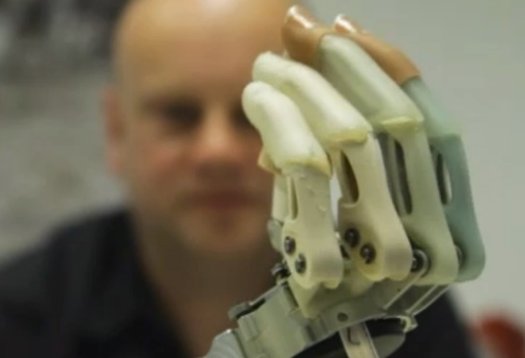
Bionic Hands from Otto Bock Milo's hand will be able to pinch and grasp. via BBC

A Serb living in Austria has elected to have his hand amputated so that he can be fitted with a working bionic limb. The 26-year-old Milo’s biological hand was intact but useless, as a nerve injury stemming from a motorcycle accident ten years ago robbed him of feeling and movement in that extremity. Now, an Austrian doctor--not without controversy--has amputated Milo’s hand and is replacing it with a robotic version that responds to nerve signals in his forearm.

Milo lost his hand function when his motorcycle skidded off the road into a lamppost in 2001, and while his injured arm and leg healed, an injury to his shoulder called a brachial plexus left his right arm without feeling. By transplanting some muscle and nerve tissue into his arm from his leg, Professor Oskar Aszmann was able to restore feeling down through the forearm.

Milo’s hand, however, never recovered. But with the nerve tissue in his forearm restored, electric signals from his brain to his forearm were boosted, allowing for another less conventional option: discard the useless hand and replace it with a robotic one.

After trying out the bionic hand via a rig that fitted a working bionic hand parallel to his real one, Milo volunteered for the surgery. His new hand will be able to grasp and pinch in response to signals picked up by two sensors placed over the skin near nerves in the forearm, using nerve stimuli that would’ve caused similar movements in his biological hand.

Here’s the thing: Milo isn’t even the first person to volunteer to have a hand amputated by Prof. Aszmann. Last year a 24-year-old patient living with a similarly useless hand (electrocution the culprit this time) had a similar bionic hand installed. And, to hear the BBC tell it, he’s happy with the decision and with his augmented arm.

Some of Prof. Aszmann’s colleagues apparently aren’t so keen on the idea of voluntary amputation of biological tissue, arguing that more attempts should be made to repair the hand that’s already there. Aszmann sees it differently, saying years of pointless surgeries would still leave these patients with useless biological limbs.

The crux of the matter is this: we are just beginning to enter an era of prosthetic and neurological medicine wherein the bionic prosthetics are good enough that patients can opt (and have opted) for robotic solutions over conventional physiological ones. That’s a brave new world in many respects, as prostheses and bionic solutions historically have been solutions of last resort (and not great ones at that).

Will patients begin electing for amputation and robotic augmentation over experimental or risky surgeries and lengthy stints in rehab (and is there some kind of ethical protocol doctors should follow in performing such procedures)? It’s a thorny question, and one medical science on the whole is going to have to grapple with sooner rather than later.

[BBC]

17 Comments

I don't see the big dilema. A doctor should never opt for the long drawn out and more painful path when a viable option exists that will speed recovery and use and will return the member to active society quicker and easier with better intergration. If that means cutting off nerve dead parts and replacing with biomechanical, then so be it. Plastic was looked down on when it started to get used for replacements, so did Titanium. There will always be a sect of any population that will oppose the change, even if that change is in fact for the better.

Lopping off dead/nerve dead parts is fine in my book, cutting off viable parts that have not issue just for the sake of an "upgrade", not so much.

Playing Devil's Advocate since 1978

"The only constant in the universe is change"
-Heraclitus of Ephesus 535 BC - 475 BC

Sign me up for a complete overhaul. (visions of the 6 million dollar man)

What else can they replace, and how well does it function? After the kitty cat ears article, now this, its seriously only time till someone gets a tail!

I agree 95% with CodeZero. The man's hand was paralyzed. They did surgery, and it didn't help. He could keep going in and out of the operating room for years, or just have one surgery, a few months or so of learning to use the hand, and be done with it all and back to having at least some hand function. I say he made the same choice I would have.

The 5% I don't agree with in CodeZero's post is about upgrading. I think that if a person with a healthy limb, organ, whatever wants to amputate it in favor of a bionic one, let him. Current prosthetics are, of course, more limited than natural parts, but when the day comes where a fully-functional BCI limb with twice the strength of an average human is available, if someone wants to replace their arm with it, why not let them? I'm assuming, of course, they gave their consent after learning of the risks involved, just like with any surgery.

-IMP ;) :)

@the.tabest: I'm pretty sure people have been getting surgically-implanted animatronic tails for many years now...

-IMP ;) :)

If your limb isn't working correctly, this is a great option. However, it would be best left to those who have disabilities, not those who want to become bionic. If you have healthy limbs, don't hog the prosthetics!

we are witnessing the first steps of becoming cyborgs, 100 years from now (if we are still around) robots and cyborgs will become virtually the same, both having hardware and biological components, could create some interesting politics

I have no disabilities whatsoever, but I have always dreamed of having enhanced bionic parts better than their biological counterparts.

Medicine is based on the principle that nothing should ever be undertaken that worsens the *health* of the individual in a conventional sense. This is not true of cosmetic surgery, which is, frankly, immune to ordinary medical ethics, an entire industry built on causing damage to health to bring about functional advantages.

The amputation is a cosmetic surgical procedure, with only disadvantageous effects on health, and shouldn't be confused with medicine. (Any surgical procedures involved in the proper installation of the prosthesis, on the other hand, would fall under the domain of conventional medicine.)

I support this procedure in every possible sense, of course, but the semantics are important.

It's not a matter of Health. Clearly this mans life will be improved by this device.

His health remains the same, but not having to deal with the psychological ramifications of having a "dead" hand has been removed. In that situation, the over all health of the body will perk right up. A new confidence, and a new lease on life with a bright future can do AMAZING things to the general health of any human.

That being said; if these replacement parts become more available, easily installed, and capable of replacing any part of the body, inside or out, there will be NO MORE disabilities caused by degeneration, or by accident.

If you break your back, we bathe a few "bionic" spinal discs in a stem cell solution taken from your own body, and boom... you're out of the hospital in a few days, with a prescription of physical therapy for a year. You are not wheelchair bound, and with a little sick leave, your life is not terribly interrupted.

As for me, I would like an double ocular upgrade to allow me to see in low-light, infrared, as well as the heat spectrum.

with components in a wristwatch and a high tech glove (possibly with exoskeleton) they can operate the hand without cutting it off. The nerve leads did not require it.

And yet another option that requires amputation, but not further surgery, implants, etc. that will undoubtedly need to be further addressed later in life, or to just buy some time as the bionics are being constantly improved, or to just save money - see the Stark Hand on the cover of the June 2011 issue.

im sure the army would use this as an advantage in war. make all of their soldiers super soldiers by replacing all limbs with titanium parts ala Irobot.

@jedimindset

...That's not the Jedi mind set... That's overly pessimistic.

Don't forget that any program done to any soldier is done so with the soldiers permission. they don’t just snatch people in the night, cut their arms and legs off, and jam new robot ones in their place...

Military applications for this would allow soldiers who lost a limb to continue to serve instead of being sent home. Which if you ask them, they would prefer.

@JSBRADS

I agree completely...
I fail to see why amptutation was necisary to accomplish this. They could have kept the hand, built an armature around it, and used the same technique without the removal of biological material. Outside the box, doc.

@seatellite

lol i know. I'm just saying that's what they would most likely do. but the military wouldn't care what the soldiers wants. they would do what is best for the fighting nations. all in all id prefer this tech for peaceful purposes then evil ones.

Given that the man couldn't move or feel from that hand I think its a good move for him. In time they will develop sensory artificial skin that can go over prosthetic limbs and translate the sensation of feeling as well. It is after-all just a signal to the brain.


June 2013: American Energy Independence

Five amazing, clean technologies that will set us free, in this month's energy-focused issue. Also: how to build a better bomb detector, the robotic toys that are raising your children, a human catapult, the world's smallest arcade, and much more.


Online Content Director: Suzanne LaBarre | Email
Senior Editor: Paul Adams | Email
Associate Editor: Dan Nosowitz | Email
Assistant Editor: Colin Lecher | Email
Assistant Editor: Rose Pastore | Email

Contributing Writers:
Rebecca Boyle | Email
Kelsey D. Atherton | Email
Francie Diep | Email
Shaunacy Ferro | Email

circ-top-header.gif
circ-cover.gif
bmxmag-ps