
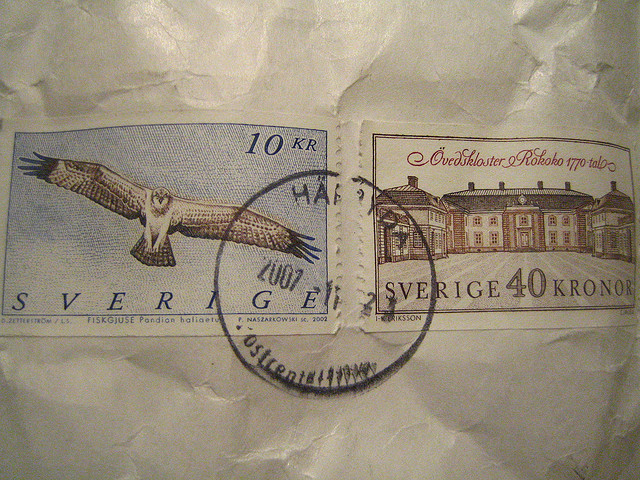
Postmasters in Sweden and Denmark are looking into a clever system of vending postage that a cash-strapped U.S. Postal Service might do well to consider: selling stamps via text message. The system is supposed to roll out in Denmark in April, The Local reports, and Sweden may deploy a similar system later this year.
How does one obtain a postage stamp under such a system? A user sends a text to the system requesting postage. The automated system then texts back a postage code that the user simply writes on any package up to 4.4 pounds. That’s it. It’s unclear exactly how the post office charges for the “stamp,” but presumably it either subtracts from an account the user keeps with the post office or perhaps charges users through their phone carriers.
According to Sweden’s postal chief, the risk of forgery is no higher than it is with regular stamps, and the postal service can cut down on the expense of printing secure adhesive stamps. Moreover, it saves users a trip to the post office just to spend physical money on physical stamps. If we can’t make all mail e-mail, this at least goes part of the way toward augmenting analog post with digital conveniences.
[The Local via Ars Technica]

The incredible innovations, like drone swarms and perpetual flight, bringing aviation into the world of tomorrow. Plus: today's greatest sci-fi writers predict the future, the science behind the summer's biggest blockbusters, a Doctor Who-themed DIY 'bot, the organs you can do without, and much more.


Online Content Director: Suzanne LaBarre | Email
Senior Editor: Paul Adams | Email
Associate Editor: Dan Nosowitz | Email
Assistant Editor: Colin Lecher | Email
Assistant Editor: Rose Pastore | Email
Contributing Writers:
Kelsey D. Atherton | Email
Francie Diep | Email
Shaunacy Ferro | Email
Quite an interesting idea. I wonder how the automated systems in place would handle the written codes rather than scanning the stamps that it is used to scanning. Only downside with big changes like this is the potential need for big expensive changes to the handling machinary and control systems.
I disagree that it makes no difference to the ease of counterfeiting, I think it would make it much easier. Think of all the "hacking" software out there used to "hack" product codes and activation keys. Shouldn't be too much of a stretch to think that that particular type of computing could applied to this new "digital" stamping.
You still have to buy envelopes. And while at it you can also buy stamps. Easy enough if you ask me. The post office will spend way much money maintaining this new text system than printing stamps that last forever. Plus I like stamps because you can learn something from them.
@highermorals,
they don't sell stamps next to envelopes in stores
you don't have to use envelopes--you can send postcards and such
some stamps don't last forever since postage rates increase over time... your $0.34 stamps are no longer enough, so they have to print more, and you have to buy more
maintaining a computerized system is insanely less expensive than printing machinery
You can still buy fixed rate stamps?
I buy forever stamps.
I think you are all missing the big picture...what will all the stamp collectors do? I mean thia is a terrible idea how will they collect stamps!!!!
"maintaining a computerized system is insanely less expensive than printing machinery"
In the long run it will become more expensive. Look at what buying cheap products from China did to USA: it bankrupt USA.
There is less work printing the stamps than running, maintaining, updating the computer system. Way less.
Computers do break and need constant updating. Stamps do not break.
This is why cash is sometimes better than cards : it does not break and it is ready to use.
@highermorals,
That is moronic. WTF do you think runs the printing machines for the stamps? *HINT HINT HINT: computers*
Or did you think there was a guy with a paint brush drawing each stamp by hand and therefore he would be impervious to "breaking".
Or maybe you think they just grow on "stamp trees" or something?
They already use computers to operate the stamp creation... If you move to an all digital system you are taking away complexity by getting rid of the need to maintain and repair the printing machinery--you are still left with the computer/IT costs for processing stamp orders.