
Feature
As nations around the world rush to reconsider their nuclear plans, nuclear experts look toward a future of smaller, safer reactors designed to greatly reduce the likelihood of a Fukushima-sized catastrophe

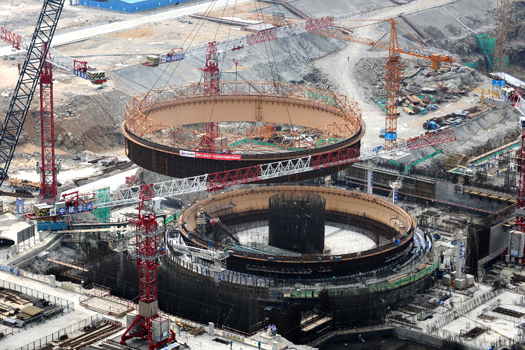
Areva's Taishan 1 EPR Facility Under Construction in China Areva

At this time last week, the Nuclear Renaissance was in full swing. Plans were moving forward to use the $36 billion in loan guarantees for new reactors in President Obama's 2012 budget. China was approving reactor stations at a steady pace, and nations across Europe were considering new nuclear sites of their own. Seven days later, the push toward more and better nuclear power has come to a full stop, as the crisis at Japan’s crippled Fukushima Daiichi power station threatens to unravel into the worst nuclear disaster in history.

But amid a strong, worldwide nuclear backlash, it's important to remember that the next generation of nuclear reactors are designed to prevent exactly what went wrong at the 40-year-old Fukushima Daiichi plant. Which is good, because according to the experts, a future weaned from fossil fuels will include nuclear power whether we like it or not. Here's what that future may look like.

In the days since the 9.0-magnitude quake and resulting tsunami heaped human tragedy and potential atomic disaster on Japan, things have gone from bad to worse at Fukushima Daiichi, sparking a flood of conjecture about the future of nuclear energy worldwide. Switzerland quickly suspended the approval process for three new plants, Germany's Chancellor announced that country would undertake a "measured" exit from nuclear power, and even China--the vanguard of the global nuclear energy charge--showed apprehension, freezing all new approvals for new nuclear power plants.

“When someone dies in a car accident we don’t stop using cars. We work to make them safer.”It’s too early to begin tallying the lessons learned in Japan, but technically speaking most of what’s gone wrong with Fukushima Daiichi's 1970s-era reactors has already been learned and accounted for in the latest nuclear power plant technology.

Keeping a nuclear plant safe means keeping it cool in any circumstances, including those in which man-made or natural disaster knocks out the usual cooling methods. This highlights the importance of safety features built into so-called Generation III-plus nuclear plant models, the latest feasible plant designs. These redundant and passive safety systems work without the help of an operator, or even electricity, during times of duress, be it man-made or natural.

Generation III-plus includes a handful of high-tech plant designs, many of which still await regulatory approval. Others, like France-based Areva’s Evolutionary Power Reactor (EPR) and Westinghouse’s AP1000 (both are pressurized water reactors) are already under construction, and they are designed to withstand exactly the crisis the 40-year-old Japanese reactors are failing to deal with, whether operators are around to trigger emergency countermeasures or not.

“The new reactors really have a lot of features that were not available thirty, forty years ago,” says Michael Podowski, a visiting professor in MIT’s department of nuclear engineering and an expert on nuclear plant safety systems. “These new advanced reactors will employ more passive safety systems that will make them safe without any external intervention.”

Areva is currently building four EPR reactors, two in China and two in Europe. The design includes four independent redundant cooling systems, two of which are engineered to survive an airplane crash.

Westinghouse’s AP1000 packs a battery of passive systems that use natural air flow, gravity, and other natural phenomena to remove pumps and valves from the equation; if the plant begins to overheat these measures will automatically cool the core for up to three days with no external intervention whatsoever.

The Akademik Lomonosov: An artist's rendering of a floating nuclear power station currently under construction in Russia  Wikipedia

Of course, not everyone is sold on these systems. While it’s fair to say that the latest generation of reactors would have weathered the power outage at Fukushima Daiichi better than the existing reactors have, it’s hard to predict just how secure even they might be after a devastating earthquake-tsunami one-two punch.

Ed Lyman is a physicist at the Union of Concerned Scientists and an expert on nuclear plant design, and while he agrees that designs like the EPR far exceed the minimum safety standards set by the U.S. Nuclear Regulatory Commission, he is careful to note that there’s no accounting for the unexpected. “Some new designs might be more robust than others, but generally I think they share flaws in that if you are going into uncharted territory with a severe accident case--which is where we are now with Fukushima--that all bets are off,” Lyman says. “I’m not sure that once you reach that point there would be any clear significant advantages to the new designs.”

Truly safe, secure nuclear power requires plants that simply cannot melt down, and that means going smaller rather than bigger. Podowski thinks one potential future relies on many smaller, distributed nuclear plants--so-called small modular reactors--that would contain a small amount of nuclear material, power a small area of the grid, and be protected by a smattering of passive mechanisms.

Because these reactors don’t concentrate too much heat in one place, no active cooling systems would be necessary to cool them--excess heat would be dispersed in the ambient air. By definition, Podowski says, these small reactors will be safer.

“The small reactors are inherently safe because nothing can happen at the small reactors,” Podowski says. “If something goes wrong they will be shut down automatically, the heat will be dispersed, and it will bring itself basically to a neutral state where there will be nothing coming in or out.”

Will such a future come to pass? No matter how one slices any future energy portfolio, nuclear is a major piece. A further generation of reactors--so-called Generation IV reactors--already exist on paper and explore the possibilities of advanced cooling systems and other technologies that could make nuclear plants even more productive and safer, though none are expected to become reality for another 20 years or so. In the meantime, engineers are experimenting with all kinds reimagined nuclear plant paradigms, from floating nuclear power stations that are immune to seismic calamity to subterranean systems that are already safely buried deep beneath the ground.

Whether or not the pursuit of these designs is blunted by the Fukushima Daiichi event remains to be seen. Dr. Yaron Danon, a professor of nuclear engineering at Rensselaer Polytechnic Institute, is waiting to see whether the Japanese crisis will have the same effect on young people that previous nuclear accidents had on prior generations.

“It’s interesting to see how young people will react to this, the ones who don’t remember Chernobyl or Three-Mile island," Danon says. "Will they say we shouldn’t build or will they try to design better reactors?”

The Japanese crisis is a human tragedy and an opportunity to learn from past mistakes and re-evaluate the future, he notes, but giving up on the nuclear age in its adolescence would be a mistake.

“I don’t see a reason why we should eliminate this technology,” Danon says. “When someone dies in a car accident we don’t stop using cars. We work to make them safer.”

78 Comments

as sad and scary this situation is, the last line sums it all up. If we did add all the deaths related to automobiles, it would be less than nuclear power related deaths, we might even be able to say that the total number of auto deaths outweight all nuclear related (including the 2 dropped bombs)... but overall, we either need better sources of power than what we have now.. be that nuclear, solar, geothermal, water. Fossil Fuel is almost run out... we need to scramble before we face a major issue.

There is too much attention on money, land and religion and not enough attention on saving the human race. We are not trying to save the planet, the planet will still be here after we wipe ourselves out. So stop the "Save the Planet" bs and lets get on the "Save the Humans" bandwagon!

Why don't we simply put reactors in large excavations in the ground that can be easily flooded from a remote location? Set things up so that diverting a stream half a mile away will flood the hole.

@CodeZero: yep, I agree. Although a nuclear accident is a catastrophe of epic proportions which will cause all kinds of nuisance for years to come, one should still put things into perspective. A seldom mentioned fact is that nuclear power's main alternative, coal, causes directly and indirectly hundreds of thousands of deaths globally per year. Not speak of severe environmental problems caused by mining operations and air-pollution.

But, actually, contrary to what you think, fossil fuels in general are not running out. Crude oil is. There's still plenty of coal and gas out there...

@jonsmirl: in fact, I was thinking about the same thing yesterday. Im not sure, but I think that putting reactor deep underground could make cooling it harder. Just a guess...

In addition to all the engineering safety measures, there is still a political question - who operates nuclear plants.

Corporations, by their very nature, cannot operate nuclear power plants safely. Corporations are very good at innovation and wealth creation but looking after public safety isn't their strong suite. Their primary objective is the bottom line so they will cut corners as is seen in the Japanese tragedy as well as numerous incidents in the US.

So, who should operate them? In the US, only one organization has the credentials - the United States Navy.

Uniformed Navy personnel have operated their nuclear ships for decades creating an exemplary safety record in the tradition of Adm, Rickover. Sailors are subject to the discipline of a chain of command and the UCMJ - something sorely missing in corporations. The US Navy operates its own nuclear schools which are the best in the world.

This makes sense if you consider energy independence a national defense issue which makes it the military's business.

So, how would it work? Let the USN design, build and operate nuclear power plants just as it does nuclear powered ships. No civilian contractors in the control room - just uniformed USN personnel. Let the Marines provide security - with orders to kill intruders first, then sort out the details. Sell the power thus generated to corporations who will distribute it and bill the customers. Corporations are good at billing.

Would I feel safe living near a nuke operated by Tokyo Power and Light? No! With a nuke operated by the USN in my 'backyard', I'd sleep soundly.

Underwater reactor I say. what damage could a tsunami do to a reactor complex offshore under the surface? If it lost power and for some unexplainable reason cooling capabilities fail, open valves and flood the complex.

Though what honestly should take place, but enormous costs will not allow, is that the older reactors should be replaced with the newer designs. Take the old unsafe reactors out of service before something else happens involving them.

They HAVE to move to FUSION not this barbaric fission BS ... As you can see fission is too dangerous. The radioactive waste contaminates EVERYTHING in its path. Even under normal circumstances (when not in meltdown!) even radiation suits used there, tools used on site,old fuel, building materials are ALL radioactive and have to be buried! Anything that touches the uranium/plutonium/etc has to be disposed of in a mountain (or some other ridiculous place)because it is permanently poisoned. There is NOTHING green about fission!!!

@Scythelord - an underwater reactor may not be terribly effected by a tsunami, but it probably would still have been damaged by an earthquack unless you plan to just have it floating between the seabed and the surface.

also, can you imagine the devestation if it DID melt down? surely contaminating an ocean would be at least as bad as a surface meltdown.

this is an interesting article. It's good to see that modern reactors are learning from older designs and are safer.

I think one thing a lot of people have very unrealistic expectations about nuclear power, its like the old pilot's addage: "any landing you can walk away from is a good landing". there is a difference between a plant surviving a 9.0 quake, and a plant failing safe in the event of a 9.0 quake. I've heard a LOT of people going off on Fukushima because the plants are toast now and its going to be expensive to clean up.

they got his by a 9.0 quake and a tsunami. they were never going to be able to turn them back on. the quake alone was some five times stronger than they were designed to take and they are, more or less, failing safe. latest reports say the situation in the reactors is under control and they are just working to get water in the cooling ponds now.

its a terrible disaster, but I think its a true feat of engeneering that it hasn't gone horribly worse. Now its just a matter of looking at what they did right, what they did wrong, and incorporating what we learn into the next generation of reactors. barring some unforseen technological breakthrough, nuclear is still the best option for clean and safe (at least as safe as coal or oil, anyways) power.

NO, there isn't a "safe" reactor.

There would have been way more destruction to the earth had these reactors been oil or gas burning. The results of burning fossil fuels are taking decades to be seen. Just because it is slow, it doesn't seem bad as the instant case here or the other two well known reactor disasters.

The only green and safe solution is to reduce energy use. Every time one uses electricity, some plant, animal or ecosystem is being destroyed.

What a silly comment about cars. They killed way more people than any bombs did.

@jonsmirl

Sounds nice, until one with less than good intentions floods it for no reason.

Clearly nuclear power will be greatly needed as fossil fuels become more and more scarce, but people please a nuclear disaster is no small thing. You cannot compare nuclear powers safety to the safety of coal because there is no comparison. Coal directly causes pollution and does lots of damage over time (harvard study found coal has cost the us 400 billion in loss of productivity and damages), but will not cause a global disaster (quickly). Nuclear on the other hand causes very harmful pollution that will not effect anyone unless we run out of "safe" places to keep its waste. But what nuclear can do is cause a large explosion which can kill many people, but more importantly release radioactive fallout which can cover 100's of miles. This fallout can cause plant life to die, and also humans to suffer from cancer and deformed babies. Remember Chernobyl!!!. I understand that nuclear will be needed but we must be extremely careful and not rush into things. Also we need to make sure that not only our own reactors are safe but also the reactors of other countries.

The solution is going green and dismantling existing nuclear powerplants. The are plenty of powerful good renewable sources wainting to explored.

Nuclear Power => nuclear waste => leads to a big problem...we cant just throw the waste in coffins to the underground and wait for the next genarations to be contaminated by it...even if it is in the next 10000 years.

Despite a generally high security standard, accidents can still happen. It is technically impossible to build a plant with 100% security. A small probability of failure will always last. The consequences of an accident would be absolutely devastating both for human being as for the nature. The more nuclear power plants (and nuclear waste storage shelters) are built, the higher is the probability of a disastrous failure somewhere in the world.Fukoshima is just an example..

The energy source for nuclear energy is Uranium. Uranium is a scarce resource, its supply is estimated to last only for the next 30 to 60 years depending on the actual demand..yup Nuclear isnt forever also..

Why not just harvest the sun?!

Your nuts codezero. There have been no nuclear power generation deaths except those at Chernobyl. You stupid lying moron. Makes me angry when people start telling lies to try and get gullible readers to form an opinion as stupid as your own.

Now we all know what your name stands for and that is zero brains!

I think that we need to harness the power of the sun, wind, and water, but as we all know these alone will not provide enough power. Also, you are incorrect in saying that Uranium is "the" energy source for nuclear power. While it is true that it is the most common, there are many other elements than can be used. In addition, 10000 years from now we will have found uses for the nuclear waste or ways to efficiently recycle it, so it will not be a big problem them. We just need to make sure that until then we are very careful with the waste so that it does not cause too much harm.

@gizmowiz chernobyl was kinda a big deal. And as far as we know the waste from other plants could very well have caused illness and eventually death to people. Im sure if I felt like wasting my time i could find good evidence that shows nuclear waste has in fact killed people.

@gizmowiz

Wow, your comment couldn't have made you sound like more of a moron. It's very rare to see such immature comments on popsci, but there you have it. Not only is your comment disrespectful, but it is also (from what I can see) completely wrong. CodeZero didn't say anything about "nuclear power generation" causing deaths. He DID, however, comment on nuclear power related deaths in general (for example nuclear bombs included). I believe you may need to grow up and read more thoroughly.

No he didn't say that. Here is what he said:

'If we did add all the deaths related to automobiles, it would be less than nuclear power related deaths'

This is saying specifically that ALL auto deaths are less than ALL nuclear power related deaths.

He did not say that ALL auto deaths are less than deaths by nuclear weapons. There is no listening of 'Weapons' in that sentence period.

Get YOUR facts right and learn how to read.

Ah crap, I read that backwards. Oh well. Either way, your comment was childish.

If Japan had used LFTRs there would have been no problems. LFTRs have a very simple fail-safe shutdown, all it requires is a loss of power to a cooling fan and gravity. A frozen plug is kept frozen by the cooling fan, and when it melts the liquid flouride drains into catch chamber. This is so simple and safe that the researchers in the late 1960s would turn off the fan when they went home Friday night and restart the reactor Monday morning.

I think our best choice is the Liquid Fluoride Thorium Reactor. LFTRs are a proven technology, research was terminated in 1975. New advances with better heat exchangers and the Brayton cycle turbines make this a highly desirable option. LFTRs can burn our stockpile of radio-active waste from existing nuclear power plants. (Because LFTRs are so efficient it would take over 100 years to do this). LFTRs produce little long term radio active waste, or products suitable for making bombs. The radio-active waste produced has a short half life and requires only 300 years of storage as compared to the uranium waste which has to be stored for 10,000 years. There is also much less radio-active waste, 0.3% for equivalent power from uranium. Thorium is plentiful, there is enough in coal ash and mine tailings to power the world for 100 years, and a million years supply can be dug out of the earth. See:
http://neinuclearnotes.blogspot.com/2008/11/thorium-at-googles-tech-talk.html
and also:
http://energyfromthorium.com/
We should build a factory to build these in a size small enough to ship on trucks (200MW) and an assembly line will bring down costs. These could be set up all over the world (no worries about nuclear proliferation) and first locations should be to replace coal and oil fired electrical generating plants, because there is already power distribution set up at these locations. Pollution from these sources will be terminated.

are these new designed reactors small enough to power a small city? if they are why not just let cities power themselves? I would feel comfortable living near a small power plant if it was a lot safer and meant my city was getting cheap electricity.

@Scytherlord: I found your method very interesting but there could be a few flaws to this idea. It might be immune to tsunamis but it would definitely take some damage from waterspouts, tornados, hurricanes, and underwater volcanoes. Even assuming it was relatively safe towards these events the risks outweigh the cost and the effectiveness of these plants. Therefore I think the best choice would be to rely on the sun, water, and wind as sources of energy due to the fact that uranium is not going to last us forever. We must think ahead and not focus on trying to find a quick solution to our problems.

A 9.0 earthquake and tsunami destroyed countless lives and property. No one is complaining that every house, factory, and fast food eatery in the path of this thing failed.

The reaction is simple. Evacuate, wait for conditions to stabalize, then go back in and rebuild.

The same policy could be applied to the nuclear plant. Nothing could or reasonably would be built to withstand something which cannot be withstood - that would be idiocy. Evacuate, let the plant melt down, and in a few decades go back in and fix things up.

There is a McDonald's now near where ground zero of Hiroshima was. You can take a backpacking trip through Chernobyl. We are surrounded by radiation and most people have suffered from it (a sunburn).

How many nukes did we blow up in Nevada before we even realized that the people downwind were suffering any effects?

@Oakspark:

Ehh... Not really a good idea... You can't just leave a plant that is in full meltdown. It's not a very wise choice.

@Everybody else:

As to what others have said, nuclear fission is not perfect, but it is a better alternative than coal. I say that and I live in Indiana, where we have but three exports: food, limestone, and coal.

Coal causes problems both in mining it and burning it. Nuclear has mining issues and disposal issues. Neither is perfect, however nuclear has the potential to be much better. Fission is typically a safe technology and the waste really isn't that much of a problem because there is no shortage of mountains we could bury it under.

As for future plants, there are ways such as heatsinks that would make plants very much resistant to outside forces. And one must not forget just how hard Daiichi got hit. Let's see your house/business get hit by an earthquake and a tsunami. How much do you think would be left? The fact that the thing is still standing is impressive. Stop complaining about the things going on now, there is an earthquake that hit it that was 2.0 higher on the Ricter Scale than what geologists thought was even possible there. It wasn't designed to get hit that hard. In fact, it would only have suffered relatively minor damage had the tsunami not delivered the final blow.

This thing took way harder hits than we thought were possible, let alone likely and it is still standing. Does it still function? No. But there are some lessons to be learned in Daiichi, and one of them is the importance of redundancy.

As for future safety systems, they are coming. They will get here and fission reactors will be much safer as a result. Think about this for a second. How safe were cars back 40 years ago? Let's say you had a 40 year old car. How well would it work now? Probably not well. How safe would it be? Not very. Just like in cars, where we now have advanced airbags and designs, nuclear reactors have had time to improve. This thing was built 40 years ago. It has functioned for that long and withstood that kind of a hit. Imagine what one built today would survive. Imagine how safe it would be.

It's interesting how little discussion there is about Liquid Fluoride Thorium Reactor technology. This alternate design for producing nuclear power was developed and tested at Oak Ridge National Laboratory at the same time as the current reactor designs. LiFTR designs are much safer , much smaller, much cheaper. The "downside" of LiFTR is that it produces no weapons-grade plutonium, and for this reason the Atomic Energy Commission et al passed on implementing it.
Look, I'm no expert on nuclear power, so do some checking for yourself. Run a search on Liquid Fluoride Thorium Reactor, watch the very instructive Google Tech Talk videos, follow the links, read about Alvin Weinberg. This technology is extremely exciting.

If the Armageddon asteroid happens,there will be nuclear disasters worldwide. Unless they are idiot proof. That won't matter too much because Armageddon is supposed to happen after a nuclear war. The Nuclear war happens after the poison . The poison happens after a CME. The CME happens after the 1 o' 7 angels...already happened.

subject to interpretation

When someone dies in a car accident, some ONE dies. or maybe two, three or ten. in worse situation, if two bus collide, there will be maximum 80 to 100 victims.
but if a nuclear reactor melt down, ... you know it !

"If we did add all the deaths related to automobiles, it would be less than nuclear power related deaths"

furthermore, most of deaths by car accidents, are not because of Car. but alcohol, texting, checking facebook, looking at the face of other drivers,...list goes on

@Roy_H Very interesting post, thank you.

Nuclear fission power generation methods are in need of some massive and prompt rethink! The economic gains from radical advances and public safety needs could be exactly what we as a modern society could use right about now.

Being on the eastcoast of the United States and never paying much attention to the amount or proximity of the nuclear power generation plants around us until the disaster happened in Japan, well let's just say there is nowhere to hide, and if any sort of event were to occur it would be rather tough and congested to try and run far away.

As the world feels the pain of Japan, this might be a ripe time in our history to step up from status quo and apply some advancements, hopefully exponetially! Hell even if we are fooling ourselves at least try, it could make for some jobs and some improvements to our safety along the way.

If power generation is de-regulated, what would it take to get a bunch of knuckleheads together and try a Liquid Fluoride Thorium Reactor?

“Politics is far more complicated than physics.”
Albert Einstein

QuantumQuantum, What needs to be done now is spread the word. Not until enough of the electorate starts clamoring for LFTRs will politicians even discuss the possibility. If politicians see that supporting an LFTR project will get them a large block of votes, then things can move forward. There has been a concerted effort by scientists to make politicians aware, but in 10 years there has been no acknowledgement.

I found this comment in this article insulting:

“When someone dies in a car accident we don’t stop using cars. We work to make them safer.”

This is Bushit. Cars are made safer due to government regulation which all industries fight tooth and nail to stop as they are doing today with the fighting of the Elizabeth Warren's Consumer Protection agency. Even the Nuclear regulatory agency has failed in keeping us save over the last few years where 14 near miss accidents have occurred within reactors sites.

Oversight and regulation is essential with corporations like these and when those corporations fight regulation they are hiding something and that should trigger an automatic investigation - this is needed to protect the people - not the corporations.

I found the line "“It’s interesting to see how young people will react to this, the ones who don’t remember Chernobyl or Three-Mile island," Danon says. "Will they say we shouldn’t build or will they try to design better reactors?”" pretty fascinating, as i'm 17, and agree exactly with Prof. Danon's closing line, to the point that i'd just posted a few tweets ranting about it in a similar way moments before i read this post; whilst my parents, who did live through those meltdowns, are rather against it. Apparently, i'm looking at the improvements that will obviously have been made, while they're looking at the past disasters.

@joeyjam
Cool, looks like it's up to us young'uns to teach the old folks how these things really work. Say, ask your parents how they would feel living next to a coal-fired power plant compared to living next to a nuclear power plant. Then show them some statistics on deaths related to the two separate types of plant. See if that changes their mind.

@bushit...what you just said is bushit...some car makers work to make cars safer, some are made to make cars safer...you are obviously wrong because someone worked to make cars safer or we wouldn't have seat belts or airbags...the article just wasn't specific on who worked to make cars safer

"worst nuclear disaster in history."

are you sure?

I think mankind should change the paradigm, investing in dense, clean and safe sources of energy instead of polluting and radioactive energies. I believe next-generation reactors could power a safer nuclear future using aneutronic nuclear fusion instead of nuclear fission. No neutrons, no radioactive waste, an enormous amount of electricity using small area, it is to be one of the most dense and environmentally friendly energy than even. www.crossfirefusion.com/nuclear-fusion-reactor/overview.html

electric38

Why bother with nuclear. Solar is here. Solar is becoming inexpensive enough to be on millions of rooftops RIGHT NOW!!. It does not need to be owned by a monopololistic entity. The power from the sun is free.
Electric cars and bikes are being advertised with solar canopies. This is definately the way to go. Out with the old radiation producing monsters -in with cleaner renewables.

The way I see it, we should be building thorium fission reactors. A thorium reactor can't blow up or melt down since it needs a continuous injection of neutrons from an external source in order to sustain the nuclear reaction. Turn off the external neutron source and a thorium reactor shuts down immediately. Thorium reactors produce nuclear waste which needs to be stored for only a couple of centuries compared to thousands of years for nuclear waste from conventional nuclear reactors.

Thorium reactors should be considered to be a safe interim technology for the next 30 years or so. The real push should an international effort to create viable fusion reactor technology. There are several potential paths for achieving fusion technology, but it needs to be an international effort due to the initial expense of developing the technology.

@jonsmirl
because when you try to cool something like a nuclear reactor with unpressurized water, it flashes to steam, and then you have a nuclear reactor flooded with steam, which is a much worse problem because then it just heats up faster.
@everyone else that is posting suggestions:
unless you have majored in nuclear power plant design, chances are you have no idea what you're talking about. No matter what you've read and how much you think you know, you don't know everything. sorry about the rant, pet peeve of mine.

Why is our Thermonuclear Sun 93 million miles away ?

Because we do not have bon-fires in our
living room and expect to live.

NO EARTH BASED NUKE ENERGY IS SAFE PERIOD.

Besides there is NO ENERGY CRISIS, only a truth crisis.

CRUDE OIL IS NOT RARE, IT IS EVERYWHERE !!!!

SECRET is that BIG OIL is treacherously behind
the Fake Environmental movement, Nuke Energy,
etc etc, because more and more are finding out
that CRUDE OIL IS ACTUALLY the PERFECT FREE ENERGY
that we have simply been getting ripped off decade
after decade, and now they have to quickly switch
to more complex schemes to avoid having to lose
their FRAUD based grip on the world.

READ HERE PLEASE:

EARTH BASED NUKE ENERGY IS STUPID http://GOO.GL/zJCuP

CRUDE OIL IS NOT RARE IT IS EVERYWHERE
& is FREE ENERGY YOU PAY FOR !!!: http://GOO.GL/5GDIB

'BIG OIL's CRIMINALITY, IS THE PROBLEM, NOT OIL,
ARREST THEIR CORRUPT LEADERSHIP !!! http://GOO.GL/92eF0

Robert1234 Until the waste disposal problem is solved, building more nuke plants is stupid. STUPID. Nothing is more important than creating 100,000 year killing material by the multi-thousand tons with no possible way of storing it safely.

The vaunted designs are utterly stupid. 30 years ago I filed a complaint about the emergency cooling systems, pointing out that putting the reactor ABOVE the cooling water has to be the dumbest engineering design in the history of the world. I've been proven right. 100% of the real emergency cooling attempts have failed. PUT THE DAMN WATER ABOVE THE REACTOR and let mother nature keep the reactor filled!

But...the waste is the whole ball game. NO NUKES! PERIOD.

Ah yes, nuclear power, brought to you by the Friendly Atom: "Energy too cheap to meter." Where have we heard that before?

Putting aside such simpleton objections such as the absolute lack of a safe way to store nuclear waste, given that it takes tens or hundreds of thousands of years to degenerate -- and civilizations, let alone nations -- seldom last more than a few hundred years; or the fact that reactors are beastly expensive to build and maintain; or the fact that fissionable materials are an invitation to nuclear terrorism; or the fact that when something nuclear goes wrong, it goes REALLY WRONG...putting aside those objections, nuclear power still doesn't make sense.

Ores that contain reactor-quality radioactive elements are scarce and mining it negates the environmental advantage that deadly gamma rays and strontium-90 waste allegedly have over coal dust and CO2 (which only matters if you believe in global warming, which most nuclear defenders in my experience do not).

Most of the nuclear champions grudgingly acknowledge that working with nuclear reveals one big black hole of ignorance after another, but "in a thousand years they'll have it knocked." Great. I'm here for 75 if I'm lucky. If your friend The Atom doesn't take us out sooner.

There is more energy in the tidal currents than in all the reactors ever built. There is more energy in the wind than all the oil that remains to be consumed (not much, it's true). There is more energy in the sun's radiation than in all the others combined, because it is the source of them all. When you add in conservation, it's a no-brainer.

Why waste all that good brain power cobbling together deadly tinker-toys when we can create lasting solutions that don't require us, like a vampire movie, to suspend our disbelief. We all know nuclear is a shell game. Let's get past our childish fantasies and like adults solve our energy problems once and for all.

Oh, and to that question about today's youth being blithe to the dangers of nuclear power now that Three Mile Island, Chernobyl, and the Thresher (yes, even the USN can't figure out nuclear) are behind us ...

What do you call Fukushima? A sand box?

I see no fear in Nuclear Power with the new plants. It's stupid for blanket fear on others mistakes or accidents. I hate that it takes so long to get a plant built.

I was stationed aboard the USS Enterprise for almost 5yrs. It has 4 small Reactors of which only 2 were online at anytime while the other 2 would undergo maintenance procedures. We NEVER had an issue. Using smaller reactors and more of them would be much safer since they wouldn't necessarily be all at the same location. You could centralize the the controls in one place, yet have local control systems when needed. Have 2 small reactors at any given location where 1 is online when the other is being maintenanced. Plus, if there was a surge in demand you could bring the other online to temporarily meet the need. I'm sure this isn't a complete solution, but I believe it is a viable step in the right direction.

What's next Nuke/Fracking plants everywhere in the US (projected 10-15 small scale plants by 2030), little by little corporate american is going to run the show (us govt).. special interest groups are doing now.. and the human race is going be done by 2600.

Sysop - Brazil just found the largest oil reserve in the world on there front porch (50 miles off the coast of Rio de Janerio)!! Larger than all of the World's oil reserves put together. Petrobras officials say the oil reserve has a life span of 200-300 yrs or more.. They also believe there is another oil reserve in the Amazon, with an oil yield of 500 years!!

The funny thing is - Prez Obama just went there the other day to talk to the first female prez, and talk about sending "Support" to middle east (Brazil is a neutral country like the Swiss, they don't get involved) and setup an alcohol/oil trade pact, he wants to put together..

This is a robust discussion and rollicking good read.

I encourage all to be civil and refraining from insulting flaming rhetoric; it is not helpful.

While I like the idea of USN service personnel running our power stations, many already do (veterans). They must be paid the fair market rate for their work.

The small modular design is the best idea we have seen in years. I imagine they are hard to sell to power companies who cannot exert economic control over us through them. Perhaps it is time to discard the free-market model for nuclear power generation. Power companies buy and make profit from buying big plants. Now they are coal fired plants. Coal fired plants generate radioactive waste, too; it is diffuse and so goes unnoticed, but it is there.

Waste is one of the BIG problems associated with nuclear power generation. Ivar Gaever has long been a vocal proponent of glassification; perhaps he is right. Current methods are unsuitable. Aspects of the matter are cooling and isolation. Has anyone explored the feasibility of storing nuclear waste in Antarctica? The continent offers cooling and isolation galore, but then we are left with the problem of safe secure transportation. I'd appreciate reasoned, civil feedback on this matter.

@ Bob.Jacobson the last part of your comment included the Thresher in the very short list of nuclear accidents is actually incorrect as the U.S. Navy as safely operated nuclear reactors on their ships an subs for fifty years. The Threshers was lost due to a totaly separate mechanical failure that caused flooding of the sub.

Well, when all is said and done, the radioactivity is still there--it doesn't go away regardless of the size of the plant. The initial nuclear thrill is long gone---I am reminded of my WWII vet Dad who often quoted this: the bitterness of poor quality lingers long after the sweetness of low price is forgotten.

The scientific community typified by Oppie who explained why they developed the bomb: it was just too sweet to resist, thought they had taken the giant leap and only had to finish with baby steps to reprocess the hugely radioactive waste. Hubris! Where is France going to get rid of that radioactive material except in the Libyan desert?

I have read all the above posts. It seems that there is either some confusion or lack of realistic thinking.

I know very well the Fukushima # 1, reactors 1 and 2. In the early 1970's I worked for a company that was asked to bid for the no. 2 thru 8 reactors to be built. (number 7 and 8 have not yet been built.)

The existing GE reactors both then and now have some design problems, however the reactors, turbines, generators and spent fuel pools survived a quake 10 times as great as the design. And they also survived the tidal wave.

The problems originated by (the Japanese ) underestimating the vulnerability of the emergency power generators.

We really do not know yet if the emergency pumps or motors were damaged - but it seems not.

So taking the situation as a whole, considering that to date there are only about 450 nukes world wide --- we are practically still in the prototype phase.

As tragic as a death is, we kill people on every big construction site, in automobiles and in lots of ways --- including the "Titanic".

But due to the Titanic disaster, we didn't go back to row boats.

Several years ago, I burned up a car engine because the fan motor failed ---- and unlikely, but the temp light didn't work ------------ I didn't ditch cars and go to a bicycle.

So I think that both pro and contro nukers would spend their time better --- by demanding laws that really look at design and construction deficiencies and remedies. AND develop three or four designs - rather than designing every plant from zero.

We would save money, save time and be safer.

We enjoy a world where a horsepower hour or two manpower hours cost only about 25 cents ------- doesn't this seem to border on the miraculous???

So instead of going back to candles, let's concentrate on how to make nukes safer.

During the early 1960's, I worked in the Titan II, nuclear missile sites --- the emergency power generators were in a shelter designed to resist the same blast as the missile silo. So at least 98% seems possible.

Forget 100%, you cannot afford 100% of anything -- so grow up and forget about it. And, not let the quest for perfection get in the way of "better".

Regards

hmmm...interesting...that gives you somesthig to think about...

The earth is a nuklear melt down inside.
SC

There have been three nuclear accidents in 70 years, as compaired to how many toxic water containment dams that are used with coal fired plants that have broken and flooded large areas?And the coal and oil and natural gas power plants spew toxic chemicals and heavy metals 24/7, but that's OK?At least this nuclear reactor disaster will push Japan to build solar power satelites much sooner than planned.

Imagine this. Before the nuclear age, Plutonium only existed in very minor trace amounts. This element is very highly radioactive. Very poisonous, and it alpha particle decays. Before I learned about nuclear power waste, I was very pro-nuclear power. Now, American Power plants produce 56 tons of Plutonium per year, and have now idea what to do with it. Certain isoptopes of this most poisonous substance known, can take up to 80 billion years to decay. I would not even trust this substance buried underground. Oh, quick side note, supposedly, our solar system has only been around for 4 to 5 billion years.

A few corrections: American Nuclear Power Plants produce 56 tons of Plutonium as a waste when Uranium-238 keeps getting bombarded with neutrons. This element existed in nature in such low quantities before the nuclear age, that it was considered non-existent. This waste is what most scientists, governments don't know what to do with. All Plutonium isotopes are radioactive. Plutonium causes many cancers, kills bone marrow. This element, mostly man-made, is beyond scary.

@Copperelmo,

Lots of things are scary.

Under the table politics.
The Mafia.
Hand in glove, or hand in pocket regulators.
(brought to you by the same people)

Getting out of bed.

Pulling your head out of the sand.

****************

Nukes are NOT going to disappear.

Humans are both tough and lazy, maybe it takes killing
50,000 or so to wake up.

No and No and no and walls are easy to circumvent, you just walk around them.

Get seriously involved in your future.

The earth, being spherical and rotating, is sort of self balancing.

If you are not pro-active(not whining)about your future--- the balancing effect is simple - you won't have a future.

Regards

Are most of you even aware of what you're asking... The majority of you would like to see nuclear power go away, begin dismantaling. And exactly what would take it's place? You would ha've to find a way to fill the giant energy gap, since nuclear power generation accounts for about 20% of the worlds energy usage. You may think that's a small gap, but no it's huge, it's worldwide.
If you took the world's 20% stake in nuclear energy away, it would be extremely hard to replace because of some fear-mongers telling you it's dangerous. I'd like to see how someone could replace that sheer amount of nuclear power generation. You say you can't live with nuclear... I say nuclear is essential to our future, until fusion reactors and other forms of truly clean energy arrive. :-)

Just build the reactors in pods, place them deep in the ocean. If/when they fail, just pop the pod and it is flooded.

The most powerful force in the universe being compound interest as a mantra that many, many societies and people on our planet subscribe to is making the much needed energy challenges of humanity's present day needs a slow and painful march to a gloomy tomorrow for our children's children to be stuck with.

Who cares, as we won't be around in 75 years, right? With much passion I say, WRONG to that rationale.

This will most likely be regarded as just a utopian folly on my part: provide every human being from birth until death random access to all of humanity's collective knowledge, so debates on several topics and challenges such as "energy" for instance, could have a LOT of informed voices included in those debates.

The terrible events in Japan did happen, and every concern raised by the lay citizen to the most learned academics all over the world should spawn innovation, safety, confidence, and HOPE!

To my fellow entrepreneurs: money appears to answer a lot of problems in today's "reality", only to be a cost for some distant future to try and reconcile. Reason, foresight, and civility are not fungible financial instruments currently, perhaps someday they will be.

Politics are still far more complicated than physics in 2011, Dr. Einstein.

@copperelmo

Radioaktive radiation is inversely proportional with the decay. Uranium 238 has a half life of 4,5 bill years and is low radioaktive. Cesium 137 has a half life of 30 years and is medium high radioaktive, but is considered high radioaktive because it decays to Barium 137 which stabilize by emitting gamma radiation. Iodine 131 has a halflife of 8,3 days and is high radioaktive.
Plutonium 239 has a halflife of 25000 years, its is a not very deadly poison. There is spread more than 10 tons of plutonium after bombs, in Nagasaki there is spread 5 kg after the "Fat Man", and never cleaned up. The main reason for US to stocks the Plutonium is use in weapon. Plutonium 239 is the best for weapon. Plutonium could easily be used, and is used, as nuklear fuel. To get rid of plutonium, just burn it in a nuklearplant.
Plutonium 238 has been used as a "battery" in pacemakers, it has alpha decay and a halflife of 87 years, in a radioisotopgenerator it will produce electricity, now this use is taken over by Lithium-ion batterys. Plutonium is still used as batterys in satellites.
Plutonium is not more dangerus than a lot of other radioaktive materials and poisons, the scary is the weaponuse.
SC

Again, Plutonium did not exist in nature 'til we created it. Now we produce 56 tons of it every year in the Nuclear Power Plants. Some isotopes decay quickly, but others last a long time, emitting gamma radiation along the way. Nobody would think of using Plutonium for pacemakers these days, but if you trust you would be safe, then go for it. Secondly, it only takes 5 kilos to make a nuclear weapon. A typical Uranium reactor only uses 3% Uranium-235, thats a lot of leftover radioactive Plutonium. This is a lot of Plutonium waste being produced, poisoning water, our ground. Many neutrons and alpha particles released do not just disappear, they cause other elements, molecules to become radioactive. This is a large domino effect. Many of you say we need Nuclear. I would rather fill Nevada with solar cells and our coasts with wind mills. This is a better investment, especially when we do not have the use for THIS MUCH MAN MADE PLUTONIUM, or leftover uncontrolled radiation. Oh by the way, The water in those reactors, do you all believe that it just gets filtered and it becomes potable again? Also, planet earth is not a nuclear reactor, like our sun.

Scottar

For those who think wind and solar can power the grid:

From many actual studies solar and wind do not really replace fossil nor nuclear power. Since it's not 24/7 and there is no economical storage technology, it's only good for remote power.

Although there is much energy in wind and solar it is too diluted to effectively harness for electrical power for the grid. It's like trying to mine gold from seawater, the costs outweigh the yields.

So the best future power remains Thorium, Gen IV nuclear and beyond with fossil for the next century. Solar can best be harness for heat from passive structures or hot box collectors.

Check out masterresource.org

The problem is human interference. Humans, as we all know, are flawed, and as such we will continue to fail and screw up horribly. No persons judgment is perfectly sound. The more we take people out of the equation, the safer we all happen to be, ironically. All failure of machines, cars, etc. are due to people doing something wrong, and the best we can do is fix that one error and move on, but that's not enough. We have to go further. Now nuclear power may not be the safest thing around, but its definitely not the worst. People kill themselves daily by smoking cigarettes, and often indulge in alcohol and end up taking place in an unsafe act getting themselves killed. So, tell me, is this a good idea, cause I'm sure it definitely not our worst.

I am not a luddite when it comes to technology but I do believe the author of this article ignores some major issues that have existed with nuclear power since its inception.

The Waste - No one has yet addressed the issues of where to store the radioactive by products of nuclear reactors for a a long enough time to make them essentially inconsequential to life. It is fairly unlikely that we will ever come up with a solution to this issue.

The danger of proliferation - We already have enough issues with countrys like Iran and North Korea using nuclear reactors as a method of producing weapons with out adding to the problem. If we build say 350 more reactors in the next twenty years how can we deny other countries the right to build them with out backing it up with the threat of military force?

The Cost - Nuclear plants are so expensive that it takes government gaurantees to make them economically viable. The private capital markets have shied away from investments in nuclear power for this very reason. This would once again put taxpayers on the hook for all the cost overruns and potential disasters of construction. Having had the experience of bailing out large financial concerns due to a 'financial meltdown' caused by a lack of regulatory vigilance, I wonder if taxpayers are ready to foot the bill for future nuclear meltdowns as well. One of the chief reasons the nuclear power industry gives for the expense of building and operating nuclear plants is because of overregulation.

The author comments that 'according to the experts, a future weaned from fossil fuels will include nuclear power whether we like it or not.' Whether this is true depends on which 'experts' you talk to. Are they experts with a vested interest in a renessaince of nuclear fission like GE or the NRC? Also, nuclear power has another advantage for large corperations, it keeps most customers tied to a centralized grid. Essentially, you have to buy the power from them which solidifies their profits.

Finally, the author talks about wind and solar never being able to meet our needs with no mention of conservation, co-generation, smart grid, geothermal, fuel cell, tidal and wave, or carbon sequestration technolgies now on the immediate horizon.

The author paints a picture of a world largely powered by the atom with out addressing the very real safety issues surrounding it or the natural tendencies of large complicated systems to suffer catastrophic failure from the occurence of multiple failures which no one will be able to predict. He leaves us with the supposedly telling comment 'I don’t see a reason why we should eliminate this technology,” Danon says. “When someone dies in a car accident we don’t stop using cars. We work to make them safer' This is perhaps the least informative part of the article since the primary reason people die in car accidents is precisely becuase we have so many of them and human error causes the majority of the accidents, something which will probably never be eliminated. However any single car accident has, at most, the ability to tragically impact only a few lives at any one time and doesn't have a continuing impact spanning multiple generations of human beings.
Let me close with my own telling comment, to borrow a phrase from Ralph Nader, "Nuclear power: Unsafe at any speed."

While the odds of any one place having a 9.0 earthquake an ensuing huge tsunami may be low, we should not be lulled into thinking that they shouldn't be planned for.

There have been 5 earthquakes of 9.0 or greater, since 1952. We are lucky that the 2004 Indian Ocean 9.2 quake and tsunami didn't also create a nuclear disaster. Had there been nuclear reactors in the path of the tsunamis which reached as high as 98 feet, Sumatra, India, Thailand and Sri Lanka might have been vulnerable to such a nuclear event.

According to Wikipedia, there is an earthquake over 8.0 magnitude once per year on average.

Here's the problem with nuclear - human hubris and stupidity and the chance of someone basically making a mistake, a bad weld, a improperly made or installed valve, etc. By hubris, I am referring to how these worst case natural disasters are not planned for. This is true not just in Japan. Given the financial restraints on nuclear developers and investors, a value judgement must be made regarding cost risk analysis, which seems to underestimate the potential for such natural disasters as well as undestimating how things can unravel quickly when things go bad. Diablo Canyon in California is near earthquake fault lines. Turkey's first planned nuclear power plant is now in question because it lies on a fault line.

Storing used fuel rods in water pools that are not in a primary containment building is another example of what I'm talking about. There are two dozen plants in the U.S. that store waste this way.

Though I'm not that knowledgeable about nuclear energy, I have heard good things about newer nuclear designs, like LFTR thorium reactors. If they are as safe compared with existing plants as they say, then nuclear can contribute to clean energy. The problem with nuclear advocates is that they overstate their case, dismissing renewable energy as a waste of time and money and pushing nuclear as the only alternative to fossil fuels.

If renewables are such a waste of time, why does Germany now get 17% of it's power from renewables, compared with 22% from nuclear? That's in terms of kilowatt hours generated, not just generating capacity.

Renewables are much faster to build and offer power price stability that no fuel can. Parts of northern Germany get 40% of their power from wind. Denmark gets 20% of their power from wind and seeks to have all renewable power, with the exception of natural gas peaker plants as backup to smooth out the grid.

The U.S. is blessed with huge tracts of land suitable for wind and solar farms of utility scale. We also have enormous potential for offshore wind power.
I believe we need both distributed power from PV solar rooftops etc, but also utility scale renewables, both solar and wind. And I don't rule out nuclear,as part of the mix, although I still believe the job can be done without it.

The alternative that most Americans don't even know about is -CSP or solar thermal electric power. (concentrating solar power) CSP plants harness the heat of the sun, using parabolic mirrors to concentrate it. They boil water to drive a standard steam generator hooked to a standard power block. Essentially, very low tech.

In the southwest, there is the potential for 1,000 GW (1,000,000 MW) from solar thermal power plants with molten salt heat storage. For comparison, the total U.S. nameplate generating capacity is now about 1,200 GW. Arizona alone has 285 GW potential for solar thermal, also called CSP . That means Arizona's potential is about equivalent to 150 nuclear power plants, even after adjusting for solar's intermittency. Intermittency is nowhere near the issue with solar thermal, that it is with PV solar or wind energy. As long as it has the molten salt heat storage, that is. This is the game changer for CSP, solar power even at night. When you tap the heat radiating from a mass of molten salt, you have steady power uneffected by passing clouds, and it is valuable dispatchable power that can follow the load. In other words it can adjust output to the demand, while storing energy as heat for later use. This dispatchable power is something coal and nuclear- base load plants -cannot offer. And this dispatchable power makes it easier to integrate more intermittent PV solar and wind energy into the grid. The first CSP plant with heat storage in Arizona, will be able to produce power for 6 hours after the sun goes down.

The numbers above are from NREL and are based on using a tiny percentage of the available and suitable land in the desert areas. Allowances for buffer zones around any sensitive areas, roads, habitation, lakes rivers etc are included in these estimates.

In order to truly realize the potential there, we need to build HVDC long distance transmission lines to carry power to more distant locations. However, a study for the Western Governors Association found there was 300 GW potential near already existing power lines. The NREL website has lots of info on CSP. They have run 9 smaller pilot plants in the Mojave desert for over 20 years. These 9 plants produce 345 MW of power. Commercial CSP plants are much bigger, at 100 -1,000 MW each.

California has 98 GW of CSP potential, compared with the 60 GW or so the state now produces from all energy types.

Of the two major types of solar thermal plants, solar trough type plants with heat storage have capacity factors of about 50%, while more efficient power tower type plants can have capacity factors of up to 70%. For comparison, PV solar is probably about 20% and wind about 25-30%. Nuclear and coal plants have about 85-90% capacity factors. Capacity factor is a measure of how much of the time a power plant actually produces it's rated power. The numbers for solar thermal assume there is heat storage built in. Many CSP plants that have no heat storage could be retrofitted for it later on.
It also assumes about 4 hours heat storage, while it is feasible to have enough to run all night, though there usually isn't a need for that, as demand is low at night.
source is NREL (National Renewable Energy Lab)

"Westinghouse’s AP1000 packs a battery of passive systems ..... if the plant begins to overheat these measures will automatically cool the core for up to three days with no external intervention whatsoever."

But is 3 days a realistic time frame? We are now well over a week into the Fukishima event. What happens if there is a natural disaster so bad that intervention isn't possible after 3 days? This still seems a bit too optomistic, in light of what a major natural disaster can engender.

Riccio
You say the cooling pumps at Fukishima may have survived quake and tsunami, but that isn't doing much to help so far. They have reconnected electric power to the plants but still don't know if the pumps will work. We'll see. In the end it won't matter, in terms of these plants ever operating again. They won't. Yes, it would be nice if they worked again- long enough to get the situation under control.

I'm a little tired of all these comparisons of deaths from other causes verses deaths from nuclear energy. Apples/ Oranges Only nuclear can go on killing for decades, centuries and even thousands of years. There may be good arguments for nuclear, but this isn't one of them.

I agree that fossil fuels at present are the biggest danger to our future, but lets be wise about how we replace them. Maybe thorium and GenIV reactors are the way to go for nuclear. In the meantime, while they are being further researched, or while pilot plants are built to prove them, keep building solar and wind and geothermal.
We don't have 20 years to wait for wizzbang technology. Renewables are already shovel ready, their costs are falling and rapidly approaching grid parity with fossil fuels, and they are entirely safe. And they can be built very fast. We wouldn't want to put all our eggs in one basket. There are different solutions for different places as well. A small island nation like Japan probably doesn't have that much open space for large scale solar or wind farms, althoug they can build lots of offshore wind power. Japan does have great geothermal potential, enough to replace all the nuclear reactors they plan on building now. The Japanese would also be wise to perfect wave and tide power technology.
England likewise has limited choices for many of the same reasons. Australia, the U.S. an many other countries could be entirely powered by renewables based on their large expanses of open space.

We really need a whole toolbox of solutions for global warming. There is no one solution. The task is enormous but can be done. Wind, solar, nuclear, biomass, geothermal, tide, waves, heat pumps, EFFICIENCY, hydrogen, fuel cells, better land use, biochar to restore soil, algae based biofuels, carbon capture and sequestration, an end to deforestation.

We will need most, if not all these. Some will take years or decades to perfect and develop. Some just need economy of scale to reduce costs, and subsidies to get them past their incubation period.

Fossil fuels receive twice as much in subsidies and tax credits as all renewables combined in the U.S. Channel that same money into developing wind and solar.

According to the IEA, fossil fuels, on a global basis, get twelve times as much as renewables.

And the comparison is further thrown out of whack, because a big chunk of the aid to renewables goes to corn based ethanol. This is what big AG corporate wants. It is not what environmentalists or advocates of renewable energy want.

I take back one statement I made. Fossil fuels can also go on killing for decades centuries etc.

Stealthyone
"The majority of you would like to see nuclear power go away, begin dismantaling"

I don't think many are advocating tearing down existing nuclear plants, other than ones that have outlived their useful lives anyway. We need to tear down coal plants. But even this is not what you are suggesting. Coal will be phased out as new clean energy displaces it. Just like electric and hybrid cars will be phased in as the old is phased out. Noone is going to create a sudden energy gap.

"I say nuclear is essential to our future, until fusion reactors and other forms of truly clean energy arrive. :-)"

Truly clean energy has arrived. It's called solar and wind power.

Scottar

"For those who think wind and solar can power the grid:"

Wrong. There have been numerous studies showing that wind and solar indeed can power the grid. It does require a smarter grid than we have now. As an example among many proposals, study the article from a few years ago in Scientific American. "A Solar Grand Plan" was the title I think.

Yes, relying completely on solar and wind presents difficult grid management issues, but combined with other sources, maybe nuclear, biomass, hydro, geothermal -all of which provide base load power, and with solar thermal which can provide base load like (but dispatchable) power day and night with only moderate intermittency of it's own.

Maybe you haven't heard of solar thermal power plants that in fact can run all night when equipped with enough molten salt heat storage. (See my other comment for more on solar thermal)
Wind blows more at night, complementing solar PV which runs only in the daytime. Another way to manage power is too plan on using power at night if the wind is blowing. Aluminim smelting comes to mind, as it requires enormous amounts of electricity - the only way to smelt bauxite, AFAIK. I'm sure numerous ways to take advantage of winds power, and thus obviate the need for as much storage, can be thougth of. Solor PV mostly produces power during the period of greatest demand, so storage isn't as much an issue.

Storage, while still not up to what we would like in terms of cost, is not the only way to balance the grid. Much of that can be done by moving power around the grid. Demand response also helps, as does a smarter grid in general. Electric cars and hybrids that are plugged in for charging, can also help supply power to the grid when needed.

One promising solution for power storage is advanced lead acid batteries. Some use an activated carbon negative electrode (essentially a supercapaciter) to vastly improve the performance of lead acid batteries, in terms of cycling characteristics.
These batteries can take a charge and dispatch electricity faster than conventional lead batteries. - taking better advantage of regenerative braking etc.
This makes sense in another way. We already have lead acid battery manufacturing and lead recycling in place. Weight is not an issue for grid storage, as it is in electric cars. These batteries are way cheaper than lithium.
A company called Axion has developed the lead/carbon batteries. I'm pretty sure you will see Exide marketing these batteries in the near future, as they have an agreement with Axion. There is also the ultralife battery, with some similarity.
We also have a few types of "flow batteries" that will work well in grid storage.
Other alternatives are pumped hydro and compressed air underground storage.

Solar thermal power plants will probably become more efficient than they already are. There are other heat storage technologies besides molten salt. Molten salt is really good at holding heat. There has been some development in carbon heat storage that could store heat at much higher temperatures, hence more efficient power production.

Graphite based storage -

www.peakenergy.blogspot.com/2010/12/leg-up-for-solar-energy-storage.html

And then there's Shec Energy

Canadian company claims they can produce four times the power at half the cost of todays CSP plants.

www.social.csptoday.com/qa/breaking-heat-barrier-shec-energys-red-hot-technology

from Shec Energy's website:

"Traditional heat transfer fluids have consisted of oils or molten salts limited in temperature to 400°C and 560°C respectively. Since SHEC Energy's solar collection systems can operate in excess of 900°C, we have developed technology to allow us to transfer heat at these temperatures. This is key to higher efficiency power generation and key to high temperature thermal storage in order to maintain overall higher efficiencies in a stored energy system."

"SHEC Energy has invented proprietary technology to form glass mirrors that is 30 times faster than compared to traditional processes. SHEC Energy has been awarded a grant of about $40 million to establish optics manufacturing using this technology. Since mirror structures is one of the most costly aspects for solar energy collection in CSP systems, SHEC Energy has a significant advantage with this technology." (note; other companies are developing mass production mirror manufacturing also, so I'm not sure how Shec compares with them.)

"Due to the driving force or temperature differential (delta-T) required for effective heat transfer to a steam turbine boiler, the steam temperature is a couple of hundred degrees cooler than the storage temperature. For example, a molten salt system operating at 560°C may only be able to deliver 280°C steam to a turbine. This relatively low temperature results in relatively low operating efficiency. SHEC Energy's Storage technology on the other hand, could deliver steam temperatures of 570°C, significantly improving turbine efficiencies"

They have also reduced heat loss with their proprietary solar receiver.

From the National Renewable Energy Lab (NREL)
"Solar thermal and heat storage"

"Profit Maximization
Energy storage allows the plant operator to maximize profits. During periods of low hourly power prices, the operator can forgo generation and dump heat into storage; and at times of high prices, the plant can run at full capacity even
without sun.

Peak Shaving
Solar generating capacity with heat storage can make other capacity in the
market unnecessary. With heat storage the solar plant is able to 'shave' the
peak load.

Reducing Intermittence
The ability of thermal solar plants to use heat energy storage to keep electric
output constant: (1) reduces the cost associated with uncertainty surrounding
power production; and (2) relieves concerns regarding electrical interconnection fees, regulation service charges, and transmission tariffs.

Increasing Plant Utilization
Solar plants equipped with heat storage have the ability to increase overall
annual generation levels by 'spreading out' solar radiation to better match
plant capacity."

www.nrel.gov/csp/troughnet/pdfs/owens_storage_value.pd

Large vehicles like trucks and buses will likely be hybrids, and in fact these are already in development. They could use natural gas, biogass, biodiesel for the fuel.
Some large hybrids, like buses, are being developed using microturbines instead of internal combustion engines. These are like small jet engines, very efficient, clean burning and low maintanence. A company called Capstone Turbine is the leader in this technology. Their pattented microturbines can run on almost any fuel, liquid or gaseous.
They basically have one moving part, which rides on air cushion bearings. They never need lubrication or cooling.
A Capstone turbine has also been installed in a large hybrid workboat, as well as being used for co-generation and other industrial applications.

Nuclear is not the only game in town. If the U.S. isn't careful, it will miss out on the global clean energy revolution. That would not be good for the economy.
China will spend $454 billion in the next five years, promoting renewable energy in China, and $750 billion in this decade. They already have 46 GW wind energy and are on track to have 200 GW by 2020. They have a renewable energy goal for 2020, unlike the U.S. There is a "solar city" in China where reportedly over 800,000 people are employed in solar energy of one kind or another. They are the world leader in solar power manufacturing, and in wind.
Our congress is still stuck at drill baby drill.

wikipedia.org/wiki/International_Nuclear_Event_Scale

@copperelmo
The risk of using plutonium battery in an pacemaker is less than the risk of opperating and changing other batteries.
Burning 1 mill. tons of coal gives 10 tons of uranium and 10 tons of thorium, in ashes and airpolution. It's deposited in concrete and roadfill.
Burning 12-15 tons of enriched uranium (the same energy as 1 mill. tons of coal), creates after recycling (purex-process) 1-2 tons of highly radioaktive waste with a half life so it is decayed to earth background radiation in 500-600 years.
Radioactivity is inversely proportional with the half life. The lower half life the higher radioaktivity. Longer half life does not mean more danger.
The process in the center of the earth is not fission, it's decay, but still it creates enough energy (heat) to melt the inside of the earth. The sun is fusion.
And i'am danish.
SC

@sailrick
We know csp (at least over here), but still it gets dack at night even in Nevada.
SC

Nuclear Expert Calls Global Warming Alarmist Monbiot “Criminally Irresponsible” For Downplaying Fukushima ,

http://www.prisonplanet.com/nuclear-expert-calls-global-warming-alarmist-monbiot-criminally-irresponsible-for-downplaying-fukushima.html

New fears as radiation levels at Japan nuclear plant soar to 10 MILLION times higher than normal.

http://www.corbettreport.com/videos/

Japan's Deadly Game of Nuclear Roulette,

Of all the places in all the world where no one in their right mind would build scores of nuclear power plants, Japan would be pretty near the top of the list.

http://thecrowhouse.com/Japanroulette.html

A New Chernobyl: Fukushima Nuke Plant Now in Full Meltdown,

Reactor number two at the Fukushima Daiichi has gone into full meltdown, although this is not being reported by the corporate media. The core has melted through the floor of the containment building and is now releasing large amounts of radiation.

http://www.prisonplanet.com/a-new-chernobyl-fukushima-nuke-plant-now-in-full-meltdown.html

Interview with – Helen Caldicott, MD,

If a meltdown occurred at the plant, a large number of people could be exposed to high doses of radiation in this region, one of the most heavily populated in Japan. (After the March 11 earthquake, the Japanese government evacuated people living within a 20-kilometer radius to mitigate the possibility.)

Men exposed to such a dose would be rendered sterile, women would stop menstruating, and spontaneous abortions would likely occur. Babies could be born with microcephaly, with tiny heads and mental disabilities. Many people would develop acute shortness of breath from lung damage. In five years, there would be an epidemic of leukemia, and in 15 years, solid cancers would start appearing in many organs: lung, breast, thyroid, brain and bone.

http://www.corbettreport.com/interview-306-helen-caldicott-md/

http://nuclearfreeplanet.org/

Nuclear radiation 'the greatest public health hazard',

http://edition.cnn.com/2011/OPINION/03/25/caldicott.nuclear.health/index.html

Fukushima nuclear plant to be entombed in concrete as Japan admits it has lost battle with crippled reactors,

- Radioactivity levels in the ocean 4,385 times above regulatory limit
- Fisherman warned not to operate within 12 miles of plant
- Compensation claims could top $12bn
- Power firm’s shares lose 80% of value – may need government bailout
- President still recovering in hospital recovering from ‘fatigue and stress’
- U.S. sends specialist Marine unit to assist in decontamination
- Traces of radioactive particles found in U.S. milk,

http://www.prisonplanet.com/fukushima-nuclear-plant-to-be-entombed-in-concrete-as-japan-admits-it-has-lost-battle-with-crippled-reactors.html

I am disappointed that only one person seems to have responded to the post by Roy_H about LFTR - liquid floride thorium reactors - molten salt reactors. If more people would take the time to just Google "LFTR" or "thorium" or the similar, and spend a few moments, which would then stretch to an hour or so, including the great video talks which are out there, then we would generate that groundswell towards LFTRs Roy_H mentions is needed.

LFTRs don't generate transuranics (plutonium and other nuclear weapons materials) and are therefore non-nuclear-weapon proliferating, are inherently safe, and are very cheap, generating power for at most 1/3rd of current costs. LFTRs can completely remove our dependance on foreign oil in less than ten years. And once our power grid has been beefed up to handle the load, true nonpolluting transportation can become a reality, and we can pay for this upgrade by using excess income from the sale of electricity generated by LFTRs while at the same time lowering the current price of electricity. We can provide the plans for these plants to third world nations and even fund building them, which will raise their standard of living and decrease their population gains (see the references which accompany some of the LFTR articles).

Just take a few minutes to see if these claims are even close to being true (they are true). Then infect your friends. If you can waste time on this web site, you can waste a little of this time on researching LFTRs :-).

I like the idea that the nuclear plant should be built on the moon...considering that gravity is less on the moon, the neutron can rotate faster. Maybe the problem of having better and faster centrifuges will be solved...by using them on the moon and see if they are more effective in enriching Uranium 237 or whatever...to get more enriched Uranium...Instead of figuring out how to build faster Centrifuges on the earth, let's try it outside the earth...I think NASA is working on it but now I'm more aware of this alternative method that we can speed up the work much faster in the space....I might start thinking how gravity and other forces change the reaction and separation of neutrons...How fast can we enrich Uranium and get Po239???

A) Fission plants can cause minor local problems, but that's all. Even Chernobyl was trivial--except for the grotesque over-reactions and fearmongering--on a societal scale. Fukushima has killed no one (by radiation)--though thousands got pulped by the water surge--and all fatality "projections" are based on the LNT (linear no-threshold) model, which is ignorant nonsense.
B) Small plants will work quite well, and furthermore permit distributed generation, saving transmission costs and construction of corridors.
C) Fission will work even better, but not the huge ITER-style nonsense. E.g.: the LPP Focus Fusion model (lpphysics.com ) generator will put out 5MW, no radiation or waste, and cut costs by a factor of 20 or so.


June 2013: American Energy Independence

Five amazing, clean technologies that will set us free, in this month's energy-focused issue. Also: how to build a better bomb detector, the robotic toys that are raising your children, a human catapult, the world's smallest arcade, and much more.


Online Content Director: Suzanne LaBarre | Email
Senior Editor: Paul Adams | Email
Associate Editor: Dan Nosowitz | Email
Assistant Editor: Colin Lecher | Email
Assistant Editor: Rose Pastore | Email

Contributing Writers:
Rebecca Boyle | Email
Kelsey D. Atherton | Email
Francie Diep | Email
Shaunacy Ferro | Email

circ-top-header.gif
circ-cover.gif