
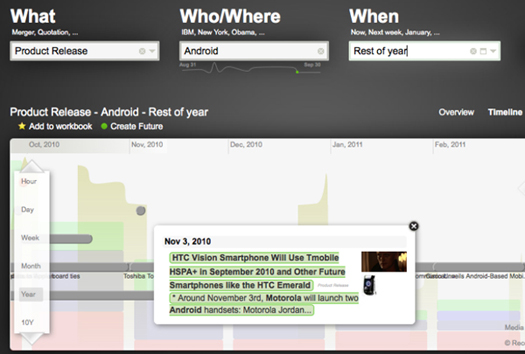
Remember Recorded Future, the future-predicting information analysis company that made a splash earlier this year when it scored investments from both Google and the CIA? The company has recently revealed a bit more about how its technology works and just how well the firm has done recording events before they happen. And, presumably, how well it will continue to do in coming days.
Speaking to Technology Review, company founder Christopher Ahlberg described how its software goes deeper than search engines like Google that simply rank the relevance of results by links. Rather, it analyzes the more nuanced, invisible connections between events and people that shape the future. Doing so, he says, lets Recorded Future look for patterns that suggest certain outcomes, like when a product might release or when a company might clear a patent hurdle or offer an IPO.
Recorded Future’s software does this semantically, using linguistic tools that identify certain types of events and the sentiment conveyed in the wording. It aims for articles with some degree of established veracity, like government filings, news articles, and speeches by leaders or heads of industry, but the software also scans Twitter updates and other measures of general feeling or sentiment surrounding an event, person, company, or product.
In other words, it’s less a matter of Recorded Future wagering an educated guess about a future event and more like an aggregation of predictions that have already been made. That aggregate collated prediction about the future is influenced by all the factors listed above and gives, say, a stock analyst a reasonable measure of when an event is likely to happen.
Right now Recorded Future has fewer than 100 clients paying to use its tools, but those that are using them aren’t lightweights – Ahlberg tells TR a mix of government analysts and financial firms are taking advantage of the insight the company offers. Those are players whose decisions are tied to serious stakes in both security and finance, lending Recorded Future an air of serious credibility. Indeed, studies of its past performance have shown its models tended show increased strength of activity around an event or entity that correlated to real time market activity.
Which means Recorded Future, and analytic tools like it, might have a future after all.

Five amazing, clean technologies that will set us free, in this month's energy-focused issue. Also: how to build a better bomb detector, the robotic toys that are raising your children, a human catapult, the world's smallest arcade, and much more.


Online Content Director: Suzanne LaBarre | Email
Senior Editor: Paul Adams | Email
Associate Editor: Dan Nosowitz | Email
Assistant Editor: Colin Lecher | Email
Assistant Editor: Rose Pastore | Email
Contributing Writers:
Rebecca Boyle | Email
Kelsey D. Atherton | Email
Francie Diep | Email
Shaunacy Ferro | Email
This article is just silly - since the company is still in business, then SURELY the algorithms have predicted wild success for itself? right? RIGHT?!?!
Not quite how financial analysis work, which I am assuming this is a form of.
The problem with predictions is that they will transition from predictions to self full filling statements that change the outcomes. Especially when given in the context of predicting/manipulating financial markets. When more and more buy into the predictions the predictions are more and more accurate as everyone follows them.
I disagree biggin - I don't see how a investment bank believing that a major announcement will happen on a certain date will cause that announcement to happen on that date.
I think biggin is right. For example, if the system predicts a stock will rise 100% within a month and many investment companies buy stock because of the prediction, then the prediction would become true regardless of if there is any good reason for stock price increase or not. So it would become a self-fulfilling prophecy.
biggin has a great point, and slightly creepy. If a large enough majority of companies used it, the predictions would influence investing behavior and marketing choices. This would most likely, as biggin points out, lead to an economic system where the software could basically guide the entire economy in a certain manner. Next step, people start using the software as individuals because of the success it showed in business applications, and after enough entities are tied into it and nearly everyone reacts to it's predictions...the software can, to a point, directly influence society as a whole.
Next thing you know, we get advanced enough for quantum computing...and the **** thing becomes self aware. One day, that thing is going to "predict" SkyNet.
LOL just taking a bit of liberty with the concept...but I still don't like it.
This does seem silly, but how many of these programs are out there collecting data, analyzing, predicting... what program will finally unify this information? It may seem farfetched but we now all have a communicator. Shouldn't we be asking what else they are trying to predict or bring about through self fulfilling prophecy? Will the internet become sentient at some point? What program or combination of programs could correlate all this knowledge and learn from the past? Isaac Asimov wrote about such a computer in "I, Robot". I suggest you read it. I don't like it either, not one bit.
This would most likely, as biggin points out, lead to an economic system where the software could basically guide the entire economy in a certain manner.