
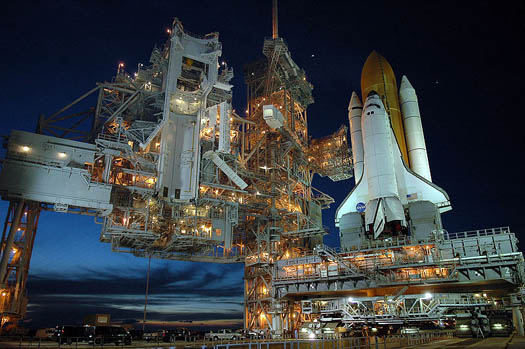
A Senate committee vote this afternoon should keep the Space Shuttle Program alive for at least one more mission and grant NASA the leeway it wants to continue developing a heavy-lift rocket capable of carrying crews into deep space. The Commerce, Science and Transportation Committee unanimously approved the authorization bill earlier this afternoon, sending it up to the full Senate for review sometime in the near future.
NASA already had two more shuttle flights scheduled -- one in November of this year, one in February 2011. The authorization bill calls for one more run to the ISS sometime after the February flight, and calls for the immediate resumption of work on a heavy-lift rocket with a revised goal of sending a mission to an asteroid as soon as 2016 rather than 2025 as outlined in President Obama's space exploration plan unveiled earlier this year.
The Senate bill could be viewed as somewhat defiant of the President's wishes, though in some ways it brings the agency's goals and Obama's plan into congruence. For instance, the President and Congress both supported an initiative to extend the ISS program through at least 2020, and the extra shuttle flight was necessary to ensure the station will be finished and fully stocked with supplies before the shuttle fleet retires.But the resumption of Constellation-like activities -- a heavy lift rocket, revised goals for deep space missions, etc. -- are something of a coup for legislators from states in the space game, places like Texas, Florida, and Alabama.
The extra shuttle mission will likely fly aboard Atlantis and carry a fresh four-person crew in summer of 2011. The authorization bill also allocates $1.6 billion in funds for commercial space development over the next three years.

[Space]
Five amazing, clean technologies that will set us free, in this month's energy-focused issue. Also: how to build a better bomb detector, the robotic toys that are raising your children, a human catapult, the world's smallest arcade, and much more.


Online Content Director: Suzanne LaBarre | Email
Senior Editor: Paul Adams | Email
Associate Editor: Dan Nosowitz | Email
Assistant Editor: Colin Lecher | Email
Assistant Editor: Rose Pastore | Email
Contributing Writers:
Rebecca Boyle | Email
Kelsey D. Atherton | Email
Francie Diep | Email
Shaunacy Ferro | Email
For once the legislators in D.C. are actually working to keep America and it's technical prowess. America is the leader in both space and technology and it's good to know that they are working to allow us to focus on the fountain of knowledge that can be obtained by venturing into the last frontier. Because remember knowledge is power.
www .nerdherd .ucoz .com -- our site (without the spaces before the dots)
just because you added a comment your still a trolling spammer in my book... anyway: This is a mixed bag. Its exciting to see that congress has taken what seems to be a positive interest into space. They did allocate more money. The thing is, what Obama wasn't ALL bad. Constellation was\is exciting but like many things at NASA in the last 20 years, it is way over budget and behind schedule. When Obama canceled it is was disappointing because there is no back up plan. There is nothing on the horizon for decades with out constellation. So it looks like the bloated elephant is the best option we have at continuing to put men into space. We all want to see men in outer space, on the moon, on mars. Why? because WE want to be right up there with them. WE want to go to outer space. BUT Obama felt, and was correct in MANY ways, putting men into space is not that efficient. Money can be spent more efficiently on robots, propes, and un manned ships. The satellites we have cruising around the solar system add more to man over all knowledge than ALL the men who have been into space. I suppose its as much about knowledge as it is our ability as man to be able to do it ourselves. Its a testimonial to our growth. isn't that worth some tax payers dollars. I guess congress thinks so.
SpaceX will be supplying ISS at about 1/3 the cost or less beginning next year. They could carry 7 astronauts up and back in comfort if they get the go-ahead to man-rate the Dragon capsule.
NASA should be sent to the moon and a permanent colony established. And private interests should be allowed to mine asteroids nudged into Earth orbit. The wealth that would generate exceeds, from one 1-mi diameter nickel-iron body, the value of all precious metals extracted from Earth to date.
@Brian - Asteroid mining would have to be INSANELY accurate if that were the procedure used. Imagine if you will a mile wide hunk of iron pushed a tiny bit too hard towards Earth. For reference, the one that killed the dinosaurs was about 9 miles across. Do you want something like that coming within any distance of Earth?
@Brian - You have clearly never played Free Allegiance. A mining accident (or was it?!) similar to what neuenkir discribed destroyed the earth, resulting in a brilliant mix of RTS and space sim combat. Check it out.
@Brian - If I'm not mistaken, it costs roughly $10,000 to send one pound of cargo into orbit. . .do you have any idea of the size and mass of the heavy-duty mining equipment that would be necessary for use on an asteroid made up primarily of nickel and iron?
Even ignoring the difficulties of getting the equipment into space to work on an asteroid, how would you propose that we bring thousands of tons of precious metals back to earth?
I'm all for space exploration, but I just don't see the recovery of deep-space resources being feasible for a very long time. However, space exploration would undoubtedly be the first step towards that ever occurring.
Can someone give me a link to this on another website? It sounds almost too good to be true. I didn't see anything about it on Nasa.gov...
I really hope it's true though. We've been doing nothing with our space program for too long now.
@Brian. Good job, you just killed millions of people.
Seriously. Is there somewhere else that has this info? This looks so good (restarting work on the heavy lift rocket) that I'd want at least two sources to believe it. And NASA.gov didn't mention anything, last time I checked.
I am the author of the novel RED MOON and this book of mine had some influence on this decision by congress and the senate. The novel is about a defunded NASA that struggles to put together a return mission to the Moon in 2018 after the successful establishment of a Chinese moon base defended by the Chinese military in their aim to dominate trans-lunar space. The book was a hit with Congressman Bill Posey and Senator John Cornyn. Just google my name, Chris Berman and RED MOON, and it should come up.
I'll be on PBS radio on Monday to discuss this very issue with Constellation being a priority for NASA and the US.
what will one more shuttle flight do for our space program? this is shameless politicing.
constellation was cut because it was a bad program, over budget, behind schedual and a very far cry from "visionary". Bush and congress asked for shuttle 2.0 and we got a bloated apollo reboot. we can do better.
i don't dissagree that we need something to take constellation's place, but lets call a pig a pig here. constellation was and is being kept alive by congressmen and senators from states where constellation bits are manufactured. they don't have national interests in mind, only the next election cycle.
manned space exploration is important, but it needs to be done right.
@wylekyote
Yes you are correct it does cost about 10,000 dollars per pound currently.... But Heavy lift rockets being created by space ex plans to drop that price significantly in the next 3 to 5 years
Seriously, can someone link me to a page on Nasa.gov which even mentions any of this? There was nothing in the news or anything.
I believe this wouldn't even be an issue if the world would stop thinking of the space race as being a competition and actually work together. There wouldn't even be an issue. As a whole, we can accomplish anything if we put our pettiness aside. Just like Gene Roddenberry's vision, we, as the human race, are full of potential. It's to bad space exploration seems to be turning to the private sector. Just my opinion.