
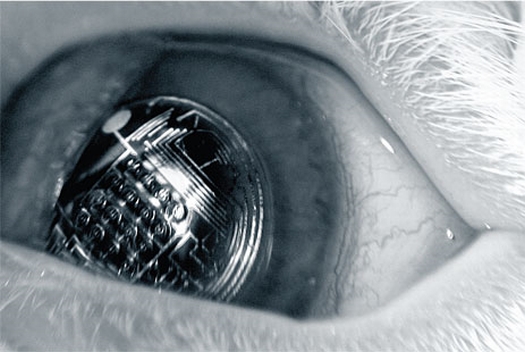
It's the year 2023 and you're lost in a gigametropolis full of flying cars and robots who have achieved singularity. A guide literally appears before your eyes, giving you enough info about your surroundings to guide you on your way. The computerized contact lenses that Babak Parviz is developing could make this fantasy a reality.
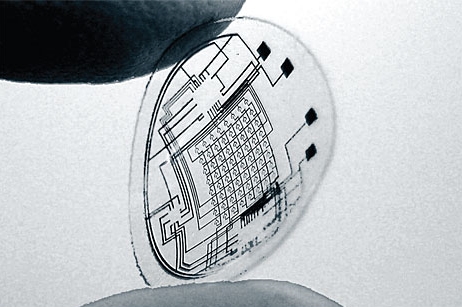
Parviz is working on a contact lens that can give visual feedback to the wearer using an embedded CPU. It can also glean data from the wearer's eyes and transmit that data somewhere else. While the current prototype is rudimentary (read: an 8x8 pixel LED array), Parviz says you don't need terribly complex tech to create an augmented reality interface, and thinks that with the help of laser imaging, he can create a sharp enough interface to overlay on the eye.
As for a power source for the mighty little lens, Parviz is working on solar or RF power harvesting to keep the contact lens going.

138 years of Popular Science at your fingertips.
Each issue has been completely reimagined for your iPad. See our amazing new vision for magazines that goes far beyond the printed page
Stay up to date on the latest news of the future of science and technology from your iPhone or Android phone with full articles, images and offline viewing
Featuring every article from the magazine and website, plus links from around the Web. Also see our PopSci DIY feed
Science is reinventing play, from extreme sports to gamification to ridiculous roller coasters to the playgrounds of tomorrow, and this issue is chock full of fun. Also, on a less fun note: Did global warming destroy my hometown?
The tech is no brainer. It's a question of when. Do we really want data gleaned from our eyes and have it transmitted somewhere else? There's usable applications and I say perfect, yet at the same time, the other scenarios may not be worth the implementation or AR. If something can be taken out with existing hardware, it can be put in - images through your retina and iris. What if you don't agree? But don't have time, because it's flash-speed. The implications of effect and questionable "pushes," from the implemtation beg a lot of thorough examination and questioning. There's the double-edged sword of AR in this application.