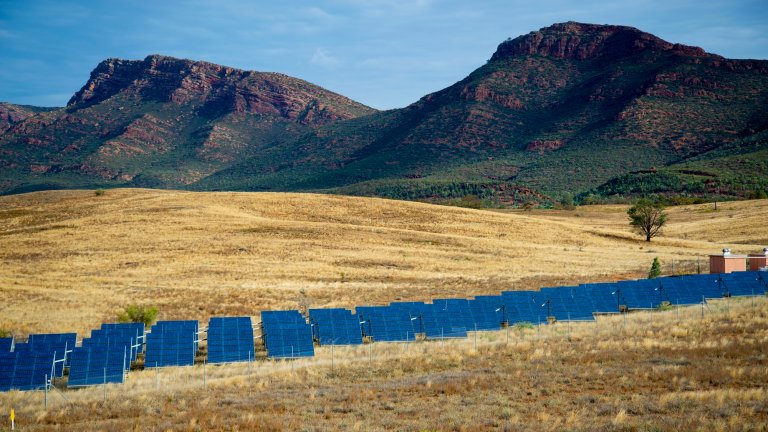
The Department of Energy just gave $100,000 to upstart company Solar Roadways, to develop 12-by-12-foot solar panels, dubbed "Solar Roads," that can be embedded into roads, pumping power into the grid. The panels may also feature LED road warnings and built-in heating elements that could prevent roads from freezing.
Each Solar Road panel can develop around 7.6 kwh of power each day, and each costs around $7,000. If widely adopted, they could realistically wean the US off fossil fuels: a mile-long stretch of four-lane highway could take 500 homes off the grid. If the entire US Interstate system made use of the panels, energy would no longer be a concern for the country.
In addition, every Solar Road panel has its own microprocessor and energy management system, so if one gives out, the rest are not borked. Materials-wise, the top layer is described as translucent and high-strength. Inhabitat says it's glass, which seems odd, especially since Solar Roadways claims the surface provides excellent traction. The base layer under the solar panel routes the power, as well as data utilities (TV, phone, Internet) to homes and power companies.
Still, this is a ways away from actual implementation, seeing as a prototype has yet to be built. But we can be excited, right?
[via Solar Roadways via Inhabitat]
Five amazing, clean technologies that will set us free, in this month's energy-focused issue. Also: how to build a better bomb detector, the robotic toys that are raising your children, a human catapult, the world's smallest arcade, and much more.


Online Content Director: Suzanne LaBarre | Email
Senior Editor: Paul Adams | Email
Associate Editor: Dan Nosowitz | Email
Assistant Editor: Colin Lecher | Email
Assistant Editor: Rose Pastore | Email
Contributing Writers:
Kelsey D. Atherton | Email
Francie Diep | Email
Shaunacy Ferro | Email
Great idea! They should also consider generating energy from the motion of panels as the vehicles are moving.
That is a great idea! I like how they could change the width of lanes dynamically. Dynamic carpool lanes or closed lanes too. Amber alerts in the road? Would some form of energy be possible from the cars moving using magnetism?
Joel Seguin
www.linkedin.com/in/joelseguin
Business Intelligence / Analytics
Found a FAQ
www.solarroadways.com/FAQ.htm
Joel Seguin
www.linkedin.com/in/joelseguin
Business Intelligence / Analytics
I wonder how they will handle defense questions related to EMP attacks?
http://onesecondafter.com/pb/wp_d10e87d9/wp_d10e87d9.html
Joel Seguin
www.linkedin.com/in/joelseguin
Business Intelligence / Analytics
To Mr. Joel Sequin,
Extracting any energy from cars moving by is not a good idea...conservation of energy tells us this. Any power we are able to convert is provided via the vehicle's propulsion system. To extract any energy, a proportional load would be placed on the vehicle, which would cost more energy from the vehicles power source (and ultimately the grid, if it is an electric vehicle) than would be provided, due to the unavoidable (and in this case, I would estimate very high) inefficiency associated with such a process.
Well it's about goddamn time. This idea's been around for such a long time and has been waiting for someone to apply it. It's such an obvious asset as an energy source. More R&D funding into this should have been put up a long time ago.
Great idea on paper but the road system isn't built on paper. Durability, cost, light gathering efficiency, etc, etc, there is a lot of work to be done but all options should remain on the table like this one.
All it takes is just one stroke of genius to make illogical looking ideas work...
I have had this idea for years and years. The billions of flat paved roadways on this planet could create far more energy than we could ever need with only a fraction of those miles having these solar panels embedded in the road surface.
Applying this technology to the roads in the Midwest and south alone could easily power all of N. America and then some.
Such a novel concept. Add solar panels to existing flat surfaces, thus eliminating the need to dedicate vast swathes of land for solar farms. Everyone wins.
Only thing that would stink would having to run cleaning vehicles over all of the panels to maximize efficiency.
Can we implement tomorrow? Thanks government for using your collective brain for once and funding something that is actually extremely viable, and can be implemented almost immediately.
You wouldn't even have to dig roads up, just incorporate the technology into the roads as you do regular repair and resurfacing work.
--GTO--
I assume that the solar roads can take the same loads as a regular concrete road? I would hate to have a fully-loaded semi trashing these things.
Being able to turn the entire road surface into a display is a wonderful idea, if the lanes could be visible in strong sunlight. Road markings configurable as needed, what a concept!
It would also be better if the panels could be installed without the old road having to be completely torn up. I hope this works; sounds like a great idea.
DJC
Why don't they just use regular solar panels in the median strips of current highways? All that wasted space between opposite lanes on the interstates could be used for practical purpose. No new tech, just mile after mile of solar panels.
This sounds like a great idea - I really hope it is feasible and is implemented as soon as possible. Like many of you, I wonder about the durability of these roads - especially in the northern states, where freezing and thawing rip roads apart so easily. But, even if it isn't feasible in the north, we have so many southern highways, that it could be great.
AWESOME! Finally a way to get more cable companies in operation. If you send cable signal over the roads, you can get it anywhere you live.
I hope it works out.
That's going to take a lot of cleaning.
Now this is something I wouldn't mind this near my house. This is a really good idea. Especially the warning signs integrated into the road. This is good for drivers who can't see the road signs because of brush or tree branches. Problems are solved.
This would be AWESOME! If it can be done in an economically feasible way...Combine it with the technology they use here in Japan that creates electricity from the kinetic energy generated by people walking on specialized sidewalk tiles, and you get a double benefit!!
Simply awesome...let's get to work!!!!
MLG4035/Tokyo
Sounds like a Robert Heinlein idea from the 50s
surface is made of glass and has great traction...
WHEN ITS DRY!
This is a crappy idea. Roads get dirty. dirt blocks light.
If you have ever seen what a rock stuck in the tread of a semi- tire can do to concrete you would know that it would take glass so thick to stand up to the punishment of the road it couldn't let very much light through. Keeping the surface free of enough scratches to allow it to work efficiently would be a challenge.
What on earth is an idea like this doing in a science mag. Firstly of all you have the guy confusing solar energy with extracting energy from vehicles. It DOES say SOLAR energy. Secondly - even concrete cannot stand up for very long to regular road use - and so are these people going to do constant road repairs and at what cost? Thirdly, putting solar panels UNDER cars and trucks - what ARE they thinking about? Roads get filthy almost immediately in use. Wheels deposit rubber on the roads etc. This is just silly. I'm in Spain right now and they have massive solar farms ALONGSIDE the road on adjascent fields - that I can see...
As stated above I am apprehensive about this idea because they would be tearing up roads much more than they are doing today just to fix them. As other people alluded to alongside the road or in between the medians may be a better idea. Cleaning them may not be such a big issue a simple rainfall may clean most solar cells however not as good as washing them squeaky clean.
Usually in between the medium is used for storm drainage. I would prefer to install them in low traffic areas such as on the curb that way they will last longer than a few months.
Wouldn't it be a better idea to use all the heat from the dark tarmac for solar thermal power? This would be only usable for new roads and the yield should be lower, but afaik it would be a lot cheaper and require less maintenance.
Glass does have a high coefficient of friction so the claim that good traction would result is reasonable.
Glass does dull however due to abrasion, think about scratches on your windshield. This will reduce the efficiency of the devices. So the challenge is will these problems sufficiently reduce performance that the system would be uneconomical?
Otherwise good research. Except why grants? I would think putting down a test patch 1' X 1' would be a better use of money than a grant.
Well, as far as the top layer being made of glass, I was actually a bit surprised the author made the comment of traction. Or any negative comment for that matter. About 5 years ago PopSci had an article about bridges being built from glass and how the built-in fiber-optics would make it easier to detect damage. There was a similar article about US Army bridging vehicles using these lightweight glass bridges. Just because it's glass doesn't mean smooth and slippery. Glass can be made into several textures and weaves and still maintain a valuable translucent quality.
--Who?
Nowhere Nowhere Land
This also does not take into account other abuses:
Tonight on COPS - police chace a pick-up truck. The spike sticks take out a tire. The truck drives on for two miles, sparks flying, digging a debilitating gash across the panals at $7,000 every 12 feet! They arrest one young punk for drunk driveing. Taxpayers cry in the streets.
This is an attempt to mitigate the cost of solar by tying it into public land (I don't want the government owning my power more than they already regulate it!) and by factoring against the cost of resurfacing an highway (I'm assuming these would be snaped together, plug and play style to a parrellel power line, like hardwood flooring panals).
I'm with the previous poster. Imbedding loops of thermal coil under a fresh layer of ashphalt during a resurface would be much cheaper to create/install and more durable, despite a lower output of energy (due to type of energy conversion as well as the tendency of ashphalt to grey-out over the years.
Solar still just isn't economically feasable. If space were the only issue, every roof would already be covered with them.
No more saying that humans do lots of nasty things in the road like chucking things. I think that no matter how much resisting will be this glass after a time it will break. A serious study must be done to see if costs of implementation and maintain of this system is reliable. I believe that it's not a very good idea, but it's an idea.
http://mattressesguide.com
The concept sounds like a great idea, but I agree that glass sounds like too fragile a material to use as the surface material. You would need to have a material that is still transparent enough to let the light through, but can handle the weight of cars, trucks, and tractor trailers as well as be dirt resistant so that the light doesn't get blocked out. Solve these two problems, and you've got a winner. :-)
I would like to see how these panels are affected by heavy load like trucks, crap falling from them, accidents etc. :)
Why, instead of designing heavy duty solar panels, not to put cheaper panels on areas which are not affected by heavy loads, like roofs, pedestrian sidewalks, medians between the lanes etc? Тhere is plenty of space empty in any city.
Two words: Transparent Aluminum. Where's Scotty when you need him?
Solar powered street sweeper robots could clean dirt, debris, etc. off of the solar panels. The robot would repeatedly do the same programmed route each night by following sensors embedded in the panels. The robot would have to have flashing lights on it so it didn't get run over by a passing car. Then it parks it self back on a charging station (like a rhumba) and receives power from one of the solar panels.
(Maybe it would secretly put on a mask and fight crime at night as well :)
I wonder how much money is going to be spent and wasted on what is a complete and utter folly.
There is only one response thus far that realises that this concept is fundamentally stupid.
Having said that there are plenty more where this came.
Hint: Do the maths !
I've read through the article and I've checked out the website for these panels. Although the concept is interesting, there are a couple of things that don't really seem to be explained very well. For one thing its stated that every panel will store energy. What kind of battery are they planning to use and how expensive will they be. The battery's that they are planning on using for the new electric cars are bulky and very expensive. Also, if they're planning on decentralizing the electric grid with these panels, they're going to have a couple of hurdles to jump through. Every area has different load characteristics and cycles. This means that different places are going to need more power than other places. To deal with higher loads now, energy companies install larger and thicker cables. Most of the time, depending on the area these cables are upgraded every 5 to 10 years. Unless the panels have a way of dealing with increasing load, they will burn out once a new apartment building or factory in built in an already dense area. Although the concept for these panels is a good one, there are a lot of obstacles to face before they become feasable.
It will NEVER be feasible.
Think about the underlying physics and the fundamentals. This is yet another classic clase of 'its works in the lab and all we have to do is scale it up and we are rich'.
This is then followed by getting some mugs to invest and perhaps someone with a suitable qualification to add a bit of credibility and the gravy train sets off once more.
There are three fundamentals that should be properly established right up front. In this folly two are missing.
The fundamentals are not a secret. It isnt rocket science and they can be calculated in about 5 minutes. No computer required. So for the sake of doing 5 minutes of maths right at the outset something as stupid as this concept starts to look interesting to the ignorant.
--GTO--
well then
His glass must be half empty...
Actually, work is already being done with converting heat from roads into power. The piezoelectric idea ought to work as well: Japan has an airport terminal whose power needs are supplied by piezoelectric floors that harvest the pedestrian's foot pressure.
If I told you you wouldnt have learned a thing.
Now if you did the maths or found out by yourself how to do them, then you would. It would empower you be able make bold and seemingly arrogant statements, similar to those I posted earlier AND you would be able to stand your ground.
What appears to be a good idea nearly always isnt. It only requires enough in the way of cool sound bites and tecno rubbish to sound plausible.
The concept has no merit.
I dont have to prove anything to anyone here. It is up the those who put forward a concept for consideration to do the proving.
I'll not be holding my breath waiting as far as this concept goes.
I will however give you one teenie weenie hint. Why do you think static solar panels point towards towards where the sun will be at noon ??
The answer to above should cause you to ask further questions. Dont cheat ! Dont just go and read someone elses answer. Find out WHY.
If you need further clues I will post them.
Re the airport in Japan.
The power need of the terminal are NOT met by peizo-electric floor.
Is this forum meant for children ?
Do you have any idea just how much electricity it takes to run an airport terminal ?
More importantly do you have idea what the conversion efficiency is of Peizo when converting mechanical energy into electricty ? I wont bother raising the question of how much 'extra' energy is floating around by virtue of a human walking. I will give you a clue: it is tiny !
When you know the answer to the two FUNDAMENTAL questions I have asked you will then understand why an airport terminal will NEVER use what you have been mislead into believing it does to meet its needs.
To bgpursuit:
Extracting energy from moving cars through "magnetism" will not slow down a vehicle. If a magnet moves along a path and goes through a copper wire loop a current is induced perpendicular to all sides of the magnet, which will not slow down the magnet. Though a copper wire loop isn't to practical, I'm sure other designs are plausible
To UKELITE:
Maths is not a word. It's math.
The regulars on this site will probably be wondering who the hell I am. I am one of two. We seem to be drawn to bad science and unfortunately an ever increaing waste of money, yours and mine.
No one picked up on the really big clue that is in the press release. It sticks out like a sore thumb. It is a classic bit of techno rubbish and is in fact meaningless.
The second paragraph should have made alarm bells ring.
The claim is each 12f X 12f panel can generate up to 7.6KWH per day. This statement doesnt hold water. It implies that the output is around a constant 7.6kw and that is absurd. How come no one else spotted this, including the person who santioned a nice juicy $100k grant.
For fun lets say the peak output, assuming the panel in the road is pointing directly at the sun at midday and there are no vehicles on the road at the time; a clear field of view, then each square foot of solar panel kicks out 52.77 watts. This is peak output under optimum conditions.
The optimum condition only exists for a very short period of time in one year. By that I mean a few MINUTES.
Outside that small time window there are little things like darkness and the little matter of the sun being lower in the horizon but the panel is fixed. In other words the claimed output does not and will not exist in reality.
So what sort of output could we reasonable expect and how would THAT little gem of information affect the viability of this folly ? Try something in the order of about 10% or less. It is perfectly possible to calculate EXACTLY what the total output would be over say a 1 year period but that wont have been done. The reason is had those numbers been known before the $100k was handed over there might be implications. The figures will come to light down the road but only after a lot more money has been wasted.
I apologise for my gate crashing and arrogance. We actually care !
John
I'm going to drive my hover car over this road.
To CKnick
That is complete and utter rubbish.
A moving car has kinetic energy. Place a large magnet in it and pass the car through coil. Thanks to Mr Faraday we know that electricity will flow in the coil and this will cause the car to slow down.
The prinipcle is used already. It is called regenerative braking.
I take it you havent heard of back EMF ?
I agree the glass panels are a joke...
embedding copper wire in roadways... with permanent magnets in vehicle undercarriages, they would have to be seriously strong magnets, or very close to the road surface... but, that idea is the best yet for retrieving energy from roadways.
Which roadways? Inner city or interstate? Where will the copper come from? What are the environmental effects of mining enough copper to go into roads? How about the viability of retrieving copper from roadways that are being repaired?
Are solar panels based solely on visible light? Might other wavelengths give a higher energy return?
To podbog
Why on earth would you want to try and recover kinetic energy from a moving vehicle. It makes so sense in phsyics at all other than to slow it down ?
Gas/Petrol is full of potential energy and modern engines are very efficient indeed. Nothing but nothing comes even close except nuclear.
There simply isnt an easy fix to the fuel problem. There are solutions and there are so called solutions.
I don't think you understood what I wrote.
Cars move by use of liquid or electrical energy... their movement over the roadway, coupled with magnets and copper, just like any generator, would generate power from the magnets passing over the copper wire...
Did you think i meant, electrify the copper to move the magnets in the cars? LOOOOOOOOOOOOOL, that'd take more energy to do than we ever dreamed of.
But cars, hundreds of millions of them, are not adding to the grid's power, if even the cities' roadways were wired to be energized by magnets in vehicles, wouldn't that offset the amount of fuel power plants would need to burn?
podboq
Like I said, you havent heard of back EMF have you?
You also havent heard of a linear motor either it seems :)
In answer to your last queation, NO !
Hey ya spelled my name correctly, congrats.
While you're here swinging your obviously large and useful brain around, maybe you could try less of a browbeating technique for your conversational additives.
In other words, if you can't say anything nice, just stfu.
Good teachers rarely condescend to those they're attempting to teach. But occasionally a smart ass comes along and makes those who are trying to think critically regret conversing in the first place.
Enjoy.
To podboq,
Typing with prostetic hands isnt easy so apologies for the typos.
As yet no one has challenged the logic or the physics of what I have stated. So far I have managed to make a couple of you react in a totally predictable manner. You feel threatened because someone you dont know actually does know things you dont.
Im not here to teach. This site is but one of thousands.
You can continue to believe what you do but the world is round not flat. Everything I have posted can be verified using basic physics and maths that have been known for well over a century. It is taught in schools worldwide but soon forgotten. Enough is retained so that techno sound bites have a ring of truth about them.
The result is that far as 'green energy' is concerned HUGE sums of money are being wasted on follies.
If my contribution causes just some of you to stop and think and even better take the trouble to check out what makes a concept have merit as supposed to accepting at face value press releases then that will be something.
I have pointed out that the concept of solar roads is fundamentally flawed. I have indicated this without going into great detail why this is. My responses to other mooted concepts have not been challenged on a technical level either.
You are defending your space. I ask the question given what I have witnessed thus far as to the contents, why bother ?
What a dumb concept. Solar is barely cost effective when sited at proper angles and stable environments. Putting them into road surfaces where the constant wear and grime will reduce the solar radiation reaching the cells makes no sense.
The same cells would be more efficient in rooftops, exterior walls, and other situations where surface scratching wouldn't be a daily occurrence.
I can't think of any instance where I've felt threatened by someone else's knowledge on a subject.
Having prosthetic hands doesn't affect your proofreading skills, does it?
Having a prosthetic leg doesn't affect my cooking skills....
From what I gather about back emf, is, any magnet that induces a charge in a coil, gets feedback from the coil, in effect, the charge affects the magnet, causing it to slow. Am I right?
How much would a charge in a coil slow a vehicle with a magnet moving at highway speeds?
There are plenty of high schools that don't teach physics and electrical theory such as we're discussing, many of us have chosen to educate ourselves without formal schooling. Talking down to people rarely accomplishes anything.
"So far I have managed to make a couple of you react in a totally predictable manner." Why do you choose to behave this way?
UKELITE seems to be one of the few people here who have a smidgen of a clue about reality... physics and math.
Anyways as someone who actually works for an engineering firm that designs and installs PV systems, all I can say is this story sounds like a whole lotta pie in the sky. Really folks as UKELITE says do the math! If you can't then please just shut up.
I dont know of many schools that dont teach BASIC physics and maths. There are none in the UK.
Science is science whether taught in a school or not.
To answer the question you asked, you need to understand Newton's 3rd Law: For every action there is an equal and opposite action.
Since energy cannot be created or destroyed (which is another fundamental) what you can do with it has limitations and consequences. You can covert one form on energy to another but ALWAYS there has to be a balance. This causes problems.
For example you want to make something hot using electricity. How to do this is well known and understood; no problem. But in doing so you incur losses. The energy lost hasnt gone; it manifests as something else instead. The losses may be light for example or they could be sound and so on.
In other words the conversation ratio between what you have and what you want to make is very important indeed and in between those two things you have some sort of gizmo.
In the mooted concept the gizmo is a solar panel enbedded in a road. Even if the solar panel was 100% efficient at converting even a lit candle two miles away into electricity there are a lot more losses in play. The current generated in the panel is DC. To connect to the grid it has to be converted to AC. There are losses in doing this. Then the voltage has to be stepped up considerably from the starting point to 120. There are losses in doing this too.
Also in play is the storage device. It cannot be 100% efficient; it is a chemical reaction that degrades over time too. Therefore there are losses there too. Then we have the conductors running from the panels to the batteries then onto the grid. These have electrical resistance and there will be losses there as well.
All of this above is known.
The output of even the state of the art solar panels is known, as is what happens to the output of a solar panel when not in the optimum position; it falls off a cliff.
I havent touched on all the other signficant issues as given the fundamentals, the concept has zero merit.
The problem is that enough people believe that is has. The belief is NOT based on knowledge but from the little snippets they do remember from school. People tend to trust their knowledge and have a bit of problem coming to terms that it isnt as robust as perhaps it might be.
That is why you have reacted towards me in the way you have. It was predictable. Having said that I was being provacative deliberately.
You didnt come up with the concept and you are not to blame. You read the press release and thought it might have some merit and because of that and the fact that you are on home turf, you defended it against a total stranger who attacked it.
The problems facing this planet in terms of energy needs is immense. Every man and his dog has an idea how to resolve it. Only a slack handful actually have the faintest idea about how it can be done but millions of others will be suckered into believing or investing or supporting in some way the cranks.
We like to think that there is a quick fix that science will trip over, almost by accident. It wont happen. The fundamentals were worked out long ago and they stand now and will in the future. These fundamentals are watered down and ignored. There is a sort of blind faith amongst many that all we have to do is something along the lines of the mooted concept.
The biggest problem of all is the reality that without nuclear power (which isnt my preferred option), the remaining options are not exactly tree hugging either; our lifestyles will change dramatically and that is motivating people to come up with basically stupid ideas and concepts. Instead of clutching at straws we should get down to the basics. If you do that you realise just what is facing us all, perhaps not in our life term but almost certainly before the 22nd Century.
Like I said, I care.
To Wowlfie.
I have to now admit I am at a loss as to why you went and looked up all the figures you did.
Why one earth would you want to put any solar panel flat on its back ? More importantly place it between rails ?
Lets for the moment work on the premise that this is a good idea. The space between the tracks is X. There are little things that support the tracks called sleepers. They remove at a stroke about 25% of the available surface area available. Then we have the height of the rails above the panel which we will call Y
Assuming the rails run north to south only you could calculate in about 10 seconds flat the window that the sum shines on the panel. To save you the effort it is less than 30 minutes.
Outside of that window only part of the panel gets direct sunlight and for about 3 hours a day the panel will get none.
There are several more reasons I could give you as to why this wont work in reality but what I have just done to your concept took as long as it did with the solar panels in the road.
Please note Im not trying to be a smart a**e here or cause you to stop creative thought.
To get the most from a solar panel it MUST track the sun from dawn to dusk and it HAS to compensate for the change in the height of the sun over the horizon. In winter it tracks low, in summer high.
These exist and are close to the best that all known science is capable of in this area of physics. The split second you stop a panel from being able to track you are going backwards in terms of science and technology.
The fundamental problem with solar is the same as wind; storage.
There is another aspect to solar power that has to be taken on board. That is the energy required to make one. When you crunch those numbers you realise that as an option in meeting out needs, the prospects are even less rosy.
I did not support the panels in the road idea, solar roads is stupidity. I went along with the other fellow who suggested using cars with magnets to energize a copper coil in the road.
I'm all for tree hugging. I wouldn't have much of an issue with living in tipis and hunting for food, so long as I was relatively safe and secure doing so. Natives did it for 10s of thousands of years, all over the planet. It's when mankind builds cities and starts raping the land for resources that we get into trouble.
No animal that destroys its own environment survives long, that I know of.
Each and everyone of the naysayers is missing the point of Solar Roads' idea- if, and this is the if they are exploring, they can implement this type of roadway for a similar cost of a cement or asphalt road, then ANY energy that can be generated is all gravy! This idea is analagous to those companies developing solar panels that can be integrated into building materials, whether roofing, siding or even paint- even if they are a lot less efficient than tradition PV panels, they may prove to be a whole lot cheaper. In the same way, if we could build roads out of solar panels, even if grossly inefficient compared to PV panels, or shoot, even compared to other forms of energy generation, the energy from a solar road may still be much, much cheaper than other forms. Roads, all roads, have to be redone every few years- if Solar Roads, and that is a big if, can produce a road that costs the same to install, or costs the same over time if it lasts longer, they will have a huge winner on their hands. The concept is certainly worth the measely few dollars, comparatively speaking, to develop and test.
you have to offset the energy any road might itself make, with the energy needed to produce it from base materials.
While UKELITE has a rather nasty conversational manner at times, his physics is spot on.
Turning a car & roadway into a linear generator is a really poor way to convert gasoline to electricity. Its one of those ideas that is great for a brainstorming session, and one of the first ideas to get tossed out once you consider basic physics.
For those of you interested in physics, but without any formal education, allow me to recommend MIT's OpenCourseware. It is an amazing service MIT provides.
This idea isn't practical with current technology, but it could be in the near future. All of UKELITE's objections can be solved with a bit of technology and engineering.
For example, we now have edge-intensive flat panel solar concentrators that greatly reduce the need for sun tracking, as well as reduce the area of solar panels needed.
We actually could make an efficient "between the railroad tracks" solar collector in short order. I'm not interested in do the math to see if it would be feasible, but it could be done.
This will be my last post.
I urged all of you to go away and learn the basics. None of you thought that was a good idea. Those of you who still believe a solar road/rail track has merit even after being informed of just some of the fundamental problems are living on a different planet. I pointed out that the Laws of physics prevail, always.
I deliberately did not detail the one truly fundamemental that shows the concept for what it is. Had any of you done even a couple of minutes searching on the internet you would have found it. I dropped several hints.
Fact: There is a finite and known amount of energy that comes from the sun and lands on earth. This means the energy available per square foot, square inch or square mile etc is known. There is NOTHING that you or anyone will EVER be able to do to increase it.
When you know what that figure is you will very quickly realise the stupidiy of the concept. You cant produce a greater output than the input can you ?
You can pontificate till the cows come home, you will never change the Laws of Physics.
You are members of this site because you and interested in science. You are young and still learning. You have an opportunity and it is a golden one.
There is a branch of physics that is challenging to understand. It isnt new but it really is VERY important. It is called thermal dynamics. Very few engineers/scientists these days know this subject.
In essence thermal dynamics allows you to calculate accurately things like the amount of energy available from a complex source. For example calculating the energy available inside a human body or the output of a heart. Another example is the energy available in moving water or air.
There are some short cut formula that can be used that will provide a reasonable estimate or you can cheat and look the data up. Either way, once armed with the knowledge you can rip apart stupid concepts. However doing so doesnt bring solutions any closer. To create VIABLE solutions that add up and can withstand peer scrutiny you need to understand all the underlying physics.
From time to time (becoming more frequent) ideas are mooted and gain traction. Many of these are fundamentally flawed because no one did the up front number crunch. Universities go on wild goose chases all the time. It is how professors live and it goes on world wide. I will give you one example of this and money is still being wasted to this day.
A company in California was created out of an idea that came from a university. The concept was to use human motion to recharge batteries carried by soldiers. It is basically Faraday's principle. It is possible to generate small amounts and this is all that was required to sucker millions from governement and investors alike. It will NEVER achieve its goal for one simple reason: The input energy does not exist. The scientists believe it does but they havent done their homework.
A similar venture has just been given 2 years funding in the UK but they are going to use peizo generators instead. This too is complete and utter folly.
How do I know this to be so ? The answer to that is easy. We have crunched the numbers. I am the co-inventor of a highly efficient generator that can be made very small or very big. We were asked by medical scientists to determine if our technology could be used to convert blood pressure/flow into enough electricity to keep a heart pacemaker charged. We knew how much current a pacemaker needs (and it is very small indeed) and we know the efficiency of our generator. However until we established what is called the 'work available' we didnt know. I can tell you that the work available was about 10% of what is required. The concept is dead in the water.
Using the human body as an engine to drive a generator is foolishness. It is OK for say winding up a torch but thats about it.
Finally I will leave you with another fact that puts into context the huge problem facing this planet. You should all know that 1 horsepower equals about 750 watts. Those figures dont really mean anything; they are very hard to visualise. Fortunately someone has saved us the trouble.
1 Horse Power = 3,300 gallons of water raised a height of 1 foot in 1 minute. Those are figures you can relate to.
The lesson here is that a HUGE volume of water has to flow to create a meaningful amount of electricity. For fun work out how much energy is available when you empty your bath. Please note that energy was required to fill the bath in the first place so dont get any bright ideas. It is possible to recover the energy but when you crunch the numbers you will see that it is very little.
Im 53 years old. 4 years ago I asked a stupid question regarding how much electricity could be produced from rainwater running off a house roof. The answer showed that even if every drop was converted with 100% efficiency there would only be enough over a one year period to charge a mobile phone about half a dozen times. That was far less than I have envisaged and obviously doing this is not worth the costs involved. The reason I mention this is that the means we were going to use to convert the water to electricity was novel (we didnt know that at the time) Now there are world wide patents pending. The same technology when inverted creates a superbly efficient electric motor, up to and beyond 99% when optimised. The only losses are from the bearings.
I hope that you have learned something that will be useful to you.
The best of luck to all of you for the future
Bye !
Ahem.
Now that the rude, pompous, arrogant, part-cyborg net bully UKELITE has promised never to post here again, we may continue.
Sorry was not an airport as I wrote before, it was a train station that was testing the piezoelectric paving system. It's not 'robbing' energy from the pedestrians, it is harvesting wasted energy in the compression of the pavement under many feet. And the system works. And they DO anticipate meeting all of their elcetric needs from this. If UKELITE has a problem with this, he needs to leave off calling me stupid, and go lecture the source. I am sure they will appreciate it.
Others are investigating piezoelectric roadways. Any of these makes more sense than a solar road.
UKELITE said it was not solar roads were not feasible. I check and at the moment the best solar cell money can buy have a conversion rate of about 30%. So only 30% of the suns ray are converted into usable electricity.
I also know that some folks are looking at creating solor cell made out of synthetic chlorophyll that would have a conversion rate of close to 100% at noon around the equator.
http://www.sciencealert.com.au/news/20070604-14870.html
Combine those cells with another product that other folks are creating. It's a material based on plants that let water and dirt slide off (sorry I no not have a current link). That way dirt would not be a factor if you put those cells on a roof top.
So UKELITE might be right in saying that currently solar power is not efficient enough for our needs. He never gave us his math so I tend to be skeptical. What about in 20 years?
I cant resist myself Tikihead. You should consider changing the first four letters of your handle !
The conversion ratio of Peizo to electricity is 1% max. It cannot EVER be anything above this figure. You have learned nothing except how to how to make yourself appear even more ignorant. A simple wind turbine can extract about 40% of the available energy. The Laws of physics prohibite anything much beyond that. So ask you self the the question you should have done, before shouting your mouth off: Who in the right mind is going to invest in something that is 1% efficienct when other 'free' renewables can manage 40% AND cost FAR LESS per unit of electricity produced ?
To Loius C: You need to look at the input figure BEFORE conversion. Solar has its place but not large scale units. A 30% converstion ratio under optimum conditions that vary over the time of day and seasons dramatically isnt good. The very best panels are also very expensive.
The maximum input figure is in the public domain. I didnt calculate it, NASA did.
I also pointed out that there are consequences in everything we do. If we have a lot of solar panels grouped together then these will damage or destroy delicate eco-systems because
1) they block the light
2) they prevent heat from going into the ground
3) they prevent the rain from going into the ground
etc etc
The finest conductor of electricity is silver (not gold as many believe), it has about 10% less resistance than copper but costs a great deal more. The voltage produced by a solar panel is very low indeed. They are linked in series to create a higher voltage but in doing that the resistance goes up. Again the voltage drop caused by a given length of wire or a given diameter is tabulated and available in the public domain. It essentially means if you dont want use or waste the little current you have produced that each little group of panels has to have and invertor, regulator and step up system, as well as a storage device on the door step. The economics dont add up.
Finally, and it is something that should be considered right up front too, get ahold of your domestic electricity bill and see just how little is costs you for 1 unit (1 KWH hour), then compare that cost (typically about 10cents) with the hair brained schemes. They are not just a little bit more expensive they are off the scale by a very significant order of magnitude. Some I have seen are more than 1,000 times more expensive.
-Some people dont like the truth and they certainly dont like being made fools of. I would rather look an idiot but know the truth. Widsom only comes with knowledge, not guess work.
QED
Bye. (really time !)
Trolling is alive and well on the net. I love people that are defeatest, rather than come up with something useful or helpful to the idea they just want to debunk anything that's potentialy progressive or positive for the world. Rather than constructive critisism you get this wash of negative insight and loose rambling.
I think the idea is at least interesting. I worry about the glass, sure, but any energy put back in the grid could hardly be a bad thing. I once read an article ( I think it was on here) about a new coating that could refract light at different angles to make solar panels more efficient. Maybe this uses that idea as well. Panels on the sides, medians or even above the road could help.
this is way cool, but i'm skeptical about maintenance and the practicality of it. I hope something great can come out of this. Kelly at www.savings-for-you.com
Ok as for sidewalks in Japan, there is a train station in japan that powers a majority of its systems using the piezoelectric systems. it generates 1,400kw per day from 25 square meters of floor. this is a decent amount of energy and a viable source of alternate energy.
I would just like to point out that a generator will not do any good if the amount of power you get from it (after all losses) is not greater than power put into producing it (electricity, materials, transport etc.). Also remember that everything wears down and eventually needs to be replaced/fixed.
On a somewhat related note, I won't pretend to know the exact figures, so could someone who knows please tell me two things:
1) Would it be a good idea for homes and other small-scale sites to generate energy from the heat of the sun instead of PV cells? (Not concentrating the sunlight with mirrors, just using dark surfaces.)
2) Wouldn't a good form of energy storage be lifting weights off the ground (pumping water into tanks somewhere up high etc.)?
I agree dgiborvic. It is quite a spectacular idea.
hey Imongi,
You wrote: "Trolling is alive and well on the net. I love people that are defeatest, rather than come up with something useful or helpful to the idea they just want to debunk anything that's potentialy progressive or positive for the world."
Yo! Dude I sooo agree with you, ya know what it just so happens I picked up this really cool perpetual motion machine.
I works fine and produces lottsa energy, right now it's producing just a wee bit less than what it consumes, but no worries if you'd like to take it off my hands for just a small amount of moola (negotiable)I can include the manual which very clearly explains how to calibrate it so it produces more than it uses.
Trust me brother, it *REALLY* works. I can even accept payment via paypal, don't miss this once in a lifetime opportunity.
BTW I really like your positive can do attitude! We need more people like you it's folks like you who can make pigs fly, keep it up!
one word IMMPOSSIBLE , how about you create a solar panel that can hold up a tractor trailer.....
and how mad can you be to spend that much money...
look at the pure physics side of it, theres gonna be friction, and the harder it is, the longer it shall take to break down...not gonna be easy (and costly) when considering the complexity
JEEZ, Im not defeatist, Im practical!! And all of you up there still dreaming of utopia propose these ideas!! I could go on and on, but I wont for the lack of point because...
A man convinced against his will,
Is of the same opinion still.
The idea is more insane than space elavators.
oh and FMagyar, by the defenition, there is no perpetual motion machine...Iv evene made one of my own, didnt work
if you had a perpetual motion machine you would NOT want to sell it even if you were to lazy to "calibrate" it
shoot, mabye I am a defeatist.....
"oh and FMagyar, by the defenition, there is no perpetual motion machine.."
Please let be sarcasm, please!
Cars will more than take to flight, before the roads are made of solar panels.
Cars will more than likely take to flight, before the roads are made of solar panels.
Defeatest? How about having some common sense. The main obstacle to solar is the currently low efficiency/high expense of the cells. Which is why they have to be built on frames at some angle to horizontal and take many years to recover the cost in spite of credits and subsidies.
At some point they may be efficient enough for this purpose. As in efficient enough that the angle isn't as important and they could be covered by some thick, durable translucent material.
But once they are that efficient it would be far past the point where they are cheap enough to just be built into regular roofing material, exterior wall panels, tops of cars, etc.
The cost of the road surface material, whatever it is made out of, will be so expensive they could instead pay people to put the cells onto regular surfaces and get probably 10 or 20 times the area for the same money.
1 mile road of 12-by-12 ft Solar panels ( 7k each) with a width of 100 would make the price almost 3 mill...
It's amazing that no one seems to grasp what UKELITE was hinting at. The sun only gives 1.4kwh per square meter,so a 12x12 panel at 100% efficiency, at noon, with no earth atmosphere could give 18kw/h. BUT since we don'tt have efficiency anywhere near that, and we need the earths rotation, and atmosphere to live, the figure suffers slightly. At 30% efficiency, even with the panel magically collecting full noon light constantly with no atmospheric disruptions the best you could get out of a 12x12 panel is about 5.4kw/h.And the reality is FAR less.
HOWEVER, and this doesn't really suprise me considering some of the grammar here, you've all been had by a simple misleading statement.
"Each Solar Road panel can develop around 7.6 kwh of power each day"
This does not mean 7.6kwh continous,but that the additive output over the course of the day is 7.6kwh. This is a far easier goal to achieve, and the statment was probably worded the way it was to be misleading and attract attention. The figures are still based on imaginary ideal conditions of course, but when aren't they. The figure of 500 homes being powered off of a mile of 4 lane highway is fairly accurate at the rate of 7.6kwh each per day, a mile would have 1760 panels,(assuming a road with 4 rows of panels) give 13367kwh per day (26.75 per house, which is about average use), and cost $12,320,000 (about 25 grand per house). It would be a 4 billion dollar project just to do a few parts of highways in my state, nevermind the cost of labor and project budgets that are overinflated to begin with. The cost of doing it nationwide would eventually run over ten trillion, and that's not an exaggeration. But who cares, it won't happen, it's hardly a realistic idea, with such an ill devised plan. Technical defects not withstanding, it would still never happen, not in todays social climate. I can't even get health care thanks to the ridiculous bickering debates going on, and you think we're gonna get subsidized electricity?!
--Caleb
I like the idea, though i bet the grant was more about the LED's- if the LED's could gather enough electricity to power themselves than it might be a viable alternative to the reflective paint. but its a long shot, hence the small grant amount. I am playing a "game" called citizen mundi- it is part democratic experiment, part "think tank"- the comments posted here seem interesting. maybe you all would like to play? http://citizenmundi.wordpress.com/
Absolute Common Sense. Defeat, no reality!
Solar Flux: 1367 W/m^2 at the summer equinox. 30% reflected out into space. Maybe 900 W/M^2 before losses. Two energy peaks, one in the Red and One in the Blue Green. Photovoltaics can not use the red. If they did then you could put your drink on the cell in direct sunlight and it would cool your drink or at least the cell would be cool to the touch. Instead these things just get hot because they do not absorb the red. The heat therefore ages the cells.
Solar cells are semiconductors. It is all about band gaps. The conduction occurs around the doped silicon. There are few doped areas in the silicon. But enough for conduction. The bulk of photons arrive at locations where there is no bandgap that can be used to cause conduction. The band gap only accepts photons of a specific wavelength. The range of wavelengths accepted by a specfic band gap is narrow. There are wide bandwidth bandgaps but they make use of very rare elements that are not avaialable in meaniful amounts terrestially. Would probably have to place many different combinations of silicon / doped elements close together in layers right on top of one another. Can not overwhelm silicon or similar semiconductor with too many dopant elements or band gaps will not develop. Therefore, band gap sites where photons can be captured are sparse and tuned for specific narrow bands of photons. Think of raison bread. The raisins are the only place where light can be converted to energy. If there are too many raisins they interact with each other and no conduction can occur. Plus each raisin can only accept a narrow band of photons, every other simply pass through without interaction. Bulk of light passes through cell without useful interaction.
You also have to connect these things in series to develop adequate potential. Then you parallel them for higher current. New problem, when cells in series have part of the string in shade the part of the series string still in sunlight has to overcome the the impedance of the cells in the string that are in the shade. Consequence, string does not produce high enough potential to contribute. So as cars move down road they cause series strings to cut out continuously. So part of the string will still produce power and generate a a counter potential on the rest of the string. Some vehicular spacing patterns will completely cut out entire solar array. Cars would not need to be bumper to bumper. Would relate to the string length. So if string length is 50 feet. Cars spread 49 feet apart would cut out strings. Something like that. Design would have to account for this phenomenon
Also these strings have many tiny connections. Think 10 - 50 mils each. When they break the string is dead. Also requires control and switching electronics to find dead strings and ability to isolate dead cells/strings. This requires an economic assessment on the point at which detection is feasible to the number of parallel strings that is acceptable in being switched out due to a detected failure. For example, not feasible to detect individual strings but possible to isolate a dead string to maybe 10 strings and switch out the 10 strings.
I have a suspicion that much of the solar phenomenon is a pump and dump scheme that works off of fear, uncertainty and doubt. The wrong people come to the table when government grants and loans are on the table. It brings in people that look at the money that is available and then they start going out to find technologies they they have not be involved but yet package them up with a lot of hype to obtain the grants and loans. Once they have they grant money they repackage the scheme and sale it to someone else for a profit. Unknowingly the next group is responsible for making the vision work. Except the second or subsequent groups are not capable of fulfilling the vision. All they are capable of is in managing an ongoing concern. Except that there are no ongoing solar installation, to date, that is an effective economic ongoing concern.
BTW, I have had the opportunity to work in an profession where I come in many different engineers. I have worked directly with electrical engineers for 19 years. I have never came across an electrical engineer that has supported solar or has invested in a solar system.
Joe Frisco PE
Electrical Engineer
7000 for a 12 by 12 way tooo costly. I mean the u.s. is already in debt where would the money come from
Jafrisco:
I love how you start off with "Absolute Common Sense" then you kind of ramble off on a rant about semiconductor architecture....then you stopped without saying what the point of it even was, other than to throw around some jargon. If you're trying to help people understand that the concept is dead in the water, it helps if you don't drown them in more useless information. I've got a small library dedicated to quantum physics, but I'm not about to post it all on here, it would only serve to confuse, and make people less interested in actually reading the other comments before posting...like the individual in the comment above this one
" I have worked directly with electrical engineers for 19 years. I have never came across an electrical engineer that has supported solar or has invested in a solar system.
Joe Frisco PE
Electrical Engineer"
Do you moonlight for The Onion? LOL!
I am really disappointed that this idea is getting any attention whatsoever. I am all for solar, wind, nuclear and energy independence, which I am sure all of you are. Enthusiasm for these movements cannot be allowed to cloud your ability to identify a really stupid idea despite how great the intentions may be. I would advise all of you excited about this idea to brush up on your arithmetic skills. I will give you a quick lesson. Here are the 2 important number: $7,000 dollars produces 7.6 kwh of power/day. Let's assume that you are paying $0.25/kwh (this is extremely expensive and probably much more than you are actually paying) delivered to your home and measure at the meter. This means these nifty solar panels are $2/day or about $700/ year and then you still must worry about delivery to the end user (additional expense) At this rate you will have a ten year payback assuming that you don't pay anything to maintain the panels and they will continue to produce at the same efficiency at least for the first ten years. With these numbers the only ones who should be interested in greenlighting this thing would be the manufacturer. Speak up people, don't allow us to be fleeced under the guise of "being green".
so everyone FORGET this idea it will never be put into use
there really is no reason to believe this concept cannot be implemented in the future. It will never take the place of our old road system, but new housing developments are being constructed everyday and it is very likely these roads could be used for them along with the roads being built to get there. As far as large roadways, man is constantly searching for new stronger materials so there is no doubt given the money, time, and research that this may come to pass. I dont believe it will need to occur given that a new energy resource will be developed within the next 10 -15 years. Nuclear fusion will come about, it will be controlled along with many new ways of harvesting the energy we all waste.
I have to step in again.
There is every possibility that it will in fact be put into use. That fact that is WILL be totally useless doesnt matter as such.
There appears to me to be three groups on this site. Those that know science, those that think they do and those that want to learn.
I have an interest in each.
I didnt know when I was directed here that there were people whu were still learning and I screwed up. Convincing those that think they know but dont is an uphill struggle but worthwhile. Those that want to learn should strap themselves in.
Just because I can, I'm seriously considering making an example of the solar road to a far bigger audience. There again I may not. It isnt an easy decision to make. PArt of me wants to expose stupid concepts and those silly enough to support but the other half tells me not to bother.
Now if those of us know that this concept is folly I believe we owe it to those who are learning to tell them why. They may be too young to get their heads around the politics BUT if they have got this far in life they should at least get a flavour of what the real world is like.
The reason why this silly project might get off the ground is that at least one person has made a decision to provide 100K in funding. That person will move heaven and earth to justify their decision. They will surround themselves with PHDs. That person is going to come unstuck.
There are VERY important lessons for young minds to learn, one of them is all about honesty and integrity. Another is about how much ego can really spoil things. Humility is right up there too. On the face of it none has a lot to do with science but actually it does. The mooted concept fails all the critical tests before it even gets to a technical evaluation.
It is snake oil.
It IS important that those still learning can recognise it. It is a great shame that the person who happened to sanction 100k of someone elses money couldnt.
Wouldnt it be rather nice that a little bit down the road someone else puts up another concept but at that point those who are currently learning have gained enough knowledge to rip the concept apart, without any help from us?
To those that think they know they have a choice. Carry on down the road you are on or get real. Most of you wont.
In the last few days a huge amount of highly relevant and technical information has been deposited on this forum. Far more than normal. Far more than the silly concept could justify on merit. Some contributors have hit important nails on the head but not agreed with each other.
Who knows, this little site could become quite a hot spot.
John
and to everyone who says the money to power ratio is the problem... Open the box you live in and realize by the time anything like this would ever ever come to pass, solar panels will be much more efficient. All they did was give an estimate for todays standards. Everyone needs to understand that the world we live in today is going to DRAMATICALLY change by 2020-2025.
To ice cold...
.. fraid not. Now which camp are you in?
As I and others have pointed out, and can be backed up with REAL science, even if you have 100% efficiency transfer it isnt viable. Science isnt going to change dramatically in the next 25 years, no more than it did in the last. LIFE may change but that ISNT the same thing.
There are a few geeks on here. You may be one, I dont know.
Let me enlighten those that think that digital stuff only came about with MP3 players. Look back over 150 years. THAT'S where it started. It was called the TELEGRAPGH and used MORSE CODE. A series of dash and dots, no different from TTL or logic circuits of today.
LCD and Plasma TVs are all the rage. The resolution isnt in the same league as what went before it BUT it now dominates. The ONLY people who buy cathode ray tubes are medical and military these days. Ask yourself why that should be and why havent they switched ?
Although science should follow a logical path it often doesnt and that is down to external forces and vested interests. These are just as important as the science. They shouldnt be but they are.
You have also failed to recognise the one fundamental that you and no one else can change; the amount of energy the suns puts out that reaches earth. The figures have already been posted. Dont ignore them; they are real.
One of the postings (and Im not going to tell you which) gave a HUGE clue about where this whole concept and any futrue one will fall apart. I will give you a hint; Science isnt colour blind. That last sentence defines what is and what isnt possible !
Solar panels are NOT new. In fact they existed BEFORE the transistor became known. I'll bet that your text books tell you that semi conductors came about circa 1947. No they didnt ! That is why I used the word 'known'.
There are two ways you can climb the mountain of knowledge. You can go the short route straight up which is faster and carries more risk OR you can take the long walk around. It doesnt matter which route you take, what does matter is getting to the top. There are no points in falling off. You either get to the top or you dont.
Until you have climbed or walked to the summit, do not assume that you will get there. Do not assume that others who have 'walked the walk' are obligated to share their knowledge and experience to make YOUR journey any easier.
I will help those who are willing to learn. They are not under any obligation to me whatsoever.
John
Incorrect use of the word "borked," which means to destroy a man's reputation via the media so he can't be seated as a Supreme Court justice.
You probably meant "BSOD" wherein a failure of one key element takes the whole system down.
See also "Fannie Mae," "Freddie Mac" and "AIG."
One obvious problem with road surfaces made of solar panels is that (at least here in California) we can't keep our regular roads properly repaired. And they're just concrete and asphalt.
Many large trucks have a practice of driving while severely overburdened. Some would rather pay a fine than carry the proper weight. This pounds the surface to potholes. Secondly, after a simple rain, the road falls apart. And let's not discuss Detroit after its winters and steel trucks. If you have never driven there you have really missed a suspension-testing roadway experience.
We Californians pay $0.18 per gallon tax (multiply that times the brazillian gallons purchased each year) to keep the roads in repair. The money gets siphoned off to other, er, priorities. The roads suffer.
My guess is the much ballyhooed federal program builds a few miles of solar road with one-time, deficit-funded federal money. Victory is declared. Awards handed out. Then the road breaks and is forgotten. Maintenance will have been conveniently unfunded.
Sort of like ethanol, a program that also can't stay in business without massive federal subsidy.
With repsect,
You have missed the whole point. The proposed stupid road has ZERO merit, irrespective of ANY other considerations.
You cannot mitigate stupidity.
By that I mean the weight/volume of trucks etc has no bearing.
The focus should be on the concept; it has ZERO merit.
For any of you out there reading this; just be very grateful that such stupidity doesnt manifest as often when it comes to medical science.
Perhaps now you know why I am here, or maybe you dont.
I'm trying to figure out why UKELITE thinks that the railroad ties ("sleepers" in the UK) will decrease the area available for solar cells by 25%.
Note: This does not mean I believe in the concept, I just don't see that much area reduction.
Hey! I've got an idea.
We are experiencing in California at this very moment a "Flex Your Power" command from our benevolent overlords because we don't produce enough electricity.
We recalled Gov. Gray Davis and installed Ahnald because we didn't have enough electricity in this state. Now our glorious automotive future is to drive electric cars. As if the grid can stand that.
Here's my idea:
BUILD MORE POWER PLANTS AND BEEF UP THE GRID!!!!
Sorry. Had to yell because no one is listening.
The article miss one interesting point.
Guys from Solar Roadways claim that total cost of their solar panel road will be about the same as the average cost of asphalt road, i.e. same several million $ per mile. So, they suggest, lets do solar panels instead of asphalt on new roads, it will cost nothing additional to what it would normally be, but will produce electricity, have LED warnings etc.
Can anybody who is close to road construction comment this claim?
OK, here's some quick order-of-magnitude math.
Solar insolation at the earth is about 1000W/m^2. Given night, weather, the latitude of the U.S. and sun's motion across the sky, a flat horizontal plate gets a long term average of maybe 200W/m^2 (in the southwest, maybe half in the northeast). So each day you get maybe 5kWh/m^2. At an efficiency of 10% a 12x12 foot panel (=16 m^2) should collect 8 kWh. So the claimed 7.6kWh per day sound reasonable. The physics works - what about the economics?
The panels cost $7000 each for 16m^2 or about $400/m^2. A quick search of the MLS finds land in Arizona for $1000/acre or about $0.25/m^2 (and you could probably find cheaper). So if the panels are 99.9% of the installation cost and the land is essentially free, why would I put them where heavy trucks and cars constantly run over them and deposit oil and rubber on them? If the point is power generation, buy some land and build a solar farm; solar roads make no sense at all with the current economics.
Now, when the cost of solar panels comes down by a factor of 1000, we might look at this again. 80,000 km^2 of 10% efficient solar power would power the whole U.S. economy (after solving storage and transmission) which is only a few percent of the total U.S. land area, but obviously a big environmental impact on the covered area. In that case, having your roads (and rooftops) generate power might make environmental sense. I think the price of solar power is halving about every 7 years, so I'll look for solar roads maybe around the turn of the next century.
More order-of-magnitude math on the cost of these panels vs the cost of highway construction.
I find figures for rural divided 4-land highway construction at around $3,000,000 per lane-mile (and 12' wide lanes) or about $450/m^2. If you could just lay the panels on the ground, then at $400/m^2 (see my last post) the solar road seems reasonable. However, I can't see how you'd avoid still needing to do all the grading, compacting, adding gravel and fill, drainage, bridges, etc. that goes with building a road. It seems all you're saving is the surface paving, which costs maybe $10/m^2 for 2 inch asphalt.
So this idea doesn't make sense to me from a road construction cost point of view either, until you reduce the cost of the panels by a very large factor.
Your maths is incorrect. The output based on your assumptions is 16M2 X 200 watts = 3.2kw. Assuming the output is constant as an average then the panel could be considered as having an output of 3.2KWH, not 7.6
The panels cost 7,000 each.
To put this into context a new generator design with a rated output of 5KW at 120 volts AC will soon be in production. The net out the factory price is a shade over $600. The generator is 12 inches in diameter and just under 12 inches deep.
You wont find any details anywhere on the internet about this technology. It is real, it exists and it was invented in the US and funded from the UK. Total project cost to date = $4,500 excluding patent and legal costs. Conversion efficiency in excess of 90%.
The reason why details of the project are not in the public domain is simple, No money required and no point disclosing until production starts.
UKELITE
Kid, you persistently misinterpret power and energy. KW is a unit of power. KWH is a unit of energy.
When something works at 3.2KW for 3 hours, it produces 9.6KWH of energy. :)
John
WRONG
The rating of a generator is given in watts or multiples thereof. It is NOT given in KWH
The output of a solar panel in given in watts, not KWH.
The figure you quote of 9.6KWH is meaningless in your example since the output is NOT 9.6KWH. The output is 3.2KW
Multiplying the output by the number of hours gives you a total figure but it is NOT the rating.
The press release deliberately mislead.
UKELITE
Kid, you need to go back to your school and learn some physics. Then you will understand that power multiplied by time gives you energy. An that current article tries to tell you that each solar panel 12x12 feet produces 7.6 kilowatt-hours of electric energy per day. Which is a very common measure of estimating solar panel efficiency and a very reasonable number.
First I aint no kid.
There is no such unit as 7.6 KWH of energy per day. It DOES NOT EXIST. You dont ESTIMATE the output of something, you DEFINE it.
A unit is self contained within defined boundaries. These are ONLY UNIVERSAL established principles
There is no such thing as 'an equivalent of 7.6KWH'. It either deliveres 7.6KW or it doesnt. The time is irrelevant. Obviously the output of a generator is accumulative over time BUT that is NOT how it is defined.
It doesnt matter at all if we are talking years or micro seconds. The output is measured in watts, not watts per second which would then be joules.
I will repeat so that it just might sink in:
The output of a generator has NOTHING WHATSOEVER TO DO WITH TIME.
I believe you are confusing the output of a generator with that of a storage device such as a battery which is rated using MAH or AH which defines their capacity NOT their ability. For example a AA battery might be rated at 2500MAH but try pulling 2500 MA from it. You can draw 250ma for 10 hours or 25 for 100 and so on.
A 60 watt light bulb draws 60 watts. It isnt called a 60 watt per hour light bulb is it ? It draws 60 watt period !
The power output rating of a generator is NOT a function of time. That is BASIC physics and a BASIC fact.
Consumption of energy IS a function of power X time.
You tell me where time comes into the equation in regards to measuring the output of a solar panel.
I'll not hold my breath waiting for the answer.
I also suggest you re-read you second last sentence in your post above so that you might reflect just how badly you have screwed up. When you have done that may I humbly suggest that it is you that needs to relearn basic physics.
The mistake you have made is a simple one but also very common.
It's not a good idea to take energy from the passing cars as some mentionned. Because in fact it would means cars will need to spend more fuel to run.
UKELITE, you said "There is no such unit as 7.6 KWH of energy per day. It DOES NOT EXIST."
A kWh per day certainly exists. Based on your username and your use of the word "maths" I'm guessing you're from the UK - maybe you don't use that terminology there, but it's common in North America.
This is what we mean: 1 W = 1 J/s. 1 kW = 1000 W. Both units of power. 1 kWh is 1000 watts for one hour = 1000 W x 3600 s = 3,600,000 J; a unit of energy. Electricity is commonly sold by the kWh, say 10 cents per kWh. How much electricity does my house use? About 8 kWh per day in the winter, maybe 15 kWh per day in the summer when the A/C is on. So a kWh per day is a unit of power, and yes we know its equal to about 42W, but it's convenient.
For instance, the panels in question might put out 1200W at noon, 800W in the afternoon, 200W in the evening and of course nothing at night. Integrating over a 24-hour period might yield 7.6 kWh, so we can say they deliver 7.6 kWh of electrical energy per day. This is a more convenient measure than giving their peak output or average output in watts.
These comments are all very interesting.
To Jtonca
You too are getting your apples confused with your oranges.
The RATING of a power station is given in MW. No mention of time. The output of a car engine is given in HP, no mention of time. Electric motors are either rated in HP or watts, again no mention of time.
The rating of ANYTHING electical in fact. The reason why this is so is in order to stop confusion. Like I pointed out it is universal IE used all over the world.
The expression used in the press release is wrong. It was chosen to deliberately make the concept seem a lot better than it is. Saying that the solar panels are rated as say 200watts isnt anything like as sexy as 7.6kwh per day.
The term 7.6kwh a day is marketing hype.
One term is WORK AVAILABLE and the other is WORK DONE. This is basic and fundamental physics
KHW is a measurement of CONSUMPTION.
On 08/28/09 at 4:03 pm UKELITE wrote:
"If I told you you wouldnt have learned a thing.
Now if you did the maths or found out by yourself how to do them, then you would. It would empower you be able make bold and seemingly arrogant statements, similar to those I posted earlier AND you would be able to stand your ground.
What appears to be a good idea nearly always isnt. It only requires enough in the way of cool sound bites and tecno rubbish to sound plausible.
The concept has no merit.
I dont have to prove anything to anyone here. It is up the those who put forward a concept for consideration to do the proving.
I'll not be holding my breath waiting as far as this concept goes.
I will however give you one teenie weenie hint. Why do you think static solar panels point towards towards where the sun will be at noon ??
The answer to above should cause you to ask further questions. Dont cheat ! Dont just go and read someone elses answer. Find out WHY.
If you need further clues I will post them."
On 08/28/09 at 7:02 pm UKELITE wrote:
blah blah blah something mumble
"Im not here to teach."
You gave up your mission of educating us IN ONLY THREE HOURS?
Crawl back under the London Bridge until you can play nice with the rest of us, Trollita.
You're pretty good at analyzing and you're obviously smart. Why try to lord it over the rest of us? It is very easy to debate in a manner that keeps the productive flow of conversation healthy and attractive. I realize you felt that nothing good would ever come of this article and the comments it has generated so you felt obligated to obliterate it. Why throw out the baby with the bathwater? The advent of nanotechnology is showing some real promise as far as solar is concerned. Check out the article at http://www.groovygreen.com/groove/?p=2385 and see if you still find yourself so doubtful of this concept's feasibility. I am not nearly as good at analyzing an article for faults as you so I anxiously await your response. Please, resume teaching us. You have a lot to offer but few will listen if you remain so brash.
UKELITE: Not sure why you are so rigid on this question. kWh is a unit of consumption or output (energy). kWh per day is a rate of consumption or output (power). kWh is perfectly well defined: kWh per day = 1 kW x 1h / (24h/day) = .04167 kW = 41.67W.
It's useful in situations where electricity is priced by the kWh, and the consumption or output varies widely across the day, but would be similar from day to day. Such as household consumption, or the output from a solar panel.
And it's widely used. Google the phrase and you'll get 670,000 hits, plenty from respectable sources, e.g.
news.bbc.co.uk/2/hi/science/nature/8014484.stm
"David MacKay ... Professor of Physics, University of Cambridge ... I would like to suggest measuring energies in kilowatt-hours, and measuring how fast activities use or produce energy in kilowatt-hours per day."
zebu.uoregon.edu/1998/ph162/l4.html
"A typical household Winter energy use is around 3000 KWHs per month or roughly 100 KWH per day."
www.cityofseattle.net/light/accounts/rates/ac5_rtpq4.htm
"For many years City Light has had a “two-block” rate structure. Consumption in the first block (10 kWh per day in the summer months and 16 kWh per day in the winter months) has been charged a low rate."
The "kWh per day": precisely defined, widely used. All I have to say on the subject.
UKELITE:
Sure it does exist. This is how people use to measure the output of solar power plants and many other things all over the world. An there is a good reason for this.
UKELITE:
"There is no such unit as 7.6 KWH of energy per day. It DOES NOT EXIST."
Sure it does exist. This is how people use to measure the output of solar power plants and many other things all over the world. An there is a good reason for this.
Measuring output of a solar cell in kwh to show it's output per day is fairly common,due to the non-continous nature of the output. Also due to peoples familiarity with seeing kwhx$$ on energy bills. Typically the number is 20% of peak cell output times 24 hours. A square meter cell in the northern hemisphere is typically good for 150 watts peak output, but when when measuring for kwh it will typically be good for 1kwh per day.
Ukelite:
Here I have to part with you on the basis of facts.
You say :
"The RATING of a power station is given in MW. No mention of time. The output of a car engine is given in HP, no mention of time. Electric motors are either rated in HP or watts, again no mention of time."
A watt is defined as a unit of power, equivalent to moving one joule of energy per SECOND.
An ampere is one coulomb or 6.242x(10 to the 18th)electrons per SECOND.
And HP! You already mentioned HP on a previous post! How could you forget so soon?
A Horsepower is defined as 550ft/lbs per SECOND, or 33,000ft/lbs per MINUTE.
Nothing personal, I've yet to disagree with your other posts
If the highways across the country are anything like the ones here on the east coast the panels will be shaded most of the day by the bumper to bumper traffic jams. But I like the idea... Perhaps instead of Highways they could do driveways and roofs for a residential applications. I'm sure those options will be out there at some point.
I can see Im banging my head off a brick wall here.
Until such times as international standards change definitions of scientific terms, what I have posted will remain correct. I never argued that the terms were perfect or that they couldnt be better.
There has to be a level playing field and that is precisely why there are international standards. It doesnt matter where you live or what language you speak, standard defintions apply. Obviously there is more than one.
What those of you who have argued that 7.6kwh per day is reasonble have missed totally is that the panel may have an output at say noon of 1 million watts per second. None of you can argue otherwise. THAT is why the output of a device or appliance in NOT given in KWH.
The BIG piece of the jigsaw, the one that separates the boys from the men was not quoted. This is the one that is required in order to see just how good the technology is. It is IMPOSSIBLE to use 7.6KHW as a reference.
If the panel is rated at say 1KW per square yard then we know exactly what that means. It means that the maximum output is 1KW. That would be a very good rating. A rating of 200w max for the same area would not be.
I dont see why this is so hard for some of you to grasp.
Does the term 'a day ' mean 24 hours ? or is it during daylight. Was the output measured at the equator at noon on the longest day of the year ? Was the output just measured for say 5 mins and then multiplied by 12 to give and hour then perhaps multiplied again by 24 to give the magic day figure ??
Nobody here knows. That is yet another reason why the expression is 100% meaningless.
Since they havent even built a prototype none of us have the faintest idea what the rated output will be or how they have calculated the magic figures.
They could have plucked any figure they want out of the air, we dont know. However what I know is that this whole concept is about as stupid as they come. Despite the blindingly obvious defects/flaws/misleading expressions, some here are actually arguing that it has merit. It has ZERO merit.
Popular Science doesnt or shouldnt mean dumbed down science.
I'm doing my bit to debunk the huge amount of stupidity that is going around over renewables. The solar road concept is only one of thousands. There is some good stuff out there, stuff that is worth learning about and looking into. The problem is that even the so called experts cant see the wood for the trees.
I think that that the guy who started this post has a smile on his face; he knew !
John
I missed an earlier post I should respond to, apologies for being out of sequence.
I dont have prosthetic hands. I was being ironic. I wouldnt dare as to be so arrogant to have a go at someone because of typos.
You refer me to nano technology and what it might do for solar power. Guess what ? I dont care.
Nano this and Nano that is yet another buzz word and sound bite for larges chunks of money to be wasted on follies.
As has been pointed out by others there is a known amount of energy that hits the earth from the sun. There is a limit how much can be converted to electricity and that is defined by the laws of physics. So called Nano technology does not change the laws of physics, it is contained by them
Exactly the same Laws dictate the absoltute maximum energy that can be extracted from the wind or moving water. This is all known science and yet just about every day someone comes along and claims to have found a way of breaking the Laws of Physics.
Our knowledge is already very close to being able to extract what is possible. That means that the focus should be on lowering cost or making the gizmos smaller or safer and so on. You are not going to make millions by inventing something that squeezes the last 0.1% from something.
One of the real ironies about the tree hugging movement is this:
30 years ago devices like mobile phones, personal computers, games consoles, LCD/Plasma TVs didnt exist. Now just about every household on earth has multiple examples, even in darkest Africa !
If you just tot up the amount of energy it took to manufacture the BILLIONS of devices and delivery them to the users, then the energy they consume over their lifetime, followed by the energy required to dispose of safely, you will find those figures very interesting.
The irony is this, with the exception of games consoles and perhaps of course the portable MP3 player, the other devices are used as a means of educating us all that we must do more to save energy.
What did any of us do over the last 30 years or so to offset our purchases ? Answer: nothing. Anybody here got rid of their car to offset ?
I know that one day we will no longer be able to have our cake and eat it. We can at the moment and it isnt going to change in our lifetime. That means that apathy rules.
The polution and damage to our environment and eco systems is FAR more dangerous than us running out of carbon based fuel. It isnt as sexy though and there is no real money to be made so it is pretty much ignored.
One day however it will come home to roost. I just hope that science has the answers ready and that we dont rely upon the junk that is currently being sold to us.
The big buzz sound bite of just a couple of years ago was 'global warming' Now it has manifested into 'climate change'. I am one of those that believe that mankind has had very little to do with climate change and that there is nothing we can do to prevent it.
We can however mitigate the effects and that is where science comes into play.
I get it. You read the article and attacked everything except what was pertinent to this concept. The "I don't care" was a cop out. By not caring you remove the possibility of getting owned again.
Hippies smell like skunk. The fact that I hate paying my electrical bill does not mean I want to abandon the modern world and say, get rid of my car to offset whatever it was you were saying while you were blatantly avoiding the crux of the post you just responded to.
Personally, I don't like the idea of trying to get huge amounts of power from the road surface. The point that roads get dirty is daunting and can't be neglected. Medians, driveways, basically any other flat or optimally angled surface? Golden. Yes, there is only so much energy we can harness from the Sun but it's free so we need to be doing it as soon as possible. And as you know by now (I know you read the article) there are people who are doing huge things as far as solar efficiency using nano. 80% efficiency on tablecloth-like panels for the price you'd pay for cheap carpet? It does sound too good to be true. So did a free cell phone I could fit into my pocket.
What is attractive about this concept is the in-road display ideas, at least in my opinion. It would make sense to attempt to have the unit power itself so yeah, solar would be an option there. I'm sure that a shiny, brand new blinky road panel will attract every vandal, punk and hoodlum within a 5 mile radius so they need to be cheap to replace.
Concepts evolve. Where does one stop and the next begin? I dunno. I guess it's irrelevant as long as we're evolving.
You don't have prosthetic hands? I'm going to have to get a new log in ID.
In-road advertising, anybody? "This WATCH FOR FALLING ROCKS is brought to you by BURGER KING. HAVE IT YOUR WAY!"
The UK is stuffed full of solar powered road signs. The latest types are stand alone units that light up and display your road speed.
I saw several last time I was over in the US a couple of weeks ago too. These make great sense and I dont have any problem with them. The 'cats eyes' will save lives and the inventor of that stands to make a fortune.
Solar panels do have a rosy future but not as a road surface.
Before many of you were born tube radios were to only means many had to find out what went on in the world. Before we had the luxury of mains electricity these radios worked from batteries, they each had two. One for the tube heaters and the other for the H.T. You didnt buy batteries, you went to your local garage and exchanged them, a bit like you do with bottles gas today.
When mains power went national it changed the internal design of houses and caused an explosion in the number of household appliances that became available over night.
Things have moved on. What used to be designed work exclusively from AC mains can now work far better from low voltage DC (it nearly always did anyway)
So there is a very good argument for having a mains circuit and a low voltage circuit in a modern house. Using switch mode technology which is very efficient indeed and far exceeds that of conventional transformers, solar panels become a cost effective means of supplying all the power required for several electrical items we now seem not to be able to live without.
These sort of applications have considerable merit and could make a reasonable contribution to meeting long term energy needs. Efficiency isnt the big deal here, cost is.
John
Re: UKELITE post 09/02/09 3:01 pm.
Are we talking past each other?
Yes, there are standards for rating solar panels. Yes, they are rated in watts or kilowatts of output under standard, specified conditions (temperature, air mass, panel perpendicular to the sun). Yes, they are a measure of the panel's efficiency. Yes, they let you make a head-to-head comparison between panels. I think that's your point. I don't think I've said anything to the contrary in my earlier posts.
However, would you not agree that in assessing a solar installation, they do not tell the whole story? What is the latitude of the installation? Do the panels track the sun? If not, what is their orientation? Is there partial shading? What time of year is it? And finally, taking all this into account, how much energy can I expect to get from them in the real world?
I've done some solar installations on boats, and believe me you better consider all these factors when sizing the panels, or you'll be disappointed. What you do is you try to estimate these (boats are especially hard since they move around a lot) and come up with a rating for the installation: on an average day (24 hours), how many kWh should I get? (Honest, that's the unit people use; that or amp-hours per day.)
I did all the math (and showed my work, see my earlier posts) and 7.6 kWh per day seemed reasonable, assuming a rather low efficiency of 10%, a horizontal installation, a location somewhere in the southwest, averaged over a year.
I think I see where you're coming from; do you see where I'm coming from?
BTW, enjoyed your last post. Nice thought about having a low voltage DC circuit in the house for electronics.
Is this thread dead yet?
I'm surprised that for all UK's talk about math nobody noticed that the first thing he said was way off. To produce 7.6kwh per day, assuming a pretty standard 4 hours of optimal sunlight per day, would only require a rating of 1900 watts over an area of 144 sq ft which is quite possible with existing technology.
If anyone actually bothered to read the FAQ that someone posted you will learn that *SHOCKER* the people working on this are well aware of the obstacles. If the technology already existed that made this effective and cheap it would already be installed. The $7000 price tag will only come down and lets not forget that it is offset by the cost of the other road building material not being used, as well as the fact that is is producing energy which can be sold. Some quick calculations put the payback period at roughly 30 years which is too long for right now but not a bad starting point.
To Jtonca,
I dont disagree.
To JRS One. You have fallen into the trap.
I never said that a solar panel with a rating of X, size Y couldnt produce an accumulative output of the meaningless figure of 7.6kwh a day.
You have fallen into the trap of making assumptions based around the 7.6kwh figure. I dont disagree with them but we dont know if they are valid in this context. Had they given us the rating life would have been so much easier.
As I posted earlier it is all about work available and work delivered. As several have pointed out correctly the work delivered will only be a fraction of what it needs to be to be viable in the real world.
Without knowing the rating there is another very important aspect we cant exmaine and that is the charging rate and the specification of the batteries. There are things like back emf, voltage drop, I^R losses to consider. We also dont know if they factored in the cost of replacing the batteries every so often (they probably didnt). This would be par for the course.
We dont know anything about the construction dynamics and there are massive technical issues here. For example how do they intend to stop the road surface from being like a skating rink. How do they intend to form the camber. What is the sub surface material and how do they intend to manage the loading from say a 40 ton truck.
The one thing that I believe will put the final nail into the coffin on this crazy concept is wet weather performance, basically there wont be any and the road will be a death trap.
New roads are expensive to build because of all the preparation work and it is still pretty labour intensive, however once laid it is pretty cheap to maintain. Asphalt is one of the most recycled materials there is; scrape it up, heat it and re-lay. I somehow dont envisage that being possible with solar panels.
THIS IS REDICULOUS - HERE'S WHY:
Whenever you have new technology such as this that requires massive production and massive remaking of infrastructure, by the time you get it in place, it is already obsolete. Once they pave all our highways with these panels, they will have created new panels 100 times more efficient. Imagine if they had embedded 486 Processor PC's in all our freeways (hey, they seemed fast at the time)?
No, the real ANSWER for free solar power will hinge upon the perfection of wireless power transmission with huge space-based solar collectors beaming power to earth.
No infrastructure and when the technology improves, just upgrade the satellite.
$100,000 (I'm in the UK so ~£61K)
This won't buy you very much... it is probably about enough money to contract a small focus group to discuss the feasibility of 'solar panels in road', and would probably contribute less than what I have read so far in this thread - maybe they could split the cash between us all?
I have worked for a large solar panel manufacturer and know that our current technology turns out panels which are:
a) costly to produce, they only produce a cost saving after years 5-8 (in terms of energy produced vs energy to manufacture)
b) only have a viable life of 15 to 20 years
c) their raw materials (silicon) is scarce so they are in limited supply
4) very very fragile and would be unlikely to withstand heavy prolonged vibration - like you would associate with traffic.
Politically, Solar Panels represent a big 'Green Card' which companies and governments wave around like threy're interested in saving the planet. Dishing out $100K for a grant like this is just pin money used to leverage someones political advantage.
In reality solar panels produce f*ck all power which is why we're back to building nuclear reactors to satisfy our ever increasing electrical consumption.
Roadbeds are a very harsh environment, and not at an optimum angle. Roadside fences could be, and provide noise abatement. Overall, roofs are probably the best place for panels, since they can protect or replace roofing material. Compare the surface of an average road, and its cost of maintenance, to the usual condition and clarity of a solar panel.
Bob Stuart
To boomshack,
Wireless power transmission ? The limits of what the Laws of physics define are very close now to being reached. Technology isnt an issue, the basic premise is fundamentally flawed, which should means plenty of funding for someone...
John
It's always fun to think of futuristic ideas like this. However, I have concerns that might effect the viability of this whole idea:
1) What happens when the tire rubber coats the panels and prevents solar energy from striking the solar cells?
2) Who is going to pay for the cost of this kind of system? At 12'x12' and costing $7,000/panel, that's 440 panels and $3,080,000 per mile (5,280 ft). 12 feet across means two lanes, so that would cover a city street.
3) Can such a device stand up to the weight of traffic?
Good luck to them in working all this out though.
No way. Road use would tear it up.
And the busier the road, the less light the cells get.
Impractical.
Back to the drawing board.
What would be a turnaround time for this to be implemented ? like 400 years ?
-----------------------
http://jewelrybyjim.com
Don't know too much about lectricty and whether this would work or not but I do see a downside that hasn't been brought up.
Where I live we have a constant problem with people stealing copper from construction sites and even live power lines and going to scrap metal dealers with it.
I can only assume these units will have some materials folks like this would find miles and miles of unguarded treasure an easy target.
Great Idea! Now all they need to do is combine this technology with wireless power and you can recharge your electric vehicle while you drive!
I believe that UKELITE is correct on all his points. I also believe that this idea isn't very good and has way to many points.
UKELITE, you should be nicer to other people even if you are correct.
I meant way to many flaws.
Any good idea on technology is good for the country's future economy, ONLY if the parts are all made in the US and by the US domestic engineers. If this is true, it will give incentives to our future generations to be more interested in Math and Science or education in general. And yet it will help the economy (increase the GDP and may reduce the future budget deficit) as we will PRODUCE and NOT keep buying or importing leaving the US human capital resources idle or redudant.
I clearly remember the problem of the first solar car being not only that it was too expensive and slow, but that solar panels were so valuable that people would steal the panels in a parking lot.
In this aspect, it seems impossible to build a solar panel road system because people will probably steal this 7,000$ section of road
That's exactly right. I doubt these panels will last long without getting stolen, spray painted, intentionally broken, scratched, hacked, hi-jacked, broken by auto accidents, struck by lightning and / or torn apart and stripped of recyclable components. The little cleaner robots mentioned earlier in the comments would make excellent targets for drunken teenagers playing mailbox baseball. If there were miles and miles of these things stretched out across the desolate southern countryside then it would be open season on the things.
Panels in the roads, in the medians and beside the highways would probably be easy for thieves to steal, just like monaki said. You could pull up right next to them, cut them loose and make a getaway without ever leaving the pavement!
It makes more sense to keep the expensive solar panels on the tops of buildings and at least fenced in or under some sort of security, especially if they've been purchased using tax money. If the solar advances through nanotechnology pan out like we hope, the solar panel as we know it will soon become extinct and the new "panels" will be so inexpensive they won't even be worth stealing.
to solve the dirt problem maby the roads could have street cleaners that operated off of solar power during the day and could free the roads of dirt and scratches at night. i think that could work lpease build off this idea.
I notice the magic word 'nano' has crept in again :)
The value of something has nothing at all to do with its cost, it is only worth what someone is willing to pay for it or what you are willing to sell it for. One of the holy grails is coming up with a product or process that costs peanuts that people will beat a path to your door for, and pay through the nose for it. The classic example of this is fashion.
Renewables are no different.
Ignoring the really crazy stuff like bio fuels, we have water, air, light and heat. Everything there is to know about energy density, maximum conversions is known science and a closed book to all intents and puposes. So we have basically 4 possibilities. All of them work and all have positives and negatives.
Wind and solar are probably close to maturity. In both examples they are very close to reaching the limits as defined by the good old but robust Laws of Physics. Both technoligies would become far more appealing if the storage issues was sorted and I see a lot of scope for improvement there. That may or may not include nana stuff.
Heat exchangers IE ground pumps have all sorts of limitations and problems that say solar doesnt.
This basically leaves water. Canada and Norway hold a lot of the aces. They have huge volumes of flowing water provided by mother nature so they can produce meaningful amounts of electricity without having to worry about refilling the bath so to speak. That means their electricity will always be cheaper. Just about all the rivers/lakes that could have hydro fitted have them and this leaves the sea.
This is where the big bucks are being spent and ironically where most money is wasted, a lot of it taxpayers and the rest from investors who lose their shirts on a regular basis.
There is a place for all the renewable technology but in my opinion the sea has the most going for it.
This is something that I am directly involved with and I have been truly staggered at some of the really barking mad ideas and concepts that have been given funding. I have been even more staggered by some of those that have received funding and it has made me very cynical indeed.
Part of the problem is the overload of rubbish and crazy information that is pumped out as fact. Things are made to appear far more complex than they really are. It is actually very easy indeed to get ones head around when you get down to the basics, the one thing that seems to always be ignored.
For example, given the billions that has been spent thus far you would have thought that someone would have done the basic experiments to determine which contains the most energy, a wave or a underwater current. There is actually a huge difference and takes about 5 minutes to calculate with a pen and paper. So when I see or read about some wonderful new renewable concept that involves wave power my eyes start to glaze over. The solution as to how to calculate was provided by Archie the Greek. Link his stuff with the definition of Horse Power and the answer becomes very obvious indeed. It aint rocket science.
It follows therefore that I favour underwater systems and that is where I believe that most of our renewable energy will come from in the future and technology to do this exists now.
It will grow legs if the costs make sense and that as I said at the start of this, is what it is all about.
John
I don't know if anyone said this but @$7000 for every 12ft of road is over $3,000,000 dollars a mile. So, who's going to pay for it? Big energy companies, Oil, Auto, etc... then guess what?.. We get to pay for it and it won't be cheap. Sure eventually we'd be energy independent, but at what price?
You’d be better off using the Government incentives now in place and use Wind, Solar & Co-Generation to make your home energy independent. When your old water heater dies get a waterless one. Use a Gas Dryer. Use that toilet thingy that PopSi just did an article on to save water. Get a water barrel under you rain spouts and use that to water you lawn & garden. Yada yada yada…
Underwater current for power production? That's a good idea. Make it work and all will rejoice.
If you think that whatever concepts you can come up with regarding underwater current ---> power won't benefit from anything NANO-related, though, you're just being thickheaded. There are companies with working prototypes of lithium batteries with 1,000 times the storage capacity of the best lithium batteries on the market. And these guys are promising 10,000 times the storage capacity just over the horizon. NANO NANO NANO NANO NA-NA-NA-NA-NAAAAA!!!!
I'm sorry that your entrenchment in the stone age keeps you from feeling excited about how good we can have it. Do yourself a favor and don't invest in the things that will become obsolete when the NANO floodgates start to open.
NANOTECH. NANOTECH. NANO F'IN TECH.
I have the lithium battery article's website address somewhere around here, too, if anybody is interested.
I see that the green contingent is again engaging in "magical thinking." This proposal is wrong on so many levels. Not only is the cost outrageous but the non-technical problems are probably not solvable, dirt and grime blocking light, cars and trucks covering the roadway and normal use will destroy the solar panels. Hasn't anyone seen the miles of deep grooves dug by trailers and other vehicles that have lost there tires? After a couple of miles they finally pull over to the shoulder. Those are just the obvious problems.
"UK Elite" has filled you in on the technical flaws based upon physics. Didn't anyone catch on to his user name while he was baiting you? I assume that most of his assertions are correct.
Currently the non-technical politicians and their followers are declaring a war on carbon based energy production. Their mantra is energy independence through alternative energy. They are calling for wind, solar and bio-diesal to replace oil. This will obviously take decades to accomplish, assuming that our scientists can find scientific breakthroughs to make it happen.
90% of the posts have accepted everything in the article as gospel and deflected any facts to the contrary as "defeatist."
Use your brains and stop saying, "Yes we can." "Magical thinking" will not solve our dilemma. We need to use all of our energy resources while we develop new energy sources. UKELITE is right; do the math before running off half cocked.
We cannot fall for every green scam that comes along. By the same token we cannot believe every thing that politicians tell us!
To PPP.
I didnt say nanababble didnt have a role to play and I did point out that a major issue is batteries. Nano stuff isnt going to be a blind bit of difference to a wind turnbine, ditto water. It may be able to do something in regards to solar but it isnt going represent an earth shattering break through.
A solar panel is basically loads of semiconductors and the technology is very similar to how microchips are produced. The density employed today is not fully optimised but even if it was, the difference in output per given area will not be very much. This is because the input is finite. You obviously can get more out than was put in. Increasing the active density has really big hurdles to get over and the biggest one is the semi conductor junctions HAVE to be spaced to allow heat to dissapate.
It is reasonable to assume (but incorrect) that solar panel technology will mirror in the increases in component density in micros. I have no doubt that solar panel technology will improve over time and that manufacturing costs will come down but it is never going to take first prize.
Battery technology is a major stumbling block; high density types are very expensive,a disaster for the environment and they dont last very long. Super capacitors may be a solution but their density can never be as good. To put the problem into context the Tesla sports car uses high end batteries that are good for 100,000 miles. The range of the car is 250 so the batteries can only be recharged 400 times before they are scrap. Check out the price of those batteries !
Storage capacity is one factor but actually isnt a big deal, we have loads of space we can locate them so size doesnt really matter. The internal impedance does matter as this restricts the current you can draw.
There is a technology which is free and 100% tree huggingly green and that is using water as the storage device. The problem is that if you used the output of a solar panel or wind turnbin and employed a pump to move water through a turbine there would be dramatic losses so this isnt viable using those two inputs.
Heat enchangers are a side show which leaves using the sea asthe prime mover AND the storage device. This is the ONLY viable option to pure hydroelectric but it will never be as cost effective. It will however be a far way in front of the other types.
Interestingly not a nano in sight.
To chrumsey. My handle does back to the early 90s. I invented the worlds first RFID lock that was able to determine if it had been locked or unlocked or if someone left a key in it. It was called ELITE (electronic locking inter-technology engineering.) This was developed by my brother and is now called Genous. It isnt a consumer product and is used in high security environments.
In 2005 I met a design consultant in the US and we formed a small company as he is as barking mad as I am. Since that time we have filed 15 patents, 3 have been dropped, 1 granted and the rest still in play. 2 of the patents have significant potential when applied to renewables. Fortunately they are not one trick ponies and can make better mousetraps in several market areas. I cant provide more details as I am bound by commercial contracts.
I agree that the funding is political and has little or no bearing on technical merit. We havent sought any funding to develop out technology for use in renewables as none is required. We have licensed all the technology to a major player and it is they who will commercialise and we get a royalty. We keep our feet on the ground where normal dog-eat-dog rules apply.
The renewables market is a farce and so is much of the technology. It amuses me that some think I dont embrace new stuff because Im a ludite. Nothing could be further from the truth, I just know what deserves a hug and what doesnt.
Hopefully the next time Popsci draw to the attention of members a new whizzo bang idea they will look at it more objectively and bring their knowledge and understanding of fundamental physics to bear. This isnt a negative approach it just happens to be the correct one.
Nice idea, but have ya noticed the Michigan roads. Pot holes all over. Can you imagine and accident where the metal of the vehicle digs into the ground and in that ground is the panels producing power. One spark and it ignites the leaking gas or fuel. Flat tires being riden and driven right into the ground digging into the asphalt.
Sink holes due to errosion or water main breaks in the street. (Water and electric mix so well)
Salts from the road and air being trapped into the glass like material. Normal solar panel lights out side have to be replaced once a year.
Heating the road in the winter is an awsome idea as long as all the panels are working all the time. Massive snow fall at night when the panels are not getting power from the sun would cause a power consumption instead of output. Panels shorting after somewhat working and only melting some of the snow and then freezing would be a nightmare waiting to happen.
How about airports, have roads along the runnways made of solar panels. Not used to travel on or land on, but great for soaking up the suns rays all day.
How about outfitting all the power poles with solar panels instead. Not as much power as the road, but safer.
To be4stealth,
Nice idea ?? Heating the road with solar panels for winter ??
Roads are a natural storage device; they retain not reflect heat. The amount of energy required to take the road surface from X degrees to Y is EXACTLY the same as required to take it from Y to X.
I'm being diplomatic and polite here but I am at a loss, given what has been posted by many which are facts, why you would submit such a concept ?
Try to think of a way of making a solar road viable or do-able is like flogging a dead horse; there is nothing to be gained for either party.
There is a word worth looking up the meaning of. It is 'Axiom'.
I'm not trying to shoot people with ideas down in flames; 'm trying to direct thoughts away from the sand traps towards the oasis.
Out of every 1000 or so crazy ideas, it only takes one good one !
It seems to me. If they can produce power on the road way. Then it should be pretty easy to have a couple little conductors hanging from bottom of car. Getting energy from the roadway itself. These panel can make it and also give it up. Complete electric cars. With no refueling needed. No gas. No coal burners.
Probably the quest create a solar powered manned airplane will have featured on this site or many will have read about it nad thought 'thats cool !'.
The press release will have included sound bits such as 'this could be the way forward in air travel' and other such rubbish. Investors will have tripped overthemselves believing such stupidity.
Now how can I make such an arrogant statement ?
Because the facts are staring everyone in the face. The equations that determine flight like lift/thrust/drag/weight are not exactly new but they have been ignored.
The people behind the project should know full well that all they will achieve is getting their names in the record book. The technology cannot possibily be used to as viable passenger transport. Why is that ? Because the Laws of Physics tell us so.
As has been highlighted by many in this thread, the amount of energy that falls on the earth is finite and known. Lets call that a constant that no technology can do anything about. It is a 'given'.
The aircraft that has been designed and displayed to the world's media and interested geeks might JUST manage to do what it is supposed to do. That is all it is ever going to do. It doesnt matter how efficient, light, cheap the solar panels are, or the batteries or the motors. It is all completely and utterly irrelevant. The fundamental is the power source; the sun.
I dont have a problem with the quest but I have a very real problem with the methods used to obtain funding.
Now chances are some bird brain is going to post that when man made their first powered flight the consequences could not be seen. The truth is they were. That exercise was based on real science, real physics and a goal that was achievable as a result.
Solar powered manned passenger aircraft are not going anywhere.
Anyone here care to throw some real physics back at me and prove that I am wrong ??
The lesson, if there is indeed one, is to focus on the fundamentals, not the hype.
John
To UKELITE,
My immediate reaction to everything you wrote is twofold. First, you talk in absolutes far to much. ONLY, NEVER, etc. Your dismissal of nanotechnologies ability to alter everything is amazing. Nanotech will effect everything, including wind turbines.
Second, if your writing abilities are any indication of your engineering abilities, everything you just published on this forum is most likely a lie.
Lastly, you wrote "The renewable market is a farce." That goes back to the point in my first paragraph. You say your not close minded but I do not think I have been exposed to anyone on this forum who is more so. The limits of your imagination is sad.
Sorry, but I am a skeptic, why on earth are we spending so much on these usless expensive energy concepts that will make some corporation rich. Give us cheap ways to create our own energy. We don't want just another way to get a utility bill. We want personal energy independence.
To Jim,
The answer to that is a simple no. You can have toy electric cars that use conductors in the road, also trains, trams etc have been doing this for well over 100 years but the energy required is MASSIVELY greater than anything than the road way or track beneath the vehicle could ever produce.
However,
If our vehicles were capable of ether running on rails on picking up energy from embedded conductors, powered from a central location, that has a lot of merit. We would lose a lot of freedom but vehicles could have a bit of storage capacity to get around that.
The big problem however is supplyi ng the capacity to move several thousands vehicles during rush hour. It would work a treat on long roads with little traffic but the infrastructure required would not make sense. It would be VERY expensive.
So technically there is no reason why not but in practical terms there are loads why this will not grow legs.
Solar power, apart from small scale stuff, is NOT the solution. It can help on the margins but thats about it. Doesnt mean it isnt worth while because it is.
I dont have any problem with the roof etc of a car having solar panels on it. They could take some of the load off the engine which would reduce pollution and so on. Just about everything in a modern vehicle is electric and conveniently uses 12 volts DC. This to my mind is a no- brainer. In a modern car just about everything is ran from the alternator. That battery is there to start the car or give a bit of power when the engine is switched off.
If you didnt have the alternator you could cut the size of the engine and reduce the fuel used. That makes sense but would people buy the product ?
I would.
To Chards,
I dont lie.
Come back to me with a bit of PROVEN physics or some maths that can withstand any sort of peer review and I might change tac.
I now challenge you, smart alec, to tell me EXACTLY why nana babble is going to have a really dramatic impact on wind turbines.
I dont want theory, I want fact.
Everything I have posted is to the best of MY knowledge truthful and accurate. If I have screwed up I will say so.
But before you challenge my knowledge and expertise you had better make sure all your little nano ducks are in a row.
You have knee jerked: 'my first reaction' You have done what so many others have done which is ASSUME. Dont.
I type straight into the little box, I dont do spell check, I dont cut and paste and I certainly will NEVER use Powerpoint. You can mark my spelling and grammer to your hearts content but you will need a very sharp pencil if you fancy having a go at substance.
I do take great exception to being called a liar.
John
UKELITE,
Your statements regarding the available power don't make a lick of sense. My hometown on yearly average receives 4.83 kWH/m^2/day of solar radiation. A 12x12 ft is approximately 13 m^2 (it is actually over). That means one panel will have on average 62.79 kWH/day of solar insolation. I understand that somehow the unit of kWH/day confuses you, but it is a convenient term that nearly everyone else is comfortable with. Seeing as how energy consumption is measured and conveyed with this, it is a good one to use. Assuming 10% efficiency of converting that insolation (solar radiation in case you didn't know) to usable electrical energy, that results in an average of 6.279 kWH/day of energy being produced.
Care to point out what is so horribly wrong with this calculation? I could do it all in kW if that makes you feel warm and fuzzy, but kWH/day is basically the same unit. watts*time/time = watts.
good idea .....but i would go with interlinked side x side dual 1' x 12' panels. they would run underneath vehicles not where tires tread normally. this would eliminate the "dirty window syndrome". Also they may only need cleaning weekly due to dripping vehicle fluids and lane changing. I have other Ideas not so similar to this but it would solve our electrical energy solutions. but im not going to put out in a forum like this.
Stupid idea!!!! Why bother creating a road surface with solar panels? You have to tear up a perfectly good road. Plus you have to manufacture solar road material. Common sense says to just put regular solar panels along the sides of the road. If there's no room, then don't put it there.
There must be a couple hundred thousand square miles of desert in the U.S. You could put all the solar panels you wanted out there. For example, Arizona is 113,998 square miles. Lets take half of that area, 56,999 sq mi. Assume you get 50 milliwatts out of 1 square inch of solar cell, which is Radio Shack quality solar cells.
56999 sq mi = 228821892710400 sq in,
228821892710400 sqin x .05 watts/sqin = 11441094635520 watts
11441094635520 watts = 11441094635 kwatts = 11441094 megawatts
So we can get 11,441,094 megawatts of peak power using half the area of Arizona. And, say you can get half that amount of power (5720547) over 4 hours on a perfect day. Over 4 hours, that's
5720547 x 4 = 22,882,188 megawatt-hours = 22,882 GWh per day.
They are talking about 7.6 KWh for 144 sq ft of road for $7,000. I'm looking at over 22 thousand gigawatt-hours of potential power per day without digging up roads, developing new solar materials, or manufacturing or other costs. The numbers just don't add up for their idea, assuming my math is right.
Note, Hoover Dam is rated 4,000 GWh annually, or 11 GWh per day.
To almo,
Your formula is accurate but the result may have one of those decimal point errors. I like the way you have approached the problem.
Your figures for Hoover are skewed or capable of being misleading You cant have a rating as you decribe. You can have an output which is the equivalent of but that is not the base figure. What is required is the peak or maximum output and from that all the variables can be factored in.
I stress again we need the basic facts, NOT someone elses spin. Smoke and mirrors.
As far as a piece of engineering goes it is right up there with the very best.
If you post the peak output then we can plug in the variables and work out if the figures quoted make sense. I'm not doubting your integrity as others have mine.
Please note, and I mean NOTE you cant have 4,000GWH annually
You can have an output of 4,000 GW, the TIME is irrelevant. Should the output be constant 24/7 under all conditions then 4,000GWH would have merit but it doesnt and that is why it is distilled into 11GWH per day which is just as meaningless
The TIME is a total red herring. You can only calculate annual or seasonal or daily or hourly output if you know the base figure. I repeat that this isnt rocket science and there are no nanos involved. Again I repeat, without knowing the rated output given in a recognosised unit of measurement IE watts, all other figures quoted mean ZERO.
They dont means maybe, they dont mean possibly. They mean NOTHING.
According to the U.S. Bureau of Reclamation web site:
"The average annual net generation for Hoover Powerplant for 1947 through 2008 was about 4.2 billion kilowatt-hours."
"The plant has a nameplate capacity of about 2,080 megawatts."
http://www.usbr.gov/lc/hooverdam/faqs/powerfaq.html
It's always good to encourage forward thinking, however this idea, even if it could work, would cost more in the form of maintenance than the benefits it would provide. Keep trying, but... next.
UKELITE,
It is amazing that someone who claims to be such an intelligent engineer isn't able to address a basic mathematical flaw with his attacks.
The instantaneous power generated is completely irrelevant. That is what is expressed by watts. The problem is generation of energy, not power. Generating 5 watts for 1 hour produces the same amount of energy as generating 1 watt for 5 hrs. Is this not true? KWH measures energy.
As you are clearly incapable of doing basic conversions on your own, 7.6 kWHs is the equivalent of 27.36 mega-joules. That is the quantity of energy being produced in SI units.
Because it is unwieldy and grossly inconvenient to carry around charts of average instantaneous solar radiation for different areas, it is expedient and universally accepted to integrate the area under the curve of a radiation energy versus time to get the resulting total energy radiated at that location. This is expressed in energy.
Either address the gross inaccuracies in your posts, or quit trolling and baiting the less educated into thinking you're a genius.
wow that is a really cool idea. it would certainly help with power if all the roads in the country were like this. but what about maintainence? it would cost a ton to keep these running smoothly. well, we'll see in a few years.....
sox all the way
If William Proxmire were still around, this nutty idea would be at the top of his Golden Fleece award list.
To c-tine
I am more than capable of handling data in any format; I do it for a living. You like so many others just dont get it. Perhaps one day you will.
Keep hugging the trees and leave reality to those that have to live in and provide the means for those cant.
I once again point you to the fundamentals, the basics, the foundations: They stand up to scrutiny.
I didnt compile or calculate the figures that started this thread. I pointed out that they are meaningless as they had no reference or context. Now if you think they have please enlighten me as to where that infomation is. You can speculate till the cows come home but you cannot calculate based on the information provided. This was done on purpose. It was done to mislead. If you think this concept has merit then fine. Take out a loan, mortgage your property, borrow from friends and support it to the hilt.
This concept is about as barking mad as they come but only a mere 100k is being wasted on it. Unfortunately I have also pointed out it is but one of thousands. Now I'm pretty certain that you can do the maths on that.
I have never said Im a genius, I never said I was a good teacher either, in fact I pointed out that I wasnt here to teach. I dont have a hidden motive or agenda. I'm not trying to sell my skills or knowledge. I dont have an ego problem either.
My cards are on the table: I want to see an end to junk science and the corruption that goes hand in hand with it. Is that clear enough for you ?
I do feel like I am banging my head of a brick wall here. You have exactly the same information about this concept that I have which is just about nil. The supposes figure of merit is 7.6KWH per day. I will repeat yet again; it is meaningless because it has NO reference. You and I and everyone else on this planet has no way at the of knowing if this was the output when the surface is pointing directly at the source, tracking it, measured in winter or a cloudy day; we dont know !
What we can determine is the output of the panels is possible given known technolgy but we CANNOT POSSIBLY determine if the claimed figure quoted is achievable in reality because the information required to do so was not given. THAT is yet another reason why the 7.6kwh is meaningless. We need to see the chart !
To verify the figures we need EXACTLY the same information. Dont hold you breath waiting for it.
Remember that they havent even made a prototype.
I dont make truth; it is what it is. You either deal with it or you dont.
I doubt the 100k was granted based upon a popsci article. I'd be willing to bet that those who are actually handling this project have done the maths and have all the numbers they need to make their decisions. Does that make the panels worth two pages of fussing and fighting? Nope. Popsci is not attempting to sell this product for the product's producers, at least as far as I can tell. Popsci is just telling the masses about another futuristic concept being considered. It's kind of their thing.
That being said, it seems kind of ridiculous for us to carry on about the TRUE amount of power this thing will generate and whether or not the info given is misleading or not. This project obviously doesn't need the popsci readers in order to run it's life cycle. It started and progressed this far on its own. If we don't know what we need to know and we really care, let's contact the people who are actually involved in this thing and quit bickering over the limited info we have available to us at present.
I don't care enough to bother, but perhaps yall do.
Yes I had same idea but since you have some other great ideas I have another one to add to the road idea. Pressure sensors in the road to save energy that way lights and warnings only come on when there is actually a viewer on the road. The road would detect a car from another panel in the distance since computer sensors would be connected in already anyway. Also build in traffic lights to get ride of the dangerous hanging ones? o and automatic detour when needed.
To make sure I got my point across, let me say this:
The info in this article has been compiled by somebody to be published as a magazine or web-mag article. That means that somebody sorted through the info available and used what they felt would make an easy to understand, condensed, somewhat controversial and slightly sensationalized article that would attract attention to Popsci. If you want engineering grade specs, I'd suggest getting them from those who are attempting to make this concept a reality IF anybody really is doing so.
That means that UKELITE'S assertions that the specs were deliberately misleading are questionable. What would Popsci have to gain by attempting to mislead us?
I'm going to take a break from this site but before I do I would like to give you something to ponder on.
In the renewables game (for that is what it is) wind turnbines are top of the league. I would ask you to consider a few facts:
The maximum energy that can be 'captured' by a propellors on any design, type or construction is about 62%, give of take a puff or two. That is the starting point.
Now to make the economics work even with a nice juicy subsidy, the propellors used on wind farms are huge and cost a fortune. They dont last; they are durable BUT the design is about as good as physics says they can be. There isnt going to be a break thought there.
HOWEVER, and its a biggy, what goes on BEHIND the propellor is a whole different ball game.
Lets say for fun that our propellor has captured 100% of the available energy. What it the first thing conventional thinking does with it ? It puts it through a gearbox. What does a gearbox do ? It wastes about 30% of the input.
So if we started with 100 we are now at 70. The gearbox drives a generator which in current technology is has a conversion ratio on a good day of around 60% So our 100 now looks like around 42 and we havent got anything usable.
The output of the generator has to be conditioned before it can connect to the grid. That bleeds about another 10% or so. This means our wonderful propellors are strapped onto something that only transfers about 38% of the input. Not exactly good.
BUT if there was no grid and we went and charged a battery etc things get even worse.
This should beg the question why do it this way ? The answer is that is what prevailed. Doesnt mean it was the best available, just thats the way it turned out.
So given that the wind is a viable source of free energy it follows, given the simple figures I have provided that there is a problem. The storage device is a problem if we are talking large scale but lets ignore that for now.
The figures I have quoted are in the ball park.
Now supposing you didnt nead a gearbox and supposing the generator was far more efficient. Then we would have a far better mousetrap. Now lets way we could do away with the gearbox (and we can) it follows that we dont need the same size and associated cost of propellors. This also means that we can place more turbines in the few optimum positions that exist.
I posted earlier that underwater is the future as far as I can see but wind has a lot of possibilities if the existing technology is refined.
Sounds good ? all make sense ? Anyone care to tell me the logic is flawed ? Will this become a reality ? The odds are not good. The technology isnt the problem. The vested interests are. By that I dont mean the oil companies.
Forget physics, energy is power.
end
Perhaps they just didn't feel like turning their article into an electrical geek's buffet of confusing math(s), thus alienating and boring the majority of their readers who read the mag or visit the site for the fifty gajillion other articles on other stuff not related to watts, kilowatts and the legendary mythical unicorn of North American engineering folklore, the elusive Kwh.
To PPP.
I must stress that I dont think that Popsci was trying to midlead anyone. I also dont think that they expected the reaction. Some are bored because we are now in a second pageo of debate; whoopee do.
I have no reason other than instinct to believe that the guy who started this off did so with a twinkle in his eye.
I agree that based on merit the concept didnt warrant a couple of pages of posts, a lot of them mine, but it is a start.
I have to endure the realities of marketing as part of my living and know how facts can be twisted. Journalists are very careful to avoid doing this; their expertise is taking something out of context and running with it.
Probably and hopefully a few eyes will have been opened during this debate; all that glitters isnt gold. if only !
Extracting power from the motion of objects does not always introduce entropy to the acoustical energy is a good example. At least for cars. But as for this idea honestly I do not feel this is a good idea- with the extra reinforcement the roadway will need to prevent damage to the panels- we could have just built much more cost efficient solar concentrated boiler systems. Space saved does not justify the increased upkeep, the entire worlds population of humans could fit in brazil under first world standards. The cause of roadway failure is in the foundation- not the surface, using rigid panels will only result in untimely failure.
i didn't read all comments but what i didn't see is people complaining about traction, i mean it sounds great and all, but what happens when it's pouring out and your taking a turn and the person ahead of you starts slowing. Rubber on wet glass... sounds like your gonna slide right off.
I'm not sure why I keep coming back to this page's comments. I think we've obliterated the concept entirely. Sure, we've farmed some other intriguing ideas worth exploring. We've got about a dollar and thirty six cents worth of two cents worths from a good cross section of those interested enough to comment. We've probably touched upon everything and more than any focus group that 100k will fund, just like somebody mentioned earlier. I think somebody owes us some money here, yall. Even my previously mentioned interest in the concept of the in-road displays has been abandoned by me and I'm recording this "solar panels in the roads" concept's official time of death with this post. It was a premature birth. Let's put it in a tiny coffin and bury it with the tombstone inscribed: "Wait 30 years and then dig me up. Consume my remains and make me useful if you can because in this world, I am a fairytale."
Or something less dramatic, if you prefer.
I'm out.
Client X
Ok, after reading through this long string of flaming, I agree with JRS ONE, did no one debating read the faq? (link to the faq is in the third post)
They quote 7.6 kWH per day given 4 hours of sunlight. This equals 1.9 kWH per hour (kilowatt-hours per hour), which is the same as 1.9 kW (just the figure UK wanted).
Doing a quick google search, I found a quote for a 190w solar panel that is 15.5 sq. ft. and costs $1000. Comparatively this means that for the same area of 144 sq ft., this bare panel generates 1.8 kW for $9200. So $7000 seems like a bargain. (granted the $9200 is retail price and I'm assuming $7000 is production price). So yes, I would agree, their quote of 1.9 kW might be a bit optimistic.
Resistance and series panels got brought up, so I looked and there are companies making micro-inverters so that each solar panel has its own DC-AC inverter, which negates the problem of having the panels in series. Although because the road panels have batteries, I would assume the solar energy goes straight to the battery and from there is inverted to AC for transmission.
As for the traction comments that came up recently, the surface is textured to give the same traction as asphalt. (read the faq)
My concern would be impacts, either from accidents or vandals hitting it with a sledgehammer. Trying to make glass with all the different traits, textured (for traction), photocatalytic (for self-cleaning) and strength can be complicated.
The main draws to this system are the lighted road, the heated road to clear ice, and, not to be underestimated, a continuous distributed power grid.
But there are better ways of accomplishing each of these features. Well, lighted roads would be more difficult than the others. For distributed power, just put the solar cells on the houses themselves to distribute them. And someone mentioned water tubes in the asphalt to harvest heat energy. During winter use those same tubes to put heat back into the road to assist existing snow removal techniques.
Anyways, just my thoughts, some more straw for the flamers to burn I suppose.
UKELITE -
Based on their expectation of 4 hours producing at max average .091 Watts per square inch their estimate of 7.6 kWh available for some yet disclosed storage medium isn't entirely unreasonable.
It is far below already existing cells.
But we have no reason to believe such would be able to produce even that much power.
I'm more interested in the durability of the glass surface which they claim will have a 21-year service life. This is plausible given that asphalt and poorly reinforced aggregates which make up most of the roads here in the US seem almost designed to require an incredible amount of maintenance.
Near my home in the midwest were various lengths of roads built by the DOT to varying standards to test service life. No surprise the most expensive one is still in the best repair and has suffered mostly from deterioration of the roadbed itself.
As may be expected most of the roads produced never used these pricier techniques and as a result ongoing maintenance ballooned over time and was made worse by the expansion of lanes and the addition of even more road miles leading to an unsustainable network built "on the cheap". They'd have been better off clearing right of ways and requiring everyone buy 4WD vehicles.
I do confess some attraction to the modular nature of this 12x12 panel and would like to test it out as part of my driveway just for fun. Perhaps it might produce enough power for battery powered illumination of the path to my front door. Anything would be better than a patch of aggregate, sand and portland cement which I'd rather save as a thermal mass inside my home where it would be less exposed to the weather.
I completely missed the FAQ and I wish I hadn't. I have a few questions, though.
Is vulcanized rubber "organic?" I honestly don't know. Rubber comes from rubber trees, yes, but vulcanized rubber is a completely different animal, right? Old tires remain old tires for a long, long time. Can this glass rid itself of skids and rubber buildup?
I have logged many hours building roads in Colorado. When making a brand new road where there was no road before, it is IMPERATIVE that compaction tests be performed throughout the foundation of any road that will be expected to receive moderate to heavy traffic, especially if it is to be a public. Private roads are maintained by the owners but public roads are everybody's burden. Everybody in America has a few roads somewhere in their county that just refuse to stay in good condition. This is usually due to improper crowning, poor base material and WEAK COMPACTION. What I am getting at here is this: When these panels start appearing in the roads of America, will they be installed on new roadways to insure that the foundation is solid enough to keep these things anchored and secure? Installing them over existing roads as the roads are maintained might not be as cost effective as it sounds. Many times, public road funding is stretched thin, meaning problem roads are simply resurfaced or patched, a few pot holes are filled in, life goes on for two more years and then the roads are crap again because nobody wanted to pay to have the roads properly fixed.
Properly fixing a bad road usually goes something like this: Strip the surface. Haul proper road base material in if needed, then spread it as needed. Haul and spread water if needed. Compact. Test compaction. Graders crown and bank the new foundation. More water. More compaction. Test compaction. Finish grade the foundation. Test compaction. Not compacted enough? More water. Compact. Test compaction. This can go on and on depending on what materials you have available, what equipment you have on-site and what kind of usage the road will see. Gravel, asphalt... solar panels... in a perfect world, these things are the last thing on the install list and wouldn't be installed on a sub-par road foundation. If your road needs maintained in the first place, there's a good chance it's due to some flaw in the road's foundation. Even an untrained eye can tell the difference between asphalt that needs a little rock and tar sprinkled on it and asphalt that is cracking and breaking, forming pot holes etc. because the road underneath is not as solid as it needs to be. Putting a fresh layer of asphalt on a sub-par road foundation, sadly, makes people think that their tax money is being utilized wisely, much to the delight of county representatives who will conveniently be out of office four years later when the road looks like crap again. Well, "maintaining" your roads in that fashion is not going to cut it when you're topping them with these panels. A weak spot in the road isn't going to create a pothole in these panels, it is going to break them in ways that a minimum wage worker with a county truck full of mud and a shovel won't be able to repair.
I'm telling you right now, properly preparing old roads to be surfaced with miles of continuous panels is going to cost money that your average county might not have in its budget. The state might find the funds, they might not. Just remember, though, that if they try to install these things on weak road foundations it will lead to the panels themselves unjustly receiving the blame for the inevitable failures.
And surly such a tragedy would not be what God had intended for His humble solar panels, now would it, Solar Roadways?
I wish it was going to revolutionize the world of electricity, but I just don't see it happening as smoothly as they claim it will. I say that when we run out of other places to "soak up the sun" we return to this idea. The LED lights and in-road heating probably sound great to the Canadians, what with their long, dark winters and frigid climate, but seriously... it's going to take a lot of friggin heat to keep the ice melted off of Canada's roads and if just one of these panels wasn't heating properly, it would be worse than if none of them were heating properly. Imagine doing 55 mph on your nice heated highway and then all of a sudden hitting a 12x12 sheet of ice? Imagine if it were on a corner? One accident is all it would take, and if I survived I'd never trust these things again. These are things to consider now that we're all properly educated by the FAQ's from the third post.
I can't believe I just spent an hour and a half writing that.
As a US taxpayer, I would like to thank the DOE personnel responsible for this grant to the solarroadways project.
I've been following this project for about a year now and it seems to me this is an idea that certainly has merit. It is one solution that may solve multiple problems and I'm happy to see them given a chance.
PPP you definitely have a point, without a good quality road bed, you get a pothole underneath one of them causing them to break. And of course its new and so it would take the blame.
And yes, just to keep the road warm enough to keep the ice off would take a lot of power, more than it could store I would say. You could reduce that power load with salt to lower the freezing point of water, but then salt water has its own problems.
Let's start testing on northern bridges.
(1) They most urgently need repair due to freeze/thaw damage
(2) They could prevent future freeze/thaw by stopping freezing
(3) Eliminate accidents due to slippery surfaces since bridges freeze first.
(4) In rural areas the added electricity can provide street lighting for those bridges and a couple of hundred feet fore and aft.
Then let's take them to intersections and their approaches in icy areas.
Why not exploit safety features and test smaller areas first then move on after the bugs are out?
============================
http://www.stuffdone.com
============================
What the heck...
Vehicle tyres work in patrnership with the road surface. In the dry things are pretty straight forward by add just a tiny film of water and the joys of aquaplaning joins the party. In essence you lose all control of the vehicle.
The tyre as it presses on the road surface acts as a sort of pump to move water out of the way so that there is a good contact. Glass even when dry has a VERY low co-efficient of sliding friction and virtually none when damp.
Existing road surfaces however have a high co-efficient but perhaps more importantly than that, the surface is full of small features that provides a spaces for the water to across. The concept road will HAVE to have similar features. This means that the active surface of the solar panel cannot be near the surface as in a conventional panel.
Whatever material is used for the top road surface, it will have a rather dramatic effect on the output of the panel beneath.
The stresses caused by freeze and thaw action are considerable and there is also the small matter of different co-efficients of expansion to take into account.
The point Im trying to make is that the road surface HAS to perform safely, regardless of any other issue. It is NO1 on the hit list. Someone posted that they have been following this project for a year. Ya would think that the small matter of road user safety would have been looked at but I reckon it hasnt been touched.
Whatever the material is, it has to be opaque to light and it has to be far thicker than the material that covers existing panels. Now as soon as you add the features required to make the road surface safe you will cause the light to refract and reflect, both of which again dramatically affect the performance of the solar panel beneath.
Then there is the small matter of the tensile strength of the material and its ability to withstand shear.
I wonder just how many nanothingies will bite the dust when someone uses snow chains or takes a battle tank for a spin (literally I reckon!)
The material they require has a scientific name. It is called unobtainabilium.
Couple these teenie weenie little issues to what PPP posted about road construction, the price the blue sky thinkers that live outside the box reckon they can pull this off for are almost as meaningless at the claimed output.
I almost forgot, there is another teenie problem and that is battery performance is severely affected by the cold. There are technologies that can work well, but you've guessed it, they cost a lot more.
I havent figured out yet how the concept of using the captured energy to keep the surface free of ice if supposed to work, notwithstanding the HUGE amount of energy this will take, far more than the panels are capable of generating. That is going to be a real Lulu to read about. I'm especially looking forward to the bit about how they magically transformed glass from being one of the worst conductors of heat there is to being one of the best.
It is going to be very interesting when they melt snow on the surface and the batteries die. It will make for an almost perfect skating rink.
There is nothing like a well thought out concept, and this is nothing like a well thought out concept.... :)
Ukelite- you are such an arrogant ass- and for one who was not going to post anymore, your posts keep showing up in this thread like some recurring pestilence. Extraordinary, your gifts in Physics, Engineering and Material Sciences- perhap the DOE should just run any applications for grants by you and save their scientists valuable time.
You just don't get it, do you- it is not any one aspect of this idea, not the solar panels, not the LEDs, not the melting of ice- but can it be done for about the same cost of a regular road? THIS is the big question, not the other stuff. Because if this type of road can be built, and maintained, for similar cost over the long run, then why would you not use it to replace older roads that HAVE TO BE REPLACED ANYWAY!
Will Solar Roads be able to accomplish this? Who knows! But that is the point of the grant- to build a prototype and test it. They are not proposing impossible science with this, like some perpetual motion machine, or even an unproven science- but can these diverse bits of current (no pun intended;-) technology be brought together in a new application? And at a cost that is comparable to current road constructions/repair?
We have allowed ourselves to fall behind here in the US, in investing in R&D across the whole spectrum of scientific disciplines- I for one am happy to see a resurgence from the Obama adiminstration for new investments in our future. Not all will pan out, even some good ideas (Hydrogen fuel cells come to mind- cool technology, but not remotely affordable for the foreseable future). But unless there is some outrageous scientific laws broken, you invest in ideas- and the more, the better, in the hope that some will come to fruition.
Ah- just for the record- I am no longer young myself, being over 50 years of age, very conservative, extremely practical, mostly Republican-voting- and I have never been called stupid or naive. But the faster we can invest in renewable energies, the better we will leave the world to my children and grandchildren. I have never been a 'tree-hugger,' but age has given me a different perspective now- perhaps the term 'conservationist' might come in vogue again;-)
The cost issue is one thing, first these panels would only replace the very top layer, they still need a road bed to support the weight of the traffic. Therefore you can only compare them to the cost of the surface. That comes out to be about $48 per sq. ft. for the panels. Asphalt on the other hand is on the range of $2 - $3 per sq. ft. Quite a bit more.
Although, they are more comparable to concrete, which generally has a higher up-front cost. A price I found on google being $6 - $8 per sq. ft. Still no where near $48.
People keep saying "well as long as they have similar cost" they don't, and why would they? One is a big glob of tar and rocks and one is precision manufactured.
Also, yes UK the surface is Textured so that there is something for the tires to push against and something for the water to run off of. Read the faq!
But yes, that texturing would reduce the amount of light reaching the solar cells.
Slightly off topic, but another application for solar cells that I've seen on pop sci are beach balls silvered on one side and clear on the other creating a parabolic mirror that focuses the sunlight onto a single solar cell at the focal point. Being inflated plastic and a small solar cell, it is much cheaper.
There is a huge difference investing in R&D and wasting someone elses money. The 100k that is about to wasted will not even scratch the surface (no pun intended either) on how much it would require to overcome the overwhelming problems associated with the concept. I have highlighted those that I can see and there will no doubt be a bucket load more.
So after the 100k is used up another set of meaningless figures and soundbites will be forthcoming with hands outstretched for another contribution, this time far larger and based on 'promising' results.
The finest manufacturer of solar panels in the world is owned by Boeing. Its state-of-the-art panels that are used in space have just broken the world record for efficiency. They can convert 41.8% of sunlight into electrical energy.
The technology has been in development for 10 years and the previous record which is German was 41.2% if memory serves.
For the record, the output is measured in watts per square foot, no mention of time.
My last post was sarcastic, it was meant to be. Everyone of the 'little issues' are major, especially the fundamental of road safety.
A lot of research into renewables is valid, exciting and interesting. I too believe that it is essential but so is conservation, nuclear and reducing pollution.
The press release went out over the wire and was picked up by hundreds of sites world-wide, many like this one. I have been monitoring a couple and the roasting the concept got here is nothing compared to what it has received elsewhere by people who know a great deal more than I do about physics.
I may not have pitched my thoughts at the right level for the other members of this site and for that I apologise but I dont apologise for the technical content or the issues I have raised. They are still standing and most if not all will still be standing,including all the other technical issues other raised when the concept has ran out of funds.
You believe it is money well spent because of the cause. I dont. Only time will tell, meanwhile someone comes up with a really good idea but it doesnt get off the ground, why? no funds.
Innovation is what I do for a living and that includes acting as mentor and ambassador to inventors from all walks of life, some highly qualified, some with no formal education. I have been designing and inventing since I was 12. I know from bitter experience all the problems that faces anyone who has an idea they believe has merit. I dont loose sleep when one of mine doesnt pass what we call the 'test of reasonableness'. It happens.
I cant disclose any real detail but that nearly happened to me again today. I woke this morning and for some reason I knew that there was a real problem with the biggest project Im involved with. I have no idea what caused me identify the problem during my sleep, I hadnt thought anything about the project at all prior. But there is was and it was potentially terminal. 2 years R&D about to go down the pan.
R&D funded out of my pocket and that of my co-inventor.
Fortunately we came up with a plan B. Ironically plan B makes a better mousetrap all round. We have been very lucky, not clever. It could have easily gone the other way and the project would be dead in the water. I'm just pleased that it has been trapped before production.
As a rule of thumb a 'light bulb idea' is given 24 hours. If it can withstand 24 hours of poking holes in it and looking for flaws, it gets about a week of further investigation. If then all looks good we do a full mathematical analysis that takes a couple of days. I dont got to get excited until the maths is done. 99 times out of a 100 an idea doesnt get past 24 hours. The hard part is accepting to one's self that the idea has no merit.
The way I approached the concept in this thread followed a similar pattern. It hasnt passed any of the tests and it only have to fail one to be scrap. Once in a blue moon a clever or novel way can be thought of to get around a fundamental failure and that in what inventing is all about.
Unless you have an inventive step you can protect via patents etc, you will be ripped off as sure as night follows day if the invention is good.
Coming up with something that really is inventive is very difficult because of the huge amount of patents that have been filed in all countries since patents started. All the juicy plums have been picked from that tree but there are enough there. I always advise looking backwards because odds are someone else has tried to do the same thing before but unless it was a big deal you wont know about it.
Several of my granted patents are 'improvements' on known technology IE a better 'mouse trap' The two major projects Im am currently involved with represent a very signifcant improvement but until the patents are granted or otherwise I walk a tightrope.
I embrace clever innovation, I always have. I am not blinkered but I know not to chase pipe dreams or take myself up blind alleys. You cant really teach experience, I can only call things as I see them. I call them as honestly as I can.
There are lots of younger members on this site, which I didnt know when I stepped in with both feet. I dont want to discourage any of them from being interested or learning about science. I learned my skills by asking questions and challenging established thinking.
One of my 'light bulb moments' came to me in intensive care following a quad bypass that didnt go exactly to plan. Weird but true. 20% of the royalties our company receives goes directly to targeted heart research in the UK. The odds on me recovering were about nil. What saved my life was a combination of the medical teams skill AND the technology. This experience was pretty life changing and perhaps it has made me more arrogant but I also feel very humble too.
John
the idea is imposssible right? if so why is every one arguing why it is impossible. it doesnt take a rocket scientist to figure that out. im 12 and i can see how difficult to engineer this and judging on the coments i read the growth wouldnt be sufficeint eather. so why argue (ukelite) on how immposible it is.
Bigb,
Oh, I could give you a $ hundred thousand reasons ! :)
Quite a few people here believe it has merit and have argued the case for. I dont know if my postings will have changed anyone's mind.
Below is a link that came my way today.
http://www.magniwork-review.com/how_magniwork_works.html.
This is a perfect example of rotten science and fraud, yet it is completly legal in the US. False products such as this get mixed up with the good ones, some people will believe that this product too has merit, hopefully no one on this site.
o,O wow, the "Magniwork" website is just a bunch of fluff. And its given that patina of legitimacy by the TV news clip. I'm sure that the "prototype" that they showed was plugged into the wall, ostensibly to "provide power to the house."
That's just as bad as "micro-structured water"
People fall for it and odds are they are the most vulnerable in society. I see this sort of marketing all the time, mostly US based.
This site came my way whilst I was looking for a manufacturer of very small solar panels. The last time I needed anything like this was about 5 years ago and I had no problem tracking down what I was looking for. Today there are 1,000s and 1,000s of hits. The Magniwork one caught my eye because they are a Google Sponsor and on page one. The tag line was something like' forget solar, this is better'.
I looked at a few of the other results at random. Not ONE was truthful. Not as blatant as the magnastuff but certainly enough to mislead. Google will say its not their responsibility. I dont agree with that; it should be illegal, period.
It makes me sound ancient and an old fuddie duddie, but it isnt that long ago that you had to go to a library and look at a book by THE expert in a given field to get reliable and accurate information. The internet contains so much rubbish it cannot be trusted in many respects. Regulating it isnt going to happen as far as I can see so con artists will continue to prosper in the new playground. It isnt just science, it invades just about everything you can think of.
The eco stuff and renewables hype must be like winning the lottery to the con men; a brand new and contrived set of people all primed ready to be ripped off. People are genuinely frightened about energy and rising fuel costs, even more so in the current economic climate. They trust and believe what they are being told, they dont see any reason to challenge or question.
Billions is going to be wasted, hundreds of millions already has. A great pity but one I can do very little about.
Most of these Comments, with Rare exceptions, clarify the one outstanding statistic. The USA graduates an Overwhelming number of Social Workers, Lawyers, and Political aspiring, Futurists. Substantial numbers of 'Hard Science' graduates are glaringly absent from the comments and society in the USA. The SAT scores of the USA are falling so low, as to be near the third world. Science, Engineering, Mathematics, Chemistry, Physics, etc. are the key to the future. All else is Pie In the Sky Utopian Dreamworks, interesting to read about, but failing to perform in the real world. DaFlikkers
I commented once before. This is just no where near being cost effective, and never will be even with improvements in technology. Even if these panels were more efficient than these are, wouldn't it just make much more sense to put them on every roof top, covered parking structure, south and west building faces out of harm's way where they would be much easier to maintain. (They could also be angled south to more efficiently gather the suns rays, or even better put on an axis to follow the sun across the sky) Until there is no such thing as uncovered parking (with panels on top) in any parking lot in the entire county this idea is sh&t. The only way this idea has any merit whatsoever is if space were at much higher premium than it is now. And even then it still wouldn't be cost effective. I am going to say it, this is a stupid idea.
to UKELITE
1 of corce the pizoelectric airport thing doesen't do all the energy
2 i belive the thing has every hope of suceading
sorry for the incompleatness of my earlyer post I had to go anyway to continue
3 all your comets about the efficency are beside the point no energy (normal road) is less than the power produced even if you used the first panels ever produced do you see my point
4 the comet about the cost of r&d all r&d stuf is expencive this one is no diffrent but if we didn't invest then we would have no progress this concept is promising but of corce it isn't perfect they don't have a prototype yet it is early but that can and probily will change
To Linuxnerd,
I dont know how old you are, I am assuming still of school age. That being so I will be as diplomatic as I can:
Peizo electric generators are a joke. I dont care how much money is 'invested' it will be wasted.
The solar panel roadway is also a joke.
A couple of days ago I read about a kid in India who has used human hair to create a solar panel. This was reported as FACT by one of the UKs largest daily newspapers. This too is a joke and yet on their forum there was quite a reasonable percentage who thought the concept had merit. It has NONE.
I have harped on and on about 'fundamentals' There is no way of avoiding them or getting around them; thats why they are fundamental. Huge numbers of frankly deluded souls believe that this isnt so. There is a neat trick that actually gets us somewhere in science. Basically it is about using the fundamentals to your advantage; they are not an enemy of progress and knowledge, they are in fact what allows us all to live and breath.
We are running out of a fundamental power source and it will have to be replaced. It can and will be replaced by other sources that are based on FUNDAMENTALS, not stupidity.
I am not aware of ANY real tangible large scale examples of stupidiy. There are literally thousands of examples of smaller follies and failures. All of which have enjoyed varying amounts of 'investment'.
The isnt 'gold in them there hills'. The gold exists and it is ALL wrapped around and part of fundamental science.
It isnt a case of recognising that to be the case it is KNOWING it is the case and to do that YOU have to learn WHY. When this occurs you will see the jokes but more importantly you will see what has merit.
There are some jokes I will laugh my head of at and others that I dont find funny at all.
I and others have posted a considerable amount of information that is FUNDAMENTAL. You may have missed it.
There are but two points you need to understand right up front:
1) Horsepower (which is basically mechanical work) can also be expressed in Watts (which is basically electrical work)
2) If I input 100 horsepower on mechanical energy into the very finest peizo generator, in return I will receive the equivalent of 1 hp in return. THATS THE JOKE. It is 1% efficient.
Now if YOU were going to invest YOUR 100 horsepower you would want a far better return than 1% wouldnt you ? That is basically what 'renewables' are all about. We are converting energy from one type to another.
The very finest absolute state-of-the-art solar panels can be 41.8% efficient (up in space). A typical solar panel on earth, the sort of stuff that you can buy in little gizmos to charge an MP3 player is between 10-14%. Nothing wrong with that. It works and is viable. As soon as you start to scale it up big time the problems start. That is EXACTLY what will happen with the solar road concept.
What I get uptight about is that anyone with just a basic knowledge of the technology knows that this is folly and yet money is being wasted on it. The people in charge of the purse strings havent a clue but the irony is THEY get paid very well for making decisions, right or wrong.
John
I apllaud UKELITE....whoever is right (im inclined to think he is) he is someone I would have by my side in all this beuracratic nonsense. Although this comment is tiny I can only try to express my respect for him in holding back and throwing to the ground the deductions of more than half a dozen people. That alone deserves respect...dont you agree?
Book never written:
"Ode to Uncommon Sense and Reason"
by aka "UKELITE"
Dedication:
"To those who never stopped to think"
and to his previous post, I quote:
Quite a few people here believe it has merit and have argued the case for. I dont know if my postings will have changed anyone's mind.
Dale Carnagie once said:
A man convinced against his will is of the same opinion still
To TFF, a brown envelope will be in the usual place :)
Today a little techo-bubble and yet another folly bit the dust. Costing millions in grants and the contents of investors pockets.
A company based in Scotland launched a wind turbine that you fit on your house roof. It connected directly to the mains as it had an invertor and didnt need a storage device.
So far sounds reasonable,
But once again the known and proven physics was ignored.
This product was launched in the UK by our version of Home Depot to a big fan-fair of media hype with politicians lining up for the cameras to lend their support.
The company went bust today. Was it competition ? nope.
The science behind the product works. It is real. It has been known and understood for about 100 years. So what went wrong ?
Well, as usual it is one of those little fundamentals, the ones that bursts the dreams of the deluded.
In this REAL example the maths is very simple and very easy to understand. It begs the question yet again why and how this concept was funded; it was doomed to failure from day one.
You can design a generator that might be 99.99% efficient at converting input energy to electricity, with or without nanobabbles. However as I have repeatedly pointed out unless you have a meaningfull amount of energy to start with you have a problem you cannot get around.
There is a direct and known relationship between wind speed and the length of a propellor. Without getting all mathematical this relationship means that if you half the diameter of the propellor you dont half the input. It is FAR worse than that. In other words, wind turbines do NOT scale down in a linear manner. Hence the reason why on a semi-commericial scale they are HUGE.
The killer, the thing that nailed the coffin lid of this product down tight is this:
When fitted to a typical roof in the UK, the actual achievable (not the silly marketing hype) 'savings' are about £10 or say $16 a year. It only takes a mere 150 years to recover the cost of installation.
This small, minor detail MUST have been known right upfront by those involved.
Now, for all you who might think that is the end, it isnt. You now know the truth. Now you can exploit this knowledge. You could now say design a roof that could withstand the HUGE forces of a propellor of around 15 feet diameter which can REASONABLY be expected to allow a well designed turbine to produce about 3-5KW on average.
BUT you have to produce this at a cost that makes sense.
Now perhaps some will see what have been harping on about.
There are probably millions of geeks and wannabe inventors and scientists, not to mention some highly qualified people that forgot what they were taught, who believed wind turbines on a house roof was going to the answer to all the tree hugger's prayers.
A bit like the folly of a solar road.
If you missed this one or dont yet fully understand, dont worry there are lots more to come.
John
nothing left to say really...no matter what kwh means, solar roads will NOT become a reality...ill give this my 50 year garauntee on that
Oceanic wave and underwater current... sounds like a maintenance nightmare, although I am quite sure it could be done well enough to be effective and useful.
I kind of like the idea of using the energy exerted by human bodies to produce electricity, like to charge small electronic gizmos. I've seen the hand cranks and the charge-while-you-jog things and things of that nature. That's good stuff.
I am no expert and I'm sure that I do not see all of the potential drawbacks to to what I am about to comment on, but why would it not make sense to attempt to snag a charge from public staircases, too? The mechanism would require a little extra energy to be exerted by each climber but we might be surprised how many would willingly use those stairs. Hell, people pay money to get a workout these days. It'd be good for us. And if we made the elevators in public buildings strictly for the handicapped, forcing our lazy populace to use said stairs, it'd be a win-win situation.
Yeah right, like that would ever happen.
Damn, we're lazy.
To PPP,
Using the human body as a generator is a no-no. As I have posted previously millions has been wasted already on some really stupid concepts like using soldiers to charhe the batteries for their comms unit. That maths shows that it would only take a mere walk of 30 miles to charge a 1,000mah battery, about the capacity of one in a mobile phone.
It all boils down to one of those pesky fundamentals. In this case it is 'work available and work delivered.
The work available bit is dead easy to calculate, no problems there, the problem is the work delivered.
In essence how does eating an apple deliver the current required to do some external work.
Logic tells us that it is indeed possible but the work delivered to say the battery falls way short of what is viable as the 30 mile hike shows. Now if you put a human on a treadmill and got them to run for an hour then yes, they could charge up our little 1,000mha battery. BUT, when you crunch the maths of how much energy was consumed by the human in order to operate the treadmill and then factor in the conversion loss from the treadmill to the battery the viability falls flat on its face.
The amount of energy required to move a person up a flight of stairs is quite considerable. It doesnt matter at all if the person is self propelled (IE walking) or taken up via a motor, the work done is exactly the same: Mass X Distance. So if you want to 'tap' say 10% it will take 10% more to achieve the same result and so on.
The fundamentals in regard to work delivered are encased in thermal dynamic law. This is a branch of physics that is THE bedrock on which everything to do with the conversion and conservation of energy relies. No exceptions and no way around them. As soon as someone starts to say 'but what about...' you know they dont know the fundamentals.
John
What about windows as well someday? Or even something as simple as one wind powered generator featured in an article where even the slightest breeze caused a slight wobble of material creating a usable charge although small. Even if it were a small charge a huge skyscraper would probably kick out a significant amount of energy.
Great idea though, hopefully one that can hit the ground running and enact change rather than becoming stagnant.
To JL,
Read my last post ! :)
One of the basic flaws with many ideas is that in theory there is a bit of merit in something, a bit like what you just mooted. It is real simple to produce a very small amount of electicity from a slight gust of wind.
Logic would SEEM to dictate that if we scaled things up then we could covert a lot of energy using a small gust of wind. Thats where logic without knowledge trips us up.
The amount of energy in a gust of wind hitting a surface is known and fully tabulated. In other words it doesnt matter how fast the air is moving OR the surface area it hits the EXACT amount of energy is known. This is the fundamental 'work available'. So far so good.
If you then used say a high rise building and allowed it to sway a bit as a means of driving a generator, the conversion efficiency would be tiny. Thats why propellors replaced sails. A sailing ship is OK for converting wind energy into foward motion, if the wind is in the right direction but it is terrible at converting it to electricity. The the same token using a wind driven propellor to move a sailing ship (with the sails down) is equally terrible.
Ive generalised a bit but I hope you get the point. Some things are better at converting one type of energy to another. If something isnt as good it means that it is losing 'fuel' and is therefor not efficient.
Lots of little grey cells world wide are dying trying to make a known technology do something it cannot possibly do.
The most efficient means of capturing energy from the wind is a propellor. Full Stop.
The most efficient way of capturing energy from the sun is NOT a solar panel. That is a means of CONVERTING energy (a moving propellor converts AND stores energy.
This thread has just about burned itself out but I wonder who will pick up on my last paragraph.
There is what I call stupid money that follows stupid science. This money is controlled by stupid people and given to equally stupid people.
It follows that is above is true then there has to be such a thing as smart science funded by smart people and research by smart people. Guess what ? There is.
The two can be very hard indeed to tell apart but a sound knowledge of the fundamentals is all that is required.
Even without a sound knowledge it is possible to do some quick sums using information on the internet to verify if someone is either pulling the wool or on a fools errand.
John
My 2 cents:
Ukelite is correct on most counts. He is also a bit longwinded and pompous and clearly has a lot of time on his hands. The math of the power production vs. the material costs shows a poor ROI under the best conditions, considering the other options available for electricity production.
Blogengeezer is somewhat correct, and also a jerk.
Whoever thought piezoelectric is good science/economics needs to do some remedial math.
JRS ONE is correct on the ROI being about 30 years (assuming lifetime parity with asphalt, and assuming labor costs for installation are about the same). Thanks for someone finally pointing this out!
Prosthetic Pity Play has perhaps the most important point to make, which is that the realities of wear & tear will likely guarantee that these roads will NOT last 30 years, even if they were as durable as normal roads. Forget about solar panels in the north in general, which are terribly wasteful given the comparative advantage of installing solar panels in southern states.
Numerous people have pointed out that roads are a suboptimal context for panel installation due to angle, wear & tear, synthetic residue buildup with will NOT self-clean, and astronomically higher cost relative to asphalt (roughly 25 to 1). However, panels by the sides of Southern roads, as someone suggested, are a possible solution for electrical car fueling stations in the future.
Unfortunately, Obama will probably be lobbied by leftists who think these road panels are the next best idea since ethanol and present a bill to Congress for their appropriation, instead of far more practical ideas such as constructing nuclear plants or conducting research into cold fission.
I haven't had time to read all the comments but one thing strikes me, the extra cost of toughening the solar panels to take all the punishment of traffic might more than pay the cost of putting a support structure above the road by say 6 metres, to allow the traffic to pass without affecting the performance of the pv cells. In that scenario when more efficient pv cells come along they can easily replace the old ones without having to be armoured assuming that is even possible or practical. For a few years I have had the idea that vehicles could receive power directly from a row of contacts along the centre of the lane. All other schemes to power cars electrically have one or more limiting flaw ( batteries are heavy and need time to recharge - fuel cells require both heavy stores for the hydrogen and expensive rare metals for the catalysts ) If the contacts only switch on under appropriately equiped vehicles ( and at no time or place else ) then the system should be fail safe. Vehicle weight is one constant that affects energy requirement ( light vehicles use less )so big weight savings equates to big energy savings.
To LF, The current state of the art in PV panels is VERY close to the theoretical maximum. They will never get much better than they are are now. The price may come down but output per unit of area is NOT going to increase by an order of magnitude.
Given the current requirements for a basic electric car the use of road side solar panels is folly.
John
I registered for this site just to post a comment in this discussion... which will probably be read by none and useful to none... but I felt it necessary to speak my mind about various topics anyway. If you don't feel like reading a bunch of random thoughts from a semi-educated person, move along.
I am an engineering student and have been studying physics for an amount of time which certainly dwarfs UKELITE... but as all of the juices lay fresh in my mind, I can say with certainty that virtually ALL of his physics is spot on. Anyone who calls foul on his calculations or explanations is just pissing in the wind and/or feeding their own egos.
Thermodynamics is a class that sticks out in my mind and has given me a different perspective of the universe. Reliable, testable, usable. Everything within the discussion of energy here has revolved around thermodynamics. Energy in = Energy out, it's that simple. Losses take a huge toll on our ability to generate any form of energy into electricity. Instead of wasting precious energy putting solar power into the grid, we are better off directly using the DC current directly for our personal needs. IE, buying our own solar panels and using them directly instead of indirectly using them via the grid. I don't see any other more economically viable use with the current state of solar energy technology.
The only way that renewable energies are going to "solve" our problems are if people are willing to cut back their energy use drastically. That might happen around the year NEVER.
That being said, I still have a LOT of hope for solar energies. Obviously, cost is the key, and there is no way that silicon cells are going to push the limit of reasonable net cost/joule compared to other energy sources anytime soon. Companies like nanosolar are playing around with CIGS (Copper Indium Gallium Selenide) thin films with something in the ballpark of 19.9% record efficiencies (way lower than silicon, but still respectable), but when is the cost for that kind of material ever going to go down to reasonable levels? Indium is extremely expensive. Until research develops some type of COST EFFECTIVE material, keep the large scale stuff in the lab. We may never find that golden solution to bring down the cost of solar at the large scale, and that's fine, it just means we have to move on to other ideas. Nothing wrong with a crazy idea or an idea that doesn't work. It just might be the spark for the next innovation of the year, decade, or century. Keep thinking!
Although I agree with UKELITE's view on physics, I don't agree that nanoscience is "nanablahblah". The effects that nanotechnology will have in the coming age (and even the effects it has on our lives NOW) are tremendous... I just don't see it going so deep with energy conversion/production as I do see it within Materials Science and Computing. As far as I'm concerned, anything that deals with any type of technology on the nano or even micro scale can fit into the category of generalized "nanotech". That includes our modern day computers. Processors are operating on ~42nm transistors. It's only a matter of time, research, and money that quantum based computing takes the industry, and ultimately our technology, to new heights. Who knows what we might develop in the coming age. Maybe something we haven't even dreamed of yet. No harm can come from dipping our toes into the manipulating the atomic world. Hell, no harm can come in swimming in it. Nothing ventured nothing gained. I, personally, see nanotech as being MUCH more than simply nanablahblah. The quantum world is a new horizon for ideas and innovation. Will it yield a breakthrough for solar tech? I don't know! Maybe. Maybe not. Time will tell, quibbling about it won't.
Testing to see if I'm here again....
I personally hope when the collapse happens, that a majority of us knows how to garden, otherwise those of us who DO know how, will either be in high demand, or dead from trying to defend our food.
To Swilton,
I was perhaps a tad unkind re nanobable. There are certainly areas of physics where it shows great promise. I get frustrated when it is 'sold' to us as being some sort of saviour or magic solution. Everything nano is governed by the same Laws as the big stuff.
There is research going on that isnt in the media spot light. I dropped several hints as to where focus really needs to be and you are 100% correct; it is material science. THAT is where the solution may be but it is a long shot. However nowhere near as long as the stupid ideas that have millions pumped their way.
We need a material that reacts in a different way to normal. The theory behind is sound and already used world wide. This is where Nano stuff could have its finest hour.
The focus has been to look at the solar road concept. Solar means 'of the sun'. Light is only a tiny amount of the radiated energy that comes our way.
The energy released by the sun is almost all electro-magnetic radiation and therein lies a further clue.
It isnt light that we should be spending the bick bucks on research wise, nor wind, nor water. It is the other thing that we have in spades. I havent a clue as to how far advanced the research is or if it will produce something that is viable. If it does then we will be secure.
My instinct tells me that this will occur in stages. It isnt the same as trying to scrape another 0.001% of conversion from something that is already very close to the absolute, this is something that is a long way from the absolute. There is currently no known compound that can do what is required but in theory it can exist. That to my mind is a real challenge with a huge prize at the end of it.
I could just blurt it out but perhaps some of the younger members who still check into this marathon might care to speculate.
UKELITE,
I just ran across this site the other day on a lark. Usually I never read the comments because on other sites, they're filled w/ trolls or generally useless comments.
By pure luck I started reading this one yesterday. As someone who is VERY rusty on physics, I found your arguments to be quite enlightening & enjoyable. I've found that I have been too emotionally tickled by some of the crap being "developed" and not spending enough time looking at it properly.
I can't comment on the accuracy of your math & physics, but in general I found your thought processes & logic to be excellent. The people that have a handle on math & physics here were not able to dispute your views from a scientific standpoint and in fact, validated much of what you said, whether they realized it or not. Even when they totally missed your point. Actually, it seemed like far too many people here missed your point. Too bad for the USA lol. Hopefully we'll be able to get our stuff together & quit graduating so many social workers & politicians rofl....but I doubt it. The education system here is FUBARed & even more steeped in arrogance & ignorance. But that is a discussion for a different forum.
I guess this is a long-winded way of thanking you for reawakening a part in me that I didn't realize was dying; clear, concise critical thinking and logic in the face of fun, futuristic promises and technology. Also, thanks for sticking it out here. I'm certain you've given many of us, especially some of the younger members some thought experiments to play with for years & taught some very useful skills.
I would have loved having you as a neighbor growing up.
Thanks again UKELITE. Mission accomplished. Victory achieved :)
By the way, if anyone wonders, I'm a 39 year old doctor
Also Ukelite,
You weren't at ALL unkind to nanotech. Those that actually took the time to listen to the message BEHIND your comments will have seen that. There's nothing unkind about saying that if something has reached close to its theoretical limit, there is NO technology that will make a substantive difference. Time to focus on a different arena where newer tech CAN make a SIZEABLE difference.
Also, to those whe keep saying that a road that generates ANY electricity is better than one that doesn't regardless of initial cost & upkeep....here's my proposal. Participating in this discussion group has generated NO money whatsoever for you. So if you send me $10,000 I'll send you back 5 cents within 60-90 days. Some money is better than none, right?
Mike
Im smiling and humbled !
Medical physics is a subject very close to my heart, literally!
One of the best days of my life was being able to address the superb medical professionals that saved my life, not as a patient but as an innovator that needed their guidance.
To many, Doctors and Professors are Gods; they are not. Some have brilliant skill and awesome knowledge but many are very average indeed. Titles can be intimidating and also something to hide behind.
The days of stumbling across something new science wise are just about over and there is a real and very important irony here. Because someone else has emptied the mine that contained all the really big golden nuggets, prospectors are looking elsewhere. The reality is that although the mine may appear to be worked out it isnt. The little bits of dust that we require are there waiting to be found. They do not exist outside. They never have and they never will.
The clever stuff that is going on in science isnt big scale, it is the tiny stuff. We know just about all there is to know about the big stuff and have done for ages but we are on the threshold of a breakthrough in the little stuff. The down side it that it is almost impossible to grasp unless you are a specialist in this area and I am not. It requires a really thorough understanding of not only the basics but the more advanced stuff before you can go anywhere near it, a bit like the knowledge a medical Doctor has to have.
This means a vacuum is created whereby those who are still at the bottom of the ladder cannot see what is at the top and there is simply no short cut. Since they cannot see what is at the top they spend their time and effort at ground level. The effort should be put into climbing the ladder. That is where the good stuff is.
Those who climb the ladder have my respect. That is where the best of the best are. Each branch of science has its own ladder and all ladders rely on each other yet they can stand alone.
The really clever can hop between the tops of all the ladders because science is all about joining and connecting things. Innovation is about joining things in different or novel ways to prodcye something that didnt exist prior.
This can no longer be done at the base of the ladders, it can only occur from much higher up.
Many still dont understand that science ladders are a sort of living history; we are still gaining knowledge and learing how to use it. Innovation hasnt stopped not will it, it just appears to those lower down to the ladder to be out of reach and that is true.
Most of the really big classic innovations came about from say 1800 to 1950. They changed the world. Most innovations since are adaptations of what was known prior IE they are a rung furher up the ladder. I cant think of one innovation since 1950 that isnt based on knowledge that was knonw prior. That doesnt mean to say that there hasnt been some superb innovations because there has. But, we all feel as we are climbing that we know more than the people who have been before us. We tend to ignore what they went through; it is old fashioned and not relevant BUT all science is relevant.
AS we move forward someone decides that subject X wont be taught in schools anymore because it isnt 'relevant'. That drives me mad. In medicine you have to learn everthing, nothing is missed out. The difference is that a person can qualify as a basic medical Doctor in say 5 years BUT wont be fully up to speed for at least another 5. In school the time alloted is finite. Each generation sees this. The starke reality is that computers and the internet is NOT a substitute to knowledge and in fact pupils shoud leave school when they are about 65 years old. This may seem crazy but it is actually true.
There is only so much that can be crammed into our brains as we are growing up. Someone decides what that is going to be. We dont start to specialise until we get to university and even then we are fed from a menu that may not be a complete and balanced option. In other words education is always a compromise.
To be the very best that we can be we have to add something extra to the mix. Hobbies are one way of doing that and that is the way I learned about physics.
The fact that there are lot of youngsters on this forum and some who are not so young is good. What isnt good is when open minds become closed.
The morons who came up with terms like 'thinking outside the box' should be taken around the back of the bike sheds and flogged. All science is WITHIN the box. It doesnt exist outside. It is a fantasy world full of sillyness like solar powered roads, peizo generators etc.
The answers are all in the box.
BTW are you a medical doc ?
John
Not a scientist, but couldn't these roads maybe actually help to power the cars driving on them. There is some progress with sending electricity wirelessly over short distances. Maybe with the help of only a few batteries for routes with no solar panels and no gasoline engine, the cars would be lighter . . . Add some solar panels.
jt
To rstsen,
short answer is no.
Just for reference, when you read 'progress with sending electricity wirelessly' it actually means ' send more money'
Induction is about the worst means there is of moving electricty from one place to another.
It is a closed science IE there are no more secrets waiting to be discovered.
We are not going to have coils in the ground charging our electric cars overnight !
John
UKELITE,
Amazing. The ladder analogy is my favorite to use when I'm trying to teach someone anything involving a higher end skill requiring a journey. What I've found to be constantly awe inspiring and humbling is when I have a truly amazing mentor with a depth and breadth of knowledge. He or she will constantly guide me up the ladder. Just when I get to a point where I think I might have a prayer of catching up to them a bit...I step up the ladder a rung. That is where I realize that I don't yet have the tools necessary to even BEGIN to appreciate their knowledge, skill, and depth. Meaning that even when you are quite far up the ladder, you still can't conceive all that's necessary to reach up another rung or two. Not that it's impossible, by any means, but that it's a lot further than you might think.
You can see down, but you can't see up.
This is a huge reason why people at the bottom can't/don't truly appreciate the effort and dedication it takes to climb the ladder. It doesn't seem like the distance is really very far. Ironically, my 9 month old son reillustrated this point for me. He is just learning how to stand on his own. When we were practicing this morning, he saw something on the ceiling he wanted. He reached up with his left hand...and stretched. When that didn't work, he reached up with his right...and stretched. Over and over. It was really cute. This is someone who has no concept of ladders, so the distance didn't seem to be that great.
It is particularly satisfying to find someone who not only uses the ladder analogy, but also realizes the importance of "ladder hopping". Too often, I find people who only acknowledge the existence of the ladder they choose to climb.
In the first physics class I took, a number of students were misapplying a formula. Sorry, it's been so long that I can't remember the specifics. But what really stuck with me was the professor's response. He said, "It's important to know the formula. But it's equally, if not more important to know when it DOESN'T apply." Far too often in today's society we find people who don't understand this. Take the power of positive thinking. It can and does produce miraculous results. But no matter how much you may tell yourself you can fly, it won't ever happen.
When the only tool you have is a hammer, every problem you see looks like a nail.
Alas, I'm not a physician. I'm a dentist. I didn't mean to mislead. But frequently when I tell people I'm a dentist, I hear about a friend's botched root canal or some other such fun stuff.
I was actually going to become a physician until I saw the disturbing trend of insurance companies and government increasingly dictating treatment. I refuse to have someone with a high school education tell me what treatment or drug is or is not appropriate based on a "rule book" that they have sitting in front of them. That is a can of worms in and of itself & hopefully won't start a flame war here. I also like to work with my hands and have an artistic side, so I chose dentistry.
How true though about professional school. I consider my license/degree as a learner's permit. I took 5 years worth of continuing education requirements before I even graduated. Then for the next 5 years I took between 15 & 20 times the required amount. It got too exhausting so now I'm slacking at only triple the amount required :) But it does take considerable amounts of real world knowledge and experience. That's where wisdom develops.
As a side note on titles. Yes they can be intimidating and used as a shield to hide behind. I never allow people to call me doctor. Everyone calls me Mike. I think titles just throw up an artificial barrier. All it means is that I climbed and continue to climb the dental ladder. People know that. That's why they come to me.
I for one respect and admire people like you that are not only dedicated to making a difference, but can see and recognize the realities of the process and environment it has to occur in. I've had The Structure of Scientific Revolutions by Thomas Kuhn on my reading list for almost 3 years. Maybe it's about time I actually get around to reading it rofl.
Side note number two. It's hard to keep a train of thought & type with a very busy 9 month old sitting in your lap. I've become great friends with my backspace key :p
Mike
Dentistry (or whatever the correct term is) is a classic example of the application of knowledge based on sound physics. Things that patients probably take for granted; they dont need to know and they have faith in your ability. You HAVE to know.
Recent research has proven a link between the heart and the mouth. Pretty obvious in some ways because that's where most patients pump is during a nice root canal filling.
Because a couple of our inventions had medical applications I became exposed to 'research' professionals. It is in some respects a gravy train where the good and the bad mingle but dont rock the boat. How's that for mixing metaphors!
Until quite recently dentures (false teeth) were the stock in trade, now they are not; science has moved on. It is an area that still has a lot to be discovered but isnt considered 'sexy'.
Nobody knew a while back that 'fillings' using albuman? would pose a health risk; now they do. The instruments used these days are quite amazing compared to tools used not that long ago. The science has evolved but it is all based on the fundamentals.
The evolution is broadly similar to that of correcting eye problems.
But neither is comparible with renewables. In some ways reminds me of traders selling snake oil from the back of a covered wagon. There is very little merit when you get close up and personal with the underlying physics and yet the stuff still gets attention.
I think part of that is because we have seen huge steps forward in some areas of innovation, such as mobile phones and i-pods etc but the foundations for all this stuff was done generations age. Ditto computers. They appear to be a sort of miracle when they are in fact a progression.
As a result is seems reasonable to many to believe that a rabbit is going to be pulled out of the hat and we will all live happily ever after in the renewable age. Science already knows this is pure folly but we want to believe that someone has missed something.
The changes facing the entire population of this planet are profound indeed. They are not however life threatening. They simply require a 'lifestyle' adjustment. We want to be able to have our cake and eat it. That isnt going to happen.
The tree hugging brigade focus on gas guzzling cars. They dont focus on the tiny little fact that we are now use TWICE the electricty we did in 1970. Nothing to do with cars. Everything to do with other essential convenient consumer goods such a mobiles, computers, i-pods etc etc etc.
If we go back about 150 years there was no such thing as a power station, no electrical appliances and of course no cars. The focus is on transport; it is evil!
People still havent twigged that they are being mislead. The figures are staring them in the face. For example it takes about 10 hours to charge the batteries in a simple electric car that will allow a family of 4 to travel about 100 miles. It takes about the same amount of electricity to do a family wash, have a couple of baths, surf the net, cook dinner and so on. But those are not targets.
Then of course there is the show stopper, the fact that petrol engines are extremely efficient.
One superb, teenie weenie little fact came my way the other day; it is kind of mind blowing. It we take the entire global output of oil and placed it all in one place, the volume is a mile cubed. I can visualise that.
Now if you took the same volume of water and passed it through a 100% efficient turnbine, the electricty produced would be a TINY fraction of what a cubic mile of oil produces.
The total annual output of oil globaly, give or take a drop or two, contains a huge amount of potential energy BUT it pales into insignificance when you compare it to the amount of energy that exists naturally, right near the surface in magma.
Therein lies the solution ! Convert heat into electricity. We know how to do this and have done for decades, and example is the thermocouple. Problem is it will take a new type of material and that is where I see the nano babble stuff coming into play. This it the big prize and probably the one the smart, silent money is working on. It is material science but again, it flows from proven and established knowledge, unlike the some of the rubbish I see just about every day as being the saviour.
John
UKELITE,
Thanks for all your posts! They have been a great distraction from a paper I should be writing, but keep putting off for lack of a good thesis.
Being that there is around 1.3 Sextillion liters of water moving around in our oceans would it not make sense to try to capture a small percentage of the energy from that? Or does the transport of the energy captured to where it will be utilized create to large of a problem?
On another note I really like the ladder analogy as well. At present time I am living in Germany and learning the language. Which is both daunting, fun, and at times frustrating. Yet every time I "step up" a rung, I realize just how much in day to day conversations, and texts that I read, I have missed! It was refreshing to see that I am not the only one who experiences those feelings.
Okay, back to my paper.....
Good luck with your Company, and your new product!
-Tyler
To builder2007,
The stuff Im involved with might be a sort of stop gap. It isnt radical, just more efficient and cheaper to manufacture. To gain 'traction' ( a lovely American expression) and succeed it has to 'tick the boxes'. It has to 'engage the stakeholders' and represent a 'diverse approach'. The physics and technical merit counts for about nil. It has to 'fit the profile'.
Fortunately the applications in renewables are not what Im relying on for my retirement and I dont do it for a living. I survive just about in the real world !
Being able to convert heat into electrical energy is worthy of research. The energey density of Magma is about 8 times that of oil. NOTHING in terms of water, air or light sourced power comes anywhere near the energy density of oil, which means it is even further behind Magma by 8X.
The fundamental brick wall that has to be got around in a simple one in principle. A simple thermocouple in a gas cooker can deliver sufficient current to hold a solenoid valve against spring pressure to allow gas to flow. No gas the thermocouple doesnt produce any current and the solenoid plunger fires forward and seals of the supply.
The problem is voltage. As soon as we start to link thermocouples in series the resistance quickly goes off the scale due to the high internal resistance. If (and ONLY if) a material can be produced that delivers high current at low resistance, it's game over.
My knowledge of material science is about nil. It may be that it just isnt do-able. The physics says it is so that is a good starting point. I see this challenge as being on the sort of scale that faced the micro electronic industry and that was demand driven. New semi conductor material is being developed all the time and it HAS to make a better mousetrap or it is toast.
There is a basic and fundamental fact that the tree huggers ignore completely when they are trying to push their agenda. It is that the earth is heated by the sun AND from WITHIN. 24/7/365 there are huge magma flows exposed to sea water. In a few million years that heat source will no longer be there, and I doubt either will we. Without the internal heat source this planet it its location would not support life.
The 21 century might go down in history as being the period that we applied the brakes. Technology wise it needs to literally put its foot on the gas !
Science is pure. It is being corrupted by vested interests.
Many stuck in the system have to play ball. Im not in their system. But my voice is but a tiny one because I dont have a degreee or a nice juicy research portfolio to hide behind. However, real science will prevail. It cuts right through stupidy and politics.
On the off chance that someone with loads of letters after their name trips over this site, they will probably pronounce my postings as being simplistic. They are, I believe, fundamental. You can either arrange the deck chairs on Titanic OR plug the gaping hole.
Where it all starts to get really mind blowing is when the maths is done to show the effect of say stopping or bleeding energy from moving water or wind. That gets scary !
John
maybe this could be a future to our cars driving us
Taking in data through the road possibly
im not sure how it could be done but im almost positive it could
I can't believe that this thread has lasted so long. I want to thank UKLITE for his insightful and verbose postings. Your postings have been interesting and enlightening.
Here's a crazy idea. Borderline Sci-Fi but still fun to kick around.
Of late I have been following the development of the Space Elevator. Basically the design is for a long tether (nothing yet strong enough but they are working on it) anchored to the ground that reaches up into space and is held aloft by a counterweight. The point in developing a space elevator is to move large/heavy objects into space cheaply and without the need for a rocket.
What does this have to do with the subject power generation through in-conventional means? The big problem people have with nuclear is the "not in my Backyard" sentiment. Who wants to have nuclear reactions going on down the street? What if it melts down? I know, nuclear power is generations ahead of what is was in Chernobyl, with pebble bed reactors that really cant melt down, ect.
So why not have a nuclear power plant at the counterweight end of a space elevator? That way you have power for your lift, power for homes on the ground, energy a plenty to split water into fuel for chemical rockets bound for Mars, the Moon, ect. To make everyone feel all warm inside, a fail-safe that rockets the entire power generation system towards the nothingness of space (also when it is decommissioned), or the sun. No "dirty" sites on the ground, and no nuclear waste to stress people out in Nevada. And its in no ones "backyard".
Engineering hurdles galore!
What do you guys think. Interesting but will never happen? Engineering impossibility? Or we will see something like this in 50 years?
Cheers!
-Tyler
Hi Ukelite, or should I say John - I don't know what figure you have in mind when you say that present day pv is close to it's theoretical limit, but I believe the present record stands at above 42%. I have also heard that quantum dots could push that to over 70%. Typical commercially available pv's are less than 20% so there seems a fair way to go. I see no reason ,in principle why nano scale mass production cannot in time acheive cheap pv's capable of operating at above 30% efficiency and this would be enough to transform the energy market, provided storage and distribution was developed in step.In Scotland our average insolation is about 700 kilowatt hours per square meter per annum, ( and Scotland is not noted for sunshine.) At 30% efficient solar cells with the output stored as hydrogen we would require only about 2% of our land area to meet ALL our present energy needs.
Hi LF,
The absolute record broken by Boeing a few weeks ago is a shade under 42% efficiency. PV are semi conductors and the technology is not capable of going much further. It would require a fundamental breakthrough and I dont see that happening. There has to be space between the semi conductors and the theortical maximum is around 73%
700 kwh per year per square metre is about 1.9kwh per day or say 230 watts average. At 30% conversion that = about 69 watts. Not exactly breath taking. 2% of the surface area of scotland is still several hundred square miles.
Solar doesnt scale at all, wind turbines do. Solar is OK lighweight domestic use but thats about all. I dont see this changing. I did note that yet another Scottish company has received another large wedge of cash for a wave power system. Money wasted as yet again they ignore the fundamentals. £16 million of additional funding !
Im just down the road from you in Newcastle
John
I would love to see something like this become a reality. The time is now to start thinking about the future and our energy needs. We always seem to wait till there is a crisis, then decide to do something in a panic.
www.thailandessentials.com
the crisis is now,a different one, a crisis of propaganda and idiots.....the idiots who think solar power will save the world...bullshit....nuclear is the only option....
I quote from the beggining of this thread:
Tornado1
08/28/09 at 5:58 pm
"What a dumb concept. Solar is barely cost effective when sited at proper angles and stable environments. Putting them into road surfaces where the constant wear and grime will reduce the solar radiation reaching the cells makes no sense.
The same cells would be more efficient in rooftops, exterior walls, and other situations where surface scratching wouldn't be a daily occurrence."
I rest my case ;(
Start small. Use this technology for driveways!!! Use it for patios!! Think how thrilled your Dad would be knowing he wouldn't have to shovel the walk anymore. And producing your own clean energy, it's a win-win. Just needs to be affordable. I can't wait to see this implemented!
Since this is such a good idea to harvest electricity from the sun on the roads, why not use induction from the road to the cars to make the electric cars viable for greater distance. A voltage can be induced from one coil to another with no need for wires. It is the same principle used in a transformer but on a different scale.
Just a little tidbit info here...to cover all of the United States' paved roadways, at $7000 per 12 sqft, we are talking $8.4 trillion. That just about doubles our national debt. Great idea, but maybe try to bring the cost down a little. A ton of asphalt costs around $1000, which means 12 sqft of asphalt runs about $4000. So if Solar Roadways can bring their cost even a little closer to asphalts price, I could see this being more easily justifiable. Granted, the solar roads will give money back over their lifetime, however long that is, but up front dollars means a whole lot when trying to pass something in legislature.
This idea seems to provide a possible solution to an issue Americans have long struggled over, however it does not appear to be well supported as feasible by fellow readers. What many have not considered during this craze over our greatest US environmental catastrophe, the Gulf oil spill, is that we create oil spills everyday with the use of asphalt roads. Replacement of such roads with something that not only could provide the US with energy, but help prevent our unrealized input of oil into the environment daily is quite revolutionary. Although you may be skeptical of it's implementation, solar roads appears to have the possibility to provide enough benefits to command our support.
Why not start simple with covered bridges? A key reason for covering bridges was protection from the elements. How much would the longevity of an overpass increase if it was protected from ice, salt, rain and blistering sun? A PV roof retrofit could provide that protection plus additional benefits with a far better ROI.
This is very nice and all, but who the hell is going to pay for all the costs. I bet they could use all that money they're using for this for greater causes.
But I guess what we want to do is increase debt and make the economy worst than it already is, then go for it.
I hate being so negative about such cool technology, but I think we should be thinking of smarter ways of getting this country back in shape. I know I don't have anything back to offer, but I know someone here is smart enough to throw some ideas out there.
Jonathan Hannsson
www.solarpanellessons.com
lets see, about 12,000 kwh per year per house x 500 houses = 6000 mwh/yr. . One mile of 4 lanes would give 1760 panels at 7.6 kw x 5.5 hours per day x say 350 days yr. = 25,000 megawatt hours per year. So it looks to me that one mile could power 2000 houses. I thought the reporter would be way high but he was low.
17 million houses? in Calif. x 12 mwh/yr =204,000,000/25,000 mwh per mile = 8160 miles of highway (4 lane) could power every house in the state. Caltrans manages 50,000 miles of state highways alone so there should be enough left for our electric cars! This does not count federal or other highways
The cost looks like about $1 per watt in large amounts. This includes making a new durable modular roadbed. Creates of jobs, those people spend money which helps the economy. Think of all the useless things being done with now that cost money.
Seems like a good idea to me.