
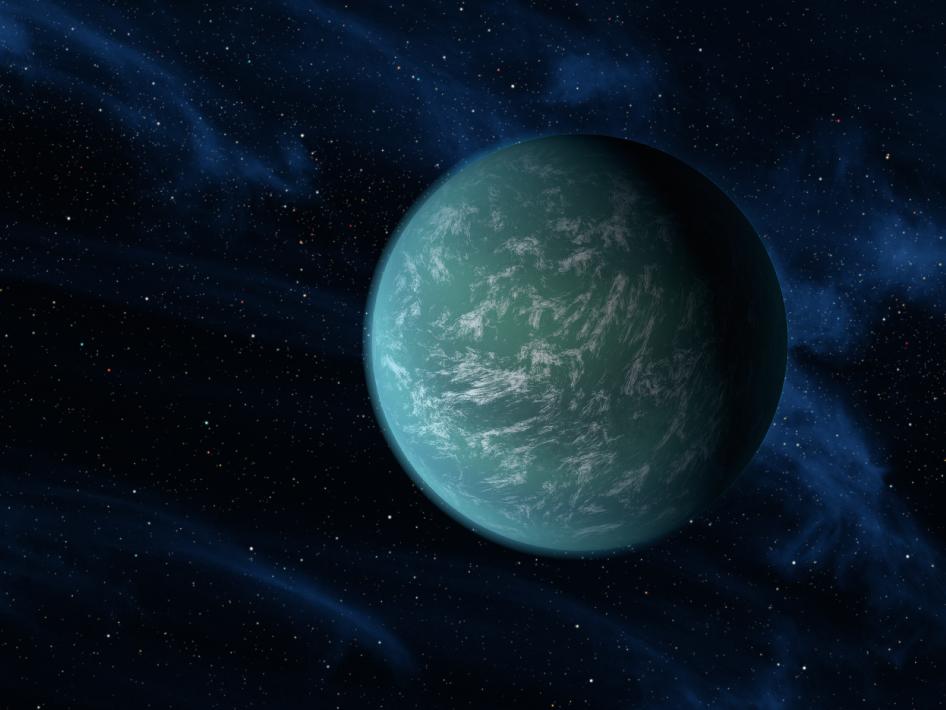
Nestled in the Goldilocks zone of a small, sun-like star is a room-temperature world a little more than twice the size of Earth. Scientists do not yet know if it is rocky or gaseous and whether it has water or clouds, but they do know that it’s the right size, and in the right place, for liquid water to exist. If it does exist, it may be one of the best places to look for life outside of our solar system.
The new planet, Kepler-22, is about 600 light-years away and the smallest planet confirmed to exist smack in the middle of the habitable zone of a sun-like star. It’s one of the most stunning announcements from the Kepler Space Telescope, which stares at a field of stars in the constellations Cygnus and Lyra and looks for blips in brightness to find other planets. While Kepler has (as of today) found more than 2,000 possible planets, finding an Earth-like world in a sun-like environment has proved elusive — until now.
“This is a major milestone on the road to finding Earth's twin,” said Douglas Hudgins, Kepler program scientist at NASA Headquarters in Washington.On top of this announcement today, the Kepler science team is sharing 1,094 more planet candidates, many of which are also potentially Earth-like and in habitable zones. Now there are 2,326 planet candidates in the sun-orbiting space telescope’s field of view, in a small sliver of the sky.
Kepler-22b’s discovery was first announced last February, when the Kepler team shared its initial treasure trove of planet candidates. Among 1,235 candidate worlds, there were 54 habitable zone candidates, Kepler-22b among them. Now it’s the first of these to be confirmed.
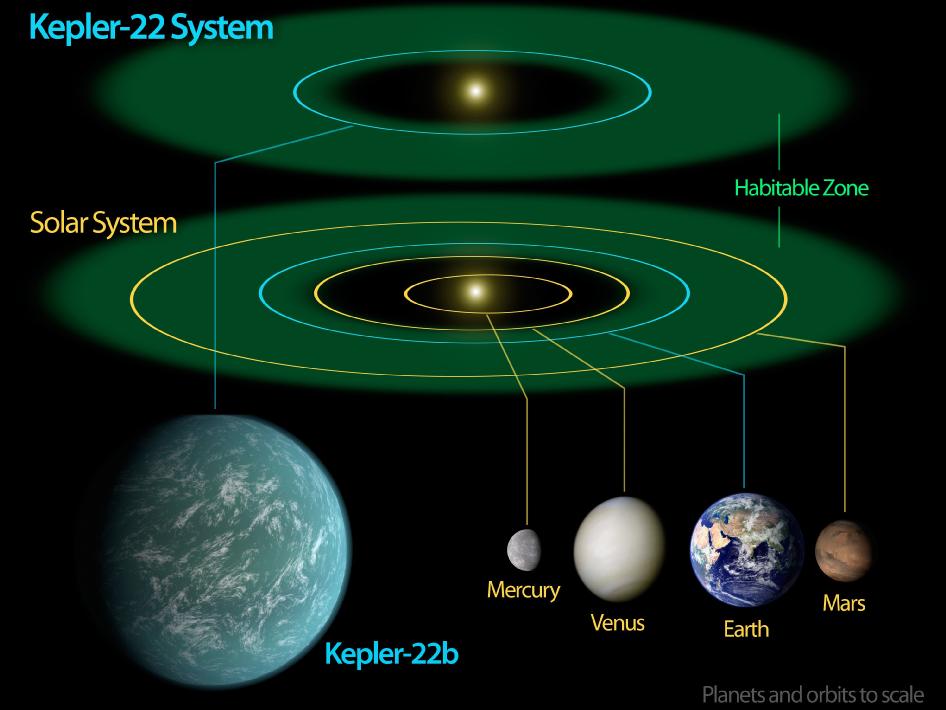
It takes 290 days to orbit around its star, Kepler-22, a G-class star a lot like the one we know best. “It’s almost a solar twin; it is very similar to our sun,” Natalie Batalha, Kepler deputy science team lead at San Jose State University, said in a press conference.
The planet is about 15 percent nearer to its star than Earth is to the sun. But this is OK because the star is cooler (by about 220 degrees), a bit dimmer, and a little smaller than our star. So the planet is in a really analogous Earth-like orbit. The planet’s temperature is even pretty close to Earth’s, said William Borucki, the Kepler mission’s principal investigator at NASA’s Ames Research Center. “If greenhouse warming on this planet was similar (to atmospheric warming on Earth), its surface temperature would be something like 72° F,” he said.
“We will give a higher priority to worlds that our colleagues tell us are not too warm, not too cold, but just right,” she said.
With so many exoplanets, astronomers will need to start making some catalog decisions, ranking planets by their habitability potential. Along with the Earth Similarity Index we covered last month, the Kepler team has their own proposed planetary directory to make this easier. The Habitable Exoplanets Catalog ranks planets by their surface temperature, similarity to Earth, and capacity to sustain organisms at the bottom of the food chain.
Monday’s announcement came during the inaugural Kepler Science Conference in Mountain View, Calif. With the addition of 1,094 new candidate worlds, the number of planet candidates has increased by 89 percent and now totals 2,326. Of these, 207 are approximately Earth-size, 680 are super Earth-size, 1,181 are Neptune-size, 203 are Jupiter-size and 55 are larger than Jupiter. So since February, the number of Earth-size and super Earth-size candidates has increased by more than 200 and 140 percent, respectively.
That’s a lot of numbers, and here’s another good one: 10. That’s the number of these new candidates that are near-Earth-sized and in the habitable zones of their host stars. Kepler-22b is not among that list, so that makes at least 11 places elsewhere in the galaxy that might look very, very familiar.
There’s still a bit of work to do to quantify just what Kepler-22b looks like. Now that astronomers are convinced it’s a planet and they know where it is, confirming their findings with the Spitzer Space Telescope, they want to find out what it's made of. Ground-based telescopes like the Keck Observatory will start making some measurements next summer, when the field of sky that Kepler studies is visible from Earth.
And there is still much more to come, according to NASA scientists. Some software improvements have made it a little simpler to sift through Kepler light-curve data and hunt for planet candidates, so there will be at least one more big batch, according to Batalha. Among those, there may be many more Earth-like candidates to join the ranks.
“We are really zeroing in on the true Earth-sized habitable planets,” she said.

[NASA]
138 years of Popular Science at your fingertips.
Each issue has been completely reimagined for your iPad. See our amazing new vision for magazines that goes far beyond the printed page
Stay up to date on the latest news of the future of science and technology from your iPhone or Android phone with full articles, images and offline viewing
Featuring every article from the magazine and website, plus links from around the Web. Also see our PopSci DIY feed
A 10,000-rpm, no-pulse heart is completely revolutionizing how we think about transplants. Plus: rapid-response virus hunters, a shocking cure for migraines, the world's youngest person to have achieved nuclear fusion (in his parents' garage!), and much more.
Good maybe we can ship all the bad terrorists to that planet and let them fend for themselves. If they can't make it too bad.
If we develop the technology to freeze someone and unfreeze them safely, I go in a heart beat! Send me! Send me!
It isn't exactly 'Nearby'...
Very cool. Assuming it's silicate and not a so called "Gas Dwarf" or something, I wonder what it's surface gravity would be?
Just keep cloning yourself...and transfer your consciousness to the new clone body....and as far as memory storage limits...well...install some hardrives into your brain to add a bigger memory storage....or somehow make the brain more effective at storing memory/information.
If my math is correct, this planet is roughly 3.5 Quadrillion miles away. Meaning, even if someone were to travel at 10,000 MPH it would still take about 965 million years to get there. Even at light speed that's 600 years.
Looks like we'll need to set up a dial in for this meeting...in person doesn't seem like a viable option.
Am i getting this right? 600 light years away? Thats like a long way off, but if we can put people to sleep like in space oddysey, we should be fine.
-sevykeble
the future is happening so fast that it is now.
Ah, but here's the physics... if you travel at aprox. 99% speed of light (gamma = 10) then that 600 years would only take 60 years. Faster then light travel is *kind of* possible, we just can't get back to earth.
Uh... ok...
That last statement was at gizmowiz.
600 light years is relatively close compared to the span of stars outside of the adequate reach of our space and surface based probes and scopes. If we have this many candidates for expoplanetary discoveries, not to mention the Earth-like ones, in the small sector of space Kepler seeks for them, imagine how many more planets (possibly habitable at that) circle the rest of the stars across the entire galaxy. This galaxy is probably highly populated and we don't even know it with certainty.
@eregorn8
Why wouldn't you be able to return to your point of origin (i.e. Earth) traveling faster than the speed of light?
I think the Alcubierre warp theory is the most practicle theory behind relativistic motion on a cosmic level.
@eregorn8 how exactly are you getting 60 years? Since proper time would be that on the ship, time dilation would be (600)(sqrt(1-(0.99^2))). Which would equal 84.64 years.
Good news, this adds to the credibility of populated life in our neighborhood.
On the other hand, shouldn't discoveries such as this one, propel governments to invest in FTL technology?
Even if we create a probe that will travel to 22b @ twice the speed of light, it would only get there in 300 years, and probably another 100 years or so if it is going into orbit, or landing on the planet.
*Sigh* I hate sobering thoughts...
it would be hilarious if there were aliens at the same stage of evolution and technology as us looking back right at us.....how would we know for sure if life was there? lol. how long would it take a radio signal to get there and back? someone should call SETI and tell them to aim their giant telescope at it.
_________________
The people of the world only divide into two kinds, One sort with brains who hold no religion, The other with religion and no brain.
- Abu-al-Ala al-Marri
I WANT TO GO!
.............................
Science sees no further than what it can sense.
Religion sees beyond the senses.
Look at it this way we have went from steam engines to jets that can travel at speeds faster than sound so I believe we are closer than any of you think.
Sincerely,
Nongeekgeek
I don't think will be lining up tourists to go to visit Kepler II anytime soon. At almost 50 million years round trip via the fastest interplanetary travel we currently possess it's silly to consider ANY interplanetary travel at all.
We would be better suited to just terraform our true sister twin planet Venus which is .95 earth gravity and within round trip distance feasibility with current technology (same as Mars).
We can kill two birds with one stone too: installing solar panels to block the sun to cool down Venus could be microbeamed to Earth to solve our energy problems forever.
We should be focusing on our Solar System terraforming ONLY!
No magnetic field.
yeaa what happens when our sun decides to go nova or a rouge planet comes smashing through no spread out is the way to survive
quseio2,
By the time our sun goes Nova, hopefully we will be so advance in technology we can find a nice room in a cozy hotel of a black hole somewhere and not worry about it. ;)
@grunt, hopefully by the time we have cozy hotels inside black holes, we can prevent our sun from going nova.
Reading this article made me wonder how much gravitational force the human body can withstand
Easy. Use existant knowledge and international funding (maybe it's time for another clash of superpowers and the technology race that comes with it, peaceful times are simply not productive enough) to build a generation ship, slap some solar sails on it for maximum crazy speed and off to the stars you go!