At today's event in Cupertino, Apple took a further step towards their idea of the future of computing: They're bringing ideas, in both hardware and software, from the iOS line (iPhone and iPad) and integrating them into the Mac. Oh, and they also announced a ludicrously thin and lustworthy new MacBook Air.
As you'd expect, glossed over much of the intricacies of their newly-announced forthcoming OS, which is pegged for a summer 2011 release. But luckily, both Lion (and to some extent the latest version iLife) can be summed up with ideas, rather than features. The main thrust of these two new releases is what we saw with the release of the iPad, and even the newest Apple TV: Apple's future will begin to blur the distinction between the mobile iOS and and the desktop OS X.
In the case of iLife and Lion, that'll mean more multitouch gestures and the addition of FaceTime chat (pretty much like an Apple-only Skype for Macs and iOS devices), but also a shift in their general design philosophies, with more full-screen app experiences and an always-on, always-saving workspace.
Apple is also launching a version of their tremendously successful App Store for the Mac platform. It'll look pretty much like it does on iOS, and comes with a few advantages (and disadvantages) over the usual system of finding software: A central repository is nice, along with universal updating, but it also means Apple will extend its significant (and controversial) control to the wide world of Mac desktop software. Of course, some Linux distros like Ubuntu have been doing this for years, but it's a pretty new idea for a major commercial OS.
Luckily, though, the Mac App Store won't be the only show in town: Steve Jobs noted that "It won't be the only place to discover apps, but we think it'll be the best place." The Mac App Store will launch on Snow Leopard, the current version of OS X, "within 90 days," but will start looking over submissions in November.
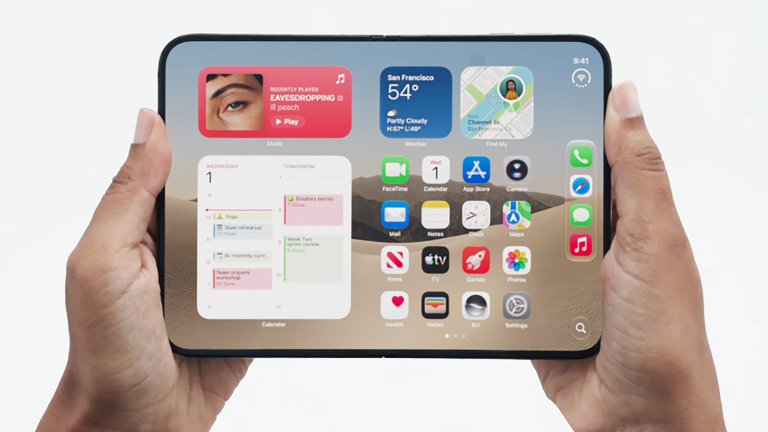
You'll be able to call up apps with what's called the LaunchPad: It's basically an iPad homescreen on your Mac, letting you swipe through apps with a gesture and group apps into folders. And Launchpad is just one part of the new Mission Control interface, which groups previous interface ideas (Expose, Spaces, Dashboard) along with LaunchPad into one page-based idea. You've got your desktop on one screen, but swipe to the left and you'll see your Dashboard. Swipe to the right and you'll see one of the new fancy full-screen apps, like those in iLife '11. It's a very direct blend of iOS and Mac OS.
Now that Mac's software is more iOS-like, it only makes sense that the hardware should be as well, right? As expected, Apple announced the new MacBook Air today, a minute slice of unibody aluminum with some impressive internals. It'll be available in two sizes: There's the original 13.3-inch size and a new 11.6-incher. Both will have Intel Core 2 Duo processors and Nvidia GeForce 320M graphics chips--not top of the line, but fast enough, considering the size. And, unlike the last Air, there isn't even an option for a hard drive this time: It's flash-only in Air-land. The larger Air will offer a 128GB or 256GB of storage, while the smaller model has 64GB or 128GB. Both have either 2GB or 4GB of memory. They've also both got an SD slot and an additional USB port (bringing the total up to...well, two), plus a FaceTime camera.
The best thing about these new MacBooks is what they gain from being pared down: Huge standby battery life (7 and 5 hours of active use, for the larger and smaller model, respectively, is farily hum-drum, but 30 days of standby time is nice), instant-on functionality, and an absolutely miniscule size. The laptops range from a super-thin 0.68 inches to a ridiculous and probably dangerous 0.11 inches at their thinnest.
Actually, scratch that: The most impressive part of these machines is their price. The 11.6-incher start from only $999, and the 13.3-incher start from $1300, a significant price cut from previous MacBook Air models. Those are both available today at Apple's site.
[Apple]
Five amazing, clean technologies that will set us free, in this month's energy-focused issue. Also: how to build a better bomb detector, the robotic toys that are raising your children, a human catapult, the world's smallest arcade, and much more.


Online Content Director: Suzanne LaBarre | Email
Senior Editor: Paul Adams | Email
Associate Editor: Dan Nosowitz | Email
Assistant Editor: Colin Lecher | Email
Assistant Editor: Rose Pastore | Email
Contributing Writers:
Rebecca Boyle | Email
Kelsey D. Atherton | Email
Francie Diep | Email
Shaunacy Ferro | Email
The 11" model is gorgeous. I think of it as a final flick on the nose for the folks saying that the netbook was a fad. And *thank you* for doing the research and noting that an app store for a full desktop OS isn't actually a new thing. I've been enjoying it since '08 on Ubuntu. = )
the difference between a netbook and this is that a netbook is 6-700 bollars cheaper.
thats why people get them
the HD size is nice, but i sure would rather get a sony vaio any day.
since it has a blu ray drive, and is expandable up to 8 gigs of ram.
There's no SD slot on the 11".
www.apple.com/macbookair/compare.html
to me it look like it would break if you touched it. I personaly dont think we need to go smaller on some things, like laptops. I dropped my lapptop before and it still works great but that and the old air will break to easily.
As far as breaking if dropped:
(1) I can't think of an expensive electronic device that I've ever dropped from a height or distance that caused any problems... Why? Because when I'm holding and using my expensive electronics I'm careful.
(2) Does F=MA still apply? A is fixed [unless you are using it pretty far from Earth], so decrease M and you decrease F. So the light-weight aspect of making these things smaller should help them in potential falls.
Tack on a well-built aluminum casing [vs plastic on most netbooks and laptops] and I'm gonna guess it'll do just fine if you dropped it.
If you are a klutz than I'd recommend a service plan that includes that. On the plus side- flash drives are very shock tolerant, so even if you dropped and destroyed the laptop, you are unlikely to lose any data [outside of maybe open documents?].
Very, very cool...
Ivan Malagurski