
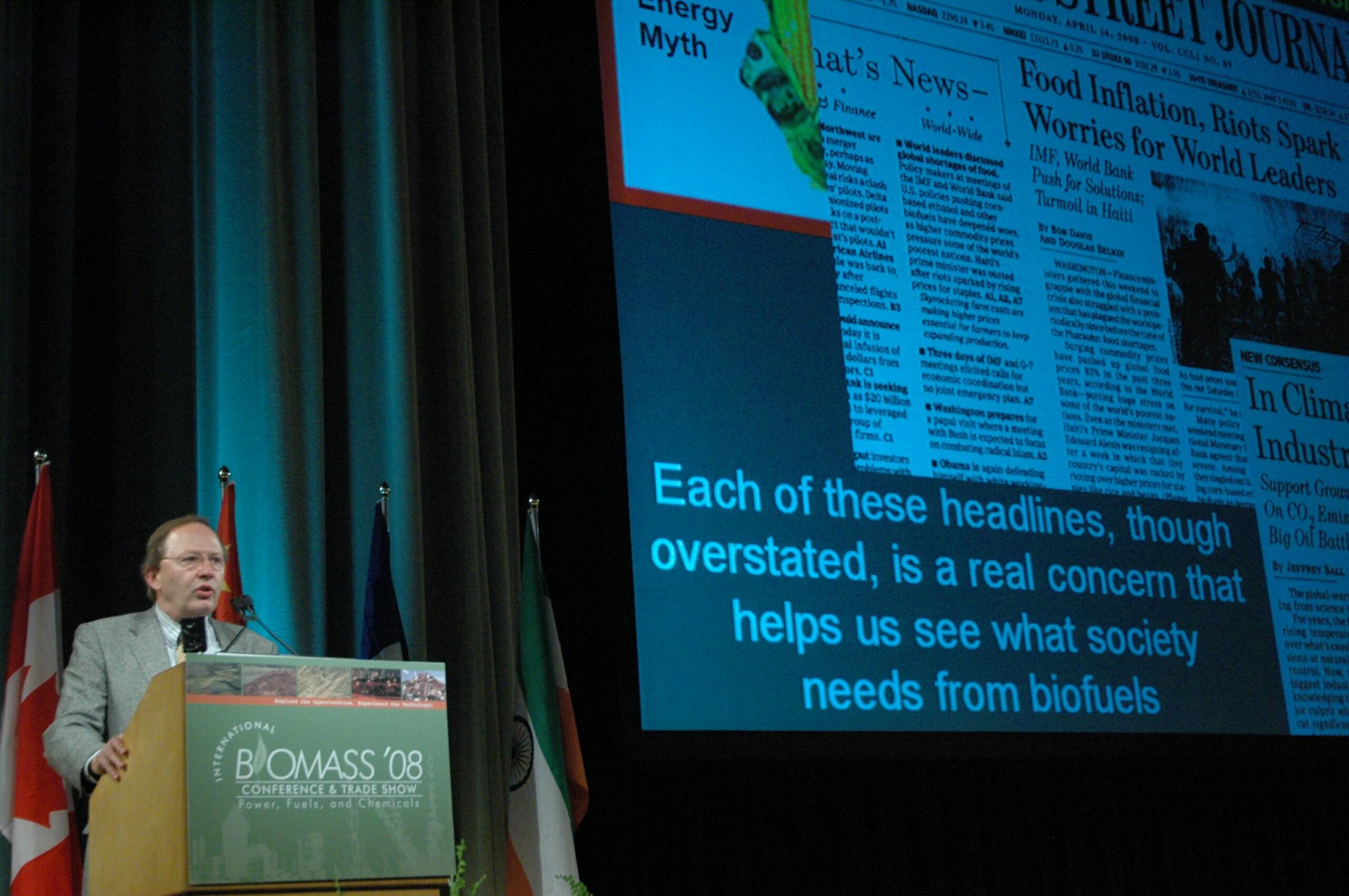
The first annual BioMass conference, attended by biofuels researchers, manufacturers, equipment suppliers, and farmers, is underway here at the Minneapolis Convention Center.
Prime on the agenda in the opening session this morning was a question lately blaring from headlines, for instance in a story in today's New York Times: can we grow crops for converting into fuel without catastrophically upsetting the world's food supply?
The answer is an unqualified "Yes," says David Tilman, ecology professor at the University of Minnesota and one of this morning's speakers. He deplored the polarization of the biofuels debate, pointing out that that biofuels were first touted as a savior a couple of years ago, with public opinion shading into doubt not long afterwards, and now in full-swing backlash mode, with people like the United Nations special rapporteur for the right to food, Jean Ziegler, calling biofuels "a crime against humanity" because it takes food out of the mouths of the hungry according to today's Times.
What's needed instead, says Tillman, is a rational look at the big picture, backed by good science. Yes, he acknowledges, the demand for biofuels derived from traditional food crops like corn has contributed to a rise in global food prices, but so has increasing demand for food from burgeoning populations in China and India.
More to the point, though, is the mistaken notion that we have to use food crops for fuel production. In test fields in Minnesota, Tilman and his colleagues have found that the best energy yields actually come from native prairie grasses, not corn or soy. And, said Tilman, "there's a surprising benefit from the mixture of species. Farmers know this from growing pastures. Nobody plants a pasture of a single species. They put out a variety of grasses, legumes...and so on. They do that because that gives them a higher yield."
What's that mean for energy? "We see here we get 238 percent more energy per acre of land that we can harvest mowing this hay in the autumn by growing a high diversity mixture of species than we can get on average by growing any one of those species by itself."
Tilman's test plots were "on land that is incredibly unproductive, with very infertile soils... We did not fertilize it, we didn't water. We put out high diversity native prairie, let them grow...." And energy production from the harvest went through the roof. "Another thing which happened which really surprised us is that we have a lot of carbon being stored in those soils."
So, growing inedible biofuel crops on otherwise unproductive farmland not only will ease the current pressure on food crops exerted by biofuels, but will also help remove harmful CO2 from the atmosphere. Seems like a win-win.

Five amazing, clean technologies that will set us free, in this month's energy-focused issue. Also: how to build a better bomb detector, the robotic toys that are raising your children, a human catapult, the world's smallest arcade, and much more.


Online Content Director: Suzanne LaBarre | Email
Senior Editor: Paul Adams | Email
Associate Editor: Dan Nosowitz | Email
Assistant Editor: Colin Lecher | Email
Assistant Editor: Rose Pastore | Email
Contributing Writers:
Rebecca Boyle | Email
Kelsey D. Atherton | Email
Francie Diep | Email
Shaunacy Ferro | Email
This is all well and good, but there are still a couple problems. Problem number one: Are the Bio-Fuel farmers actually doing this, and Two: Can you efficiently extract the required components form the grasses?
A brief note on our agricultural community. For one, in times of abundance our government actually pays farmers to let their crops go into decay rather than sell them to the public. So, in short it's not like we have a shortage, it's just another arguement to back oil companies.
.
the problems (and the debate) about Biofuels vs. Food comes ONLY from the fact that all countries and companies choices always are for the simplest and most profitable way to solve the problems
then, they try to change the FUEL rather than change the CARS
we know that EACH DAY our Sun send us an incredible amount of FREE energy and that LESS than 1% of that daily energy is enough to cover ALL the world daily energy needs
now we have the technology to capture the solar energy (as light and wind) and the good news is that it's also a CHEAP technology, so, if politics and industries WANT, we can use agricolture for FOOD and the SUN for energy
maybe... using some SMARTER, cheaper and MORE "energy dense" power plants like MY "Wind Energy Skyscrapers Power Plants":
http://www.gaetanomarano.it/articles/028energy.html
if many science magazines and websites like POPSCI.COM will talk and write articles on them, maybe, somebody will develop and build this new kind of energy source... :)
.
The current food price hike is due to short term market forces of supply and demand.
The real question is in the long term can current and easily accesible agricultural land support both world food production and bio fuel production.
I think this is an issue that needs much deeper study than a few speeches at a conference. The big picture is that in the long term, any significant use of bio-fuels will either result in a fall in food production or an increase in agricultural use of land. Scientists from different sectors need to work together to decide if the net effect on Carbon emissions justifies the cost in terms of food prices and damange to vegitation.
Also scientists need to consider alternate power sources including solar, and more efficient power production, and tell consumers what is best for the world as a whole.
I also wonder why the mentioned technique is not in commercial use. Is there serious bottleneck in the process or is it simply just a new process yet to be commercialised.
Mr. Tilman may be right in that the future of biofuels has much less of an impact on our food supply. However, cellulosic ethanol is not a present reality. The current situation is that we have politicians and agriculture lobbyists out there pushing corn based ethanol as if it's the solution to all of mankind's energy problems. And the result is that we get a lot of people who don't know the reality of the situation piling on the bandwagon which causes all of these problems with food supplies right now.
What we need from people like Mr. Tilman is to cut through all the hype, and educate politicians and investors that biofuels, while very promising, are not quite ready for the spotlight.
When cellusic ethanol moves out of those test fields in Minnesota and into a commercial atmosphere, then Mr. Tilman's speech will have relevance. Until then though, he's just compounding the problem.
So, picking up grass cuttings from "infertile" land is going to be 238% MORE efficient than corn. NOT 237%, NOT 239%, 238%. Well, let's see. Corn grows to 8 feet tall and produces a fruit that weighs about a pound each and may have 5-8 per plant. Yield averages about 6.5 TONS per acre. Various grass on unfertilized, unwatered, infertile land might be 2 feet high. What do you think the yield will be? It ain't gonna be 15 TONS! Maybe ONE. And how is this to be harvested? You are talking about YARD CLIPPINGS. It would be more efficient to pick them up with a WHEEL BARROW. Certainly not a harvester.
So maybe this whole article is just one big BLOWING SMOKE BS puff piece.
DRILL ANWAR! And the coasts. THAT will bring us "energy independence". You can't "conserve" a tank of fuel.
Coskata has a process that uses anything organic (everything from switchgrass to garbage) and produces almost 7 times as much fuel as it consumes - fermenting corn is at best a break-even process.
http://oblate-spheroid.blogspot.com/2008/01/bacteria-delivers-buck-gallon-biofuel.html
It is unfathomable why people would waste food for biofuel when there are so many better alternatives.
Lets see, a bunch of "biomass" engineers and scientists conclude that ethanol is not a problem. I'm shocked! What else would they conclude? Follow the money, folks.
Mr. Tilman claims that the best agricultural non-food energy yields come from prairie grasses. However, what energy is he talking about? Is it the total energy content of the prairie grass? If so, how would it benefit us, would it replace coal in an electric power plant? Would the harvested prairie grass be fermented to ethanol or butanol using some yet to be invented process? How much energy would be required to grow and to process prairie grass to useful fuel or useful energy? Would there be a net increase in energy in the process? How many harvests of prairie grass could be tolerated before the soil is depleted of minerals and nutrients? How many acres of marginal arable land would be required for prairie grass production in order to replace just 5% of our transportation energy needs with the energy derived from prairie grass? Mr. Tilman proposes and answers none of these questions. There is no substance to Mr. Tilman’s article, just fluff. In many ways Mr. Tilman is like Barack Obama, a lot of meaningless words and no substance, just promises.
Unfortunately, in the last few years, articles such as this have significantly decreased the stature of this once-great popular science magazine. I concluded long ago that Popular Science has an agenda that is not compatible with good science and economics.
Jose Sanchez
It doesn't matter what they make ethanol of. The problem is it requires a b-load of space to produce it in the quantities needed. This leads to deforestation i.e. brazil (now the 4th largest carbon emitter in the word due to BURNING the rain forest to grow crops). Ethanol is not the solution.
The problem is the focus on food crops for ethanol production. There is a plant, easily grown on poor soil with minimal fertilizer, AND it can produce 20 times more ethanol per acre than corn. Hemp. Oh, yeah, I forgot, the government won't let them grow hemp here.
Any new technology is going to be very inefficient and expensive in its beginning stages. What is disturbing is how many people are willing to give up on biofuels just as serious research is getting started. As world population grows and prosperity spreads, the demand for energy is going to be enormous, outstripping the demand for food.
We can't afford to pick and choose. The world needs all its technologies, bioenergy, solar, nuclear, wind and conservation. In the meantime, we cannot stop drilling for oil or mining coal either.
I can live with out chips and cokes and the accasional honey bun lol!!!!
Clearly some of us aren't reading the article fully nor researching Dr. Tilman's work before attacking him.
Firstly, to fiftycal, had you carefully read the article and had a better understanding of agricultural practices, you would understand how the >200% yield comes about. Growing corn requires several field operations, plowing, planting, fertilizing (which costs fuel AND uses fertalizers which come from fossil fuels) and watering throughout the season. Additionally, ethanol processing is very energy intense and requires quite a bit of input to get out your desired fuels. As such, the NET (that means output minus the input) energy yield for corn is very very weak.
Now in the article, Tilman describes for you how perennial prairie grasses are only planted once (they are perennial, thus will grow back each year without any more planting) and require NO fertilizer, NO watering, and NO plowing of the field. Harvesting is simply carried out with traditional grass baling operations that are well established. These grasses can then be used in a 5% blend with coal in existing coal power systems (this has been done successfully) and the NET energy they supply in this manner IS >200% that obtained with corn.
Mr. J. Sanchez's comments were also simply wrong (and obviously politically motivated). What Dr. Tilman spoke of WAS the net energy yield. He has also addressed every question Mr. Sanchez brought up in his article "Carbon-negative biofuels from low-input high-diversity grassland biomass" published in the peer-reviewed and internationally respected journal "Science" (v 314, n 5805, Dec 8, 2006, p 1598) with a sound scientific analysis.
If we take the time to actually look into the background of these articles before flaming them, we could avoid these silly misconceptions.
Can we please just kill the combustion engine already?
http://www.6rp.com