
A More Efficient Hybrid

Reusing exhaust makes for a cleaner, more capable engine

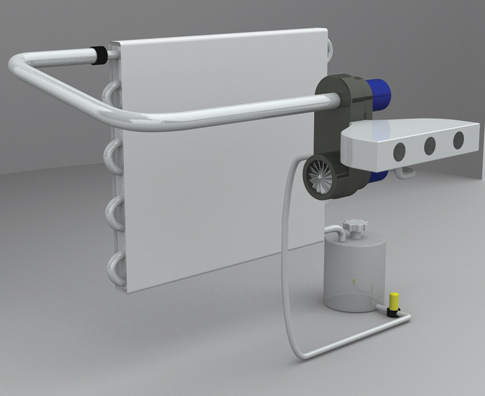
Heat Trap: Two separate turbine systems convert pressure and heat from car exhaust into electricity:

One of the first things Eric Mattessich discovered in engineering school was that the typical internal combustion engine blows about 70 percent of the energy it creates straight out of the tailpipe in the form of heat. So, he wondered, could he adapt the kind of heat-recapturing mechanisms used to make powerplants more efficient to work on hybrid cars? “The technology has been around since the 1900s,” he points out. “It’s just that no one has put it into such a small package before.”

His solution uses two turbine generators; in the first, the pressure of escaping exhaust spins the turbine to generate electricity. The second uses waste heat from the exhaust to turn water into steam; the steam powers the generator before traveling into a condenser, where it turns back into water and starts the loop again. Both turbines feed electricity back into the hybrid system’s batteries for a 20 percent reduction in greenhouse-gas emissions and a 20 percent more efficient vehicle.

WHAT’S NEXT Mattessich is working on a prototype, applying for a patent, and looking for an automaker interested in incorporating the system into new cars—although he doesn’t rule out building an aftermarket device that uses the technology. “It could be a fun project for do-it-yourself types like me,” he says.

Inventor: Eric Mattessich, senior
New Jersey Institute of Technology, Newark, N.J.

12 Comments

idratherbegolfi...

from Plymouth, WI

What a fantastic idea, congrats Eric on the ingenuity. Good luck getting an auto company to sign on to the idea; however, I think unfortunately you will have a much better chance with an aftermarket device. Most automakers won't be willing to take a chance on a revolutionary piece of technology such as this. The product would have a much greater effect if it could be retrofitted on older automobiles, rather than just on new ones.

Why not just use a regular turbocharger to power a say, tinnier high-efficient 1 liter engine (or better yet, a diesel sincce they all use turbos) to produce more power, but less emissions than a larger n/a engine. So thats one step of reusing thermal energy, another step you mentioned is steam power, which I'm also quite fascinated about applying it on modern vehicles too. Just somehow connect that to a water sprayer by the exhaust turbine part to produce flash steam which will lead into a container to hold all the press. for later use. So its kinda like a gasoline/electric hybrid sans electricity for steam power!
Imagine a Stanley Steamer with a gas engine!
But I guess you can make electricity by spinning a turbine, but its less efficient due to the energy transformation from mechanical energy to electricity to chemical storage(which also why batt. gets hot)and back to mechanical again.
High HP small gas engine w/ steam assist, is a more elegant solution.

idratherbegolfi...

from Plymouth, WI

Good point FreeWi, I think the article was in PopSci about a year ago about the inventor you took an engine and added another cycle to it. He modified it to inject fine water mist directly into the cylinders to then expand as steam and capture some of the heat from the gasoline combustion after the regular piston cycles were complete. Don't quote me, but I think he improved efficiency somewhere around 30 percent. If only there was a way to extract energy from gasoline without burning it so we could avoid the heat loss... maybe a new type of method is needed.

The device would have to come after the catalytic converter(s). Those are temperature dependent. Robbing heat energy from them would reduce they're effectiveness or eliminate it. But the further from the engine you get, the more heat is lost from the exhaust gasses. Also, harnessing exhaust pressure gasses leads to less efficient engine performance (back-pressure reduces overall horsepower). The device would also add weight to the vehicle. Prototyping is necessary to verify the gains from the steam turbine would overcome the negatives. Still, very much worthwhile to test. I'm interested in using small gas turbines to charge batteries and capacitors to power a vehicle instead of Internal combustion. Far lighter, more efficient, but they don't respond quickly enough to be used as a main drive in an automobile (ask Mercedes).

Not all the 70 percent loss of efficiency comes through the exhaust; a lot is lost through the radiator. I hope Mattessich is linking this system to the cooling system.

DiGMEH

from Montreal, Quebec

I would go with freeWi11 on this one. As soon as I read the article, there's one thing that popped in my head: turbo afterburner. The idea, as mentioned, has been around for a long time. In theory, I agree that it looks like it will reduce emissions and better fuel efficiency. But don't forget that the more stuff you add to the car, the heavier it gets, and in terms, takes more gas. If you're adding equipment that would escalade your fuel consumption by 5%, then bettering it by 20%, you are getting a 15% return for a bigger cost.
- DiGGY

Interesting concept but don't hold your breath, that anyone produces it. Any technology that constricts the exhaust (in this case the turbine) will rob horsepower from the engine. That is the reason catalytic converters( which constrict exhaust) are not on race cars, and why removing the converter will gain you about 2 MPG. The hybrid engine still requires a fixed amount of horsepower to move the car and charge batteries. So by removing horsepower you force the car to burn more gas.
The heat exchanger idea is more sound, but I doubt you will see it as well. I doubt it will do well in cold weather. You can't exactly use anti-freeze in the water, since antifreeze resists boiling. Most driving that a hybrid does is short so the water won't heat enough for steam.
NO FREE ENERGY PEOPLE.

The turbine in this device is nothing like a turbo, so if you disagree with me don't use turbos as your argument.

There is plenty of room for heat scavenging in IC engines without restriciting exhaust flow too badly. Heat exchangers can be arranged in a planar fluid-flow direction. Exchangers could be wrapped around exhaust components, which can reach 500 degrees externally. A binary turbine process could easily tap the heat of the cooling fluid in the radiator. I love this man's thinking!

If this has been around for 100 years, why hasn't anybody else tried it?

I remember reading an article about 40 years ago about the Stanley Steamers which said that they were a better technology than Ford's, but the Stanley Bros. refusal to adopt assembly line production doomed their company. I've always been intrigued by that.

I've also heard of carburetors that heated the incoming gasoline with part of the exhaust, giving big gains in fuel economy, but I'm not one of those who believes that the car companies or the oil companies could or would buy up such ideas to keep them off the market. If GM knew how to get 100 miles per gallon in a car people will buy, I think it would build it.

What we're seeing now is the result of outsourcing our energy needs for 20 or 30 years without tapping our own resources, based on promises that we can run our cars on sunshine and wind. Maybe someday we will, but if it could be done without putting most Americans back on foot or bicycles we'd already be able to buy them without government subsidies.

I believe that the future is in electric cars, but we're going to need a big increase in generating capacity and battery technology. I really wish that media like Popular Science and Popular Mechanics would tell us straight about how much these new cars will cost, when we can buy them and how soon we can realistically be completely energy independent. Too often we get the Gee Whiz! stories, but not the bottom line.

I think he won't succeed, the oil companies will make sure of that. They will succeed on their quest to keep the world running on oil for as long as they can so they can reap the profits. As long as there is oil they will fight off inventors who make inventions like Eric so they can keep themselves rich.

Einstien

I agree with Einstien, the oil companies won't allow it. Just wait until peak oil....
Dustin H

There are several refrigerant fluids that can be used in place of water that have a freezing point of less than -50 but a boiling point comparable to that of water. Of course there are latent heat capacity differences that affect efficiency. Although an advantage would also be that you could choose a one with a lower boiling point that could flash off without the exhaust being as hot.

Popular Science Photo Pool


Share your photos in the Pop Sci pool at www.flickr.com!

Subscribe for 2 free issues!

POP_embeddedForm_cover_May09.jpg