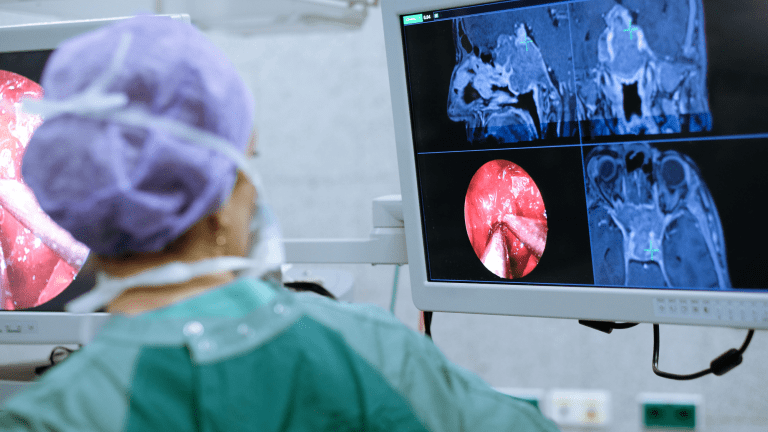
A new bionic eye implant could allow blind people to recognize faces, watch TV and even read. Nano Retina’s Bio-Retina is one of two recent attempts to help patients with age-related macular degeneration, which affects 1.5 million people in the U.S. Although a similar implant, Second Sight’s Argus II, has been on the market in Europe since last year, it requires a four-hour operation under full anesthesia because it includes an antenna to receive power and images from an external apparatus. The Bio-Retina implant is smaller because it doesn’t have an antenna. Instead, the implant captures images directly in the eye, and a laser powers the implant remotely. Because of Bio-Retina’s compact size, an ophthalmologist can insert it through a small incision in the eye in 30 minutes—potentially more appropriate for seniors. The Bio-Retina will generate a 576-pixel grayscale image. And clinical trials could begin as soon as next year.
Ordinary-looking glasses contain a battery, a power-delivering laser apparatus and working lenses (to help with vision problems such as nearsightedness and astigmatism).
The near-infrared laser beam, gentle enough to shine harmlessly through the eye onto the implant, provides up to three milliwatts of power to a photovoltaic cell on the eye implant. The light is invisible, so it won’t interfere with sight.
Photoreceptors pass light information to an image processor that translates each image pixel into a series of electrical pulses that represent a particular shade of gray.
(Inset) Six hundred needle electrodes (wrapped in biocompatible silicon and sapphire to prevent the formation of scar tissue) penetrate the retina. Each electrode represents one pixel, sending pulses of electricity to stimulate the eye’s neurons, which transmit the image to the brain.
Five amazing, clean technologies that will set us free, in this month's energy-focused issue. Also: how to build a better bomb detector, the robotic toys that are raising your children, a human catapult, the world's smallest arcade, and much more.


Online Content Director: Suzanne LaBarre | Email
Senior Editor: Paul Adams | Email
Associate Editor: Dan Nosowitz | Email
Assistant Editor: Colin Lecher | Email
Assistant Editor: Rose Pastore | Email
Contributing Writers:
Kelsey D. Atherton | Email
Francie Diep | Email
Shaunacy Ferro | Email
In wun articl thu caypubiliteys uv wiyrlis rimoet camoe.s caypubiliteys with freycwnsy suseptubilitey wiuld not siyt be posibl withowt thu implant.
Reminds me of the Deus Ex video game series.
@Cookiees453
nice to know there are other Deus Ex fan out there
its sad that this can only be used for patients with vision degenerative problems and not total blindness
but this is promising none the less, its funny, politics at home is allowing other nations to come up with new innovations in other countries
To quote; '(wrapped in biocompatible silicon and sapphire to prevent the formation of scar tissue).'
Sure, and yet scarring still happens in a minority of patients. I wish PopSci would actually correctly report, or word, their articles sometimes. Biocompatible silicon and sapphire is not a panacea against immune system rejection.
I wish, hope and pray, this helps people to see!
@warzones, PopSci is reporting as it is told, the company probably said it the way it was written here, so please don't be too much of a nitpicker. Scarring will still happen, the bio-compatible silicon and sapphire is to MINIMIZE the scar tissue. Scars happen.
And @robot, isn't that the general idea? (said in a joking manner)
Excellent!