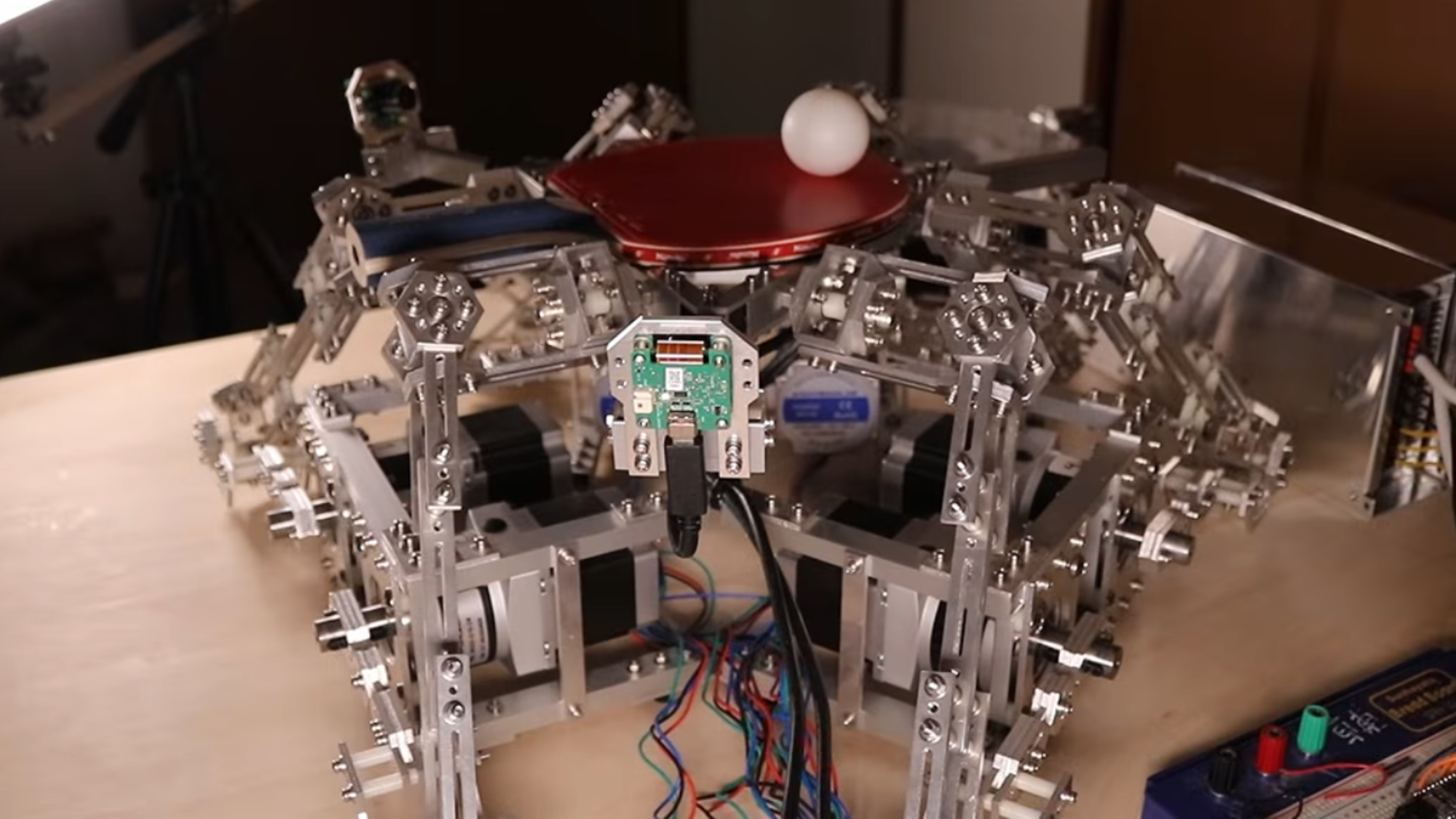
In a world where tech leaders are racing to build autonomous machines that can do almost anything, one hobbyist is going the complete opposite route: an over-engineered robot that does exactly one thing and one thing only.
T-Kuhn’s Hexa-Bouncer only bounces a ping-pong ball, but looks like it’s capable of far more. The six-armed, metal machine was first designed in a simulated environment and then brought to life with a CNC milling machine. Custom-built joints let it rise, fall, and tilt, and even bob up and down while tracing a circle. A pair of cameras, set 120 degrees apart, track the ball’s position and send that data to a computer over USB. The computer then builds a 3D picture of the scene, then calculates when the paddle should strike the ball and at what angle. All of this happens in a fraction of a second.

The Hexa-Bouncer
Hexa-Bouncer keeps balls in the air remarkably well. In a video, Kuhn holds a ping-pong ball above his creation, and the machine moves up and down in sync with his hand. When he drops the ball, the robot immediately reacts, striking it back into the air and keeping it aloft bounce after bounce, all the while making small adjustments. After a few more bounces, the device eases off its swing and the ball starts bouncing lower and lower. It’s unclear exactly how long Hexa-Bouncer can keep the ball in the air, it never misses—at least in the video posted online..
Kuhn describes his ball juggler as the latest in a series of, “useless but mildly interesting ball bouncing machines.” Prior to this, he released his Octo-Bouncer, a similar design that keeps a ping-pong ball bouncing in the air using a four-sided flat plate. Some might say all this over-engineered ball bouncing is unnecessary, but Kuhn would disagree. For him, solving the design puzzle is a journey in itself.
“Building a thing like this is like bashing your way through a jungle,” he said. “It’s an adventure. You’re not completely sure if you can make it through or not, and that’s exactly why you do it.”