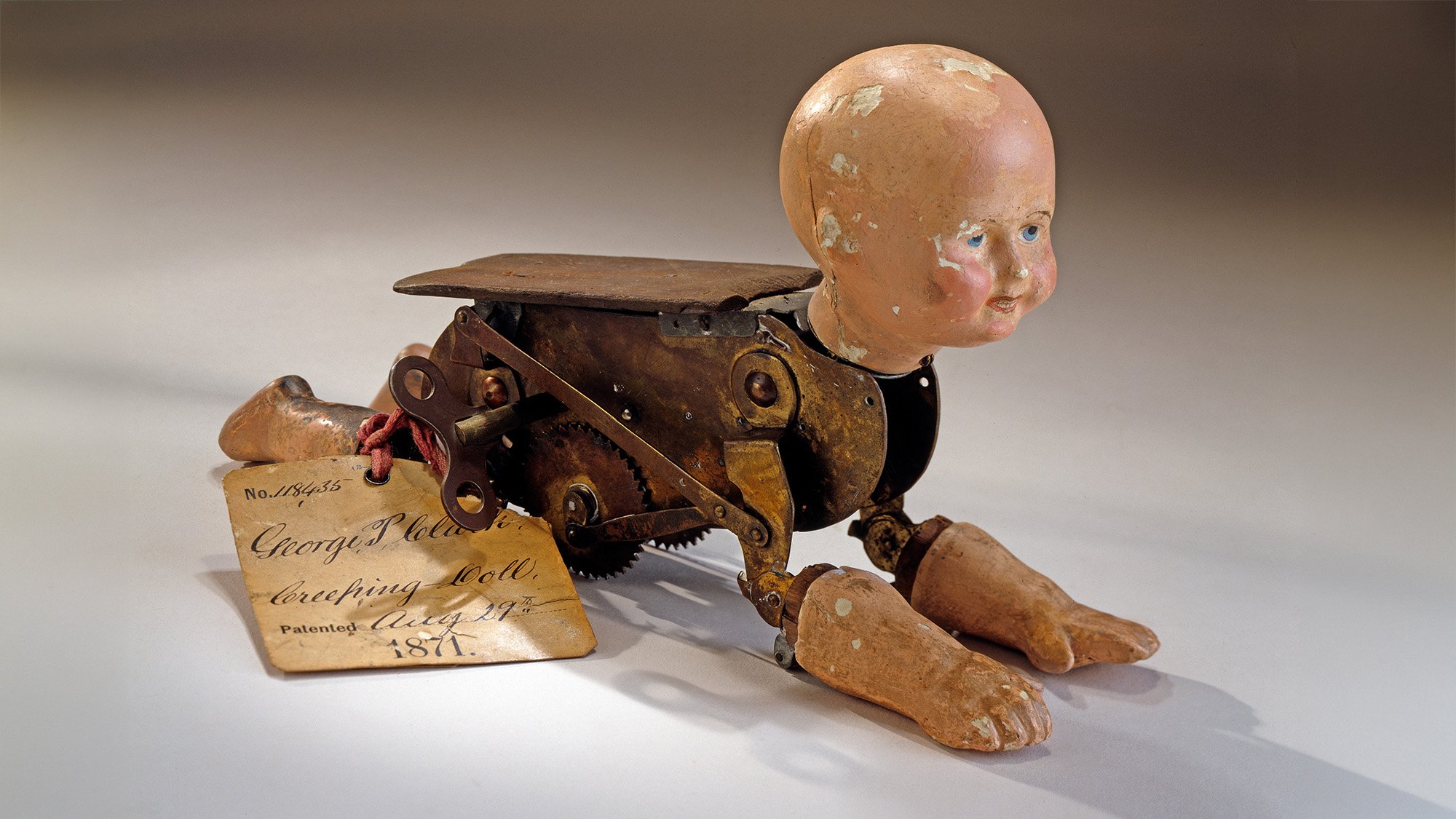
Already looking for children’s toys for the holidays? Are you also a big Halloween fan? Well, do we have a gift for you! Allow us to introduce the present no child could ever love (unless maybe they were possessed by a demon or a big fan of The Nightmare Before Christmas): The Creeping Baby Doll!
This nightmarish 1871 creation is everything you don’t want in a children’s toy. It’s noisy. It moves—seemingly propelled by painted plaster baby arms and legs. And it’s way creepy.
The mechanical baby doll has two legs, two arms, and a head all made of painted plaster (which is undoubtedly a bit chipped after more than 150 years). These plaster bits are really the only thing that actually look somewhat like a baby. The rest of the doll’s body is made up of brass clockwork. Some sort of dress or outfit would’ve likely covered its brass body back in the day.
Both the arms and legs are attached to gears that make the plaster limbs move so it looks like the baby doll is crawling (hence, the name—though we would argue there’s perhaps a reason they went with “creeping” instead of “crawling”). The entirety of the toy moves using two toothed wheels hidden under the baby’s body. A flat piece of wood covers the baby’s back to hide the mechanical instruments that make up the baby’s insides.
New York City-based inventor George Pemberton Clarke developed the horrific toy as an improvement to his colleague’s own creeping baby doll. That’s right, there were two! His associate, inventor Robert J. Clay, had filed the patent for his own creeping baby doll on March 14, 1871. Clarke later filed his patent on August 29th of that same year. They really thought this toy would be a hit apparently.

Bowes Museum Silver Swan | Howell Media
To be fair, there’s a long history of inventors trying to mimic human movement in machines. As far back as ancient Greece, there are stories of human mechanical models dumbfounding awestruck audiences. In the ninth century, Persian alchemist Jabir ibn Hayyan created moving statues. In the 10th century, Chinese engineer Yan Shi (nicknamed the Artificer) created life-size, human-like, moving figurines to the delight of King Mu of Zhou.
Mechanical automata reached their heyday during the Enlightenment and into the Victorian age. Automated sailing ships decorated tables, mechanical birds sang from gilded boxes, and silver swans floated down peaceful streams.
But even when you take into account the long history of automata, it is hard to look at Clarke’s Creeping Baby Doll and not think it’s a horror movie prop. In fact, it kind of was.
According to a Boing Boing, the antique toy actually inspired a very obscure 1972 horror film called Miriam: The Wind-Up Killer Doll. The film follows a group of friends who find a vintage crawling baby doll at a garage sale. But, in true horror movie fashion, an evil force possesses the baby doll, and the demonic doll starts killing off the friends one by one. (We didn’t say it was an original scary movie.)
That said, maybe we don’t actually recommend getting your favorite child Clarke’s Creeping Baby Doll. That decision may come back to haunt you.