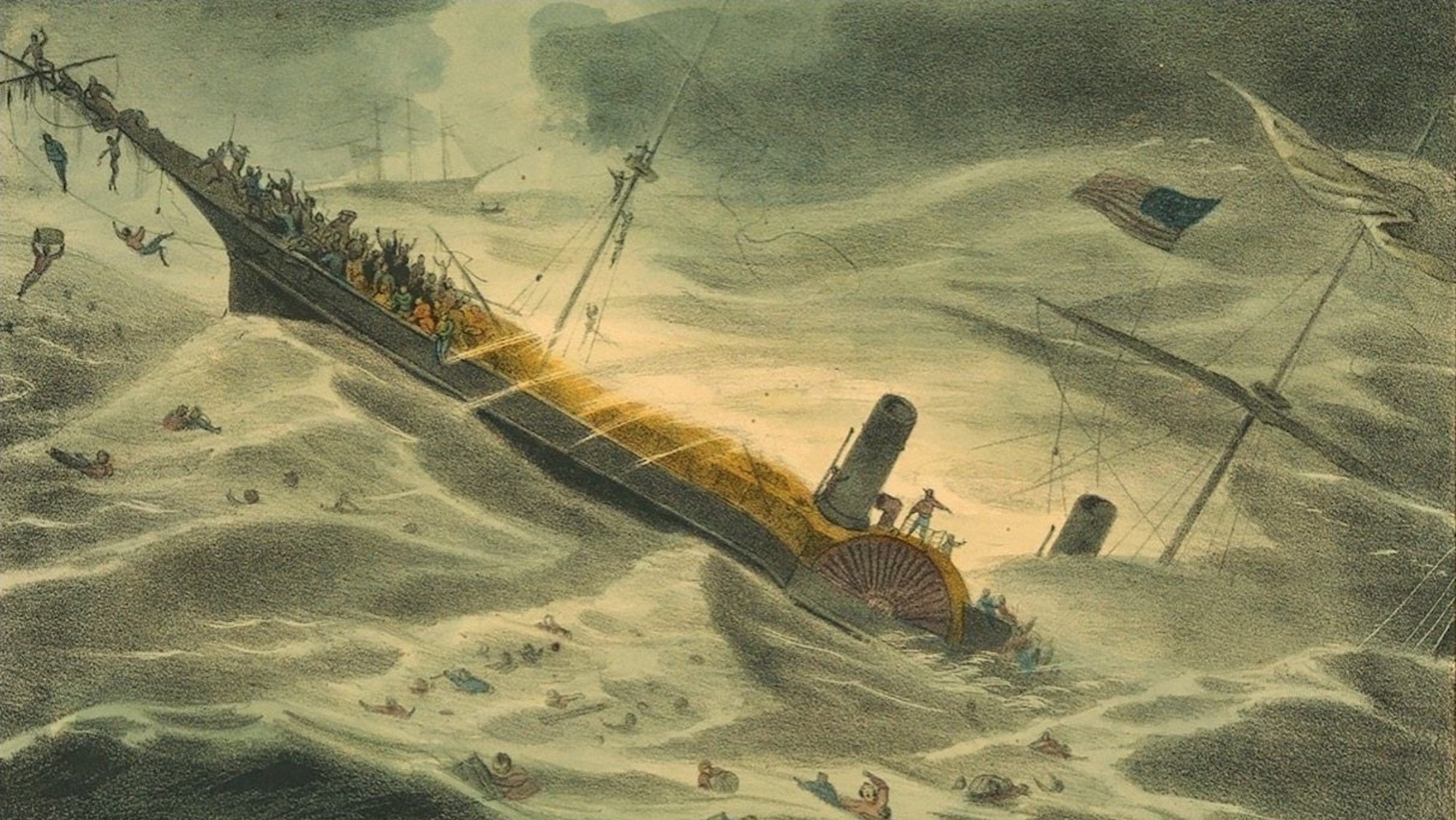
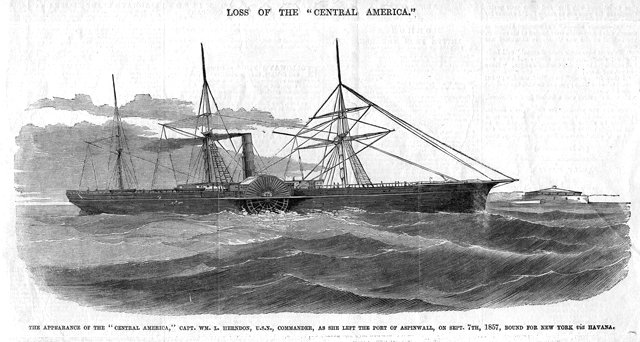
Long before the Titanic, the most famous shipwreck in the US was the SS Central America. The wooden steamship helped connect San Francisco with New York City before the construction of a coast-to-coast rail network, and sank off the coast of South Carolina in 1857.
425 people died. Most people today haven’t heard of it.
That loss of life alone should be reason enough for people to remember the ship. But the SS Central America was also hauling $1.2 million worth of gold, according to a 1992 court case about the wreck. Given the current value of gold, that’s around $236 million in today’s dollars. And that’s just what’s documented: the ship had a number of wealthy passengers, who were likely carrying their own gold, so the total could be even higher.
A ship full of gold, sunk and lost for over a century. It’s odd that the ship isn’t a household name. And the story keeps getting weirder: the wreck contributed to a massive recession, and when treasure hunters found the ship in the 1980s, decades of lawsuits followed.
A lost ship
Say you wanted to get from San Francisco to New York City in the 1850s. Going over land was miserable—cars were a half century away, and there weren’t many roads. There wasn’t even a rail line connecting the two coasts. Your best bet was to take a ship down to what is now Panama, a train across that narrow bit of land, and then another ship up to New York.
The SS Central America served the Atlantic part of that journey. It left the east coast of Panama on September 3, 1857, with 592 people on board. The ship had one other stop: Havana, Cuba. By September 8, when the ship was leaving that port, the weather looked great, according to a writeup by the US Naval Institute.
That changed—hurricane-force winds battered the wooden hull. By September 11, the crew was working to bail out the ship, and by noon every man joined them. It wasn’t enough: by 2pm the water reached the boilers, leaving the ship drifting. The bailing continued all night, and for a while it seemed like the weather would clear up long enough for a full evacuation. It wasn’t to be—the storm resumed by mid-morning. The captain signaled a nearby ship, the Marine, for help. Only 100 people—including the 59 women and children—boarded the Marine.
The captain went down with the ship around 8pm local time, along with most of the remaining men, who were pulled in by the undertow of the sinking ship. The few men who survived did so by grabbing doors, chairs, and anything else still floating, until another ship—the Ellen—could find them. In total, 425 people lost their lives.
The human cost was high, but there was also a huge economic fallout. A 1992 paper by Lawrence D. Stone, the researcher whose work led to the rediscovery of the wreck, states that the gold on board was intended to shore up several banks already on the brink of collapse. Within a month, almost all banks in the US stopped offering gold in exchange for paper money.
Found using math
Naturally, a ship this famous—with this much gold on board—became a bit of a legend. Countless people attempted to find the wreck, but no one succeeded until the Columbus-America Discovery Group of Ohio found the wreck in the 1980s. The crew was led by treasure hunter Tommy Gregory Thompson.
The discovery happened thanks to advanced technology—sonar and state-of-the-art remote-controlled submarines. But also because of math.
Stone, whose work I mentioned earlier, explained his method in a 1992 paper. He employed Bayesian search theory. This method begins with finding hypotheses about where the wreck may be, judging how likely each theory is, and ultimately making a map outlining the probability of the ship being in various areas. A route for the search is designed to start with the highest probability areas, continuing from there to lower probabilities.
The survey took 40 days, covering 1,400 square miles of ocean off the Carolina coast. The wreck ended up being in a relatively low probability area, though one included in the route. In 1988, a remotely operated vehicle provided a view of the wreck.
“The storybook result would have been for the Central America to have been found in a high probability area near the beginning of the search,” wrote Stone. “Given the actual result, what can we say about the value of the procedures for developing the search plan? The most obvious thing to say is that they worked.”
That’s the thing about probability: the most likely thing isn’t always what’s true. That doesn’t mean it’s not worth calculating—it can still lead to good results.
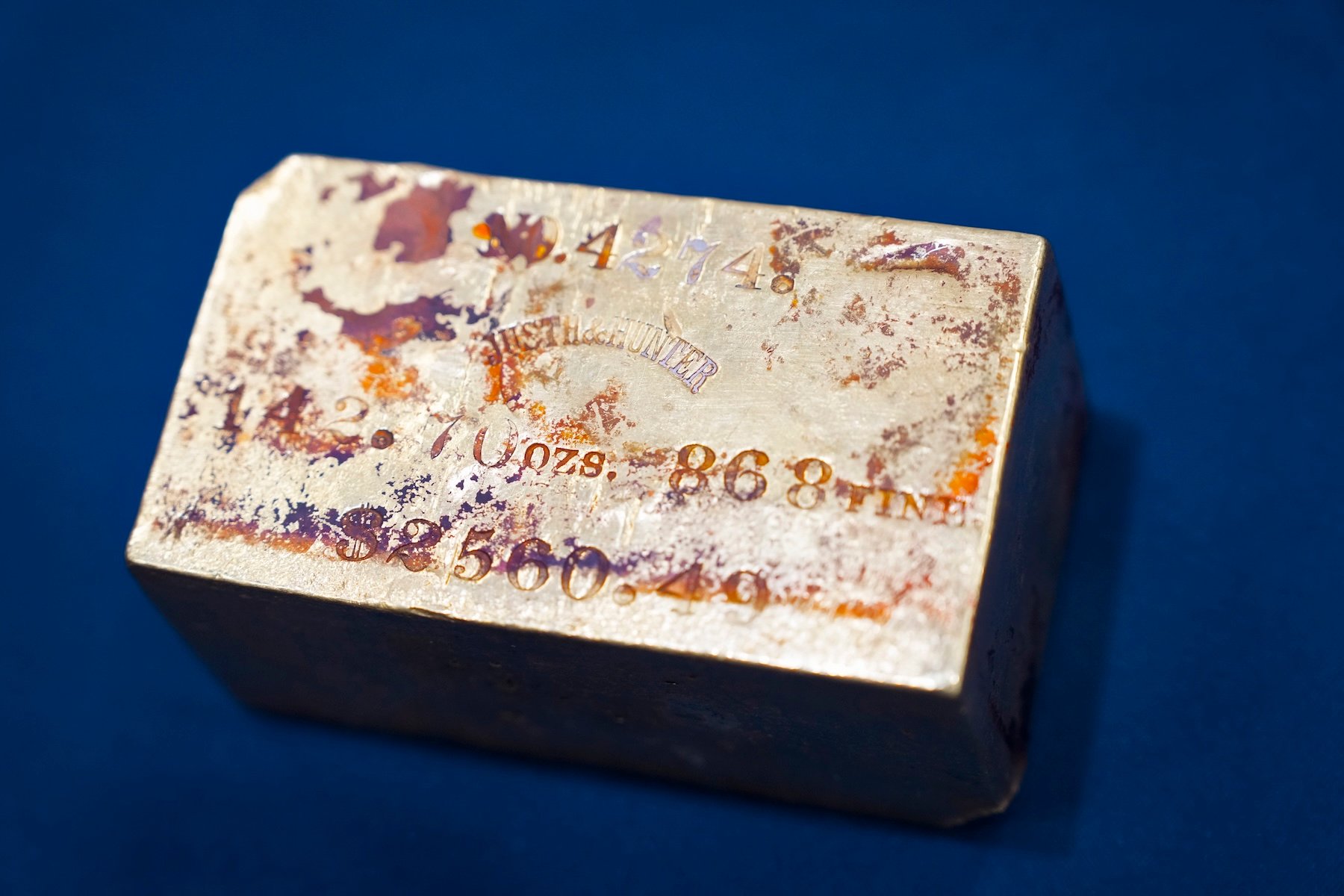
But what about the gold? Over the next few years the team brought up most of the commercial gold shipment. A federal judge put its bullion value at about $21 million in 1993, but coins and ingots from a famous shipwreck are worth far more to collectors. In 2000, the bulk of it sold for about $50 million. Today most of the gold is in the hands of private collectors.
Four decades of lawsuits
This would normally be where the story ends: the treasure is found, the treasure hunters get paid, and everyone is happy. That’s not what happened this time.
By 1989, the insurance companies that covered the SS Central America back in the 1850s argued that the gold belonged to them. Their logic: We paid damages to clients who lost the gold, therefore it’s ours. The insurance companies lost that lawsuit, but it was only the beginning.
Thompson took $12.5 million from investors to fund the treasure hunt. Those investors sued in 2005, alleging they never got any proceeds from the treasure, even after the 2000 sale of the gold. Several members of Thompson’s crew sued in 2006. Thompson went into hiding in 2012, only to be arrested in 2015. He wasn’t released until March of 2026. Some 500 gold coins remain unaccounted for.
It’s an odd footnote to a fascinating story of history, math, and science. And who knows? Maybe this story will still be going a hundred years in the future.
And there may be more to the story of the SS Central America. A 2018 expedition recovered more gold from a safe on the ship, in a passenger compartment. There could be more down there.