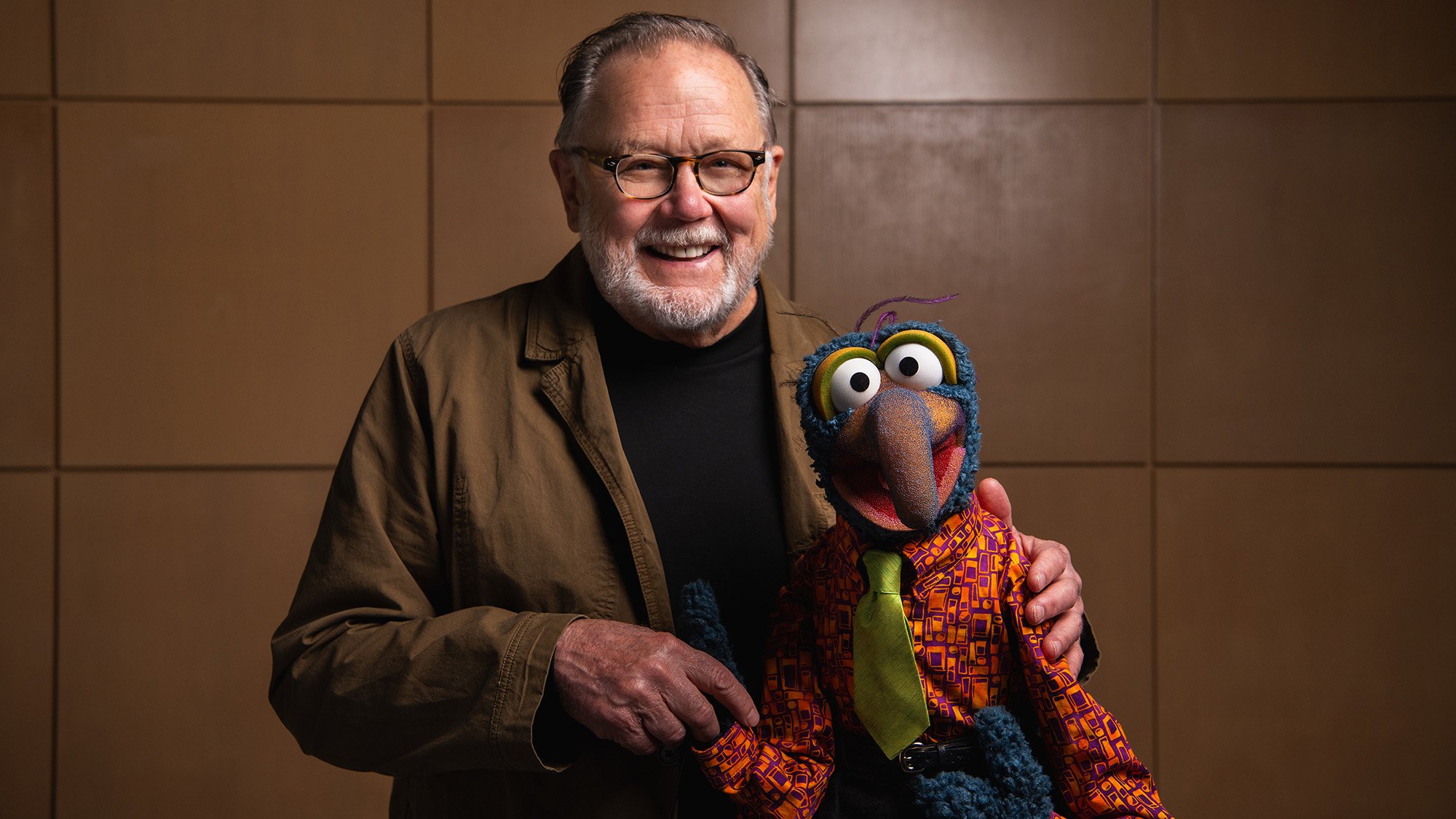
Many of the Muppets are pretty easy to pin down, species-wise. Kermit is a frog. Fonzie is a bear. Miss Piggy is, obviously, a feisty piggy. But Gonzo—with his blue-ish fur, bulging eyes, tuft of purple feathers, and long, curved nose that looks a little like a beak—is something of an enigma. The writers of the Muppets have avoided the question of what Gonzo is for years.
Well, in a new episode of Popular Science’s Ask Us Anything podcast, we asked three biologists to break down exactly what Gonzo is. We also talk to Muppets legend and Gonzo performer Dave Goelz to get his take.
Ask Us Anything answers your most outlandish, mind-burning questions—from the everyday things you’ve always wondered to the bizarre things you never thought to ask. So, yes, there’s a reason candy tastes different now and no, you don’t need to worry about Yellowstone’s supervolcano blowing up anytime soon. If you have a question for us, send us a note. Nothing is too silly or simple.
This episode is based on the Popular Science article “What kind of animal is Gonzo?”
Subscribe to Ask Us Anything
Listen and follow Ask Us Anything on your favorite podcast platform:
Spotify | Apple Podcasts | YouTube | Or wherever you get your podcasts.
Full Episode Transcript
Sarah Durn: Picture some of the most recognizable characters from The Muppets. Maybe you’re thinking of Kermit the Frog, or Miss Piggy, or Fozzie Bear. But today, we’re talking about a Muppet who’s a little harder to describe: Gonzo. You know the one. He’s got bluish fur, big bulging eyes, a tuft of purple feathers on his head, and a long curved nose that looks a little like a beak.
You might know him as The Great Gonzo, the fearless daredevil, performance artist, and stunt Muppet who eats tires, catches cannonballs bare-handed, and courts his beloved Camilla, who is a chicken. So yeah, Gonzo is a pretty unusual guy. But here’s something you might never have stopped to think about. What exactly is Gonzo?
Is he a bird, a lizard, an alien? All of the above? For decades, Muppets cast and creators have mostly dodged the question when asked, but here at Popular Science, we wanted a more scientific answer. So we asked three biologists to take a closer look at Gonzo’s anatomy and tell us what kind of creature he might be.
Their answers took us somewhere we definitely weren’t expecting, all the way back to the age of the dinosaurs. So what is Gonzo, and can science finally solve one of the Muppets’ greatest mysteries?
Welcome to Ask Us Anything from the editors of Popular Science, where we answer your questions about our weird world. From “does candy taste different now?” to “how do airplane toilets work?” No question is too simple or too out there. I’m Sarah Durn, an editor at Popular Science.
Annie Colbert: And hello, I am Popular Science editor-in-chief and huge Muppets fan, Annie Colbert
SD: Here at PopSci, we’re always pondering weirdo questions.
AC: And this week we’re wondering: What animal might Gonzo be? Is he an animal at all?
SD: It’s a very fair question, one the writers of the Muppets have spent over 50 years dodging. In one film, Gonzo even asked to be called a whatever.
AC: Which is pretty classic Gonzo, but as science journalists, “whatever” doesn’t quite hold up under peer review.
SD: Not at all. So we took Gonzo’s anatomy to actual evolutionary biologists and paleontologists to see if they could decode his unique physiology.
AC: Let me guess. They told you he’s just a funny-looking bird?
SD: That’s what you might think. He’s got that down curved beak thing, a floof atop on his head that kinda looks like feathers, and a chicken for a girlfriend.
But when you look at the clues, like his three unfused fingers and fuzzy skin, things get way weirder.
AC: Weirder than a blue guy who eats rubber tires and catches cannonballs?
SD: Well, at least on a similar level of weird, I guess. Some scientists think his traits point tens of millions of years into the past, past modern birds, straight into the age of carnivorous dinosaurs.
AC: Wait, are you telling me that Gonzo might be closer to a T-Rex than a turkey?
SD: Let’s just say Jurassic Park might need a Muppets section.
AC: Hmm. Now, before we try to decode the Muppet fossil record, we wanna know, what questions are nagging you? If there’s something you’ve always wanted to know, submit your questions by clicking the Ask Us link at popsci.com/ask.
Again, that’s popsci.com/ask, and click the Ask Us link.
SD: Send us your questions!
AC: We’ll be right back after this quick break to find out if science can really classify the greatest daredevil in puppet history.
SD: And stick around to the end, because we’ll be joined by the legendary David Goelz, the original and longtime performer of Gonzo, to hear his take on what sort of life form Gonzo might be.
And we’re back. Now, Annie, before we dive into the mysteries of Muppet evolution, we need to establish your credentials here a bit, because you are far from just a casual fan. You are a certified Muppet expert.
AC: I wear the title with great pride.
SD: Okay, so how did your Muppet obsession begin?
AC: You know, there’s no start to my love of Muppets.
I grew up in a Muppet house with The Muppet Show and Sesame Street always on. I’ve always identified as a bit of a whimsical weirdo. I dressed up even as Grundgetta, who is Oscar the Grouch’s girlfriend, for Halloween in fourth grade. No one knew who I was, but I will share a photo, so you can judge for yourselves, listeners.

And I would say generally if people know one or two things about me, it’s either that I have strange cats or that I love the Muppets. It’s a very big part of who I am.
SD: I mean, you have your own Muppet wiki page.
AC: I do! It just appeared one day after I did some fun work with Sesame Street, but it is a life highlight to have.
SD: I mean, so casual, so cool. Um, honestly, I think I’m a little intimidated because I am walking into this episode possessing maybe 1% of your Muppet knowledge. I think I saw a couple of the Muppet films when I was growing up.
AC: Don’t worry at all. The Muppets accept all, even the uninitiated.
SD: Well, I’m very happy to be here as an uninitiated Muppet fan, especially because this episode is just so fun and goofy and feels very PopSci.
AC: Yes, absolutely. I love giving scientific thought to some seriously silly questions because, as we know, science is fueled by curiosity.
SD: Of course. All right, so as our Muppet expert, I have to ask, if you had to put a label on Gonzo, what is he?
AC: Hmm. I think I would probably refer back to Muppet canon and say a whatever.
SD: Fair enough. Tell me more.
AC: Right. Well, in the 1981 film The Great Muppet Caper, a few of the Muppets get shipped to London in labeled crates. So Kermit’s says “frog,” Fozzie’s says “bear,” and Gonzo’s just says “whatever.”
SD: Very scientific.
AC: Very. But the Muppets haven’t always been super consistent with how they define what Gonzo is.
Three years earlier in the 1979 Muppet Movie, Kermit calls Gonzo sort of like a turkey. And then in 1999 in Muppets From Space, Gonzo was briefly labeled as an extraterrestrial.
SD: Hmm.
AC: But for the most part, his species is left pretty ambiguous. It’s kind of become a running joke.
SD: Right. So let’s get into it.
I may not have your Muppet know-how, but I can definitely ask experts some silly Muppet-related questions.
AC: Please, please.
SD: So the first expert we consulted is Darren Naish, a paleontologist who studies extinct vertebrae anatomy, and Naish lines up a bit with Kermit’s turkey theory. He thinks Gonzo is a bird.
AC: A bird? So is he agreeing with Kermit’s turkey comment?
SD: Sort of. He looked at the evidence. Gonzo is fuzzy, so he’s likely warm-blooded. He’s got four limbs, a backbone, no teeth, and that curved beak-looking snout. And if you add all of those together, Naish says he can’t be anything other than a bird.
AC: Okay. I hear the logic, but I’m not fully abandoning my whatever theory just yet.
SD: Fair enough. Well, Naish actually got way more specific than a turkey. He looks at Gonzo’s slender, down-curving snout and sees an ibis, one of those long-billed wading birds.
AC: Okay, but ibises fly, and Gonzo only flies if he’s shot out of a cannon.
SD: Naish actually thought of that. It turns out birds lose flight all the time in evolutionary history. In fact, an extinct Jamaican ibis from about 10,000 years ago lost the ability to fly, and its wing bones actually evolved into heavy club-like weapons that it used to smack rivals in fights.
AC: Cool. They’re just swinging club hands in a brawl.
SD: I know, right?
AC: I mean, honestly, that sounds extremely Gonzo. But not in a violent way. It’d be in a silly way. He’d be like-
SD: Yes …
AC: punching people around of course.
SD: Of course, of course. So Naish’s theory is that Gonzo could be a highly derived flightless ibis.
AC: Okay. I kinda love that, but it still feels a little too normal for him.
SD: Well, hold onto your tuft of blue fuzz. Enter our second paleontologist, Thomas Holtz from the University of Maryland, who specializes in carnivorous dinosaurs. And Holtz looked at Gonzo and said, “You’re looking at the wrong geological era. Gonzo is actually way older, Jurassic kind of old.”
AC: Hold on. A dinosaur?
SD: A dinosaur. Holtz looked at Gonzo’s hands, and if you look at modern birds, their wing bones are fused together with drastically reduced digits. But Gonzo, Gonzo has three distinct, fully functioning, unfused fingers on each hand.
AC: True. I mean, he does have to hold his stunt props somehow.
SD: Exactly. And Holtz noted that Gonzo’s body is covered in simple down-like fuzz, with just a few complex feathers on his head. According to Holtz, you only see those two specific traits together, three free fingers and simple fuzzy coats, in early carnivorous dinosaurs from a group called Tetanurae.
AC: Tetanurae? What? Okay, who else is in that club?
SD: Oh, just the ancestors of raptors and early tyrannosaurs.
AC: No way. Tyrannosaurus rex? Is Gonzo related to a T-rex?
SD: Maybe. Holtz points out that other Muppets who are clearly birds, like Big Bird or Camilla and her chicken friends, have modern veined feathers and hard, shiny keratin beaks.
Gonzo has neither. So Holtz argues that if Gonzo is in the bird lineage, he split off tens of millions of years before modern feathers or fused wings ever evolved. He’s a living prehistoric relic.
AC: I don’t think Camilla realizes she’s dating an ancient theropod dinosaur, but you know what, honestly, good for her.
SD: Aim high, Camilla. But we had one more scientist weigh in, Michel Milinkovitch, an evolutionary developmental biologist at the University of Geneva, and he said the whole debate hinges on one single question: What is that tuft on Gonzo’s head made of?
AC: His little floofy crest?
SD: Yes. Milinkovitch says it could just be convergent evolution, a mammal that independently evolved a beak-like snout, like the platypus.
AC: My brain is malfunctioning. So he’s either a modified ibis, a fuzzy Jurassic carnivore, or a bizarre egg-laying mammal cousin.
SD: Yes. You got it. Your brain is doing fine.
AC: Great. We’ll see.
SD: And to make matters even more confusing, though, Holtz points out the biggest scientific problem of all: Gonzo’s nose isn’t actually a beak at all.
AC: It isn’t?
SD: In birds and turtles, the beak is the mouth. It’s the actual jaw bone covered in hard keratin. But for Gonzo, that big purple nose thing is an extension sitting above and in front of his mouth. It doesn’t have the hard shine of keratin, and it doesn’t move like an elephant’s trunk. Holtz says it’s an anatomical structure that is basically unheard of in vertebrate biology.
AC: Leave it to Gonzo to have a face that literally defies anatomy. My whatever theory still holds water.
SD: It really does. And Darren Naish actually had a great philosophical take on this. He pointed out that nobody asks what creature other Muppets like Animal or Elmo are because they don’t have distinct anatomical clues. But Gonzo has just enough real anatomy, feathers, a beak, three fingers, a chicken for a partner, to make our human brains desperate to categorize him. As Naish put it, “Specificity invites scrutiny.”
AC: And the more details you give us, the more obsessed we become with solving the puzzle.
SD: Exactly. So whether he’s an ibis, a dinosaur, or an evolutionary wild card, science still can’t give us a tidy one-word label.
AC: Which means, Sarah, there is only one logical thing left for us to do. We’ve heard what the paleontologists and the developmental biologists have to say, but what does the man behind the Muppet think?
SD: That’s right. Up next, Annie sits down with the one and only David Goelz, the legendary puppeteer who has performed and voiced Gonzo since day one. She asks Dave what he thinks Gonzo really is, how that iconic character was born, and whether he agrees with Team Dinosaur.
AC: Truly a dream come true. That’s right after this quick break.
Welcome back. I am thrilled to welcome Muppet legend Dave Goelz. Dave has been the voice and spirit, I’d say, of Gonzo for 50 years. He also originated a number of other beloved characters, including Uncle Traveling Matt of Fraggle Rock fame, as well as Muppets Zoot, Beauregard, and of course, Dr. Bunsen Honeydew.
Dave, thank you so much for being here.
Dave Goelz: Well, thank you for having me.
AC: Yes. So we have spent this episode trying to figure out what Gonzo might be in a scientific sense, and since you know him better than anyone, what do you think Gonzo actually is?
DG: Well, I can answer from our particular corner of the field.
When the Muppets started out, they tended to be almost always abstract characters. There was one humanoid in their first series. The series was called Sam and Friends, and Sam looked like a, a person, but everybody else on the show looked like things we’d never seen before. And then when we went on Sesame Street, this is before, before I was there, actually, they went on Sesame Street, they, it stayed with abstract characters, Ernie and Bert, Grover.
Grover is considered a monster. And they stayed with those abstract characters for quite a long time, and then when we did The Muppet Show, all of a sudden we were surprised to see pigs and chickens…
AC: Frogs and-
DG: I remember thinking, “This is weird, the Muppets are abstract. Why do we, why do we have a pig?” You know? “Why do, why do we have a chicken?” It was just an interesting transition ’cause that’s when we went more literal with, with species. Getting around to answering your question, I don’t know what Gonzo is. I have no idea. He was something that Jim built for a previous special, as you know, and when it came time to do The Muppet Show, Jim asked me to do this character who was kind of a loser outsider who does stupid acts and thinks they’re high art.
And then he asked for them to pull Gonzo out. Or that, that puppet that wasn’t Gonzo yet.
AC: Mm-hmm.
DG: And so that was what I started with.
AC: What were your first impressions when you saw the puppet itself?
DG: Well, I had seen it before, so it wasn’t a surprise, but it was this pathetic-looking little guy, who had very downcast eyes. He was sort of limited, but I just started making a character out of him, and what my interest in him has always been is his character. And iin that one character, I found that it mirrored me. The reason that it did was because Jerry Juhl, who was our head writer and a very wise person and very funny and mischievous person, could see, I guess, that I was new.
I had no business in show business. I had no training. I had no acting training. We just started The Muppet Show, and Jim tossed me in, and I felt very out of place. I just go, “I don’t belong here. What am I doing in this room?” And so Jerry Juhl helped write Gonzo to be appropriate to where I was in life, and that was phase one. He was an outsider. He had a little bit of a baby talk accent…
AC: Yeah …
DG: like a true newbie. And then as time went by, and I’m talking about years, I got more confident, and then one of our writers, Bill Prady, he started writing Gonzo as being very upbeat and enthusiastic. Like, “That is so cool,” you know, and, and just up for anything, and that became phase two of his character, which coincided with me being more comfortable in my new world And then phase three came when Jerry Juhl wanted to include Dickensian prose in the Muppet Christmas Carol film.
He needed that narrative prose in there, but didn’t want to have a narrator, and he had the idea, because we were very close friends, and he’d watched me go through therapy, and he’d watched me deepen and soften and evolve. He had the idea of letting Gonzo speak those lines.
AC: I feel like people have been asking this question since we all met Gonzo. Why do you think people care so much?
DG: Oh, I think I’ve learned a lot about that in the last, I don’t know, 10 years, let’s say. Whenever I appear at a museum or introduce a screening, people come up to me, and so many people come up and say, “Thank you. Gonzo gave me permission to be different.”
AC: Yes.
DG: He legitimized it. He made it cool. And a lot of these people are on the spectrum, and they are lovely people who have a hard time in life. And it was unintentional on my part. I didn’t know that they were, that Gonzo was having this effect on people, but he did.
And then about four months ago, I, I realized suddenly that, oh, wait a minute, no, no, this was unconscious on my part. I knew I was different. I didn’t belong in show business. I should be on my parents’ couch, you know, watching on the other end.
AC: Yeah, I feel like, I’m sure people have said this to you, you know, I think people think of Kermit as the heart of the Muppets, and they think of Gonzo as kind of the soul of the Muppets, and I think that nebulousness around what he is, of like not really knowing, I think it allows a lot of people, you know, myself included, that you can find a piece of yourself in him.
If you’ve ever felt excluded or weird, because he is not defined, there is lots of room to sort of hold a piece of him as a fan.
DG: Oh, Annie, that’s absolutely true. Absolutely true. He’s been that for people, and I have to say also that the Muppets as a whole are like that, too. They function the same way.
AC: Yes.
DG: Jim was a lover of characters. He hired characters. He hired all sorts of unusual people and found something for them to do and let them shine. It’s like I didn’t create Gonzo. It was me and the writers and Jim and the workshop. And these qualities exist in every single character, and there’s somebody out there who responds to every single one.
AC: You have a little bit of like an engineering and design background, right?
DG: I do, yeah. I was an industrial designer by training.
AC: Yeah, and I think especially lately there’s this sort of stark line between art and science, but you know, what we see, especially at Popular Science, is we see really amazing innovations can happen when art and science overlap.
So how do you bring a little bit of that engineering mind to playing a Muppet?
DG: A couple of things. First of all, when I first began, I already knew how to build puppets because I was trained as a designer at Art Center College of Design, and the design process was something that my dad inculcated into me, and then ArtCenter set in place.
And the design process that I use is about defining the problem, whether it’s a character, a performance, a glasses case, a typewriter. Whatever it is, it’s very important to know what the problem is, and it’s not always obvious. Listen, the reason I love that approach is that the more you hone in on the problem, the clearer the solution becomes.
AC: One final question. Because we’re Popular Science, I must ask about the Muppets’ preeminent scientist, Dr. Bunsen Honeydew-
DG: Mm …
AC: whom, of course, you also perform. If Bunsen, or Dr. Honeydew, he earned his degree, won a Nobel Prize, what do you think it would be for?
DG: Well, first of all, the idea is preposterous-
AC: Yes, absolutely …
DG: On its face. That’s a great question. If he won a Noble Prize, what would it be for? A Nobel Peace Prize. All he’s done in life is make stupid inventions and hurt his assistant.
AC: It’s true.
DG: So it really is a preposterous notion. I can’t even answer it.
I can’t. It’s just a mind-boggling question. I don’t have any idea how he could possibly be recognized for anything. I will tell you this, that Bunsen was, Bunsen was derived from a lot of scientists that I knew when I was in Silicon Valley. It wasn’t anybody directly, but it was this whole idea of being focused on electrons and being focused on tiny, tiny, very specific things, and losing the big picture.
AC: Hmm.
DG: Yeah. ‘Cause it’s interesting you know, a scientist might be way deep into making a laser interferometer, and the science of it would be so riveting. And then my job was to come along and say, “Okay, what does it look like? How do you use it?” So I was, like, the user end of this whole deal. And, and so as a generalist, I could view the science world and the engineering world, and, uh, poke a little fun at it.
AC: Absolutely. Science is fun. We like to remind people.
AC: I will take off my journalist hat just for a second and say thank you so much for doing the podcast, but also just thank you so much for Gonzo. What you said about people who have maybe been called different or weird, it definitely resonates with me.
I’ve loved the Muppets my entire life, and being called weird my whole life is such a compliment because there’s so much joy and whimsy in the weirdos of Muppets, and Gonzo is such the epitome of that, that I thank you so much, Dave, for joining us today.
DG: Been my pleasure. Thanks, Annie.
SD: Oh my gosh, was your inner Muppet heart exploding while talking to Dave? Yes. He seemed so wonderful.
AC: Yeah, he is just an absolute gem of a human. I did not even try to keep my fandom in check ’cause he’s a legend, and he’s genuinely meant so much to me as a Muppet fan.
SD: He’s the best. Oh my God. So after hearing from Dave and all of our biologists where do you, Muppet expert, officially land on the taxonomy of a Gonzo?
AC: Okay, I started the episode firmly on team whatever, but now I kinda love the idea that Camilla is casually dating a prehistoric dinosaur. But I also like the idea that Gonzo doesn’t have to be defined. He can be something different for everyone, like, whatever they need him to be.
SD: Aw, that’s very sweet.
AC: Yeah.
SD: But the dinosaur theory does make his cannonball catching stunt seem a lot more on brand for a T-Rex relative.
AC: True, true. It would explain so much. And that’s it for this episode. But don’t worry, we’ve got more episodes of Ask Us Anything live in our feed right now. Follow or subscribe to Ask Us Anything by Popular Science wherever you enjoy your podcasts.
And if you like our show, leave a rating and a review.
SD: Which Muppet do you want scientists to analyze next? Tell us in the comments. Please. Our producer is Alan Haburchak. This week’s episode was based on an article written for Popular Science by Niranjana Rajalakshmi, and a massive thank you to the legendary Dave Goelz for joining us.
AC: Thank you, team. Thank you, Dave, and thanks all you Muppets for listening.
SD: And one more time, if you want something you’ve always wondered about explained on a future episode, go to popsci.com/ask and click the Ask Us link. Until next time, stay weird wherever you are, and keep the questions coming.
DG: Whoo! Whoo! Ha-hoo!