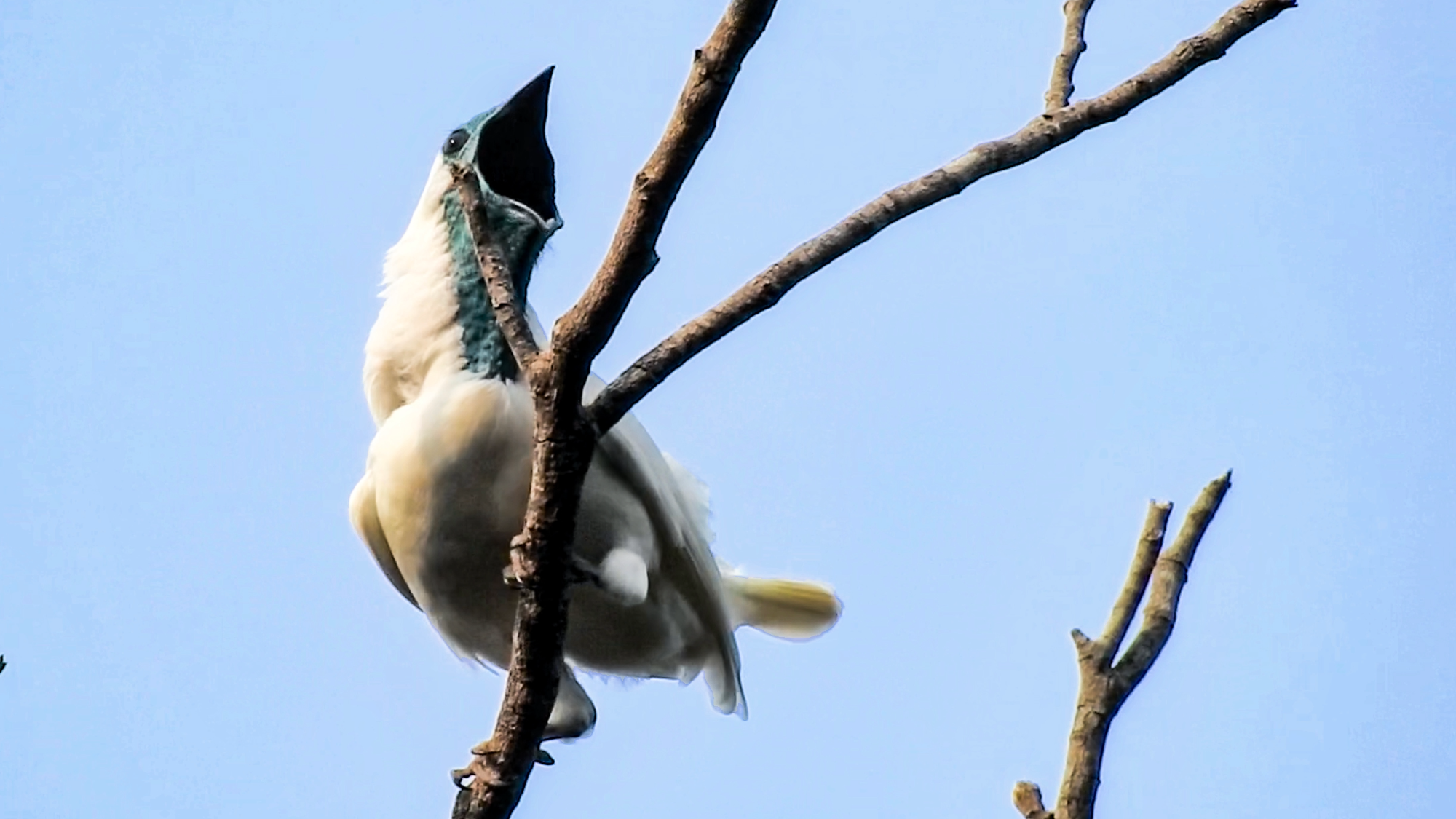
Two new contenders for the title of world’s loudest bird are flocking into the record books—the bare-throated bellbird (Procnias nudicollis) and red-legged seriema (Cariama cristata). The findings are detailed in a study published today in the journal Evolution, and mark another stage in its authors’ quest to understand how evolution shapes bird communication.

Bare-throated bellbird's call
A history of records
University of Massachusetts Amherst biologist Jeff Podos and his former graduate student João C.T. Menezes are studying why some birds are so much louder than others. In 2019, Podos discovered that the Amazon’s white bellbird (Procnias albus) has the world’s loudest bird call. At roughly 125 decibels, this bird’s call is louder than standing next to a revving chainsaw, a claim confirmed by Guinness World Records.
For this new study, the duo searched for any physical characteristics of a bird’s body that can predict the loudness of its call, and how that volume is related to a bird’s ecological niche and social organization.
“Figuring out how loud a bird call is should be pretty easy in the lab,” Menezes said in a statement. “But until very recently, it has been very challenging to do in the field, and there’s very little data to draw on.”
Part of the challenge is because volume (or amplitude) depends on distance. An ear-splitting siren or screech up close may barely register hundreds of feet away. One method to gauge the amplitude of a bird’s call is to capture a bird and bring it to the lab for experiments. However, that method is not practical or efficient, particularly working internationally and comparing large numbers of birds.
“You have to get your boots on the ground,” added Podos, who helped Menezes measure the amplitudes of 123 birds around Amherst and across Brazil.

Red-legged seriema's call
Golf meets birds
The right tools also help. The best tool for reliably measuring amplitude and distance at the same time came from the world of golf: rangefinders. Golfers developed these laser-powered tools that use high-resolution, portable sound meters to measure the exact distance between you and a target. Menezes and Podos incorporated them into their research, and took reliable amplitude data on 123 species, 113 of which had never before had their volume catalogued.
“We’ve been able to vastly increase the number of species for which there is amplitude data,” said Podos. “This is basic, foundational research that no one else has managed to do on this scale, and it points to all sorts of other questions that would be fun to follow up.”
They found a huge 58-decibel variability in the volume of bird calls. Hummingbirds produce about the sound of a normal human conversation at 64 decibels. Meanwhile, the bare-throated bellbirds and red-legged seriema rise above 120 decibels—louder than standing near chainsaws and jackhammers.
The team also found that the loudest birds are typically bigger. They have bulky muscles that possibly allow more air compression for explosive volume, and have wider beak openings. It’s similar to how musical instruments with wide bells like trumpets can help amplify their volume.
The remaining mystery
However, their data did not support any clear, broad predictions about the ecological and evolutionary purpose of amplitudes. The team had hypothesized that the loudest birds would have three traits–weak flyers who live in dense forests and practice polygamy. In theory, weaker flyers would use volume to make up for their limited mobility and be able to attract more mates with louder calls.
“We now know some of the hows,” Menezes said. “Bigger bodies and wider beaks, but we’ve yet to discover the whys, and we probably need much more data from many more species to be able to tease out what’s going on the ecological and evolutionary front.”
Podos added that he’s excited to get back out in the field, golf rangefinder and sound meter in hand.
“Yogi Berra said ‘you can observe a lot by watching,’ and the world has some beautiful things to see,” Podos concluded. “You can’t do this kind of work in the lab, or by scraping data from the internet. You have to get out into the world, you have to pay careful attention to what you’re seeing and hearing, and anything you do in the field that forces you to observe more carefully is really fun—it takes you back to the roots of why we do science in the first place.”