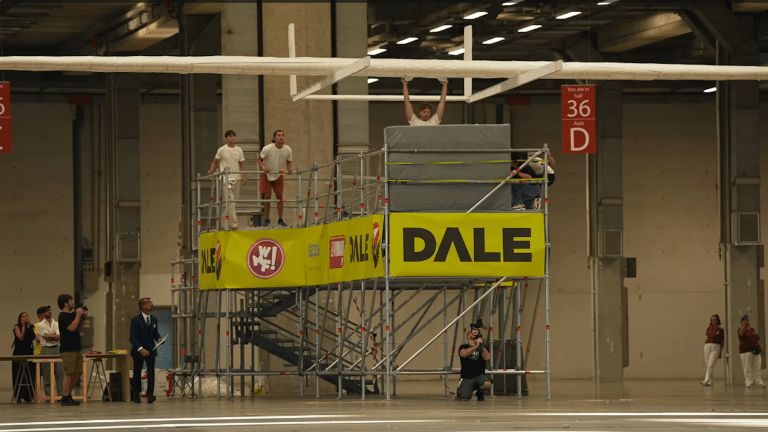
A team of Japanese motorcycle makers may soon remind the world that another type of bike--one with pedals--can be an incredibly efficient way to get around. Team Aeroscepsy is gunning for a new world record for distance flown in an aircraft under human power.
Team members built their airplane from polystyrene and carbon fiber, so it weighs only 81 pounds. Its wingspan stretches 117 feet, which is about half that of a Boeing 747, notes AFP. The craft is called Gokurakutombo, which means “happy-go-lucky” and apparently also “happy dragonfly” in Japanese. The team--whose members all work for Yamaha--wants to fly it 75 miles over the Pacific Ocean in Japan.
The plane can take advantage of thermal air currents to help it get around, but that’s a double-edged sword, because even a light ocean breeze can also work against it. This is especially tricky flying over water, as the lessons of Daedalus prove. Daedalus the real plane, not the Greek mythological hero. I researched Daedalus for my recent feature for the October issue of PopSci, which focused on the several ways humans can fly under our own power. The aircraft was built at MIT and holds the world record for human-powered airplanes, flying 71.5 miles from Crete to the Greek island of Santorini.Piloted by an Olympic cyclist, Daedalus flew between 15 and 30 feet above the water throughout its journey, which was aided by a tailwind. But the landing failed because of a thermal gradient caused by Santorini’s black sand beach. One of the wings lifted higher than the other, turning the craft back around. Increasing shore winds eventually broke the tail boom and the plane splashed down a few feet from the beach. Pilot Kanellos Kanellopoulos was fine and swam to shore.
It’s not clear exactly what route the new Gokurakutombo will fly, but it will be a few miles longer than Daedalus’ flight. Team Aeroscepsy plans to take off from a field near Mt. Fuji next spring.
[PhysOrg]
140 years of Popular Science at your fingertips.
Each issue has been completely reimagined for your iPad. See our amazing new vision for magazines that goes far beyond the printed page
Stay up to date on the latest news of the future of science and technology from your iPhone or Android phone with full articles, images and offline viewing
Featuring every article from the magazine and website, plus links from around the Web. Also see our PopSci DIY feed
Engineers are racing to build robots that can take the place of rescuers. That story, plus a city that storms can't break and how having fun could lead to breakthrough science.
Also! A leech detective, the solution to America's train-crash problems, the world's fastest baby carriage, and more.


Online Content Director: Suzanne LaBarre | Email
Senior Editor: Paul Adams | Email
Associate Editor: Dan Nosowitz | Email
Contributing Writers:
Clay Dillow | Email
Rebecca Boyle | Email
Colin Lecher | Email
Emily Elert | Email
Intern:
Shaunacy Ferro | Email
I look forward to where we can all fly exactly the same as birds.... ah..happy dreaming sigh.
Soon folks will start racing these things. I was wondering why they keep flying over water where the conditions might be worse but then realized it makes for a softer crash!
my roomate's mother makes $79 every hour on the internet. She has been out of a job for 5 months but last month her check was $21010 just working on the internet for a few hours. Read more on this site Cloud68.com
lnwolf41
One thing not mentioned, pedal power is fine for short distances, but one person who did this said that the constant physical movement to keep the plane flying takes a toll very quickly.