
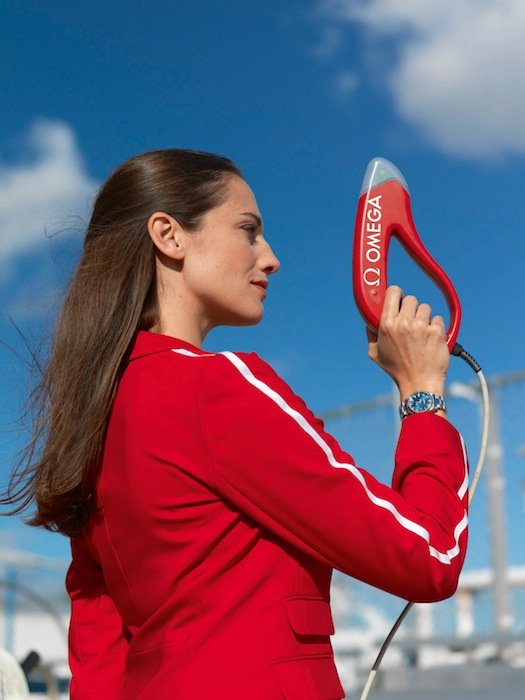
It's easy to take for granted just how insanely close some Olympic races are, and how much the minutiae of it all can matter. The perfect example is the traditional starting gun. Seems easy. You pull a trigger and the race starts. Boom. What people don't consider: When a conventional gun goes off, the sound travels to the ears of the closest runner a fraction of a second sooner than the others. That's just enough to matter, and why the latest starting pistol has traded in the mechanical boom for orchestrated, electronic noise.
Omega has been the watch company tasked as the official timekeeper of the Olympic Games since 1932. At the 2010 Vancouver games, they debuted their new starting gun, which is a far cry from the iconic revolvers associated with early games--it's clearly electronic, but still more than a button that's pressed to get the show rolling. About as far away as you can get, probably, while still clearly being a starting gun. Pull the trigger once, and off the Olympians go. If it's pressed twice consecutively, it signals a false start.
Working through a speaker system is what eliminates any kind of advantage for athletes. It's not a big advantage being close to a gun, but the sound of the bullet traveling one meter every three milliseconds could contribute to a win. Powder pistols have been connected to a speaker system before, but even then, runners could react to the sound of the real pistol firing, rather than wait for the speaker sounds to reach them. This year's setup will have speakers placed equidistant from runners, forcing the sound to reach each competitor at exactly the same time. "It wouldn’t be an enormous difference," Omega Timing board member Peter Hürzeler said in an email, "but when you think about reaction times being measured in tiny fractions of a second, placing a speaker behind each lane has eliminated any sort of advantage for any athlete. They all hear the start commands and signal at exactly the same moment."
There's also an ulterior reason for its look. In a post-September 11th world, a gun on its way to a major event is going to raise more than a few TSA eyebrows, even if it's a realistic-looking fake. Rather than deal with that, the e-gun can be transported while still maintaining the general look of a starting gun.
But there's still nothing like hearing a starting gun go off at the start of a race--more than signaling the runners, there's probably some Pavlovian response after more than a century of Olympic games that make people want to hear the real thing, not a whiny electronic noise. Everyone in the stands at home, thankfully, will still be getting that. "The sound is programmable and can be synthesized to sound like almost anything," Hürzeler says, "but we program it to sound like a pistol--it’s a way to use the best possible starting technology but to keep a rich tradition alive."
Five amazing, clean technologies that will set us free, in this month's energy-focused issue. Also: how to build a better bomb detector, the robotic toys that are raising your children, a human catapult, the world's smallest arcade, and much more.


Online Content Director: Suzanne LaBarre | Email
Senior Editor: Paul Adams | Email
Associate Editor: Dan Nosowitz | Email
Assistant Editor: Colin Lecher | Email
Assistant Editor: Rose Pastore | Email
Contributing Writers:
Kelsey D. Atherton | Email
Francie Diep | Email
Shaunacy Ferro | Email
"The sound is programmable and can be synthesized to sound like almost anything,".
Perhaps a good sound could be the DINNER BELL?
Runners don't start when they hear the bang. They watch for the gun smoke. That's what I was taught to do in high school.
I think the real reason for this change is to get rid of the gun.
It looks like the end of the gun has a transparent case at the end of it. What do you want to bet that it also has a light that emits to mimick the flash?
The thought that we have to go to a big expensive electronic system just to eliminate some infinitely tiny perceived advantage is ludicrous. Let's just be realistic and admit that companies like Omega can sell expensive equipment to bodies that get most their funding from taxes relatively easily.
How much is the difference or advantage? Well, to minimize it, you could use a starting gun that is behind lane 5 (middle lane), and thus be pretty close to everyone. The outside guys are 16 feet from the middle guy in a 9 lane setup. So, you think, how much longer does it take sound to travel 16 feet? But... you can actually cut it down tremendously by simply moving the gun back away from everyone, but still in the middle. That just requires some basic math to calculate. The farther back you move the gun, the smaller the advantage for the guys in the middle.
So let's say you go back 50 feet from the middle runner (not all that far, considering that in a traditional setup with the starter on the side, the gun is at least 40 feet away from the farthest runner). You will then be 50 feet from the middle runner, and 52.5 feet from the 2 outside runners, a difference of 2.5 feet. With sound traveling 1,116 feet per second, that means the outside people have a "disadvantage" of 0.002 seconds. Want to be even more even, put the starting gun above the finish line and the "disadvantage" falls to 0.00035 seconds. Really, 50 feet is plenty. And if a runner wants to avoid that "disadvantage", they should run faster in the heats and semis, so they can be on the inside lanes. But at 50 feet, the 0.002 number is well below the threshold for human reaction times.
If we're really actually looking at eliminating disadvantages that are that small, why don't we also put a plastic dome over the whole track so that small wind forces don't affect one runner more than another? After all, one small breeze that affects one runner more than another could put far more of a disadvantage on someone.
Or how about checking the materials in the starting block on a microscopic level for consistency, so that all runners get just as much spring from their block? How about testing every inch of the track 2 inches deep with an x-ray machine after each race to make sure that the surface is in identical condition for each athlete and that previous races haven't changed something in one lane? The possibilities are endless when you are looking to save everyone from a 0.002 second disadvantage.
And I don't buy the whole TSA-eyebrows argument either. A starting gun is just as easily a piece of a venue as anything else. Do they take the hurdles with them from place to place, or do upper-echelon track venues have their own hurdles? Exactly... they have their own equipment. What major world venue that can afford the Omega system isn't going to have a good starting gun as part of its permanent equipment?
I hate when people spend others' tax dollars on technology just for the sake of technology. If we really are so OCD about eliminating "disadvantages", then we have to spend almost an infinite amount to get rid of the last 1% of "disadvantages." When are we going to just be satisfied and say that enough is enough? Do we have to spend thousands on an electronic system to remove 0.002 second delays compared to a $100 starting gun?
@Marcoreid
Search ResultsMen's 100m Final Results
Wind: 1.5 m/s React. Result
Gold ORUsain Bolt 0.165 9.63
Silver Yohan Blake 0.179 9.75
Bronze Justin Gatlin 0.178 9.79
Seems to me 0.002 seconds made a difference to someone...
Personally, I think someone spending time developing the electronic starting system wasn't such a huge project. It isn't like they broke any new barriers to develop it - just strung together a couple of speakers and developed a gun with a small microprocessor. I'd be surprised if the entire project took more than 3 months. With that in mind, it was probably a hell of a lot cheaper than x-raying the ground of the entire track, or microscopically checking every starting block before every race. Just sayin'.
@bioguy
The difference between the silver and bronze that you posted is 0.02, ten times the 0.002 I mentioned. They don't even time down to the thousandths place for the official statistics. Oh, and they were also in lanes next to each other, 5 and 6, so a pistol 50 ft behind Blake in lane 5 would have made him of 0.16 feet closer, and thus an advantage of 0.00014 seconds, and about 100 times less than what the official stats even measure. His 0.02 margin of victory is 140 times the "advantage" in a starter pistol situation. So yes, you've just helped me illustrate how amazingly small and inconsequential the difference is, even for the fastest and closest race on the planet.
And having worked myself at previous Olympic games, in very sensitive areas (I almost had to strip down in front of guys with M-16s just to walk through the metal detectors, twice each way, just to get into my work area), I can pretty much guarantee that it isn't nearly as cheap and easy as "stringing together a couple of speakers and developing a gun with a small microprocessor." If it isn't a lot more complicated than that, it won't have the accuracy to actually overcome the tiny "advantage". These systems cost many tens of thousands in hardware, development, installation, maintenance, testing, and support for a 2 week event. Stuff at the games is never ever inexpensive, and I've seen that with my own eyes.
This can't really be a bad thing. I think any steps to eliminate points of contention from the games will only go to improve credibility for the games overall. A recent article about a gold medal swimmer, who admitted to adding extra "illegal" dolphin kicks, highlights the need for added technology at the games. He said he does it, everyone does because there is no official underwater review of the event. He basically said if he followed the rules of the game he would be at a disadvantage to those who don't. This tells me that they either need to change the rules or they need to fully enforce them and tracking technology may aid officials to do this.
I find it really funny that people believe that a fraction of a second advantage at the starting line translates to a fraction of a second advantage at the finish line.
This just plain ignores the fact there are much bigger variances at work. You have the swimmers going for say 800 meters, at any given time they can be quite far apart. You have one that has the strategy to conserve energy at first and then make his move at the end because he is a strong finisher. You have the one that goes out guns blazing, because he needs a lead to try to have a chance at winning. At any given point in the race they might be having to over come being tired, and maybe even pain. They are watching the others and deciding and adjusting.
They don't come out so close to the each other because some tiny difference in when the sound got to them. They are that close because of that is how humans compete.
And even though it would be nice to have everything perfectly the same, it is impossible, and there is certainly demising return after a certain point.
And I will tell you something else. I believe that it is in fact it is ridiculous to say X beat Y by 1/100 of a second. That is a tie, there is no way in the world if someone beat someone else by that amount to say that they "are better".
marcoreid,
Please check your math. In a 9 lane setup, the difference is 0.003 seconds, which, granted, does not sound like a big deal, until you multiply this by all nine lanes. This translates to almost three hundredths of a second from the guy in the closest lane to the guy in the farthest lane. This is the difference between silver and bronze (or any other potential positions).
Second, you think that this costs thousands of dollars to develop? This setup could be accomplished with my ardunio, a speaker delay microprocessor (which is common stadium equipment),several speakers, and some shiny plastic. Speakers readily available, I could do this with under $1,000 of equipment.
@ Marco Reid and Burdman 111:
Nahh. You may have seen that equipment with your own eyes, and even worked with some of it, but you can still misunderstand which equipment needs to be highly accurate vs. which does not.
1. The sound-*generation* equipment does not need to be the least bit accurate at all, except that it just has to make a quickly sharp sound. Any toy that makes an abrupt pop noise of some kind, amplified to the speakers, could be used. That device (not counting the amplifier and speakers) could only cost a few dollars, and it would do a fantastic job. Then the speakers could not have to cost much at all either. All those are is your average-Joe alarm horns. "Big deal." The most expensive piece of *that* equipment would be the amplifier, and it doesn't even have to be very good. So that could be average and not cost very much also. It wouldn't have to cost anywhere even close to $1000. I've seen amps that would do the job for about $30. All that has to do is amplify a sharp sound loud enough for 9 alarm speakers. "Big deal."
2. The equipment that has to be *highly accurate,* which is what would cost a ton, is the *measuring* equipment. That has to sense the very moment that the gun sound hit, and then start measuring from there until all the people have hit the finish line. So there you go: this gun doesn't have to be very expensive at all. If it is, it's absurdly inflated! But if the highly accurate measuring equipment is very expensive, then that's completely understandable.
Thanks for your readership. :)
Happy Olympics!
Mike
Oh, I forgot something. The only accuracy that the device that makes the sound has to have is good timing with the light that flashes. I suppose that might make it a bit more expensive than just a sound generator alone, but probably not by much.
Oh, but Marco, I do agree with you on the whole plane thing!
1. Yeah, that whole thing you said about the venue having its own equipment that was either made locally or properly imported makes sense, and...
2. Really? They'd have to carry this stuff on the plane as a carry-on? We can still legally check real guns in our baggage that goes to the belly of the plane, can we not? The same would go for a real starting pistol!
One thing else that I forgot to say, Marco: Oh, even starting the timing equipment doesn't have to be that complicated: I don't know what I was thinking before. The button in the "gun" would start the timer!
But let me ask all of you this: Why do they even need a gun sound anyway? Why can't they just have a voice command going through the speakers the same way as in swimming and other races?
Oh, I meant a beep or a buzz, as they do in swimming...
