
Silicene could be the material of the future. Or at least the material of the near future, until graphene-based semiconductors become more efficient.
A team of European researchers claims to be the first to synthesize silicene, a new allotrope of element No. 14 that forms two-dimensional single-atom sheets rather than three-dimensional crystals. This could be good news for the semiconductor industry.
While graphene is the most conductive material in existence, its lack of a band gap can actually be a hindrance when you’re trying to build an effective transistor. IBM has shown it’s possible to build graphene transistors, but it may be a while before this type of research percolates from the lab to the factory. Silicene’s one-atom-thick structure could be even more effective in building faster transistors and computers, partly because of how its electrons are arranged.
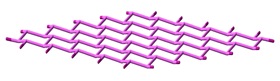
A silicene sheet has a buckled honeycomb structure, seen below, in which a few atoms are arranged above and below the main sheet. Electrons in these locations have distinct energies, and when a voltage is applied, they can jump across the gap, allowing silicene to serve as an on-off transistor. Silicene sheets would thereby bring silicon’s superb on-off abilities to the smallest scales possible, while remaining compatible with existing fabrication processes and existing electronics. That’s something graphene can’t do, at least not yet.
At least four research groups have claimed to grow silicene on silver substrates before this, but the team led by Le Ley claim to be the first to have clear, microscopic proof. The next step is to grow silicene on insulators to further examine its properties.
The paper by Le Ley et al. appears in Physical Review Letters.
[via Extreme Tech]

140 years of Popular Science at your fingertips.
Each issue has been completely reimagined for your iPad. See our amazing new vision for magazines that goes far beyond the printed page
Stay up to date on the latest news of the future of science and technology from your iPhone or Android phone with full articles, images and offline viewing
Featuring every article from the magazine and website, plus links from around the Web. Also see our PopSci DIY feed
Engineers are racing to build robots that can take the place of rescuers. That story, plus a city that storms can't break and how having fun could lead to breakthrough science.
Also! A leech detective, the solution to America's train-crash problems, the world's fastest baby carriage, and more.


Online Content Director: Suzanne LaBarre | Email
Senior Editor: Paul Adams | Email
Associate Editor: Dan Nosowitz | Email
Contributing Writers:
Clay Dillow | Email
Rebecca Boyle | Email
Colin Lecher | Email
Emily Elert | Email
Intern:
Shaunacy Ferro | Email
We are getting closer to a bio electric life form.....
.............................
Science sees no further than what it can sense, i.e. facts.
Religion sees beyond the senses, i.e. faith.
Open your mind and see!
I see silicene having an impact in lithium ion batteries--taking the place of carbon based graphene sheets because silicon can tie up 4 lithium ions per silicon whereas it takes 6 carbons to tie up ONE lithium ion (a 24x differnce).
If this could be mass produced effectively it could revolutinize battery technology finally allowing the holy grail of 'coast-to-coast' batteries on a single charge.
I've always had the fantasy of The Digital Notebook. Need to call someone? Page 3 has a cellphone. Jot down a few grocery ideas? Page 8 is ready for your digital use.Page 6 and 7 are the laptop and keyboard. Electronics flat as paper. I'd love to to have my cellphone im my wallet. Though I still loose my wallet a lot, I could call and find both.
---------------------------------------------
I like nonsense, it wakes up the brain cells.
This article just highlights the next logical step in the fufillment of Moore's law (CPU^2 >_18 months)
This will enable nanotechnology to become more common in everyday life, as hardware gets smaller and thinner
The mineral silicon is an essential mineral for the human body and has a primary function in helping develop and maintain the structural and functional integrity of the connective tissues and the skeletal system.
Silicon is also used much in electronics.
Hence the point of my first comment, "We are getting closer to a bio electric life form".
When Robot and Human merge and become one.
.............................
Science sees no further than what it can sense, i.e. facts.
Religion sees beyond the senses, i.e. faith.
Open your mind and see!
I couldn't agree more, the hospitals of today will seem ancient in comparison to what we will see in the coming decades.
Forget my notebook idea!
Self MRIs, blood tests, x-rays! No more waiting in areas where sick people congregate!
"Gotta call my dad here."*presses hand like a kid mimicing a telephone, hand buzzes before he finishes dialing.* "Oop, that's my boss, gotta take this."
ID chips embedded in your wrist. "You'll have to steal my arm before you steal my identity!"
creditcards embedded in your fingertips. Tap and pay!
I'm getting dizzy here!!
--------------------------------------------
I like nonsense, it wakes up the brain cells.
The lack of band gap in graphene is being addressed by doping the sheets with other atoms. Plenty of useful technologies are being made possible by this technique, including photo electric devices. Graphene really is going to transform the way we live. Check out Invest in graphene for an overview of the science and investment potential of graphene.