Feature
The path to a better internet begins with engineers rethinking its networks. It might be the only way to keep it free
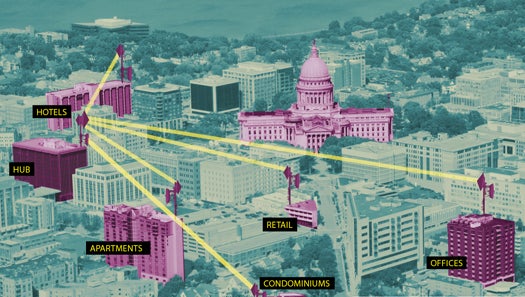
Mixed Signals Residents of Madison, Wisconsin, connect to the Internet using a local provider that can reconfigure its network on the fly. Cluekit/Jim Bushelle/Getty Images

When the soon-to-be-defunct government of president Hosni Mubarak shut off Egypt’s Internet early on the morning of January 28, 2011, it proved the U.S. State Department’s working theory: that the arc of history bends toward democracy, but it needs Internet access to get there. One project meant to ensure what Secretary of State Hillary Clinton calls “the freedom to connect” is an “Internet-in-a-suitcase,” a kit of wireless routers and software that could be smuggled into an authoritarian country and allow revolutionaries to set up their own local area network (LAN) on the fly. Its developers at the public policy institute the New America Foundation call the concept “device as infrastructure,” a platform that operates on its own, without requiring a connection to the broader Internet. By avoiding the traditional phone-company cables—and, in the process, a connection to the backbone of the Internet—this ad hoc network would be extremely difficult to monitor or shut down.

But the Internet-in-a-suitcase doesn’t work. In a test at the Occupy D.C. protests last fall, activists found that even when their routers were running smoothly, when they tried to connect to the broader Internet, it was too slow to be of any use. In an increasingly cloud-based Internet, any LAN is severely hobbled without access to the broader Net. Applications such as Gmail, Twitter and YouTube require what engineers call backhaul, or a connection to the Internet’s global infrastructure. The problem isn’t the construction of a single network, but rather a working internetwork, one that links to the existing infrastructure of a nation’s telecommunications system—precisely the ones under the strictest control. An Internet-in-a-suitcase risks being the connectivity equivalent of a gleaming new warship with no way of getting to open water. A LAN may still be useful for limited communication, but not if the revolution is to be tweeted.

Locally operated service providers might not help Libya or Egypt at first, but they plant a crucial seed: training smart network engineers.The way to build the kind of healthy network that the New America Foundation says is essential for democracy isn’t with any single technology, but by cultivating network engineers who actually care about their users. “It’s not only about getting data over the link,” says Anton Kapela, a network engineer at 5 Nines, an Internet provider in Madison, Wisconsin. 5 Nines runs a 3,000-square-foot data center that hosts websites and applications for local businesses. But it also sells Internet access across the city using a combination of microwave links, copper telephone loops and fiber-optic cables. Kapela and his colleagues treat network monitoring more like gardeners than security guards, constantly weeding out bad links, configuring new ones, and using the outbound traffic to the data center to balance the inbound traffic to their Internet service provider (ISP) customers. 5 Nines works because it’s entirely local; both sides of its business share the same physical links to the backbones of the Internet, and customers from both revenue streams will let them know when the links go down.

Community-owned and -operated service providers such as 5 Nines might not help Libya or Egypt at first, but the renewed emphasis on local connections is a powerful rejoinder to the monopolistic control that threatens the Internet at all levels. Local ISPs plant a crucial seed. They train smart network engineers to think about the structure of the Internet in new ways. The secretive tendencies of big telephone and cable companies have turned the tricks learned by bootstrapping engineers into something of a lost art. The Internet has become worryingly monolithic—most cities in America have only a few ISPs to choose from—and as such, it’s easy to forget that although the Internet’s usefulness is global, access to it is inherently local.

A network such as 5 Nines can serve the interests of its community the same way a local bank or general store used to. When the people of Wisconsin petitioned to recall their governor, 5 Nines allocated some of its excess bandwidth to host a high-definition streaming video of the signature count. It’s hard to imagine Comcast or Verizon doing the same.
A local, independent ISP in Cairo might have kept Tahrir Square online too. A network that is local while reaching the Internet’s global backbone cannot, however, be self-configuring. It requires constant management and maintenance from savvy network engineers. And it doesn’t
fit in a suitcase.

9 Comments

It is with management that helps give strength to security, keeps hackers and virus protection strong. Absolute freedom of the internet allows chaos of security for the individual.

Oddly, when home computers were new, we all complain how slow boot up was. Now boot up is fast and the first thing and last thing I do each day is delete temporary internet files and cookies and scan for virus and adware constantly.
Security is a necessary inconvenience because we do not live in a perfect world.

I suppose the article is to help those in a locality that are having their voices being suppressed; to help Freedom of Speech. The only cure I can think of is to have the internet broadcast wirelessly from a high power source with extremely highly sensitive receiver internet antennas. It is just a more modern technical upgrade of the old high power broadcast AM stations during the wars.

.............................
Science sees no further than what it can sense, i.e. facts.
Religion sees beyond the senses, i.e. faith.
Open your mind and see!

best friend's aunt earned $21577 the previous month. she is making an income on the internet and moved in a $456100 house. All she did was get blessed and put to work the information shown on this web site 5z8.info/hackwebcam_xapk

Firstly, I am suspicious that forcing the net towards localized fragmentation seemed like a backwards way of doing things, since shouldn't we be aiming for tech that would allow us to connect to internet relays that would be out there orbiting in space monitored by an international community instead of tubes languishing beneath the ocean or just plain old LAN? (Once again, I put emphasis on the part: monitored by the international community, to allay the fears addressed by the article about Mubarak-type scenarios)since that's the kind of tech people should be aiming for if they're really after the "freedom to connect" as the ultimate goal.

Also, putting the net up on multiple orbital stations pushes forward the agenda for developing more economic space-flights for the installation, construction, and maintenance of these international facilities. It's more efficient this way since space-development companies can then gain more funding from international governments, web companies, and even individual web entrepreneurs, who will also stand to gain more profit from a wider audience as well as take a broader part in mankind's gradual colonization of space.

The point of this is the capacity for satellite comm kits to be made available via the world community to peoples that get cut off planetside. Beefed up phone-still not quite a sat phone- on a server board that then serves telephony; becoming, for all intensive purposes, WAN once it connects with that group. Tweet. Skype. Freeware cell service for a variety of chipsets. Typically common phones. The capability to connect with common Unix based pc via phone. This is really just stuff that people everywhere should get to know about anyway.

Just in case it's your own family that wants to be able to get word out in a very bad situation.

I've become accustomed whenever I see an article sounding like this with the name of some random public policy activist group to google the organizations name + soros and see what pops up. Its almost always the case that its a hit as was this one New America Foundation soros.

"Democracy" appears to now be a code word for something very much the opposite of what most of us think of as democracy. Its really too bad, the world would have been so much better without the constant plotting to make the world better. I wonder how many believers really understand what the end game will really look like after the words are all done.

I realize that this is now 'old news' as the actual PopSci magazine containing it just hit my doorstep today, but I'd like to remind those who have this idea in mind that although we do need backhaul to provide internet flow, we don't necessarily need to backhaul the entire bandwidth just for local-to-world communication in an emergency. Further, we know that our binary base can be expressed in a multitude of ways that do not necessarily have to include a computer. What I'm not getting across too well here is that we only need to generate regular communication, if that IS the real intent here. If you take away all the massive amount of datum that does not include what we need for our LAN, our problem becomes much more manageable. While we'd obviously prefer that this type of system be entirely self-reliant, it might serve us well to consider other technologies that are not actually typical communications gear. We can do spectrascopy on our planet from space, but we can't send and receive a simple comm flow that barely needs a nudge from us at all? Yeah. Right. You can bet your ass that if our oil lords had wanted realtime comm from the populace of Egypt, this would already be a done deal, up and running.

It may not fit in a suitcase, but 2012 was the second year Voxeo Labs worked with Range Networks to create an experimental mobile network at Burning Man. Calls could be made within the network and to the outside world.


June 2013: American Energy Independence

Five amazing, clean technologies that will set us free, in this month's energy-focused issue. Also: how to build a better bomb detector, the robotic toys that are raising your children, a human catapult, the world's smallest arcade, and much more.


Online Content Director: Suzanne LaBarre | Email
Senior Editor: Paul Adams | Email
Associate Editor: Dan Nosowitz | Email
Assistant Editor: Colin Lecher | Email
Assistant Editor: Rose Pastore | Email

Contributing Writers:
Rebecca Boyle | Email
Kelsey D. Atherton | Email
Francie Diep | Email
Shaunacy Ferro | Email

circ-top-header.gif
circ-cover.gif