Data Is Power
A new age is upon us: the age of data
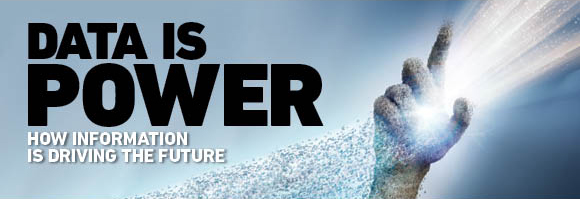
As we were putting together this special issue on how Big Data is supercharging our ability to understand and transform the world, I was struck by the sheer range of ways that data itself can be understood. Data is information. It’s numbers. It’s bits. It’s one side of a binary state, or an assemblage of such heads and tails. It’s code, whether digital or DNA or both. It’s the decision that leads to a reality, and it’s everything we can gather and glean from that reality.
I was also struck by how many people I spoke with assumed that our data issue would focus on personal data—the information that is collected about pretty much every action you take during the course of any day, whether with or without your knowledge or approval. It’s not that we don’t find the collection and exploitation of consumer data, and the privacy concerns that arise from it, to be rich journalistic territory. We do. And on a personal level, I suspect I’m not all that unusual in the queasiness I feel when I contemplate the Faustian bargain I’ve struck in offering myself as a product in exchange for free or cheap services that are optimally tailored to my needs. I’m also the editor-in-chief of a magazine and media brand whose business model, future growth prospects, and success in satisfying the needs of our customers, both readers and advertisers, rely in part on collecting and using information about you and your consumption behavior. So my fascination with these issues grows ever deeper and queasier.
But we cover data and privacy issues on an ongoing basis in these pages. This month we chose to move away from the consumer/marketer rabbit hole and to look at data from the standpoint of what decades of exponential growth curves in data collection, storage and processing power have wrought. We have entered a new era in which data is a tool not only for insight but for influence, action and control. I expect that this will prove, on balance, to be a good thing. But probably not always. Either way, it’s certainly worth knowing about.
Check out the stories examining the many sides of data, below.
The Glory of Big Data
Suddenly, we can know the world completely. Next, we program it by Juan Enriquez
The Santa Cruz Experiment
Can a crime problem become just a data problem? by Kalee Thompson
[Where Data Lives
Inside the ten most amazing databases in the world By Rena Marie Pacella
The Unsplittable Bit
As scientists cache, crunch, and quantize everything, will they ever reach the end? by James Gleick
Timeline: Data
A history of revolutions in data, from the cuneiform to your Google search (and Wikipedia research) of the word “cuneiform” curated by Stephen Wolfram
This Man Could Rule the World
How Albert-László Barabási went from mapping systems to controlling them by Gregory Mone
Q&A: Seth Lloyd
Seth Lloyd, director of the Center for Extreme Quantum Information Theory at MIT, answers some (very) big questions, about his beer keg superconductors and our quantum universe. by Flora Lichtman
And Yet… And Yet…
Do we really gain anything from the ceaseless profusion of data? by Lawrence Weschler