
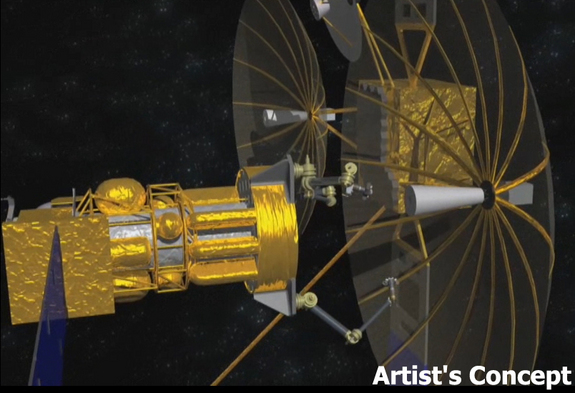
Our growing space junk problem could become an orbiting spare satellite parts sale if DARPA has its way. The DoD’s research arm has launched a new program, appropriately titled Phoenix, to create new satellites from the decommissioned and dead satellites currently sitting idle in geosynchronous orbit some 22,000 miles above the Earth.
Defunct satellites are in relative abundance in “graveyard orbits” where they have been placed to essentially stay out of the way of newer, working satellites. But while these satellites are out of fuel and out of power, they still retain functioning elements that are both useful and heavy--particularly their antennas. DARPA envisions a scheme where the inner guts of a satellite could be launched into space (at a relatively low cost, since the communications large antennas make up a decent portion of a satellite’s launch weight) and then be attached to an antenna already in orbit.
To do this, DARPA will need an orbiting space robot, or a “tender” spacecraft, that can make all of this happen on orbit. Like an automated mechanic, the tender would rendezvous with “satlets” (those are the small satellite “brains”) that would likely hitch rides on other satellite launches. It would then remove the satlets from the larger satellite or launch vehicle and carry the satlets to a dead satellite where it would attach the satlet to a used antenna and then cut the antenna loose from its former satellite. The tender would then place the new satlet-antenna combo in its new orbit. Just like that, the tender will have built a new satellite from old parts already available in space, limiting the amount of new debris introduced into orbit.Of course, all of this is going to require some pretty big technological leaps, and as is often the case with DARPA, it’s the derivative technologies that could make the biggest impact here. DARPA is going to need, first and foremost, a space robot with keen machine vision and some degree of AI autonomy, the ability to refuel on orbit (possibly at the International Space Station, which is testing its own satellite refueling tech), and the ability to chase down and intercept satellites as they are orbiting (can’t think of a defense application there).
All said, if DARPA can pull this one off the agency is going to have a nice suite of orbital technologies at its disposal. Not that it would dream of using them for anything other than the originally stated purpose.

[SPACE]
Five amazing, clean technologies that will set us free, in this month's energy-focused issue. Also: how to build a better bomb detector, the robotic toys that are raising your children, a human catapult, the world's smallest arcade, and much more.


Online Content Director: Suzanne LaBarre | Email
Senior Editor: Paul Adams | Email
Associate Editor: Dan Nosowitz | Email
Assistant Editor: Colin Lecher | Email
Assistant Editor: Rose Pastore | Email
Contributing Writers:
Rebecca Boyle | Email
Kelsey D. Atherton | Email
Francie Diep | Email
Shaunacy Ferro | Email
of course if we wanted to destroy a satellite, any old radar space missile would do just fine. to capture is high tech
It's a good idea. rather than just destroying space junk, or crashing it into the ocean, why not harvest it for recycling?
--------------------------------------------------------------------------
why learn from your own mistakes, when you could learn from the mistakes of others?
“The most incomprehensible thing about the universe is that it is comprehensible” -Albert Ein
why would you take space junk (outdated, possibly damaged material) to build NEW satellites in space?
I think removing space junk good.
Creating a robot and putting this in space in effort to relive old space junk a wasted effort verse just sending up new satellites.
Yes!! Thats what I was hoping for.
heres the idea i had about that awhile back.
http://www.popsci.com/technology/article/2010-11/russia-invests-2-billion-clean-space-debris
The Russians planned on destroying all of the debris
I'm not sure why everyone is knocking this. I can still run my Win7 computer on a monitor from my old Win95 machine. Ideal? No. Cheaper and functional? Yes. Just because it is old doesn't mean it is useless. Any university (let alone scores of other companies and businesses) would love to be able to have their own discount satellite. I wonder what they will do with the "old guts" from the refurbished satellites. Probably deorbit it, but bringing it back to the ISS for a return ride on a cargo vessel could work too I would think.
(Disclaimer: I do not use an old monitor, I much prefer my widescreen lcd. However, I am not in orbit.)
or u could attack enemy satellites and reprogram them...
Personally I think its a good idea to clean up the junk, but it would be a better idea if they could show that we were capable of smelting down the metal's and make other useful tools.
I read a lot about creating colonies in space where we utilize asteroids or the moons natural resources to build things, but until they actually come up with a way to do this, I don't think it would be even close to possible.
This might be that first step:)
I happily volunteer to be a space junk astronaut and push the dysfunctional satellites into a fiery death into the ocean!
The best way to do it is to use a low tech "Gatherer" to bring all the defunct satellites to one location. I don't see them being brought to the ISS because it's orbit is so low. Most of the big birds are at 10K and 20K mile orbits. If you could bring them into a collective "Junkyard" Then you could have some of the robots we are developing for ISS to take parts and make new ones. This just might work.
Too bad they cant give our politicians new brain packs and disconnect their old ones. Then they could use their large loud mouths to say something intelligent for a change!